2027 Dual Relationships in Social Work: Understanding Overlapping Professional and Personal Roles
Audited and Verified:
Our Editorial and Data Verification Process
Research.com uses government datasets, official education statistics and primary institutional information to support its career and degree guides. Our review process checks factual accuracy, occupational definitions, source dates and the requirements associated with the credentials discussed.
How This Article Was Fact-Checked
Our editorial team verifies salary estimates, employment projections, education requirements and program information against original data providers and official organizations. Salary figures are checked against the relevant occupational definitions and reporting periods. Information about licensure, accreditation and required in-person training is reviewed separately.
Fact-checked and verified on:

Co-Founder and Chief Data Scientist
A social worker may encounter a client at a place of worship, receive a social media request, or discover that a field instructor knows the client's family. These overlapping relationships can affect privacy, trust, and professional judgment - even when no one intends harm.
This guide explains how to recognize dual relationships, distinguish unavoidable contact from unsafe involvement, and respond within professional boundaries. It is designed for social work students, new graduates, and practitioners deciding when to consult a supervisor, change an arrangement, or check a licensing rule.
Key Things You Should Know
- A dual relationship exists when a social worker has, or develops, another role with a client beyond the professional helping relationship; the concern is the risk of harm or exploitation, not merely that two roles exist.
- NASW Code of Ethics Standard 1.06 directs social workers to avoid dual or multiple relationships when there is a risk of exploitation or potential harm and to take protective steps when overlap is unavoidable.
- Before continuing an unavoidable overlap, assess the power imbalance, consult supervision, clarify boundaries with the client, and document the decision; agency policy and state licensing rules may impose additional limits.
What are dual relationships in social work?
A dual relationship, sometimes called a multiple relationship, occurs when a social worker and client have a second connection alongside their professional one. The connection might be social, financial, familial, religious, educational, or online. It can exist at the same time as services or arise before or after them. It can also involve someone close to the client.
The ethical issue is not simply whether two people know each other. Social workers have access to private information and influence over services, referrals, or clinical decisions. A second role can make it harder for a client to decline a request, speak freely, or know which relationship governs an interaction. These concerns apply in case management and community work as well as clinical practice; the guide to professional pathways after an MSW describes roles with different duties, not an exemption from professional boundaries.
What are common examples of dual relationships in social work?
Examples differ in how much choice the social worker has and how much power the second role creates. That distinction matters more than treating every shared community connection as equally risky.
A clinician who begins dating a current client creates a serious, prohibited boundary violation. A case manager who hires a client for personal work creates a financial conflict. A school social worker who also coaches a student client may have competing responsibilities and difficulty protecting the student's privacy. In a small town, a social worker and client may simply attend the same community event; that contact may be difficult to avoid, but it still calls for discretion and a plan.
Clinical placements deserve particular scrutiny because students may mistake familiarity for therapeutic rapport. When comparing MSW clinical concentration program choices, ask how instructors teach students to identify these differences before they encounter them in fieldwork.
Are dual relationships always unethical in social work?
No. An overlapping role is not automatically an ethical violation, but it is never a reason to skip a risk assessment. In rural communities, schools, and close-knit cultural or faith communities, avoiding every incidental connection may be impossible or may limit access to services. The social worker must consider whether the overlap could impair judgment, pressure the client, compromise confidentiality, or create an opportunity for exploitation.
Some boundaries are much firmer than others: sexual activity or sexual contact with a current client is prohibited under the NASW Code of Ethics. For less clear situations, a client's apparent agreement does not by itself resolve the power imbalance. Nor does a student's entry route change the standard: students in comparing graduate social work entry-track requirements should expect to learn the same core ethical responsibilities, though their coursework and field sequences may differ.
NASW Code of Ethics Standard 1.06 addresses conflicts of interest. It says social workers should avoid dual or multiple relationships with clients or former clients when there is a risk of exploitation or potential harm. When such a relationship is unavoidable, social workers are responsible for taking steps to protect clients and setting clear, appropriate, culturally sensitive boundaries. The Code also addresses conflicts of interest more broadly; its provisions on sexual relationships with clients establish separate, stringent restrictions.
The Code is professional ethical guidance, not a substitute for state law or a licensing board's rules. An employer, placement site, or board may impose additional requirements. This distinction matters when checking online MSW alignment with licensing goals: ethical coursework and a qualifying degree are important, but the applicable board decides license eligibility and practice authorization.
The most important test is what the overlap could do to the client - not whether the social worker believes their intentions are good. Risks include reduced freedom to refuse, favoritism or unequal access, confusion about professional responsibilities, disclosure of private information, and reluctance to report a concern. A client might also lose a trusted service if a preventable conflict forces a transfer.
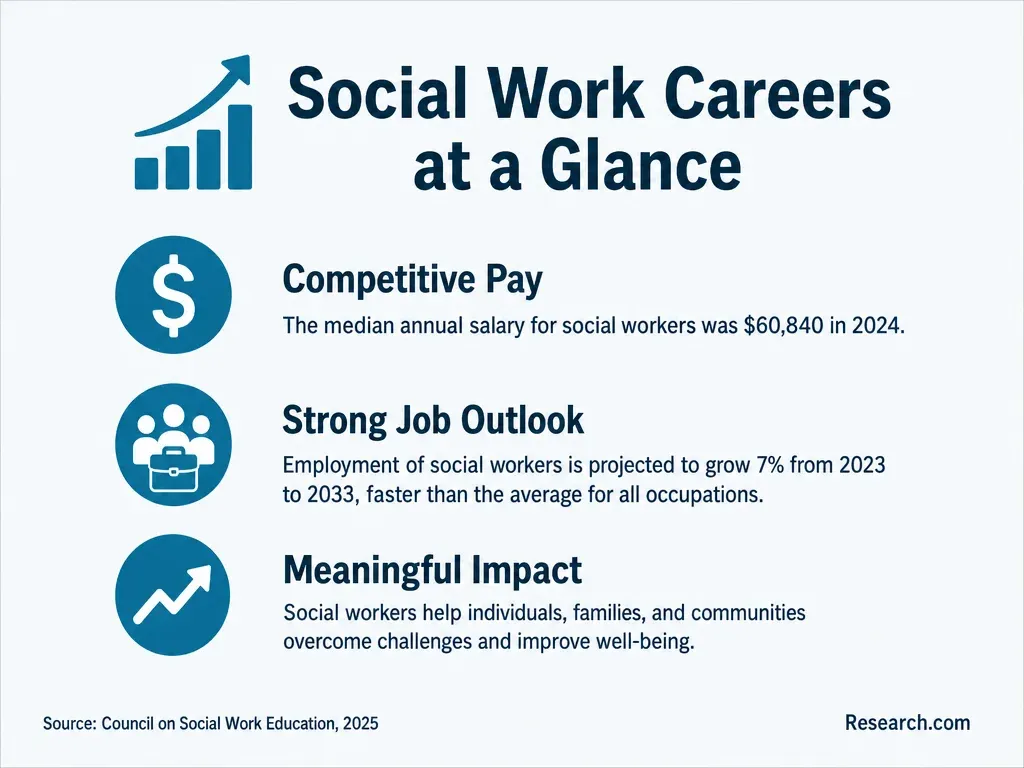
Financial interests deserve particular attention. A worker who refers clients to a business they own, accepts valuable favors, or seeks a personal transaction with a client may benefit from the authority of their professional role. The existence of different earning opportunities, illustrated by social work earnings across different state markets, does not justify using client relationships for personal financial gain. If money or access to services is involved, seek supervisory review before acting.
How can students compare online and campus social work ethics training?
Compare what students must practice and demonstrate, not just whether an ethics course appears in the catalog. Either format can provide substantive instruction; neither guarantees that every student will receive adequate feedback in every placement.
Ask prospective programs to describe a boundary scenario students work through, who gives feedback, and how concerns raised during fieldwork reach faculty. Confirm whether skills sessions are live, whether field seminars have scheduled attendance, and how quickly a student can reach a field liaison. Online students should also verify placement support and local site expectations; online classes do not make field responsibilities virtual or optional.
These questions are useful from the start of social work education. When reviewing online undergraduate social work degree choices, look for clear explanations of field supervision and competency assessment alongside course-delivery details.
Other Things You Should Know About Social Work
Do not assume every gift is acceptable or forbidden. Consider its value, meaning to the client, timing, potential pressure, and agency policy; consult a supervisor before accepting it.
Protect the client's privacy. Generally, let the client choose whether to acknowledge you, and do not identify the professional relationship to others. Follow any plan previously discussed with the client.
Ending services does not automatically remove the power imbalance or confidentiality concerns. Review the circumstances, applicable ethical standards, agency policy, and licensing rules before pursuing personal contact.
Follow the agency and school's confidentiality rules. Remove identifying details and seek guidance before sharing information that could reveal a client, family, or agency situation - even in a restricted classroom.
- Boundary Crossings and Violations in Clinical Settings - PMC https://pmc.ncbi.nlm.nih.gov/articles/PMC3361837/
- Rule 4757-5-04 - Ohio Administrative Code https://codes.ohio.gov/ohio-administrative-code/rule-4757-5-04
- G1.1 Ethical Practice | ky.gov https://manuals-sp-chfs.ky.gov/G1/Pages/1-1.aspx
- Social Work Boundary Issues in the Digital Age - IU Indianapolis https://journals.indianapolis.iu.edu/index.php/advancesinsocialwork/article/download/26358/25414/55806
- 11.4 Dual Relationships - Ethical Practice in Co-Occurring Substance Use Disorder and Mental Health Counseling https://open.lib.umn.edu/ethicalpractice/chapter/11-4-dual-relationships/
- Dual Relationships - IU School of Social Work https://socialwork.iu.edu/professional-standards/dual-relationships.html
- Social Workers' Ethical Responsibilities to Clients https://www.socialworkers.org/About/Ethics/Code-of-Ethics/Code-of-Ethics-English/Social-Workers-Ethical-Responsibilities-to-Clients
- Code of Ethics of the National Association of Social Workers | naswma.org https://www.naswma.org/page/71/Code-of-Ethics-of-the-National-ssociation-of-Social-Workers.htm
- Practice Notes: Dual Relationships: Ensuring Clients | ocswssw.org https://www.ocswssw.org/ocswssw-resources/practice-notes-dual-relationships-ensuring-clients-best-interests-are-paramount/
- Respecting Boundaries - The Don'ts of Dual | Social Work Today Magazine https://www.socialworktoday.com/archive/012610p18.shtml