2027 Best Online MSW Programs Without Campus Visits

Co-Founder and Chief Data Scientist
Choosing an online MSW program without campus visits is mainly a question of fit: Can the program meet licensure expectations, place you in a suitable local practicum, and give you enough flexibility to keep working or managing family responsibilities? For many students, the answer depends less on whether classes are online and more on accreditation, field education support, total cost, and how well the program aligns with their intended social work role.
Fully online MSW programs can be a practical path for working professionals, rural students, military families, caregivers, and career changers who cannot relocate or commute regularly. They also appeal to students who want access to a wider range of universities without being limited to nearby campuses. However, “online” does not mean low-effort or entirely self-paced. MSW students still complete graduate-level coursework, supervised fieldwork, and, in many career paths, additional state licensure requirements after graduation.
This guide explains how no-campus-visit MSW programs work, what to look for before applying, how online and campus formats differ, what accreditation matters, what admissions committees expect, and how costs, timelines, careers, salaries, and job outlook should factor into your decision.
Key Things You Should Know
- Top online MSW programs in 2026 offer full remote learning with no campus visits, increasing accessibility for working professionals and caregivers nationwide.
- Accredited programs often include virtual field practicums and use up-to-date technology to ensure quality education and compliance with CSWE standards.
- Graduates of online MSW programs see 15% higher employment growth compared to traditional formats, reflecting strong employer acceptance of remote social work education.
What Are the Best Online MSW Programs Without Campus Visits?
The best online MSW programs without campus visits combine three things: CSWE-accredited coursework, strong local field placement support, and a delivery format that allows students to complete the degree without required travel to campus. These programs are built for students who need geographic flexibility but still want a degree that can support licensure preparation and long-term career mobility.
A strong no-residency MSW program should not simply stream campus lectures. It should provide structured online courses, faculty access, advising, practicum coordination, and clear guidance on state-specific licensure considerations. Many programs use live online classes, asynchronous modules, virtual skills practice, simulation activities, and cohort-based discussions to help students build clinical, policy, research, and advocacy skills remotely.
What makes a fully online MSW program worth considering?
- CSWE accreditation: This is the most important quality marker for an MSW program and is often necessary for licensure pathways.
- No required campus visits: Confirm that orientations, intensives, residencies, and skills labs can all be completed online if travel is not possible.
- Local field placement help: The program should assist with identifying approved agencies near the student rather than leaving the entire process to the student.
- Licensure alignment: Coursework and field education should support the educational requirements commonly expected for social work licensure, especially for clinical practice.
- Flexible pacing: Full-time, part-time, and Advanced Standing options can make a major difference in cost, workload, and time to graduation.
- Student support: Online learners benefit from responsive advising, writing support, technology help, career services, and faculty availability.
Degree timelines commonly fall within two to three years, depending on enrollment status and prior education. Students with a BSW may qualify for Advanced Standing, which can shorten the program and reduce tuition. Students from unrelated undergraduate backgrounds usually enter a traditional MSW track that includes foundational coursework before advanced practice courses.
Demand is one reason many students consider the MSW. Social work jobs are projected to grow by 7% through 2033, adding approximately 61,700 new positions and exceeding average occupational growth. A fully online, accredited MSW can help students prepare for these opportunities without relocating or pausing their careers.
Students planning for advanced leadership, academic, or specialized practice roles may also want to explore an online doctorate of social work after completing the MSW and gaining experience.
How Do Online MSW Programs Differ from Traditional Campus Ones?
Online MSW programs differ from campus programs mainly in delivery, scheduling, and access, not in the core professional expectations. Accredited online and campus-based MSW programs are held to the same broad educational standards, including social work competencies, ethics training, research preparation, and supervised field education.
The largest practical difference is flexibility. Online programs allow students to complete classes from home or another location, which can reduce commuting time, relocation costs, and scheduling conflicts. This is especially important for students who work full time, live far from a university, care for family members, or need to remain in their current community.
Online MSW vs. campus MSW: key differences
| Factor | Fully Online MSW | Traditional Campus MSW |
| Course delivery | Remote classes through live sessions, recorded lectures, discussion boards, and online assignments | In-person classes on a university campus |
| Campus travel | No required campus visits in fully online no-residency programs | Regular travel to campus is required |
| Field education | Usually completed at approved agencies near the student | Usually completed near the campus or within the university’s regional network |
| Best fit | Working professionals, caregivers, rural students, military-connected students, and career changers needing flexibility | Students who prefer face-to-face instruction, campus resources, and local networking |
| Main challenge | Requires self-direction, time management, and comfort with online communication | Requires commuting, schedule availability, and proximity to campus |
Field placements remain essential in both formats. Online students typically complete practicums with local agencies approved by the program. This can make the degree more accessible, but it also means students should ask early how placements are arranged, who approves sites, and what happens if a local placement is hard to secure.
Hybrid programs may combine online coursework with occasional campus sessions. Fully online MSW programs report a higher job placement rate-92% within six months versus 85% for hybrid formats, according to the Council on Social Work Education's 2025 Annual Statistics Report.
The benefits of completing MSW degrees fully online include broader school choice, more control over location, and opportunities to build peer networks through video meetings, group projects, and online discussion spaces. The trade-off is that students must be proactive: they need to manage deadlines, participate actively online, communicate with faculty, and plan fieldwork logistics well in advance.
Because licensure rules vary, students should confirm whether an online program’s curriculum and practicum structure meet expectations in the state where they plan to practice. Applicants comparing cost-conscious options can start with affordable accredited online MSW programs and then verify each program’s accreditation, field placement model, and licensure disclosures.
What Accreditation Ensures Quality in Online MSW Programs?
For MSW programs, the key accreditation to look for is accreditation by the Council on Social Work Education (CSWE). CSWE accreditation signals that a program has been reviewed against national social work education standards, including curriculum quality, faculty qualifications, field education, assessment, and professional competencies.
This matters because MSW accreditation is closely tied to professional credibility and licensure eligibility. Many state licensing boards expect applicants to have graduated from a CSWE-accredited program. A non-accredited MSW may limit access to clinical licensure, government positions, agency roles, advanced certifications, and doctoral study.
Why CSWE accreditation should be nonnegotiable
- Licensure preparation: Accredited programs are more likely to satisfy educational requirements used by state licensing boards.
- Field education standards: CSWE-accredited programs must include supervised practice experience that supports professional competency development.
- Employer recognition: Agencies, hospitals, schools, and government employers often prefer or require accredited MSW degrees.
- Transfer and advancement options: Accreditation can affect eligibility for advanced credentials and further graduate study.
Programs lacking CSWE accreditation may hinder graduates' eligibility for state licensure and certification, limiting their professional growth and job opportunities. Case Western Reserve University's online MSSA program, accredited by CSWE, reported a 98% pass rate on licensure exams, outperforming national averages (Case Western Reserve University Program Outcomes Report, 2025). This example shows why applicants should evaluate accreditation and outcomes together rather than relying on convenience alone.
Many reputable universities now offer fully online MSW tracks with concentrations, part-time schedules, and Advanced Standing options while maintaining CSWE accreditation. Before applying, students should confirm accreditation through official CSWE listings and review program-level licensure disclosures. Applicants interested in faster pathways can also compare online social work programs that meet professional standards.
Choosing non-accredited programs risks:
- Ineligibility for licensure in many states
- Limited employment options within social work agencies
- Barriers to advanced certifications and doctoral studies
The safest approach is to treat CSWE accreditation as a baseline requirement, then compare programs by cost, field placement support, faculty expertise, concentration options, and fit with your state licensing goals.
Admission requirements for online MSW degrees usually include a bachelor’s degree from an accredited institution, official transcripts, a minimum GPA, recommendation letters, and a personal statement. Some programs also require a resume, prerequisite coursework, an interview, background checks, or documentation needed for field placement eligibility.
Most programs expect applicants to show academic readiness and a clear commitment to social work values. A BSW is not always required. Students with undergraduate degrees in psychology, sociology, public health, education, criminal justice, or unrelated fields may qualify for a traditional MSW track. Students with a BSW from an accredited program may be eligible for Advanced Standing, which can shorten the degree path.
Common online MSW admission requirements
- Bachelor’s degree: Usually required from an accredited institution.
- Official transcripts: Programs review prior coursework, degree completion, and GPA.
- Minimum GPA: A common expectation is around 3.0 on a 4.0 scale, though some schools offer conditional admission.
- Statement of purpose: Applicants explain their career goals, motivation for social work, and readiness for graduate study.
- References: Programs often request two or three academic or professional recommendations.
- Resume or work history: Relevant human services, advocacy, healthcare, education, or volunteer experience can strengthen an application.
- Background checks: These may be required for practicum placements involving clients or vulnerable populations.
- English proficiency: International students may need TOEFL or IELTS scores.
Applicants with lower GPAs should not assume they are automatically disqualified. Some programs consider professional experience, strong essays, upward academic trends, graduate-level coursework, or compelling recommendations. If you are a career changer, your application should connect your prior experience to social work skills such as communication, ethics, cultural humility, problem-solving, advocacy, or case coordination.
Prerequisite expectations vary. Some programs prefer or require prior coursework in social sciences, statistics, biology, or human development. Others admit students from any major but may expect them to demonstrate readiness for graduate-level writing, research, and applied practice.
Cost should be evaluated before applying, not after admission. For example, Fort Hays State University offers a fully online MSW for $23,019 total, which is about 40% less than the national average tuition of $38,500. Students deciding whether a social work bachelor’s degree is the right foundation for graduate study can review this discussion of whether a BSW is worth it.
Online MSW curricula prepare students for professional social work practice across individuals, families, groups, organizations, and communities. Courses typically cover social work theory, ethics, human behavior, social welfare policy, research methods, cultural competence, assessment, intervention, advocacy, and field education.
Most MSW programs begin with foundation coursework, especially for students who do not hold a BSW. These courses introduce the profession’s values, practice methods, policy context, and evidence-based decision-making. Advanced coursework then lets students focus on a practice area such as clinical social work, community practice, child and family welfare, healthcare social work, school social work, or organizational leadership.
Typical curriculum areas
- Human behavior and the social environment: How individuals and families develop within social, cultural, economic, and community systems.
- Social work practice: Skills for assessment, engagement, intervention, documentation, referral, and evaluation.
- Ethics and professional responsibility: Decision-making, boundaries, confidentiality, mandated reporting, and professional standards.
- Social welfare policy: How laws, institutions, and public systems shape access to services and resources.
- Research and evaluation: Methods for interpreting evidence, assessing programs, and improving practice outcomes.
- Diversity, equity, and cultural competence: Practice with varied populations and attention to structural barriers.
- Field education: Supervised practicum work that connects classroom learning to real agency settings.
Core coursework usually addresses micro, mezzo, and macro practice. Micro practice focuses on individuals and families. Mezzo practice involves groups, schools, neighborhoods, and community organizations. Macro practice emphasizes policy, administration, systems change, program development, and advocacy.
Clinical tracks often include mental health assessment, diagnosis-related content, therapeutic interventions, trauma-informed practice, substance use, and supervision issues. Macro or leadership tracks may include grant writing, program management, policy analysis, community organizing, budgeting, and organizational change.
Fieldwork is not optional. Even in fully online programs, students complete supervised practicums, usually at approved agencies near their location. This is where students practice interviewing, case planning, documentation, advocacy, crisis response, interprofessional collaboration, and ethical decision-making.
Flexibility is a major reason students choose online delivery. According to the CSWE Online Education Survey, 2025, 75% of online MSW students are fully employed and 60% manage family responsibilities, contributing to an 89% retention rate. That flexibility is valuable, but students should still plan for the time demands of coursework, synchronous meetings if required, and practicum hours.
Online MSW programs generally take 2 to 3 years to complete, but the exact timeline depends on enrollment status, prior education, field placement requirements, and whether the student qualifies for Advanced Standing. Full-time students often finish in about 24 months. Part-time students may take 3 years or longer. Students with a BSW may qualify for Advanced Standing, reducing the timeline to 12 to 18 months.
Program length is not just about the number of courses. Field education can shape the schedule because practicum hours must be completed in approved settings under supervision. Students working full time should ask whether field placements can be arranged during evenings or weekends, though availability depends on agency schedules and program policies.
Common online MSW timelines
- Full-time completion: ~24 months
- Part-time completion: up to 3+ years
- Advanced Standing: 12 to 18 months
- Accelerated programs: under 2 years
Accelerated cohorts can be attractive because they move students into the workforce faster. The trade-off is intensity. Students may need to handle heavier course loads, tighter deadlines, and concentrated fieldwork. This can be difficult for those with demanding jobs, caregiving responsibilities, or limited flexibility during business hours.
Part-time programs are often more realistic for working adults, but they can increase the time before graduates qualify for certain roles or licensure steps. A longer timeline may also affect total cost if fees recur by term. Applicants should compare the full program plan, not just the advertised time to completion.
Most fully online MSW programs include clinical field placements that must be arranged locally. Programs with practicum placement support or established agency partnerships may help students avoid delays. Before enrolling, ask who identifies sites, how far students may need to travel, whether virtual supervision is allowed, and what support is available if a placement falls through.
Career and financial goals also influence timeline decisions. The median annual salary for MSWs reached $78,000, with online graduates earning approximately 12% more in remote clinical roles due to strong national demand (U.S. Bureau of Labor Statistics, May 2025 Wage Data). Students pursuing faster completion should still prioritize accreditation, licensure alignment, and field quality over speed alone.
The cost of an online MSW can vary substantially by institution type, residency status, credit requirements, fees, and field placement expenses. Top online MSW programs typically range from around $10,000 to over $40,000 for the full degree. Public universities are often less expensive, especially for in-state students, while private universities usually charge higher tuition.
Applicants should focus on total program cost rather than a single per-credit figure. A lower per-credit rate may not be the least expensive option if the program requires more credits, charges high fees, offers limited aid, or expects students to absorb additional travel or placement-related costs.
Common cost factors to compare
- Tuition per credit: Public universities may charge between $300 and $700 per credit for in-state students, while out-of-state rates may exceed $1,000 per credit. Private schools often charge between $900 and $1,200 per credit.
- Total credits required: Traditional MSW tracks usually cost more than Advanced Standing tracks because they require more coursework.
- Fees: Technology, online learning, student services, graduation, and field placement coordination fees can add to the final bill.
- Books and materials: Course materials, assessment tools, and software may not be included in tuition.
- Field placement costs: Transportation, background checks, immunizations, liability insurance, and lost work hours can affect affordability.
- Financial aid: Federal loans, grants, scholarships, employer tuition assistance, and military benefits may reduce out-of-pocket costs.
Field internships are a required part of MSW education, and they can create hidden costs. The 2025 CSWE Field Education Report highlights that 98% of fully online MSW programs now partner with local agencies for virtual supervision. This innovation reduced placement barriers for rural students by 65%, minimizing travel expenses and related logistical burdens.
Financial aid options may include federal loans, grants, employer tuition assistance, institutional scholarships, and reduced tuition arrangements for online students. Students should complete required aid forms early and ask each program whether scholarships are available to online learners, part-time students, Advanced Standing students, or students entering high-need practice areas.
When comparing programs, cost should be weighed against support. For example, a program charging $600 per credit with strong virtual field coordination may be more cost-effective than one with lower tuition requiring costly in-person internships. The best value is the program that is accredited, affordable, transparent about fees, and capable of helping students complete fieldwork without unnecessary delays.
An online MSW can lead to many of the same career paths as a campus-based MSW, as long as the program is accredited and aligned with the graduate’s licensure goals. Graduates commonly work in clinical practice, healthcare, schools, child and family services, community organizations, government agencies, nonprofits, policy settings, and administrative roles.
The right career path depends on the student’s concentration, field placements, state licensure requirements, and preferred population. Students who want to provide therapy or independent clinical services should pay especially close attention to licensure rules, supervised post-graduate hours, and whether the program supports clinical preparation.
Common career paths for MSW graduates
- Clinical social worker: Provides assessment, counseling, treatment planning, and mental health support. Independent clinical practice usually requires licensure such as the LCSW.
- Mental health therapist: Works with individuals, families, or groups in clinics, agencies, private practice settings, or integrated care environments, depending on licensure.
- Substance abuse counselor: Supports clients facing substance use challenges through assessment, counseling, relapse prevention, and referral coordination.
- Healthcare social worker: Helps patients and families with discharge planning, care coordination, resource access, crisis support, and advocacy in hospitals, hospices, and rehabilitation centers.
- School social worker: Supports students dealing with behavioral health, family instability, attendance concerns, trauma, disability services, or community resource needs.
- Child and family social worker: Works in child welfare, family services, foster care, adoption, prevention programs, and early intervention settings.
- Policy analyst or advocate: Focuses on legislation, public programs, community needs, research, and systemic change.
- Program director or nonprofit leader: Manages services, staff, budgets, grants, partnerships, and outcomes for social service organizations.
Macro social work careers focus on social policy, program development, administration, and advocacy. These roles may appeal to students who want to influence systems rather than provide direct therapy. Clinical careers, by contrast, usually involve more direct client contact and may require a longer licensure path after graduation.
Healthcare social work continues to be an important area for MSW graduates because patients often need help navigating complex systems, insurance, discharge plans, long-term care, behavioral health resources, and family support. Geriatric social work, school social work, and community mental health are also common pathways.
Increases in enrollment of students of color to 42% reflect improved access and diversity within social work education, enhancing workforce capacity to serve varied communities. Many alumni use their online MSW to advance into roles such as clinical directors, educators, or researchers.
Students should connect career goals to program design before enrolling. Ask whether the program offers relevant electives, suitable field placements, licensure guidance, faculty expertise, and alumni outcomes in your intended area of practice.
The salary outlook for MSW graduates depends on licensure, specialization, work setting, geography, experience, and whether the role is clinical, administrative, policy-focused, or community-based. An MSW can improve long-term earning potential compared with a BSW, but salaries vary widely across social work roles.
According to the Georgetown University Center on Education and the Workforce 2025 ROI Report, MSW holders earn about 25% more over their lifetime than BSW graduates. Over a typical 40-year career, those completing accredited online MSW programs can expect a net return of approximately $1.2 million after accounting for tuition costs.
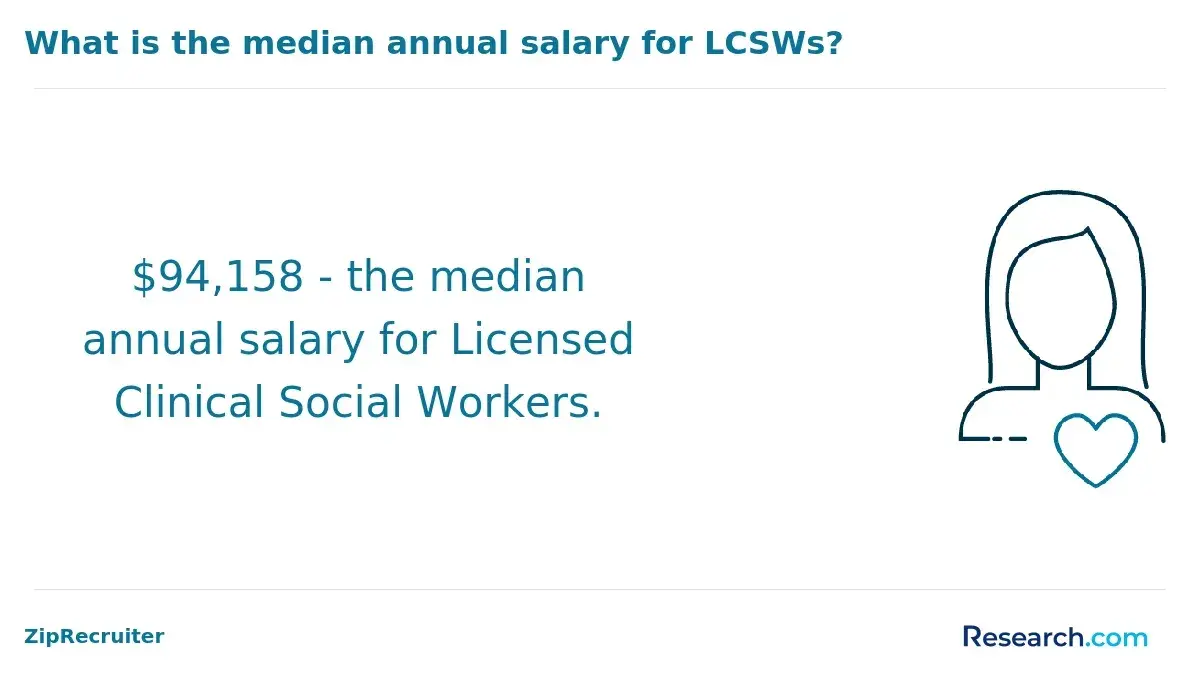
Starting salaries for MSW graduates usually range from $50,000 to $65,000 annually. Mid-career professionals often earn between $70,000 and $85,000, especially in clinical social work, healthcare, and government sectors. Advanced practitioners in leadership or specialized roles, such as licensed clinical social workers or healthcare administrators, commonly reach six-figure incomes.
Factors that can raise or limit MSW earnings
- Licensure: Licensed Clinical Social Worker (LCSW) status can expand access to independent clinical roles and higher-paying positions.
- Practice setting: Healthcare, government, and specialized clinical settings may pay more than some entry-level nonprofit or community agency roles.
- Location: Metropolitan areas and regions with higher demand may offer stronger wages, though cost of living also matters.
- Specialization: Mental health, healthcare, substance use, leadership, and administration can influence salary growth.
- Experience: Supervisory, program management, clinical supervision, and director-level responsibilities can increase compensation.
MSW graduates working in metropolitan areas or with federal agencies typically command higher wages. When evaluating programs, students should compare tuition and debt against realistic salaries in their intended state and specialization. A lower-cost accredited program may produce a stronger financial return than a higher-cost program if both support the same licensure and career goals.
What Is the Job Outlook for Social Workers?
The job outlook for social workers is strong, with the U.S. Bureau of Labor Statistics projecting a 12% employment growth from 2024 to 2034, faster than the average for all occupations. Demand is connected to needs in healthcare, schools, government agencies, mental health services, substance abuse treatment, and support for the aging population.
MSW graduates may have an advantage in roles that require advanced practice skills, clinical preparation, supervision, program leadership, or specialized work with complex client needs. However, job prospects still depend on licensure, location, experience, and the type of social work role pursued.
Areas contributing to demand
- Healthcare social workers play key roles in hospitals and nursing facilities, focusing on patient advocacy and discharge planning.
- School social workers help students with behavioral health, family issues, and connect them with social services.
- Child, family, and school social workers support welfare cases and early childhood interventions.
- Mental health and substance abuse services need trained professionals who can support assessment, treatment planning, crisis response, and care coordination.
- Services for older adults require social workers who understand healthcare systems, long-term care, family support, and community resources.
Online MSW programs are expected to represent 55% of all MSW degrees by 2026. These programs often incorporate AI-enhanced virtual simulations that help students gain practical experience remotely. For students who cannot relocate or attend campus, this expansion can increase access to accredited education while supporting workforce needs in more communities.
Licensure remains central to long-term opportunity, especially for clinical practice. Requirements vary by state and may include a CSWE-accredited MSW, supervised post-graduate clinical hours, exams, background checks, and continuing education. Students should review licensing rules in the state where they plan to work before enrolling, not after graduation.
The strongest candidates are likely to be those who combine an accredited MSW, relevant field placements, state licensure progress, strong documentation and communication skills, and specialized preparation in high-need areas. A fully online MSW without campus visits can support that path when the program is accredited, transparent, and built around high-quality field education.
Other Things You Should Know About Social Work
Graduates from online MSW programs can pursue licensure as Licensed Clinical Social Workers (LCSW), Licensed Master Social Workers (LMSW), or other state-specific credentials. The exact licenses available depend on state regulations and the program's emphasis on clinical or non-clinical social work practice. Completing an accredited program and fulfilling supervised experience hours are typically required for licensure.
In 2027, most online MSW programs require students to complete field practica or internships in-person, as it is essential for developing practical skills. Some programs may offer limited virtual options, but these are typically supplemented with hands-on experiences at approved local sites.
Yes, online MSW degrees from accredited institutions are generally recognized by employers, provided the program meets regional accreditation standards. Employers focus on the school's accreditation status and the graduate's licensure qualifications rather than the mode of education delivery. Online MSW graduates work successfully in various clinical and community social work roles.
Yes. Many fully online MSW programs use asynchronous coursework, with lectures, discussion boards, and assignments completed on a flexible schedule. Some still require scheduled field placement check-ins, live seminars, or brief virtual meetings, but no campus attendance is required for the degree.
- Best Online MSW Programs - CSWE-Accredited https://www.onlinemastersdegrees.org/best-programs/social-work-msw/cswe-accredited/
- Full-time online MSW programs https://www.onlinemswprograms.com/online-social-work-degrees/full-time-online-msw-programs/
- Most Affordable MSW Programs in California - CaliforniaSocialWorkEDU https://www.californiasocialworkedu.org/most-affordable-msw-programs-in-california/
- Explore Social Work https://www.socialworkers.org/Careers/NASW-Career-Center/Explore-Social-Work
- Social Worker (LCSW, MSW) Salary Guide By State https://socialworklicensemap.com/social-work-careers/social-work-salary/
- High-demand social work roles in 2026: trends and opportunities https://socialwork.pacific.edu/blog/high-demand-social-work-roles-2026-trends-and-opportunities
- How Long is a Master of Social Work Program? Length of MSW Programs https://www.masterofsocialwork.com/faqs/length-of-msw-programs
- MSW Program Length: 1-4 Year Timeline Guide for 2025 https://www.socialworkdegrees.org/faq/how-long-does-it-take-to-complete-a-msw-program
- 8 Career Paths You Can Pursue with a Social Work Degree https://www.sacredheart.edu/news-room/news-listing/8-career-paths-you-can-pursue-with-a-social-work-degree/
- The Evolution of Online Social Work Education https://www.socialworktoday.com/news/enews_0317_1.shtml