2027 Adoption Social Worker: Responsibilities, Education, and Career Fit
Audited and Verified:
Our Editorial and Data Verification Process
Research.com uses government datasets, official education statistics and primary institutional information to support its career and degree guides. Our review process checks factual accuracy, occupational definitions, source dates and the requirements associated with the credentials discussed.
How This Article Was Fact-Checked
Our editorial team verifies salary estimates, employment projections, education requirements and program information against original data providers and official organizations. Salary figures are checked against the relevant occupational definitions and reporting periods. Information about licensure, accreditation and required in-person training is reviewed separately.
Fact-checked and verified on:

Co-Founder and Chief Data Scientist
Adoption social work combines family support with assessments, documentation, and decisions governed by agency policy and state law. If you are considering the career, it helps to know whether you want to coordinate placements, support families over time, or provide clinical care—because those goals can require different preparation.
This guide explains the work, education and licensing routes, pay context, and day-to-day pressures so you can judge whether the role fits and choose a practical next step.
Key Things You Should Know
- Adoption social workers may assess prospective families, coordinate services, prepare reports, and support children and families before and after placement; their authority depends on the agency and jurisdiction.
- A BSW can prepare graduates for some child-welfare roles, while many specialized or clinical positions prefer an MSW; neither degree alone grants a license or independent clinical authority.
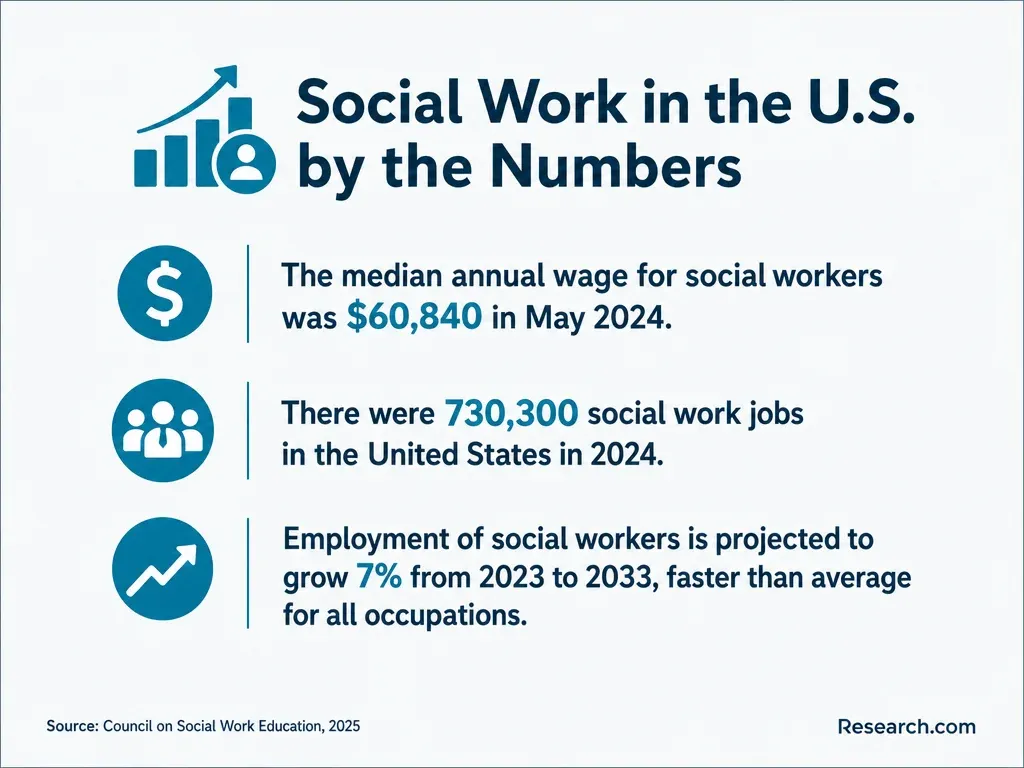
- The closest broad BLS category, child, family, and school social workers, had a May 2025 median annual wage of $59,550 and projected employment growth of 4% from 2025 to 2035—not an adoption-specific pay forecast.
What does an adoption social worker do?
An adoption social worker helps children and families navigate part of the adoption process and its aftermath. The role varies substantially: a public-agency worker may focus on children leaving foster care, while a private-agency worker may spend more time educating prospective adoptive parents and coordinating services.
Depending on authorization and assignment, duties can include interviewing and assessing families, explaining available services, coordinating a home study, preparing court or agency reports, communicating with legal and medical professionals, and arranging post-placement support. Workers also help families discuss identity, loss, contact with relatives, and changing needs as a child grows. They do not independently determine legal consent, override court orders, or promise a particular placement outcome.
Some professionals mainly coordinate services; others provide counseling within their license and competence. Readers comparing those functions with other MSW career options for prospective graduate students should look closely at job descriptions rather than relying on the job title alone.
What degree do you need to become an adoption social worker?
There is no single national degree requirement for every adoption-related job. Employers and states set qualifications for particular functions, and a job called "adoption specialist" may have different requirements from a position using a protected social worker title.
The routes below show where each degree is most likely to fit. They are starting points for checking actual postings, not guarantees of eligibility.
| Route | Likely fit for adoption work | Important limit |
| CSWE-accredited BSW | Generalist child-welfare and family-service positions where permitted | Some assessment, supervisory, or clinical roles require more education or a license |
| Traditional or foundation MSW | Advanced practice preparation for applicants with a bachelor's degree in another field | Admission and graduation do not themselves confer licensure |
| Advanced-standing MSW | A shorter MSW route for eligible graduates of qualifying social work programs | A psychology, human services, or other non-BSW degree does not ordinarily establish eligibility |
For a career changer, the first step is to compare local job postings with your existing degree and experience. If your target is family-service coordination and the employer accepts another qualification, a second degree may not be necessary. If the target requires an MSW, compare traditional routes with any accelerated Master of Social Work admission options for which you actually qualify; a faster calendar does not remove required coursework or field learning.
Do adoption social workers need a license or certification?
Sometimes. State law may regulate the use of the social worker title, home-study work, clinical services, or particular child-placement activities. An employer may also require a license even when another position in the same agency does not. Adoption agency approval or accreditation is separate from an individual worker's social work license.
Check the state licensing board and the relevant child welfare or adoption authority for the exact job function. Ask the employer which license category, if any, must be active on the start date and who may sign assessments or reports. An MSW, an exam result, or membership in a professional association does not by itself authorize independent psychotherapy. If you want a clinical role, review the state's post-degree supervision rules; social work clinical hour requirements and completion planning are distinct from BSW or MSW field education.
Strong adoption workers can build trust without treating placement as a simple happy ending. Children, birth relatives, and adoptive families may have different needs and views. The work calls for careful listening, culturally responsive communication, accurate records, professional boundaries, and the ability to discuss uncertainty without making promises.
Before accepting a role, ask about caseload size, travel, home-visit safety procedures, after-hours expectations, supervision, and access to post-adoption services. Assessments and court deadlines can create pressure; ongoing exposure to grief, family separation, and trauma can be emotionally demanding. Good supervision and manageable assignments are practical career fit factors, not optional perks.
If your main interest is ongoing psychotherapy rather than placement and family-service work, an adoption position may be an indirect route. Explore the relevant clinical pathway and check MSW program authorization and professional eligibility in the state where you plan to practice before choosing a program.
Where do adoption social workers work, and what career paths can they pursue?
Employers include public child-welfare departments, licensed private adoption agencies, foster-care organizations, hospitals, and organizations offering post-adoption support. Duties differ: a hospital worker may help coordinate resources around an infant's birth, while a public-agency worker may support permanency planning for a child in foster care. Agency policies, legal responsibilities, and supervision arrangements should shape your choice of setting.
With experience, workers may move into supervision, training, program management, family therapy (where appropriately licensed), or child-welfare policy. A DSW or PhD is not ordinarily needed to enter adoption casework; consider doctoral study only for a defined leadership, practice-development, or research goal. If that goal emerges later, compare affordable advanced social work degree options with employer-supported training or targeted experience before committing to another degree.
Other Things You Should Know About Social Work
No. Contact arrangements differ by family and jurisdiction, and whether an agreement is enforceable depends on applicable law. Workers should explain the agency's process without promising future contact.
Interstate placements may be subject to the Interstate Compact on the Placement of Children and other state requirements. The agencies and authorities involved determine the required approvals; a family should not assume it can complete a placement by traveling across state lines.
A social worker can explain available request processes, but access to original birth certificates and agency records varies by state and record type. The worker cannot disclose restricted information solely because someone requests it.
Start with the agency's complaint process if it is safe and appropriate, and identify the state authority that licenses or oversees the agency. Concerns about a licensed individual may also fall within a professional licensing board's jurisdiction.
- 11.10 Post-Placement Supervision | ga.gov https://pamms.dhs.ga.gov/dfcs/cws/11-10/
- C13.6 Preparing the Child for Adoption | ky.gov https://manuals-sp-chfs.ky.gov/C13/Pages/C13-6.aspx
- Supervision of Adoptive Placements - 0200-509.36 https://policy.dcfs.lacounty.gov/Policy
- Adoptions - California Department of Social Services https://www.cdss.ca.gov/adoptions
- Adoptive Placement and Support - DSS Manuals - MO.gov https://dssmanuals.mo.gov/child-welfare-manual/section-4-chapter-9-adoption-and-guardianship-process-subsection-4-adoptive-placement-and-support/
- Adoption and Trauma: Risks, Recovery, and the Lived... - PMC https://pmc.ncbi.nlm.nih.gov/articles/PMC8926933/
- Guidelines for Foster and Adoptive Home Studies (TARE) | texas.gov https://www.dfps.texas.gov/Adoption_and_Foster_Care/About_TARE/Foster_Care/home_study_guidelines.asp
- NASW Standards for Social Work Case Management | nycourts.gov https://www.nycourts.gov/reporter/webdocs/nasw_standards_socialwork_casemgt.htm
- eCFR:: 22 CFR Part 96 -- Intercountry Adoption Accreditation of Agencies and Approval of Persons https://www.ecfr.gov/current/title-22/chapter-I/subchapter-J/part-96
- Factors Associated with Caseworker Burnout in Child Welfare | uchicago.edu https://www.journals.uchicago.edu/doi/full/10.1086/709673