# 1 position
Best Pharmacy Technician Training Programs & Trade Schools in Texas City for 2027
Audited and Verified:
Our Editorial and Data Verification Process
Research.com uses government datasets, official education statistics and primary institutional information to support its career and degree guides. Our review process checks factual accuracy, occupational definitions, source dates and the requirements associated with the credentials discussed.
How This Article Was Fact-Checked
Our editorial team verifies salary estimates, employment projections, education requirements and program information against original data providers and official organizations. Salary figures are checked against the relevant occupational definitions and reporting periods. Information about licensure, accreditation and required in-person training is reviewed separately.
Fact-checked and verified on:

Co-Founder and Chief Data Scientist

Reviewed by Karolina Broda
Fact-Checker and Data Verification
Choosing pharmacy technician training in Texas City means weighing more than tuition: you need a route to supervised practice, certification, and Texas registration. The U.S. Bureau of Labor Statistics reports a $45,750 national median annual wage for pharmacy technicians in May 2025, but that is not a starting-pay estimate. This guide explains the costs, credentials, and local trade-offs behind the Best Pharmacy Technician Trade Schools in Texas City for 2027 ranking, created by the Research.com team of data scientists to help students choose which programs are worth considering.
Key findings about pharmacy technician degrees in Texas City
- Texas pharmacy technicians need Texas State Board of Pharmacy registration; finishing a school program alone does not confer registration. A trainee registration offers a work-based entry route while pursuing certification.
- The national median wage was $45,750 in May 2025, according to the U.S. Bureau of Labor Statistics. Use it as occupational context, not an estimate of first-job pay in Texas City.
- Compare a certificate with paid trainee work on total cost and access to supervised dispensing practice. The Pharmacy Technician Certification Board also offers a certification-exam eligibility route based on 500 hours of qualifying work experience.
Table of Contents
- Best Pharmacy Technician Training Programs & Trade Schools in Texas City for 2027
- What can I expect from a pharmacy technician trade school program in Texas City?
- Where can I work with a pharmacy technician trade school training in Texas City?
What can I expect from a pharmacy technician trade school program in Texas City?
Expect instruction in prescription processing, medication safety, pharmacy calculations, inventory, and communication, followed by practice using the equipment and workflows technicians encounter at work. A short certificate can suit someone seeking a focused entry route; a longer credential may offer more practice or broader coursework, but its added time and cost need a clear payoff.
Ask how much time students spend in supervised labs or pharmacy worksites, who arranges placements, and whether placements are accessible from Texas City. A program advertised among easy degrees is not a useful substitute for checking pharmacy-specific practical training: technicians must handle prescriptions accurately and work within a pharmacist's supervision.
Where can I work with a pharmacy technician trade school training in Texas City?
Retail pharmacies, hospital pharmacies, and other healthcare pharmacies employ technicians; duties differ by setting. Retail work commonly emphasizes customer service, insurance claims, and prescription volume, while hospital work may involve medication distribution and sterile-compounding tasks that require additional site-specific training. The U.S. Bureau of Labor Statistics identifies pharmacies and hospitals among the occupation's major employers.
Texas City residents can evaluate placements and jobs across Galveston County and the wider Houston-area labor market rather than limiting a search to city boundaries. That wider search may increase options, but commute time, shifts, and the location of any required externship affect whether a program is workable.
The U.S. Bureau of Labor Statistics reports a $45,750 national median annual wage for pharmacy technicians in May 2025. A median covers experienced and newer workers across settings; it is neither a Texas City wage figure nor a likely starting offer. Compare actual local openings by hourly pay, shift differential, benefits, commute, and whether the employer pays for certification or training.
When judging a program's return, compare its full cost and any earnings forgone during training against a realistic entry-level offer - not the national median alone. A paid trainee position can change that calculation substantially.
Many focused certificate routes take months rather than years, but schedules, course hours, and externship availability vary by provider. Texas registration should not be confused with a universal state-mandated number of trade-school classroom hours: the Texas State Board of Pharmacy sets registration requirements, while individual schools set their curricula.
Work-based entry can take a different amount of time. The Pharmacy Technician Certification Board's work-experience route requires 500 hours of qualifying pharmacy technician experience for exam eligibility. Before choosing the fastest advertised course, ask when its next required lab or placement actually starts and when you could become eligible to seek Texas technician registration.
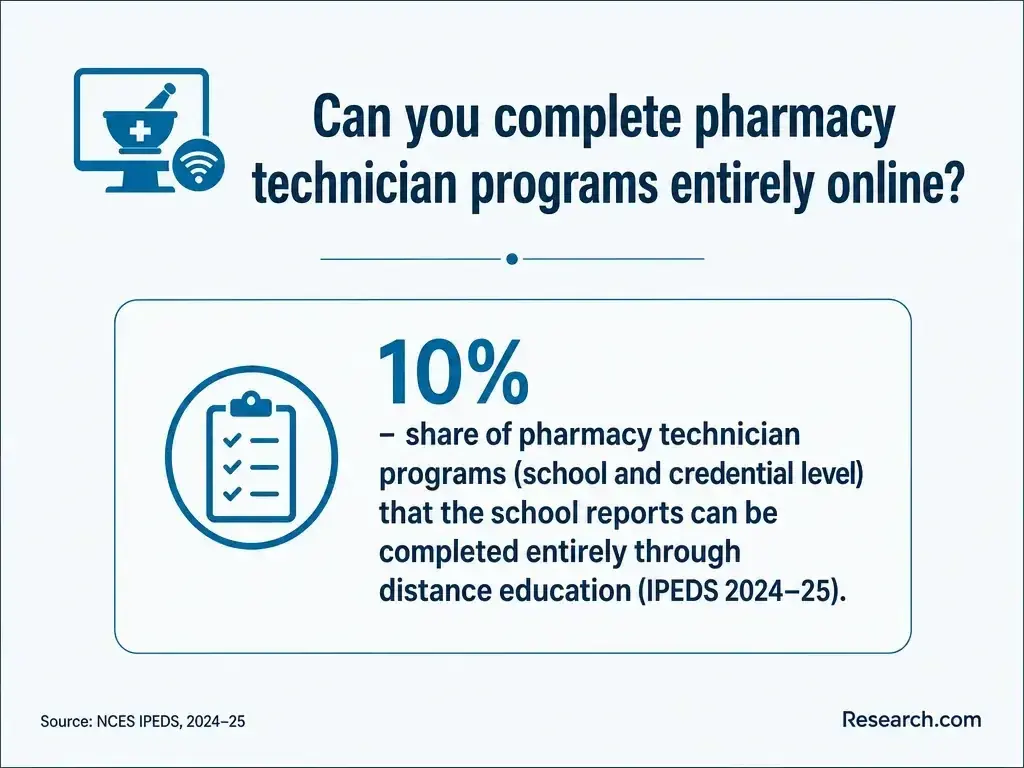
Online study can make terminology, calculations, and other classroom material easier to fit around work. Campus and hybrid formats can make supervised practice with prescription workflows and pharmacy equipment more straightforward. None of those labels, by itself, establishes exam eligibility, a placement, or Texas registration.
Speed matters less than the complete training path. Even if best accelerated online programs for working adults appeal to your schedule, ask a pharmacy technician provider which activities happen in person, whether it arranges a nearby worksite, and what happens if no placement is available when coursework ends.
There is no reliable single Texas City average that captures public continuing-education courses, credit-bearing certificates, private career-school programs, and paid employer training on comparable terms. Request a current, itemized quote from each provider, including tuition, mandatory fees, books or software, uniforms, background checks, certification-exam and Texas registration fees, and travel to labs or worksites.
Check whether the specific credential qualifies for federal aid before budgeting for it; institutional accreditation alone does not establish aid eligibility for every course. Ask College of the Mainland about its current pharmacy technician offering, price, and available funding, and ask employers whether they reimburse exam fees. Searches for cheap online master's programs address a different cost decision; for this occupation, compare the amount you must spend - and any wages you must give up - to become job-ready.
A school may award a certificate or another completion credential. School completion, national certification, and Texas registration are separate things. National certification generally means passing an eligible examination, such as the Pharmacy Technician Certification Board's PTCE or the National Healthcareer Association's ExCPT, after meeting the certifier's current eligibility rules. The Texas State Board of Pharmacy determines who may register and work in Texas.
Check institutional accreditation, any relevant pharmacy program accreditation, exam preparation, and state requirements separately. The accreditation implied by a non profit accredited online university listing, for example, does not establish that a particular pharmacy technician course supplies practical experience or meets a certifier's eligibility rules.
Schools set their own entry rules, which may include prior schooling, an assessment, immunization or health documentation for placements, and a background check. Ask which requirements apply before enrollment and which apply only before a pharmacy worksite placement; a delayed placement can extend the time until you are job-ready.
Employment has a separate regulatory gate. The Texas State Board of Pharmacy requires individuals working in covered technician roles to hold the appropriate Texas registration, and its application process includes a criminal-history review. If you have a potential eligibility concern, review the board's current rules before paying a nonrefundable program deposit.
Core training covers drug names and dosage forms, calculations, prescription entry, inventory, insurance processes, patient privacy, and error prevention. Students should also learn the limits of the technician role: a pharmacist supervises the work and handles professional judgments reserved to pharmacists. The U.S. Bureau of Labor Statistics describes dispensing support, recordkeeping, and customer interaction as common technician duties.
Do not assume that two similarly named certificates offer equal preparation. Ask to see the course outline and identify where students practice calculations, resolve a simulated dispensing error, and receive feedback in a lab or supervised pharmacy setting. If a program promotes extra coursework without showing how it improves technician readiness, question its value.
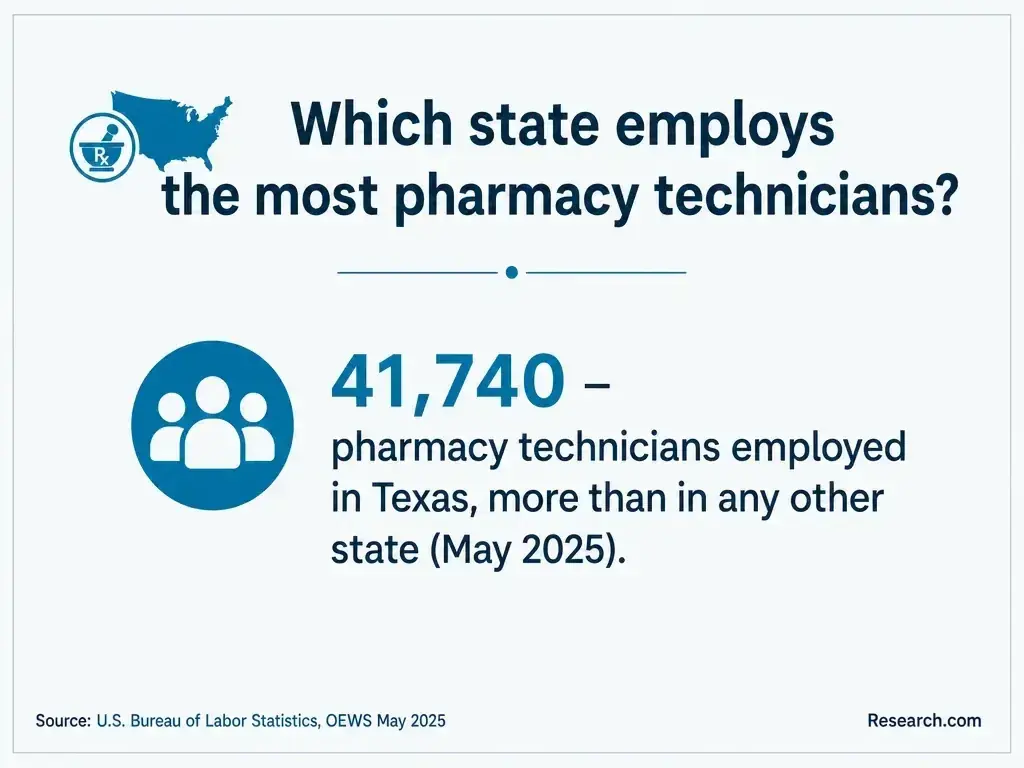
You need the appropriate Texas State Board of Pharmacy registration to work as a pharmacy technician or technician trainee in Texas. A trainee registration is a route into supervised work while pursuing the requirements for technician registration; it is not the same credential as full technician registration. Texas rules require an accepted national certification for technician registration, according to the Texas State Board of Pharmacy. Confirm the current application and renewal rules directly with the board before accepting a job.
A school certificate does not replace board registration, and national certification does not automatically register you with Texas. Conversely, a trade-school certificate is not the only possible route into the occupation: qualifying supervised work can support certification-exam eligibility under the Pharmacy Technician Certification Board's work-experience pathway.
Start with your intended job setting and available schedule, then compare the complete route from enrollment to registration. College of the Mainland is one local provider to investigate, but the best fit depends on its current offering and how it compares with an employer-sponsored trainee position. A broad search for colleges with double major programs will not answer the decisive question here: whether you can gain the pharmacy practice and eligibility needed for the job.
Use these checks before paying a deposit; each can reveal a cost or eligibility problem that a ranking alone cannot show.
- Ask the provider to identify the exact completion credential, current schedule, full cost, and refund policy in writing.
- Verify who arranges labs or supervised pharmacy work, where it occurs, and whether placement is guaranteed or subject to availability.
- Check institutional accreditation and any claimed programmatic accreditation with the relevant accreditor; verify certification eligibility with the certifier and registration rules with the Texas State Board of Pharmacy.
- Compare completion and employment information using the same student group and reporting period, then compare the result with paid trainee opportunities and your likely commute.
A short, affordable course is attractive if it leads to usable practice and a clear certification path. Avoid paying more for speed if an externship wait or unresolved eligibility requirement would erase the time saved.
Entry routes include supervised trainee work and technician roles in community or hospital pharmacies. Experience may open opportunities in inventory coordination, insurance-related workflows, sterile compounding, or lead-technician duties, depending on the employer and additional training. These are possible progressions, not automatic outcomes of a certificate.
Choose initial training for the setting you want first. If hospital pharmacy interests you, ask about relevant labs and worksite access; if you need income immediately, compare a paid retail trainee route with paying for school before employment. Additional specialty credentials can support later development but do not replace Texas registration.
The U.S. Bureau of Labor Statistics projects 6.4% national employment growth for pharmacy technicians from 2025 to 2035. That projection supports considering the occupation, but it does not measure vacancies in Texas City or guarantee placement after training.
To test local demand before enrolling, review current postings across a commute you would actually accept. Note which employers hire trainees, which require certification at application, and which offer paid training. Those distinctions will tell you more about your immediate entry options than a national growth rate alone.
Best Pharmacy Technician Training Programs & Trade Schools in Texas City for 2027
Education is a significant investment, so the Research.com team designed the ranking to compare pharmacy technician programs with other programs in the same occupation and location, using documented outcomes, costs, and quality indicators. Only programs with completions reported to IPEDS are eligible; an unlisted employer-training route or other provider is not necessarily unsuitable.
For best-program rankings, student outcomes, earnings, and costs account for 60% of the score, with weights distributed through an entropy-based method that gives more weight to indicators that vary across programs. Relevant programmatic accreditation or industry recognition accounts for 20%, institutional accreditation for 10%, and student support for 10%. The outcomes and cost measures include completion and full- and part-time retention; earnings one year after completion and relative to annual attendance cost; tuition, attendance cost, debt - including for students who withdrew - and federal loan default rates. Most-affordable rankings instead score only tuition, attendance cost, median debt, and default rates, with entropy-based weights; accreditation and other quality indicators do not enter that score.
The team reviewed the following sources to check the credibility and accuracy of the ranking. Some are relevant to other trades rather than pharmacy technician training specifically; their inclusion does not make them pharmacy program accreditors.
- IPEDS database: program completions and institutional reporting.
- National Center for Education Statistics: education data and institutional context.
- College Scorecard database: available cost, debt, and earnings measures.
- Peterson's database: supplemental institutional information.
- Commission on Accreditation of Allied Health Education Programs: allied-health program accreditation context.
- Accrediting Bureau of Health Education Schools: health-education accreditation context.
- Commission on Dental Accreditation: occupation-specific accreditation context for dental programs.
- Dental Assisting National Board: dental credential context.
- National Center for Construction Education and Research: construction-training recognition context.
- Apprenticeship.gov Partner Finder: registered-apprenticeship context.
Use the ranking to narrow your options, then verify each program's current price, practical training, and fit with Texas registration rules. More detail about the ranking approach appears on the Research.com methodology page.
# 2 position
College of the Mainland - Pharmacy Technician/Assistant.
certificate or diplomaFrequently asked questions about pharmacy technician programs in Texas City
Can I become a pharmacy technician in Texas without trade school?
Potentially. Texas permits a registered trainee route, and the Pharmacy Technician Certification Board offers an exam-eligibility route based on qualifying work experience. You still must meet the applicable certification and Texas registration requirements.
Does an online pharmacy technician certificate qualify me to work in Texas?
Not automatically. Check the certifier's exam-eligibility rules, any practical-training arrangements, and Texas State Board of Pharmacy registration requirements separately.
Should I choose a certificate or paid trainee work?
Choose based on access to supervision, certification preparation, total out-of-pocket cost, earnings during training, and the time until you can seek technician registration. Paid work may suit someone who needs income now; a certificate may suit someone who needs structured instruction.
Does College of the Mainland offer the right option for me?
Ask for its current pharmacy technician course outline, credential, price, schedule, and practical-training arrangements. Compare those details with your intended job setting and available trainee jobs before enrolling.
- U.S. Bureau of Labor Statistics - Pharmacy Technicians
Used to verify salary, employment outlook, and typical education requirements.
https://www.bls.gov/ooh/healthcare/pharmacy-technicians.htm - NCES College Navigator (IPEDS)
Used to verify programs offered and institutional accreditation.
https://nces.ed.gov/collegenavigator/ - PTCB - Certified Pharmacy Technician (CPhT)
Professional certification reference for graduates of this occupation.
https://www.ptcb.org/credentials/certified-pharmacy-technician - College of the Mainland - official website
Official school website (programs, tuition, admissions).
https://www.com.edu/