# 1 position


Audited and Verified:
Our Editorial and Data Verification Process
Research.com uses government datasets, official education statistics and primary institutional information to support its career and degree guides. Our review process checks factual accuracy, occupational definitions, source dates and the requirements associated with the credentials discussed.
How This Article Was Fact-Checked
Our editorial team verifies salary estimates, employment projections, education requirements and program information against original data providers and official organizations. Salary figures are checked against the relevant occupational definitions and reporting periods. Information about licensure, accreditation and required in-person training is reviewed separately.
Fact-checked and verified on:

Co-Founder and Chief Data Scientist

Reviewed by Karolina Broda
Fact-Checker and Data Verification
Choosing an affordable marketing associate degree in Eau Claire means looking beyond tuition: the degree must also fit the work you want to do. The U.S. Bureau of Labor Statistics projects 7.0% national growth for market research analysts and marketing specialists from 2025 to 2035, though that occupation often requires further education or experience. This guide examines costs, coursework, and career fit alongside the Most Affordable Marketing Associate Degree Programs in Eau Claire for 2027 ranking, created by the Research.com team of data scientists to help students make an informed choice about programs worth considering.
Expect a mix of business fundamentals and applied work: understanding customers, planning promotions, communicating a product's value, and interpreting campaign results. At Chippewa Valley Technical College, ask for the current marketing associate degree catalog so you can verify the award, required courses, delivery format, and any work-based component rather than assuming every program called "marketing" teaches the same skills.
The degree designation matters because it affects how directly coursework serves an immediate job goal versus future study. These are pathway descriptions, not a claim that each is currently available locally.
| Associate degree pathway | Typical emphasis | Best fit to investigate |
| Career-focused applied associate degree | Marketing, business, and practical projects alongside general education | Entering marketing support or related business work soon after graduation |
| Transfer-oriented AA or AS | Broader general education and foundational business courses | Preserving a wider set of transferable academic credits |
A portfolio of campaign plans, writing samples, audience research, or performance reports can make applied coursework more useful in a job search. Ask whether projects use real clients, current analytics tools, or an internship, and whether participation requires travel to a worksite.
Local possibilities include marketing support for retailers, health organizations, manufacturers, hospitality businesses, and service firms. The practical question is not whether an employer has a "marketing department": smaller Eau Claire-area organizations may combine promotions, customer communication, social media, and sales support in one position.
Read job postings for the tasks, not just the title. If listings ask for email campaigns, spreadsheets, customer relationship management software, or writing samples, favor courses and projects that let you demonstrate those abilities. Roles centered on independent market research or advanced analytics may require more experience than a new associate degree graduate has.
There is no single reliable salary for everyone holding a marketing associate degree. Pay depends on the job, employer, prior experience, and responsibilities. The U.S. Bureau of Labor Statistics reports a $78,760 national median annual wage in May 2025 for market research analysts and marketing specialists. That occupational median includes experienced workers and is not an estimate of entry-level pay in Eau Claire.
For a useful return-on-investment estimate, compare the wages in current local postings for jobs you could realistically obtain with your existing experience and the completed degree. Subtract what you would likely earn without enrolling, then consider aid, borrowing, time away from paid work, completion probability, and how long you expect to use the degree. A high occupational median alone cannot establish that a particular program will pay off.
Associate degrees commonly take about two years of full-time study and require roughly 60 credits, but the current catalog - not that benchmark - determines the exact requirement. Part-time enrollment, course sequencing, placement, and accepted prior credits can change your finish date.
If you work while studying, request a term-by-term plan showing when required marketing courses are offered. An apparently faster schedule may cost more if it requires reducing work hours; a slower schedule may increase living and commuting costs. Ask whether previously completed general education courses can count toward the specific degree before relying on an accelerated timeline.
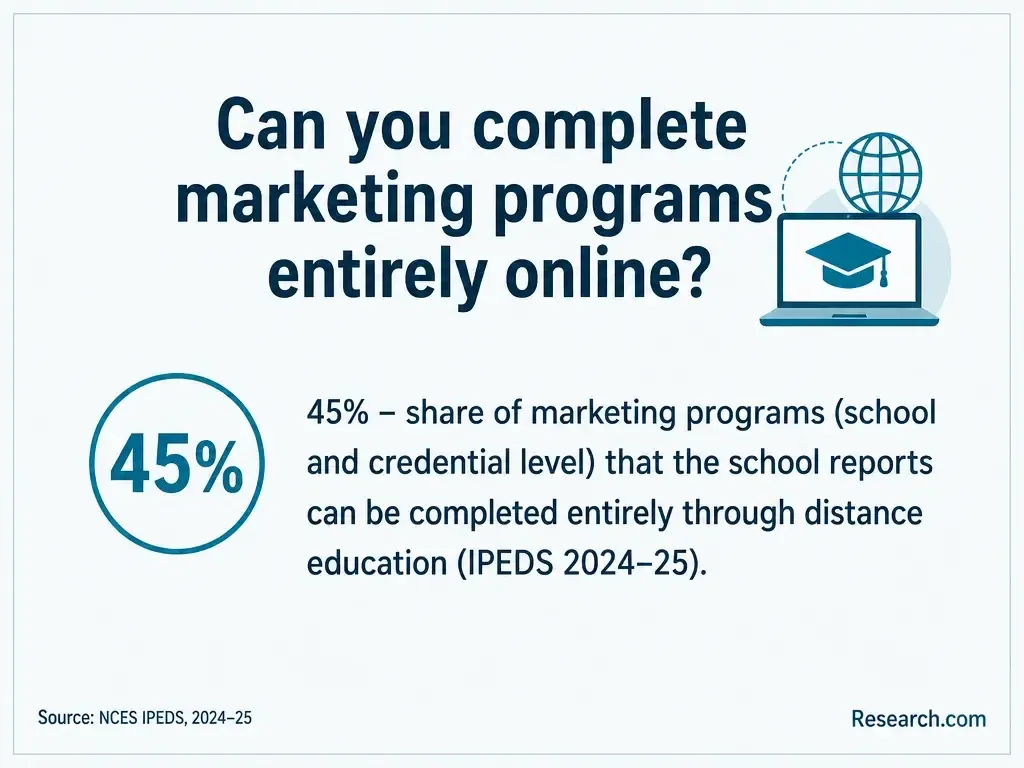
Online coursework can reduce commuting and make it easier to study around a work schedule. On-campus classes can provide scheduled access to instructors, peers, and group projects. For marketing, writing, business concepts, and some software exercises may work remotely; a client project, internship, or employer meeting may still require participation at a particular place or time.
Ask Chippewa Valley Technical College which required courses are online, hybrid, or campus-based in the terms you expect to attend - not merely whether the program has an online option. Check whether exams, presentations, or work-based learning involve in-person attendance. If you are comparing a remote provider, its listed tuition is only part of the calculation; cheapest online degrees are not necessarily cheapest after fees, transfer-credit decisions, and extra terms are counted.
A defensible Eau Claire average is not available from a single local price, and a published annual tuition figure would not equal the cost of finishing. For the 2027 decision, obtain the current per-credit charges and required-credit total from Chippewa Valley Technical College, then confirm how residency and enrollment status affect your bill. Do not substitute a prior year's rate for a current quote.
Your estimate should include mandatory fees, textbooks or digital access, a suitable computer and software, transportation, living expenses, and wages you may give up to attend. Marketing generally does not carry the protective-gear or licensing-exam costs associated with some occupations, but required technology and project expenses still matter. Compare net total cost after likely aid across schedules, not tuition alone. If you must stay employed, resources on cheapest online colleges for working adults can help frame questions about scheduling, though any alternative's degree requirements and full costs need separate verification.
Eligible students may be able to use federal grants, federal student loans, and work-study, as well as Wisconsin aid, institutional scholarships, or employer tuition assistance. Eligibility and award amounts depend on the student and program; an advertised aid maximum is not a guaranteed payment. Federal Student Aid and the Wisconsin Higher Educational Aids Board are the appropriate starting points for current federal and state rules.
Submit the Free Application for Federal Student Aid (FAFSA) and ask the college's financial aid office which state grants and school funds apply to your enrollment. Then request an aid offer that separates grants from loans. A lower monthly payment is not the same as a lower degree cost: borrowing adds repayment obligations, while employer assistance may require continued employment or a minimum grade.
Check Chippewa Valley Technical College's current admissions page for its marketing associate degree's application, academic records, placement process, and any course-specific prerequisites. Do not assume that general college admission automatically places you into every required business or math course.
Before applying, ask an adviser to review prior coursework for credit and identify any first-term sequencing constraints. Strong writing, basic spreadsheet use, and comfort interpreting numbers will help with marketing assignments, even when they are not formal admission requirements. Confirm the actual rules rather than paying for preparatory coursework you may not need.
A marketing associate degree typically combines general education - such as communication and quantitative reasoning - with business and marketing courses. Depending on the catalog, major work may cover consumer behavior, sales, advertising, digital marketing, marketing research, and business software. The precise mix matters: a program rich in campaign production may suit a promotion-focused job, while stronger research and spreadsheet work may better support an analytics-oriented path.
Ask to see actual assignments and the current course sequence. A useful applied project should let you define an audience, choose a channel, set a measurable objective, and explain the results. Do not assume a course title such as "digital marketing" guarantees practice with the tools appearing in local job postings.
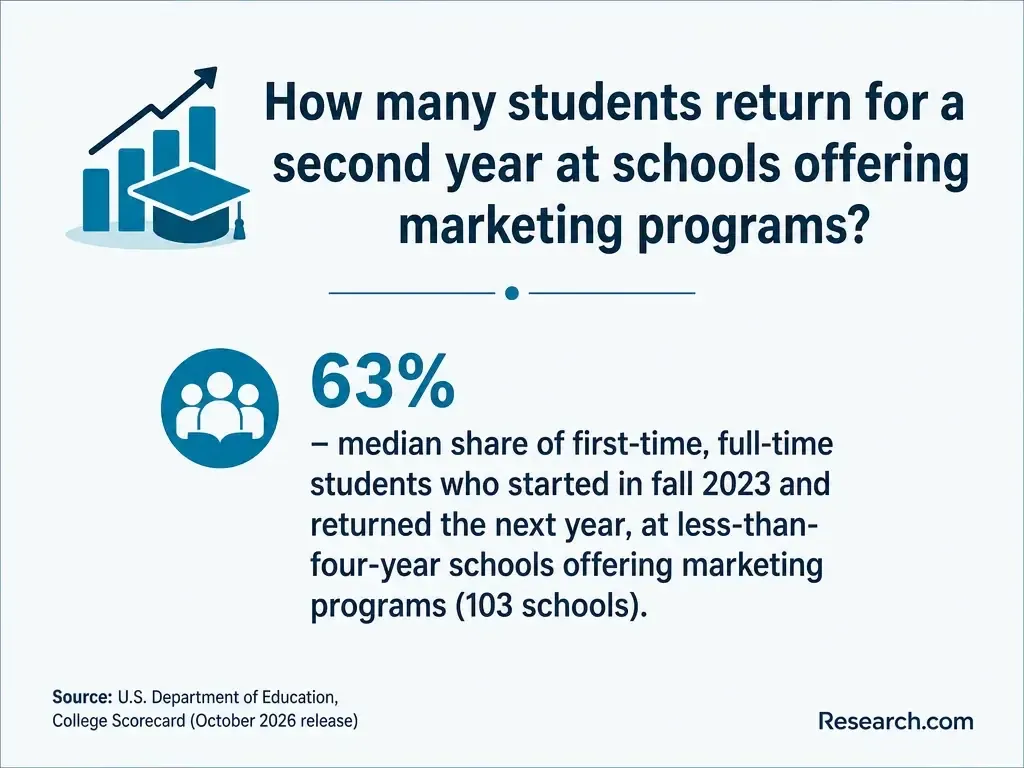
At the associate degree level, "specialization" often means choosing projects or available electives rather than a formally named concentration. Possible directions include digital campaigns, customer research, sales, and content creation. Verify whether Chippewa Valley Technical College actually offers the courses you want within the marketing degree and whether they run often enough to fit your graduation plan.
If you want to manage social channels, prioritize writing, audience targeting, and performance measurement rather than software familiarity alone. If you prefer sales or account support, look for customer communication and business-to-business projects. Avoid paying for extra electives that do not satisfy degree requirements or your intended role.
Start with the job you want to pursue immediately after graduation, then test each program against its requirements. A low-cost ranking is a useful shortlist, not proof that a degree has the right coursework, schedule, or employer connections for you.
Use these checks before accepting an offer or registering for classes:
Marketing support roles generally do not require an occupational license. Institutional accreditation addresses the college, not a promise of employment, professional certification, or credit acceptance elsewhere. The costly mistake is to choose by tuition or rank while overlooking a missing required course, an inconvenient worksite commitment, or credits that will not serve your goal.
Possible first steps include marketing assistant, promotions coordinator, sales support specialist, customer service representative with campaign duties, or social media assistant. Titles vary widely: compare the actual responsibilities and experience requirements before treating two postings as equivalent. A graduate with prior retail, office, or customer-facing experience may be able to make a different transition than someone entering the workforce for the first time.
Progression usually depends on demonstrated results - such as stronger campaign writing, accurate reporting, or successful client coordination - not the degree alone. Optional software or platform certifications can help document a specific skill, but they are not Wisconsin occupational licenses for these roles. For someone seeking a narrower skill update rather than the breadth of an associate degree, best paying 6 month online certifications offers a separate point of comparison; assess the actual job requirements before choosing that route instead.
The national outlook is encouraging but does not measure openings specifically for new associate degree holders in Eau Claire. The U.S. Bureau of Labor Statistics projects 7.0% employment growth from 2025 to 2035 for market research analysts and marketing specialists. That occupation can involve advanced research responsibilities, so its forecast should not be read as a forecast for local marketing assistant jobs.
A practical local market check is to review recent postings across several industries and record the recurring skills, minimum experience, location requirements, and pay ranges. Broaden the search to nearby employers or remote-eligible positions only if the commute or working arrangement is realistic. The strongest degree choice is one that lets you show employers relevant work while keeping the cost of reaching that point manageable. If you are mapping much longer-term career possibilities, resources on what's the easiest master's degree to earn and highest paid master's degrees should not be used as evidence of the likely return from this associate degree.
Investing in an education is a consequential financial decision. Research.com created this ranking to help readers compare affordable local options using documented institutional data rather than advertised tuition alone. The team reviews source quality and comparability, but readers should still confirm current program availability, prices, and degree requirements directly with the college.
For this most affordable ranking, programs are compared with others in the same occupation and location. Only programs with completions reported to the Integrated Postsecondary Education Data System (IPEDS) are included. The score uses tuition, cost of attendance, median student debt, and federal loan default rate; an entropy-based method gives more weight to measures that distinguish programs. Accreditation and other quality indicators are not part of the affordability score, so a higher position does not establish a better marketing curriculum or career outcome.
The ranking process draws on the following databases and reference organizations. Some industry-specific sources apply to other occupations, not marketing; their inclusion among Research.com's sources does not imply that marketing programs need approval from them.
IPEDS reporting makes comparisons more consistent but does not capture every possible education provider or establish that an unlisted program is poor quality. Use the ranking to narrow your choices, then check the current catalog and a personalized aid estimate. Research.com explains its broader approach on its methodology page.
# 1 position
# 2 position
Digital Marketing
Delivery mode: Online
88.03
/ 100
Final score
Accreditation
Institutional accreditation from Higher Learning Commission.
Chippewa Valley Technical College earned a Research.com Affordability Score of 88.03/100, supported by $4,953 annual in-state tuition and 9% federal loan default rate.
It may be if its coursework matches jobs you can pursue, you can complete it on a workable schedule, and your likely net cost is reasonable relative to your existing earnings and prospects. A ranking or national salary median cannot answer that question for you.
No. Compare total cost after aid, required courses, practical projects, schedule, and career support. A lower advertised tuition can lose its advantage if extra terms or fees raise the cost of finishing.
Some coursework may be available online. Confirm the current delivery mode of every required course and whether projects, exams, or work-based learning require in-person participation.
Marketing support work generally does not require an occupational license. Employers may still ask for particular skills, experience, or examples of completed work.
Ask for the current degree plan, a term-by-term schedule, a personalized cost and aid estimate, and examples of required marketing projects. If you have prior credits, request a review of how they would apply to this degree.