# 1 position
Surry Community College - Electrician.
associate

Audited and Verified:
Our Editorial and Data Verification Process
Research.com uses government datasets, official education statistics and primary institutional information to support its career and degree guides. Our review process checks factual accuracy, occupational definitions, source dates and the requirements associated with the credentials discussed.
How This Article Was Fact-Checked
Our editorial team verifies salary estimates, employment projections, education requirements and program information against original data providers and official organizations. Salary figures are checked against the relevant occupational definitions and reporting periods. Information about licensure, accreditation and required in-person training is reviewed separately.
Fact-checked and verified on:

Co-Founder and Chief Data Scientist

Reviewed by Karolina Broda
Fact-Checker and Data Verification
The cheapest electrician program is not necessarily the cheapest route to a job: tools, travel, unpaid study time, and the need for supervised experience all affect the investment. The Research.com team of data scientists created the Most Affordable Electrician Trade Schools in Dobson for 2027 ranking to help students identify programs worth considering. With U.S. electrician employment projected to grow 9.2% from 2025 to 2035, according to the U.S. Bureau of Labor Statistics, this guide helps Dobson-area students compare costs, apprenticeships, credentials, and North Carolina licensing rules before enrolling.
Expect a mix of electrical theory, safety instruction, and supervised practice - not immediate qualification to work independently. For someone in Dobson, Surry Community College is the local public-college option to investigate for current electrical offerings, schedules, and lab access. Confirm the exact credential and whether instruction includes work on panels, conduit, circuits, and test equipment; similarly named programs can provide very different amounts of practice.
A college certificate or diploma can help someone explore the trade or prepare for an entry-level helper role. A registered apprenticeship instead combines paid work with related instruction under a sponsor and is generally a better fit for someone ready to learn on a jobsite over a longer period. Employer-sponsored training may also offer paid entry, but its structure and portability vary. The best online vocational colleges may help with a broader school search; for electrical training, verify local lab and worksite arrangements before treating remote coursework as a substitute.
Electrical contractors offer the most direct route into residential and commercial installation work. Maintenance departments, manufacturers, and facilities with electrical systems may offer other roles, depending on the applicant's practical skills and the employer's supervision arrangements. The U.S. Bureau of Labor Statistics identifies contractors and other building-services employers as major sources of electrician work nationally; that does not establish the number of vacancies in Dobson.
Dobson's smaller local market makes commuting distance part of the training decision. Before paying for a program, ask where its work placements actually occur and whether you can reliably reach those jobsites. A placement that requires frequent travel may change both your training cost and the jobs you can realistically accept.
The U.S. Bureau of Labor Statistics reports a $63,190 national median annual wage for electricians in May 2025. That is the midpoint for employed electricians across experience levels - not a Dobson wage estimate or a likely first-year wage. A new helper or apprentice may earn less, while experienced workers' pay depends on duties, employer, and location.
Because a Dobson-specific electrician wage figure is not established here, compare actual offers rather than applying the national median to a personal budget. Ask potential apprenticeship sponsors about starting pay, scheduled increases, benefits, and whether travel between jobsites is paid. For a school route, compare expected entry-level offers with the wages you would give up while studying.
There is no single completion time: a short introductory course, a certificate, a diploma, and a registered apprenticeship serve different goals. The U.S. Bureau of Labor Statistics describes electrician apprenticeships as typically lasting four or five years, with paid on-the-job training and technical instruction. A shorter school credential can get someone ready to seek supervised entry-level work sooner, but it should not be mistaken for the full period of occupational training.
Ask Surry Community College for the current program's calendar, contact hours, lab hours, and part-time schedule. Ask any apprenticeship sponsor how prior coursework is evaluated for advanced standing; never assume that completing a course automatically shortens an apprenticeship. Lists of short courses that pay well can suggest other career ideas, but a brief online course cannot replace the practical experience needed to develop electrician skills.
Electrical theory, code reading, and some calculations can be taught remotely. Safe installation, testing, troubleshooting, and jobsite practices require supervised, in-person experience. A hybrid schedule may reduce trips for classroom lessons, but it does not remove travel to labs or worksites.
The distinction matters especially if you live outside Dobson and hope to limit commuting. Request the location and frequency of every required in-person session before enrolling. Advertising that resembles quick and easy degrees that pay well is a poor test for this occupation: evaluate the actual electrical credential, practical hours, and route into supervised work instead.
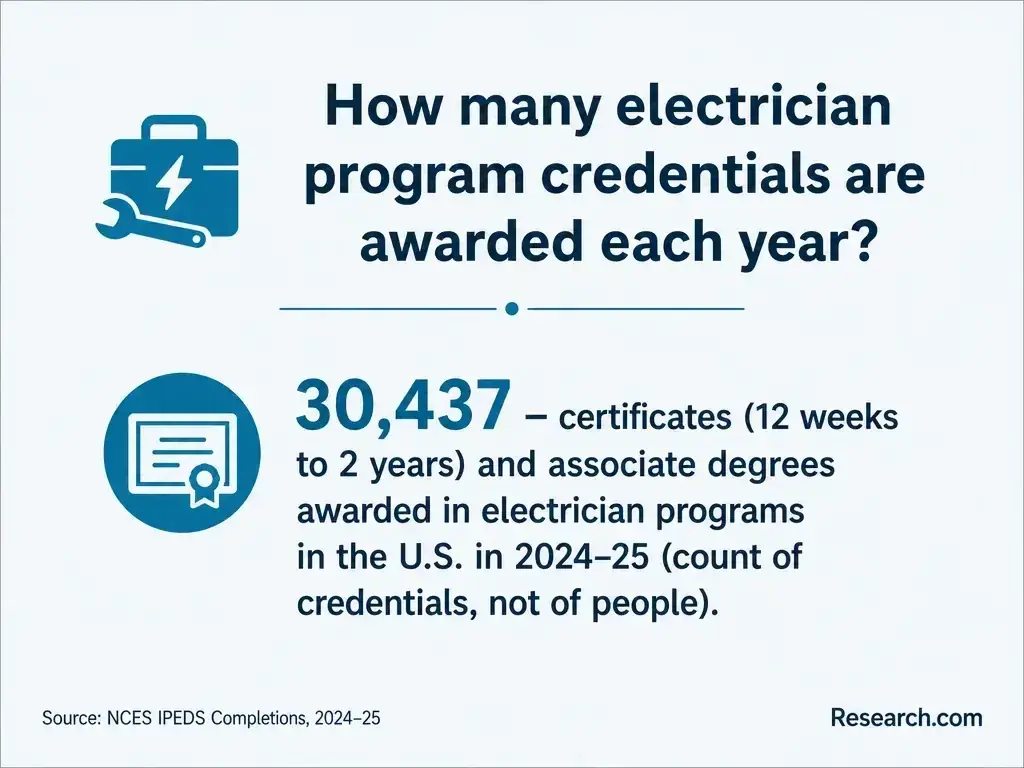
A defensible Dobson average is not available without comparable, current prices for the specific programs a student could attend. Published tuition alone would also understate the cost of becoming job-ready. Request an itemized estimate from Surry Community College and any other training provider or apprenticeship sponsor you are considering.
Compare these costs across the entire route, including any amount the provider or employer covers:
Ask the college whether your specific credential qualifies for federal aid and what aid remains after required expenses; eligibility is program- and student-specific, according to Federal Student Aid. For a working adult, a paid apprenticeship may cost less out of pocket despite taking longer. Searches for affordable masters degrees address a different educational goal and should not enter an electrician-training price comparison.
The credential depends on the route selected. A college may award a certificate, diploma, or associate degree if that specific electrical program offers one; verify the current award rather than assuming all options do. A registered apprenticeship documents completion under its sponsor's requirements. An industry credential, such as one aligned with NCCER training, is distinct from both a school award and an occupational license.
For an entry-level applicant, the useful question is whether the credential is recognized by nearby employers and backed by enough hands-on preparation for the intended role. Ask whether coursework can be credited toward a later college credential or considered by an apprenticeship sponsor. Get any transfer or advanced-standing decision in writing before counting on it.
Requirements vary by program and sponsor. A college may assess reading and math readiness for electrical calculations; an apprenticeship sponsor may have its own application, interview, work-eligibility, transportation, and employer requirements. Do not assume that admission to a school program also admits you to an apprenticeship or guarantees a placement.
Before applying, request the current prerequisite list, start dates, selection process, and any costs due before training begins. If a program advertises work-based learning, ask whether a position is arranged, competitively awarded, or left for students to find. That distinction matters when you need income soon after enrolling.
Core instruction commonly covers electrical safety, circuit principles, measurements, wiring methods, blueprint interpretation, and code use. The U.S. Bureau of Labor Statistics also identifies testing and troubleshooting as central electrician tasks. Strong practical instruction lets students apply those topics to equipment and installations under supervision rather than only answering questions about them.
Compare the lab with the work you want to do. Someone seeking construction work should ask about installation and conduit practice; someone interested in maintenance should ask about motors, controls, and fault-finding. Also ask how instructors assess safe work habits, communication, and documentation - skills employers need when new workers join a crew.
North Carolina's State Board of Examiners of Electrical Contractors licenses those who undertake electrical contracting under the state's rules. A school credential, industry certificate, or registered-apprenticeship completion is not itself a contractor license. Working as a supervised employee and operating a contracting business are different situations; confirm which rules apply to the job you intend to hold with the Board and a prospective employer.
If independent contracting is your long-term goal, review the Board's current license classifications, experience documentation, examinations, and application requirements before choosing training. Institutional accreditation concerns the school; apprenticeship registration concerns the sponsor; neither replaces contractor licensure. A program representative should be able to explain its training's relevance without promising that graduation automatically makes you license-eligible.
Start with the job you want, then compare routes on the same basis. A school program may suit someone who needs a structured introduction before seeking employment; a paid apprenticeship may suit someone ready for a longer work-and-study commitment. Neither wins solely because it is faster, cheaper on paper, or higher in an affordability ranking.
Use these questions when speaking with Surry Community College or an apprenticeship sponsor:
Check school accreditation and aid eligibility separately from program content, apprenticeship registration, and State Board rules. Calculate likely value using total costs, debt, time out of paid work, the chance of finishing, and realistic entry-level pay - not the national median alone. Results for 1 year master's programs are outside this trade-training decision and should not be used as a shortcut for comparing electrician routes.
Training can lead first to supervised helper, trainee, or apprentice work, then to more independent installation or maintenance responsibilities as skills and experience develop. Later possibilities include specializing in controls or troubleshooting, supervising crews, or pursuing electrical contracting if North Carolina's applicable licensing requirements are met. The U.S. Bureau of Labor Statistics describes apprenticeships as a common preparation route for electricians.
Choose early training for the next attainable role, not just the eventual title. If you want paid construction experience now, ask sponsors about openings. If you need to build fundamentals first, ask whether a school's lab work and employer connections make its upfront cost worthwhile. Optional industry credentials can support a specialty, but should not be confused with permission to operate a contracting business.
The U.S. Bureau of Labor Statistics projects 9.2% national employment growth for electricians from 2025 to 2035. That points to continuing demand across the occupation, but it is not a forecast of Dobson openings or a guarantee of work after any particular program.
For a local decision, investigate where recent trainees actually found work and whether openings are reachable from home. Ask providers for documented placement information with the reporting period and job definitions, and compare it with current apprentice or helper vacancies you could accept. A program with a lower price but no workable route to supervised employment may be the more expensive choice in practice.
Choosing where to invest in training is consequential, so Research.com evaluates comparable programs in the same occupation and geography rather than treating every trade school as interchangeable. The ranking includes only programs with completions reported to the Integrated Postsecondary Education Data System (IPEDS); a registered apprenticeship or employer program absent from IPEDS may still be a strong option.
For the most affordable ranking, Research.com scores tuition, cost of attendance, median student debt, and federal loan default rate. Indicator weights are distributed using an entropy-based method, which gives more weight to measures that vary more across included programs. Accreditation, earnings, support services, and other quality measures do not contribute to this affordability score. By contrast, Research.com's separate best-program rankings consider outcomes, earnings, costs, institutional accreditation, occupation-relevant recognition, and support services. Readers should therefore use the affordability ranking to narrow a cost comparison - not as proof of hands-on quality or licensing eligibility.
Research.com draws on the following data sources for its trade-program ranking work. Some cover occupations other than electrical work; their inclusion does not mean an allied-health or dental credential is relevant to an electrician program.
These sources help make cost comparisons more consistent, but college-oriented datasets do not cover every apprenticeship or employer-sponsored route. Readers can review Research.com's methodology for more on how the rankings are created, then request current, program-specific prices and training details before deciding.
# 1 position
# 2 position
Compare the current full cost of Surry Community College's relevant offerings with paid apprenticeship and employer-training opportunities. Include tools, travel, fees, and wages earned or forgone; the lowest tuition may not produce the lowest total cost.
Online lessons can cover theory, but electrical installation and troubleshooting require supervised hands-on practice. Confirm where and how a provider supplies that practice before paying.
Not necessarily. Sponsors set their own entry requirements, and some accept applicants without prior college training. Ask whether previous coursework helps with selection or earns advanced standing.
No. A certificate does not replace North Carolina electrical-contractor licensing. Check the State Board of Examiners of Electrical Contractors' rules for the work you plan to perform.
It may be if it provides useful lab practice and a realistic route to supervised work at a manageable cost. Ask what graduates can do next; a short credential is not equivalent to completing an apprenticeship.