# 1 position
Intellitec College-Colorado Springs - Electrician.
certificate or diploma

Audited and Verified:
Our Editorial and Data Verification Process
Research.com uses government datasets, official education statistics and primary institutional information to support its career and degree guides. Our review process checks factual accuracy, occupational definitions, source dates and the requirements associated with the credentials discussed.
How This Article Was Fact-Checked
Our editorial team verifies salary estimates, employment projections, education requirements and program information against original data providers and official organizations. Salary figures are checked against the relevant occupational definitions and reporting periods. Information about licensure, accreditation and required in-person training is reviewed separately.
Fact-checked and verified on:

Co-Founder and Chief Data Scientist

Reviewed by Karolina Broda
Fact-Checker and Data Verification
Choosing electrician training in Colorado Springs means deciding whether to pay for school, pursue a paid apprenticeship, or combine the two - and whether that training will count toward Colorado licensure. The U.S. Bureau of Labor Statistics projects 9.2% growth in electrician employment nationally from 2025 to 2035. For new entrants and career changers, this guide compares credentials, hands-on experience, costs, and licensing steps. It also accompanies the Best Electrician Trade Schools in Colorado Springs for 2027 ranking, created by the Research.com team of data scientists to help students identify programs worth considering.
Expect instruction in electrical theory, code use, circuits, wiring methods, testing, and jobsite safety, paired with practical work. A credible program should let you build and troubleshoot circuits with tools and protective equipment, not merely watch demonstrations. Ask for its scheduled lab hours and whether students practice on residential and commercial systems relevant to their goals.
The pathways differ most in how they connect instruction to paid, supervised work. The comparison below shows what each normally provides; confirm the exact credential and arrangement with each provider.
| Pathway | What it typically provides | Best fit and principal limitation |
| College or career-school certificate or diploma | Classroom and lab training; a school credential | Useful for building fundamentals before or alongside employment; a certificate does not replace required experience. |
| Associate degree with electrical coursework | Trade training plus additional college coursework; an academic degree | May suit students seeking broader technical study, but takes longer and should be checked against licensing needs. |
| Registered apprenticeship | Structured instruction and paid, supervised on-the-job training; an apprenticeship completion credential | Strong fit for students ready to work while learning; entry depends on sponsor openings and selection. |
| Employer-sponsored entry route | Worksite training that may be paired with outside classes | Can provide an immediate wage; verify who supervises the work and how hours and instruction are documented. |
For Colorado Springs applicants, ask Pikes Peak State College and IntelliTec College-Colorado Springs what electrical training they currently offer rather than assuming every campus offers the same credential each year. If your main objective is an electrician license, searches such as what is the easiest aa degree to get are less useful than checking lab work, employer connections, and qualifying experience.
Potential worksites include residential construction, commercial buildings, industrial facilities, and maintenance operations. Jobs differ: a residential crew may emphasize service panels and branch circuits, while commercial work can involve conduit, larger distribution systems, and coordination with other trades. The Colorado State Electrical Board distinguishes license categories and experience requirements, so the type of work you document can matter as much as the number of hours.
Ask prospective training providers which local contractors or apprenticeship sponsors interview students, where worksites are located, and whether schedules permit both classes and employment. A job across the Colorado Springs area can add substantial travel and tool-transport costs even when classroom tuition looks affordable.
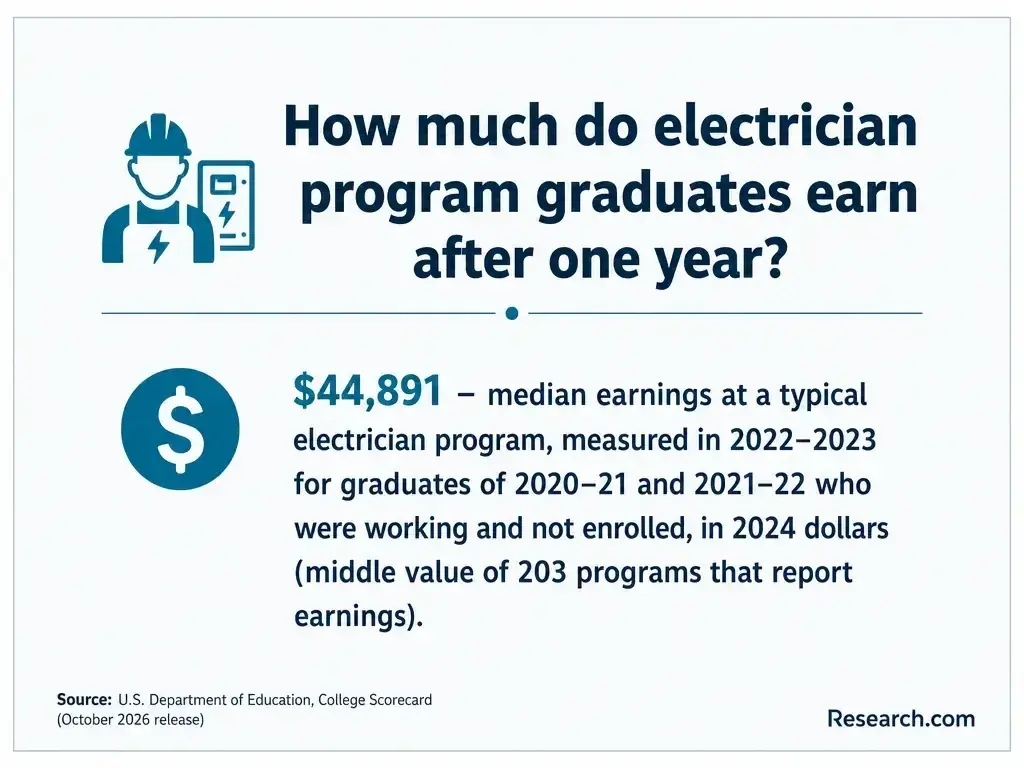
A verified benchmark is the U.S. median annual wage of $63,190 for electricians in May 2025 (U.S. Bureau of Labor Statistics, Occupational Outlook Handbook). It covers experienced and less-experienced workers nationwide; it is neither a Colorado Springs wage nor a likely first-year apprentice offer.
For a local decision, request the current wage schedule from each apprenticeship sponsor and compare actual entry-level job postings. Check how pay advances with documented experience, whether benefits are included, and whether travel between jobsites is compensated. Compare those offers with what you earn now when judging whether school costs or reduced working hours are manageable.
A school certificate may finish well before an apprenticeship, but finishing classes is not the same as becoming a licensed journeyman. Colorado's journeyman pathway requires substantial documented electrical work experience over multiple years, qualifying experience in specified types of work, required education, and an examination (Colorado State Electrical Board). Check the board's current application instructions for the exact requirements that apply to your route.
Ask schools for both calendar length and scheduled classroom and lab hours, including whether evening or part-time enrollment extends completion. Ask sponsors when paid work begins and how related instruction fits around it. Advertisements for top 6-month associate degree programs online should not be mistaken for a shortcut through Colorado's supervised electrical experience requirements.
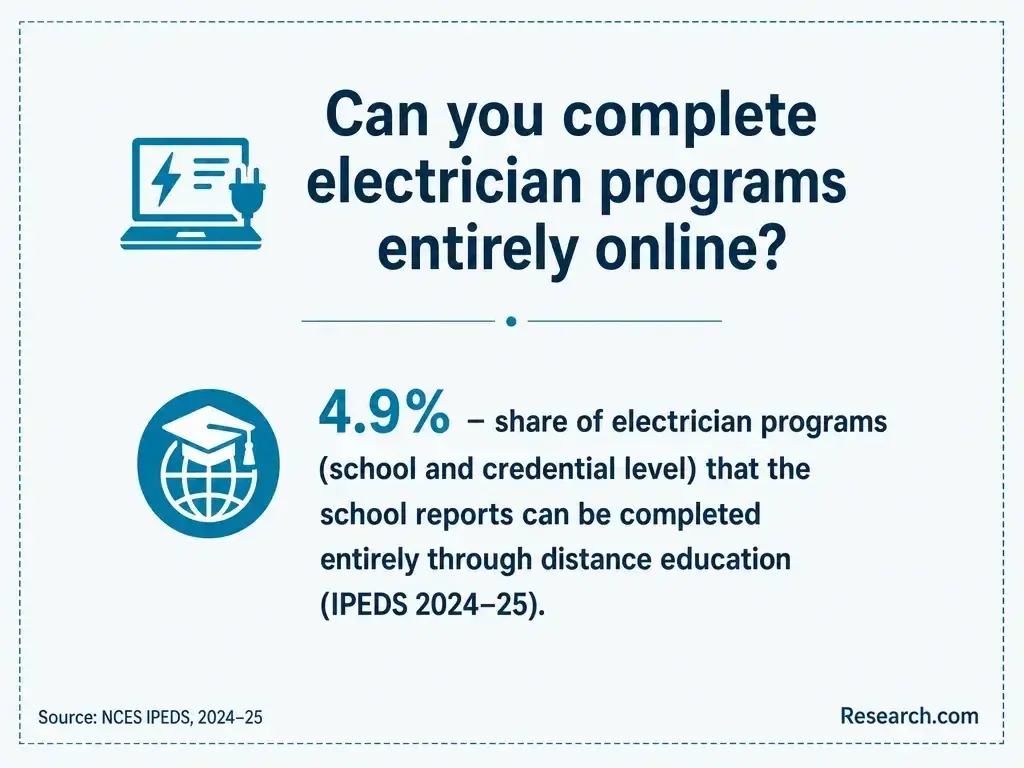
Online coursework can support electrical theory, calculations, and code study. It cannot by itself demonstrate safe installation, tool handling, circuit testing, or supervised worksite practice. A hybrid option is worth considering when it identifies exactly where and when labs occur and how students obtain qualifying employment; an entirely remote course should not be assumed to satisfy Colorado licensing requirements (Colorado State Electrical Board).
For a working apprentice, remote theory lessons may make scheduling easier. For someone without access to tools or a jobsite, campus labs may be more valuable. When comparing accredited online universities free to apply, remember that an easy application and institutional accreditation do not establish hands-on electrician training or licensing eligibility.
There is no single reliable price that represents every local route: a college credential, career-school program, and paid apprenticeship have different billing and wage structures. Published tuition alone cannot establish the cost of becoming job-ready. Get a written, current estimate from each provider before comparing offers.
The following costs belong in that estimate because they can change which route is affordable:
Ask whether an institution and its specific program qualify for federal student aid; not all short training or apprenticeship options do (U.S. Department of Education, Federal Student Aid). To assess return on investment, compare net cost and likely debt against your current earnings, plausible apprentice wages, time to completion, probability of finishing, and later earnings over a realistic time horizon. A lower tuition price is not automatically a better investment if it offers no workable route into supervised employment.
The credential depends on the route: a school may award a certificate or diploma; an applicable college program may award an associate degree; and a registered apprenticeship issues its own completion credential. None is the same as a Colorado occupational license. Ask for the precise award name and whether coursework can receive credit toward an apprenticeship or later college study; obtain any advanced-standing agreement in writing.
Institutional accreditation concerns the school, state authorization concerns its permission to operate, apprenticeship registration concerns the training sponsor, and occupational licensure concerns the worker's legal status. Industry credentials can signal particular skills but do not substitute for Colorado's licensing process (Colorado State Electrical Board; U.S. Department of Labor).
Requirements vary by school and sponsor. A school may review prior education and placement readiness; an apprenticeship sponsor may assess math, availability for work, and eligibility under its selection rules. Employers may have separate driving, safety, or jobsite requirements. Request current criteria directly rather than assuming admission to a classroom program also secures an apprenticeship position.
Before paying a deposit, ask whether you need an employer first, who arranges interviews, and whether the schedule accommodates paid work. If you have prior electrical training or military or construction experience, ask what evidence is needed for course credit or advanced standing - and whether Colorado will recognize any work experience for licensing. A school's credit decision is not a board decision.
Core instruction typically covers electrical calculations, blueprint reading, circuits, wiring methods, code navigation, testing, troubleshooting, and safe work practices (U.S. Bureau of Labor Statistics, Occupational Outlook Handbook). The important comparison is what students actually do: measure live-system risks safely, identify faults, install components, and explain why an installation meets the applicable code.
Request a course outline and lab schedule. If you aim for commercial construction, check for substantial conduit and distribution-system practice; if you aim for service work, look for troubleshooting and customer-facing assignments. Newer equipment does not make a program better by itself - the test is whether students gain supervised practice that resembles the work they intend to pursue.
Colorado regulates electrical work. An entrant can pursue supervised work under the state's apprentice rules, while independent work requires the appropriate state electrical license and compliance with its experience, education, and examination requirements (Colorado State Electrical Board). Registered apprenticeship is a structured training route; apprentice status, apprenticeship completion, an optional industry credential, and a state license are distinct.
Before enrolling, check the Colorado State Electrical Board's current apprentice-registration and license instructions. Ask the program who will supervise and document your hours, what categories of work you will perform, whether its instruction satisfies any applicable education requirement, and which license its intended pathway supports. Do not rely on a school's statement that graduates are "license-ready" without checking the board's rules yourself.
Choose backward from the work and license you want, not forward from a ranking position. A strong option for a working apprentice may be poorly timed for someone who needs daytime labs; a fast certificate may be poor value if it leaves the student without a route to supervised experience.
Use these checks when speaking with a school or apprenticeship coordinator:
Red flags include a promise of automatic licensure, vague hands-on requirements, or an employment claim that cannot be tied to the program. A ranking helps identify candidates, but searches for a quick masters degree address a different goal and should not influence an electrician-training decision.
A realistic progression is supervised apprentice work, qualification for the appropriate Colorado license, and then more independent electrical work. With additional experience and the relevant state requirements, electricians may pursue advanced licensing, crew leadership, specialized installation or maintenance work, or a contracting route (Colorado State Electrical Board). The first credential is a starting point, not proof of readiness for every role.
Colorado Springs students should select training that matches the jobs they can access: residential installation, commercial construction, and maintenance demand different practice and may generate different qualifying experience. If earnings are your main motivation, compare electrician work with other trade schools jobs that pay well, but judge each route by its entry wage, training cost, licensing steps, and fit - not a mature occupation's median wage alone.
The U.S. Bureau of Labor Statistics projects 9.2% growth in electrician employment from 2025 to 2035. That national projection indicates continuing opportunities across the occupation, but it does not predict openings in Colorado Springs or guarantee an apprenticeship placement.
For a local decision, compare current apprentice vacancies with the number and timing of sponsor intakes, then ask providers which employers have recently hired their students. If openings are limited when you apply, a program with flexible scheduling and credible employer connections may be more useful than the shortest course. Keep in mind that construction hiring can shift with project schedules, while maintenance and service work follow different demand patterns.
Research.com created this ranking because investing in training is a consequential decision. Its team checks multiple education and outcomes sources to make comparisons more credible, accurate, and useful. Programs are compared with others in the same occupation and location; only programs reporting completions to IPEDS qualify. That limitation matters: an apprenticeship or employer program can be a strong option without appearing in the ranking.
Best-program rankings assess student outcomes; earnings and return on investment; costs and debt; and quality and recognition. Programmatic accreditation or relevant industry recognition receives 20% of the score, institutional accreditation 10%, and student support 10%. The remaining 60% covers outcomes, earnings, and costs, with entropy-based weights that give more weight to indicators that vary more across programs. Most-affordable rankings use only tuition, attendance cost, median debt, and federal loan default rate, also with entropy-based weights; accreditation and other quality measures do not enter that score.
The ranking draws on the following sources. Some accreditation and certification sources cover other trades and health occupations; their inclusion in the broader ranking process does not make them electrician licensing authorities.
Use the ranking to narrow your search, then confirm current program details and licensing relevance directly. Research.com explains its broader approach on its methodology page.
# 1 position
# 2 position
Electrician
Delivery mode: On Campus (May Include Online Courses)
29.12
/ 100
Final score
Accreditation
The school is listed by NCCER as a training center for this trade. Institutional accreditation from Higher Learning Commission.
Pikes Peak State College received a Research.com Trade Program Score of 29.12/100. The school is listed by NCCER as a training center for this trade.
Not necessarily. A supervised work route or registered apprenticeship may combine employment with instruction. Check Colorado State Electrical Board requirements and ask a sponsor how it delivers and documents required training.
No. A school certificate is not a Colorado electrical license. Independent work depends on meeting the requirements for the appropriate state license (Colorado State Electrical Board).
It may be if you can secure a position and need wages while training. A school program may be useful for lab preparation or a structured entry point. Compare admission timing, instruction, costs, and access to supervised work.
Theory may be taught online, but practical electrical skills and qualifying supervised work require in-person participation. Ask where labs and worksite training occur before enrolling.
Confirm the credential, full cost, hands-on hours, employment pathway, and how the training relates to Colorado licensing. Get important claims about placement or credit for prior experience in writing.