Most Affordable Cybersecurity Associate Degree Programs in Illinois for 2027
Audited and Verified:
Our Editorial and Data Verification Process
Research.com uses government datasets, official education statistics and primary institutional information to support its career and degree guides. Our review process checks factual accuracy, occupational definitions, source dates and the requirements associated with the credentials discussed.
How This Article Was Fact-Checked
Our editorial team verifies salary estimates, employment projections, education requirements and program information against original data providers and official organizations. Salary figures are checked against the relevant occupational definitions and reporting periods. Information about licensure, accreditation and required in-person training is reviewed separately.
Fact-checked and verified on:

Co-Founder and Chief Data Scientist

Reviewed by Karolina Broda
Fact-Checker and Data Verification
The cheapest tuition does not always produce the least expensive cybersecurity associate degree: fees, commuting, and credits that do not transfer can change the total. This guide is for Illinois students comparing career-focused and transfer-oriented programs. The Research.com team of data scientists created the Most Affordable Cybersecurity Associate Degree Programs in Illinois for 2027 ranking to help students make an informed choice about programs worth considering. With information security analyst employment projected to grow 21% nationally from 2025 to 2035 (U.S. Bureau of Labor Statistics), you will learn how to weigh cost against practical preparation and career fit.
Key findings about associate cybersecurity degrees in Illinois
- For the lowest likely out-of-pocket cost, compare in-district tuition plus mandatory fees first, then subtract aid and add commuting, equipment, and any credits you may need to repeat; a low ranking position alone cannot settle your personal cost.
- Choose a career-focused Associate of Applied Science (AAS) for substantial networking and security labs, or a transfer-oriented Associate of Science (AS) or Associate of Arts (AA) when its documented transfer pathway better fits your goal. Degree titles do not establish how credits will transfer.
- The U.S. Bureau of Labor Statistics projects 21% national growth for information security analysts in 2025-2035, but that experienced occupation is not a typical first job for every associate-degree graduate; evaluate each program's entry-level IT preparation and work experience.
Table of Contents
- Most Affordable Cybersecurity Associate Degree Programs in Illinois for 2027
- What can I expect from an associate cybersecurity degree in Illinois?
- Where can I work with an associate cybersecurity degree in Illinois?
What can I expect from an associate cybersecurity degree in Illinois?
Expect a mix of general education, computing foundations, and applied security work. A strong program lets you configure systems in a supervised lab, troubleshoot networks, document incidents, and explain security decisions to people who are not specialists. Illinois programs may use different degree names for substantially different curricula, so inspect the course sequence rather than relying on the word "cybersecurity."
The degree type changes what you should verify before enrolling. This comparison describes common designs, not a promise that every college follows them:
| Associate degree pathway | Typical emphasis | Best fit and principal check |
| AAS | Applied IT, networking, security labs, and sometimes an internship | Earlier technical job entry; confirm whether required courses will transfer if you may continue studying. |
| AS | Math, science, computing, and general education alongside security electives | A documented transfer pathway; confirm that required security labs are substantial enough for your immediate job goal. |
| AA | Broad general education with available computing coursework | Transfer flexibility where offered; confirm that the available technical sequence meets your career plans. |
Institutional accreditation concerns the college; it does not certify a particular student's skills. Program recognition, transfer agreements, and professional certification eligibility are separate questions. Illinois does not impose a general occupational license to work in cybersecurity, although individual employers may require background checks, experience, or certifications. Ask for evidence of what students actually build and troubleshoot, not just a list of software mentioned in course descriptions.
Where can I work with an associate cybersecurity degree in Illinois?
Potential workplaces include healthcare systems protecting patient data, financial services, manufacturers securing connected operations, public agencies, and IT service providers supporting multiple clients. Chicago-area employers may offer a wider range of specialized teams, while a student outside the metro area may find more openings that combine help desk, networking, and security duties. That difference matters when comparing a narrow security curriculum with a broader IT foundation.
A first role may be IT support technician, network support technician, or junior systems administrator with security responsibilities. Dedicated analyst positions often expect related experience, according to the U.S. Bureau of Labor Statistics. Ask a college where its internship sites are located and whether the commute is feasible; a campus lab is valuable, but it is not the same as working with production systems under an employer's supervision.
The U.S. Bureau of Labor Statistics reports a $129,180 U.S. median annual wage for information security analysts in May 2025. That is the median for workers across experience levels and educational backgrounds nationwide - not a projected Illinois starting salary for associate-degree graduates. Use it to understand a possible longer-term occupation, not to calculate an immediate return on tuition.
For a realistic pay comparison, look up Illinois wage estimates for the specific job title you plan to pursue and compare local postings' experience requirements. An applicant entering through support or networking should budget against those roles rather than an established analyst's median. If a school advertises graduate earnings, ask for the occupation, graduating cohort, measurement date, and number of graduates represented.
Plan on roughly two academic years of full-time study for a typical associate degree, but confirm the published credit total and course rotation for your chosen program. Part-time enrollment can extend completion substantially when a required networking or security lab is offered only once a year. An accelerated schedule can shorten calendar time while increasing weekly workload and reducing time available for paid work.
Before committing, map every prerequisite to the semester it is offered. Ask whether placement results, previously earned college credit, or documented prior learning can satisfy requirements, and obtain the college's decision in writing. The easiest aa degree is not necessarily the quickest cybersecurity route: an AA with fewer technical requirements may leave you needing additional labs for the job you want.
Online delivery can reduce trips to campus for lectures, reading, and some virtual-machine exercises. Campus delivery can make it easier to use networking equipment, get immediate help with a misconfigured lab, and meet local employers. Hybrid programs may offer a workable middle ground, but "online" does not tell you whether exams, hardware labs, or internships require in-person attendance.
Ask for a term-by-term schedule showing required campus visits, supervised assessments, lab access, and internship location rules. Also check whether remote students receive the same tutoring, equipment access, and career services. If you are comparing best accredited online colleges non profit, verify the specific associate degree and its Illinois availability; institutional accreditation and an online label alone cannot establish the quality of its cybersecurity labs.
There is no single statewide price that accurately describes every student's bill. Illinois community-college charges can depend on district residency, course fees, and enrollment load; an advertised per-credit rate is not a complete degree estimate. Use the ranking to identify candidates, then request a current cost breakdown for your residency status and expected completion schedule.
The main cost categories differ in whether they appear on a college bill. Use this comparison to check that two schools' estimates cover the same expenses:
| Cost category | What to check for a cybersecurity associate degree |
| College charges | Tuition by residency category, mandatory fees, differential lab fees, and charges for repeated courses. |
| Learning resources | Textbooks, required computer specifications, software access, and any exam vouchers included in fees. |
| Attendance and work | Travel to labs or internships, living expenses, and earnings forgone if your schedule limits work hours. |
| Offsets | Grants, scholarships, employer tuition assistance, and other aid you are actually eligible to receive. |
A sensible return-on-investment comparison also considers time to completion, the chance of finishing, borrowing costs, current earnings, plausible earnings after graduation, and how long you expect the benefit to last. The lowest tuition may lose its advantage if required courses delay graduation or create a long commute.
Eligible students may use federal aid, institutional scholarships, employer tuition assistance, and Illinois programs such as the Monetary Award Program (MAP). Eligibility and award amounts depend on the student, college, program, funding availability, and applicable deadlines; the Illinois Student Assistance Commission and Federal Student Aid publish the governing rules. An aid offer is more useful for comparing colleges than a headline scholarship amount.
Submit the required financial-aid application, then compare net cost by semester, including fees and any borrowing. Confirm that your intended credit load meets each award's conditions and ask whether an internship term changes eligibility. If you work in IT already, ask your employer whether assistance covers the degree's required courses and whether repayment is required if you leave.
Colleges set their own admission and course-placement rules. Expect to provide prior academic records and complete any required placement process; a program may also require introductory computing, mathematics, or networking before advanced security courses. Verify the catalog for the year you intend to enroll rather than assuming that admission to the college guarantees immediate entry into every lab.
Prior IT experience can help, but beginners should not rule out the degree without checking the introductory sequence. Conversely, an experienced worker should ask whether prior coursework or assessed learning can reduce repeated material. If a program includes an employer placement, ask early about its eligibility, scheduling, and any background-check requirements; those conditions are not a statewide cybersecurity license.
Common technical subjects include networking, operating systems, scripting, system administration, security fundamentals, and incident response. General education commonly develops writing, mathematics, and communication skills needed to document vulnerabilities and explain a response. The exact balance depends on whether the degree is career-focused or transfer-oriented.
Look closely at lab assignments: configuring a firewall, analyzing logs, securing a host, and writing an incident report demonstrate more than memorizing terminology. Ask whether students use current tools in isolated practice environments and receive feedback on both technical work and documentation. Coursework aligned with a certification exam may be useful preparation, but a degree does not automatically award the certification; the certifying organization sets its own exam rules.
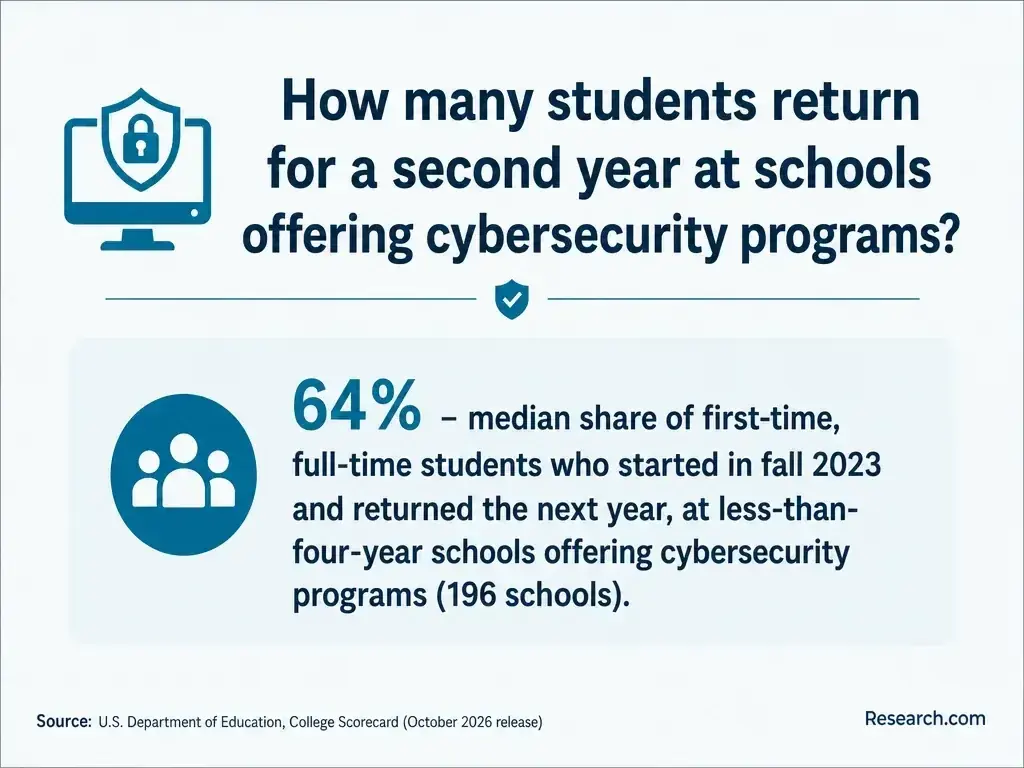
At the associate level, specialization often means a cluster of electives or a lab emphasis rather than a formally named concentration. Network defense suits students interested in configuring and monitoring infrastructure; digital forensics emphasizes evidence handling and investigation; cloud or systems security focuses on access controls, configuration, and logs. Availability varies by college and may be limited by course scheduling.
Choose a focus only after confirming the foundation beneath it. A narrowly titled security pathway without solid networking and operating-systems instruction may be a weaker fit for an entry-level applicant than a broader program with substantial security labs. For experienced IT workers, a focused elective sequence may make more sense because they already have those foundations.
Start with your next step: an entry-level technical job, advancement from an existing IT role, or transfer after the associate degree. Then compare each college on the evidence most relevant to that goal. Waubonsee Community College, Elgin Community College, Rock Valley College, Moraine Valley Community College, and John A Logan College are examples of Illinois colleges to investigate; confirm each current degree offering, location, and price directly rather than assuming similarly named programs are interchangeable.
These checks turn an affordability ranking into a decision about your own likely cost and outcome:
- Get the current degree map, catalog requirements, course rotation, and a written estimate based on your district residency and enrollment pace.
- Verify the institution's recognized accreditation separately from any claimed industry recognition; request a current, course-by-course transfer evaluation if transfer matters.
- Ask what students do in supervised labs, whether an internship is available or required, and where remote students complete practical work.
- Compare aid-adjusted total costs and likely time away from work, then ask what occupations recent completers entered and how the college measured those results.
Beware of choosing solely by rank, treating analyst wages as guaranteed starting pay, or assuming "online" means no campus visits. Broad lists of fastest growing college majors can provide context, but they cannot answer whether a particular Illinois associate degree offers the labs, schedule, and price you need.
A common progression begins in IT support, network support, or systems operations, where graduates can practice account management, troubleshooting, patching, and documentation. With demonstrated experience, some move into security operations or information security analyst work. Others use the associate degree as a transfer foundation; whether that works efficiently depends on the receiving institution's written credit evaluation, not the degree title alone.
Professional certifications can help demonstrate specific skills, but they are separate from the degree and are not a general Illinois occupational license. Compare the exam's published objectives with actual courses before budgeting for it. If your priority is immediate paid work rather than a full associate degree, assess that route against the degree's broader coursework and transfer value. A highest-paying trade school careers list may suggest other occupations, but advertised occupation-wide wages should not substitute for a realistic first-job comparison.
The U.S. Bureau of Labor Statistics projects 21% growth in information security analyst employment nationally from 2025 to 2035. That indicates demand for the occupation, not a forecast of Illinois openings specifically or a promise that an associate-degree holder will qualify for every listing. BLS notes that analysts commonly need related work experience, which makes practical IT experience an important part of an entry strategy.
Read Illinois postings in the locations where you can actually work. Compare their required operating systems, networking skills, schedules, and experience with a program's labs and employer connections. Security teams also need people who can evaluate changing threats and tools, including AI-assisted systems; prioritize programs that teach investigation, verification, and clear reporting over one tied only to a particular product.
Most Affordable Cybersecurity Associate Degree Programs in Illinois for 2027
Investing in an education is a consequential decision. Research.com's most-affordable ranking is designed to make local cost comparisons more credible by evaluating programs against other options in the same occupation and location. Only programs with completions reported to the Integrated Postsecondary Education Data System (IPEDS) are eligible; an omitted program is not necessarily unavailable or poor quality.
The most-affordable score uses tuition, cost of attendance, median student debt, and federal loan default rate. Indicator weights are assigned through an entropy-based method, which gives more weight to measures that vary more across programs. Accreditation, student support, and other quality indicators are not part of this affordability score. Research.com's separate best-program rankings consider outcomes, earnings, cost, accreditation, recognition, and support; readers should not mistake the two scores for the same evaluation.
To check cost and institutional information, the team draws on the following data sources. Some are occupation-specific reference sources and do not, by themselves, establish that a cybersecurity program has a relevant approval:
- IPEDS database - institutional enrollment, completions, and cost reporting.
- National Center for Education Statistics - federal education data and definitions.
- College Scorecard database - available institutional cost, debt, and outcome measures.
- Peterson's database - supplemental institutional information.
- Commission on Accreditation of Allied Health Education Programs (CAAHEP) - occupation-specific accreditation reference.
- Accrediting Bureau of Health Education Schools (ABHES) - occupation-specific accreditation reference.
- Commission on Dental Accreditation (CODA) - occupation-specific accreditation reference.
- Dental Assisting National Board (DANB) - occupation-specific certification reference.
- National Center for Construction Education and Research (NCCER) - occupation-specific industry reference.
- Apprenticeship.gov Partner Finder - work-based pathway reference.
These sources support a more consistent starting point, not a substitute for a current, individualized price quote. Compare the ranking with each college's published charges, your aid offer, and the required courses. More detail on Research.com's approach appears on its methodology page.




# 6 position
Black Hawk College
associateComputer and Information Systems Security/Auditing/Information Assurance
Delivery mode: On Campus (May Include Online Courses)
90.24
/ 100
Final score
- School graduation rate
- 43%
- Students receiving Pell Grants
- 28%
- In-state tuition & fees (per year)
- $5,220
- Out-of-state tuition & fees (per year)
- $8,100
- School website
- bhc.edu
Accreditation
Institutional accreditation from Higher Learning Commission.
Black Hawk College earned a Research.com Affordability Score of 90.24/100, with $5,200 median student debt among the verified supporting factors.


# 10 position

# 12 position



# 15 position





Frequently asked questions about cybersecurity programs in Illinois
Which Illinois cybersecurity associate degree is cheapest?
It depends on your district residency, aid, fees, and completion time. Compare current, personalized total-cost estimates from eligible colleges; a published tuition rate alone cannot identify your cheapest option.
Is an AAS or an AS better for cybersecurity?
An AAS often emphasizes applied labs and earlier job entry. An AS may offer a more direct transfer plan. Compare the actual course maps and obtain written confirmation of how credits transfer before deciding.
Can I become a security analyst immediately after graduating?
Possibly, but do not plan on it as the only outcome. Many analyst positions seek related IT experience, so assess the degree's preparation for support, networking, and systems roles as well.
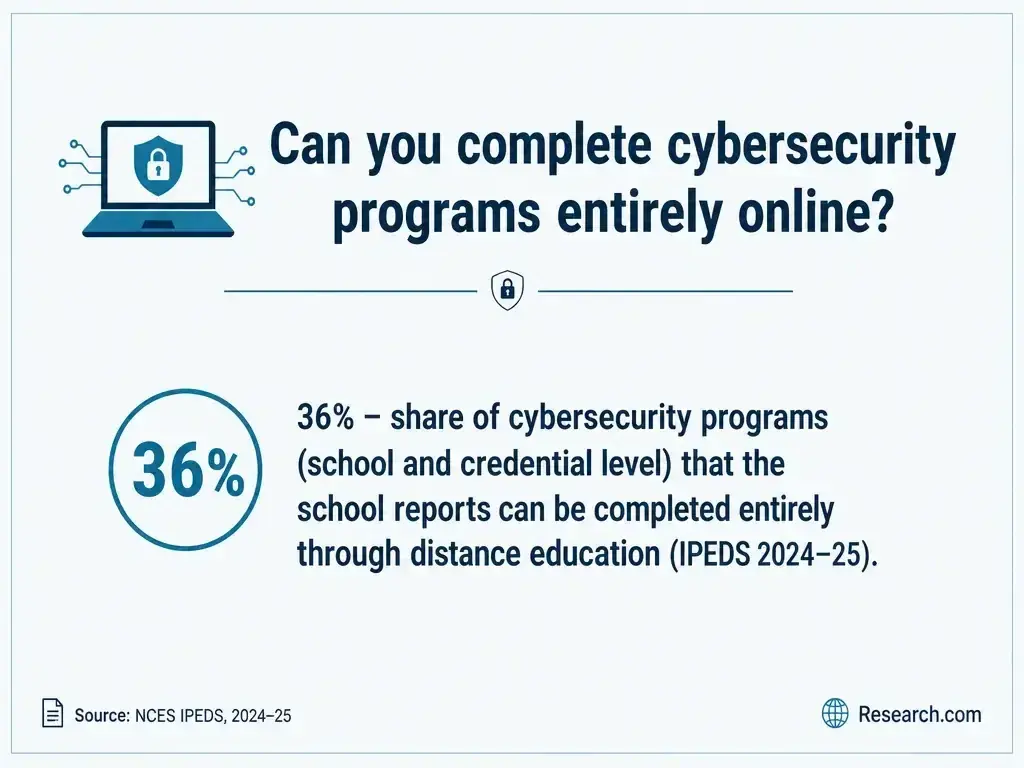
Can I complete the degree entirely online?
That depends on the program. Ask which labs, exams, and internships require attendance at a campus or employer site before enrolling.
Do I need an Illinois cybersecurity license?
Illinois has no general occupational license for cybersecurity work. Employers can set their own experience, screening, or certification requirements; a degree and a professional certification are distinct.
Is the degree worth the cost?
It may be if its labs, schedule, and career or transfer pathway match your goal at a manageable net cost. Include aid, borrowing, lost earnings, completion time, and a realistic first job - not an experienced analyst's median wage - in your comparison.
- U.S. Bureau of Labor Statistics - Information Security Analysts
Used to verify salary, employment outlook, and typical education requirements.
https://www.bls.gov/ooh/computer-and-information-technology/information-security-analysts.htm - NCES College Navigator (IPEDS)
Used to verify programs offered and institutional accreditation.
https://nces.ed.gov/collegenavigator/ - CompTIA Security+
Professional certification reference for graduates of this occupation.
https://www.comptia.org/certifications/security - Waubonsee Community College - official website
Official school website (programs, tuition, admissions).
https://www.waubonsee.edu/ - Elgin Community College - official website
Official school website (programs, tuition, admissions).
https://www.elgin.edu/ - Rock Valley College - official website
Official school website (programs, tuition, admissions).
https://www.rockvalleycollege.edu/ - Moraine Valley Community College - official website
Official school website (programs, tuition, admissions).
https://www.morainevalley.edu/ - John A Logan College - official website
Official school website (programs, tuition, admissions).
https://www.jalc.edu/