2027 Marketing Degree Specialization Pay Report: Which Academic Tracks Lead to the Highest Earnings

Co-Founder and Chief Data Scientist
Choosing a marketing specialization can shape your first job, promotion path, and education ROI. Pay varies widely because "marketing" includes analytics, product strategy, brand management, sales leadership, communications, and digital growth roles.
The Bureau of Labor Statistics reported a May 2024 median wage of $161,030 for marketing managers and $76,950 for market research analysts, showing how role level and track matter. This guide helps students, career changers, and working marketers compare academic tracks by earnings signals, employer demand, degree level, cost, and fit without treating any specialization as a guaranteed salary outcome.
Key Things You Should Know
- Marketing analytics, product marketing, marketing management, and sales leadership usually show the strongest earnings signals because they connect marketing decisions to revenue, pricing, customer data, and business strategy.
- Degree level changes the ceiling more than the starting point: BLS 2024 education data shows median weekly earnings of $1,840 for master's degree holders compared with $1,543 for bachelor's degree holders across the U.S. labor market.
- Salary outcomes depend heavily on industry, city, remote-work eligibility, experience, technical skills, and employer size; students should compare program cost against realistic role targets, not advertised top salaries.
- Which Marketing Degree Specializations Lead to the Highest Earnings?
- How Does Marketing Specialization Pay Vary by Degree Level?
Which Marketing Degree Specializations Lead to the Highest Earnings?
The highest-paying marketing specializations are usually those that combine customer insight with measurable business outcomes. Tracks tied to analytics, product growth, pricing, marketing operations, and management tend to outperform purely creative or generalist tracks because employers can connect them more directly to revenue, retention, and market share.
Salary data for academic specializations is imperfect because federal wage sources track occupations, not college concentrations. The table below uses closely related U.S. occupational wage data as a pay signal, not as a promise of what a graduate will earn:
| Marketing academic track | Common role targets | 2024 U.S. wage signal | Best fit for students who want |
| Marketing management or strategy | Marketing manager, growth manager, campaign director | BLS May 2024 median wage for marketing managers: $161,030 | A higher long-term ceiling, leadership responsibility, and cross-functional decision-making |
| Sales and revenue marketing | Sales manager, revenue operations manager, account growth lead | BLS May 2024 median wage for sales managers: $138,060 | Performance-based roles tied to quotas, client growth, and revenue teams |
| Marketing analytics and consumer insights | Market research analyst, marketing analyst, customer insights analyst | BLS May 2024 median wage for market research analysts: $76,950 | Data-driven work, research, dashboards, forecasting, and decision support |
| Advertising, digital media, and performance marketing | Paid search specialist, media planner, digital marketing manager | Often maps to advertising, promotions, and marketing management roles as experience grows | Campaign optimization, acquisition, testing, and measurable digital outcomes |
| Public relations, communications, and brand messaging | PR specialist, communications specialist, brand communications associate | BLS May 2024 median wage for public relations specialists: $69,780 | Writing, reputation management, media relations, and stakeholder communication |
For most students, the strongest pay-oriented choice is not simply "marketing" versus "digital marketing." It is whether the curriculum builds hard-to-replace skills: analytics, customer research, revenue strategy, pricing, marketing technology, experimentation, and leadership communication.
The highest-earning tracks often share a few features that make them attractive to employers. Students comparing concentrations should look for these earning drivers in the curriculum and career outcomes:
- Direct revenue connection: Product marketing, growth marketing, and sales leadership roles are easier to tie to pipeline, retention, pricing, or market expansion.
- Quantitative decision-making: Analytics and marketing operations tracks can support budgeting, attribution, segmentation, and forecasting.
- Industry transferability: Strategy, analytics, and product tracks can move across technology, finance, healthcare, retail, and business services.
- Leadership pathway: Management-focused tracks can lead from specialist roles into director, vice president, or chief marketing officer pathways, but usually require experience beyond the degree.
How Does Marketing Specialization Pay Vary by Degree Level?
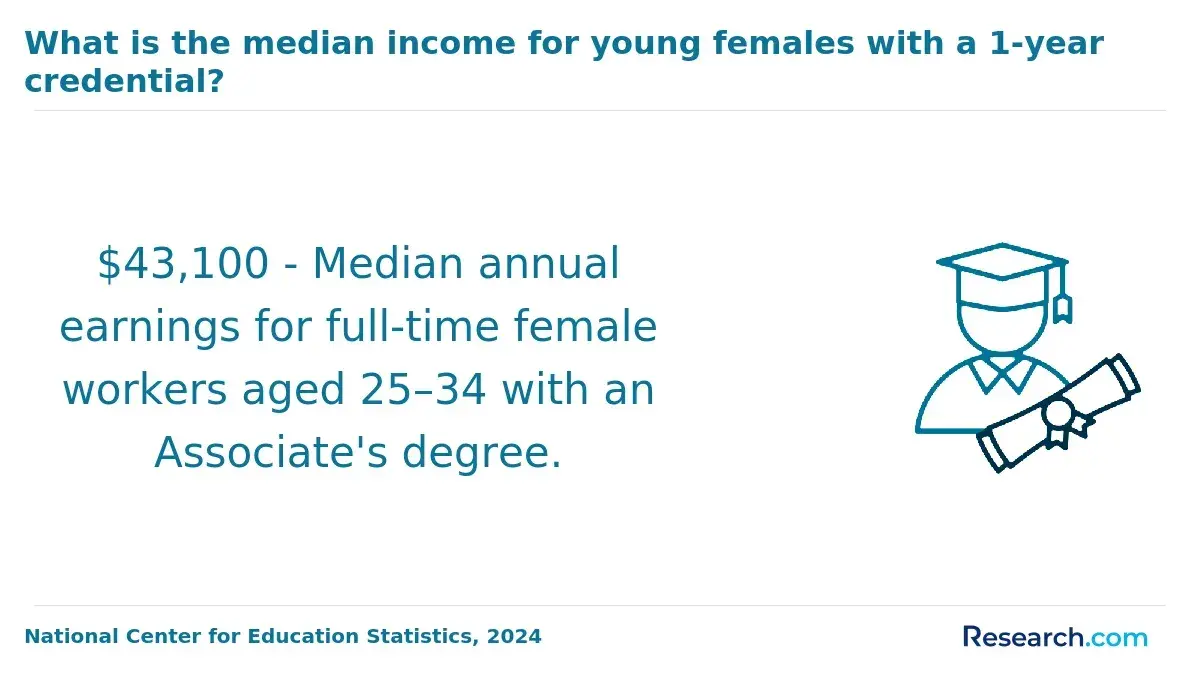
Degree level affects marketing pay because it changes the roles a student can credibly pursue. An associate or bachelor's degree may be enough for coordinator, specialist, or analyst roles, while a master's degree or MBA is often more relevant for leadership, strategy, consulting, or career-changing professionals.
The table below compares common marketing education levels by career use. It is most useful for deciding whether the additional time and tuition of a higher credential match the roles you actually want:
| Degree level | Typical marketing role entry points | Best specialization match | Pay and ROI considerations |
| Associate degree or certificate | Marketing assistant, social media assistant, sales support, content support | Digital marketing, social media, basic analytics, sales support | Lower cost and faster completion, but limited access to management-track roles without experience or further education |
| Bachelor's degree | Marketing coordinator, analyst, account coordinator, brand assistant, media planner | Marketing analytics, digital marketing, brand management, integrated marketing, sales | Common baseline for professional marketing roles; specialization and internships can strongly affect early outcomes |
| Master's degree or MBA | Marketing manager, product marketing manager, strategy analyst, growth manager | Marketing strategy, analytics, product marketing, consumer insights, revenue management | Can support advancement or a career pivot, but ROI depends on employer access, debt, and prior experience |
| Doctorate | Professor, senior researcher, executive research lead, policy or advanced analytics role | Consumer behavior, quantitative marketing, marketing science | Usually best for research or academic goals rather than ordinary marketing management roles |
BLS 2024 education data shows that workers with a master's degree had median weekly earnings of $1,840 compared with $1,543 for bachelor's degree holders across the U.S. workforce. That gap is not marketing-specific, but it helps explain why graduate study may be valuable when it leads to management, analytics, or strategy roles rather than simply adding another credential.
Students considering advanced study should also compare business, communication, and research-heavy routes. For example, a masters in communication may fit brand, public relations, corporate communication, or content leadership goals better than a quantitative marketing analytics program.
Industry can matter as much as specialization. A marketing analytics graduate in software, finance, or healthcare technology may have a different pay trajectory than a similar graduate working for a small local agency, nonprofit, or early-stage startup.
The table below connects academic tracks with industries where those skills are especially marketable. Use it to compare where a specialization may have stronger salary leverage, not to assume every employer in that industry pays at the top of the market:
| Academic track | Industries with strong earning signals | Why employers value the track | Potential trade-off |
| Marketing analytics | Technology, finance, insurance, healthcare, retail platforms, consulting | Supports segmentation, attribution, customer lifetime value, forecasting, and budget decisions | Requires comfort with data tools, statistics, privacy rules, and continuous learning |
| Product marketing | Software, medical technology, consumer goods, B2B services, fintech | Connects market research, positioning, sales enablement, launches, and pricing | Often requires technical fluency and strong collaboration with product, sales, and finance teams |
| Digital and performance marketing | E-commerce, agencies, subscription businesses, media, direct-to-consumer brands | Measures acquisition cost, conversion, retention, and campaign return | Platform changes, automation, and privacy shifts can quickly change required skills |
| Brand management | Consumer packaged goods, retail, hospitality, entertainment, sports, healthcare systems | Builds customer preference, positioning, product mix, and long-term market identity | Early roles can be competitive and may require internships or rotational programs |
| Public relations and communications | Corporate offices, government affairs, healthcare, higher education, nonprofits, agencies | Protects reputation, manages messaging, and supports stakeholder trust | Pay may be lower in mission-driven sectors, though leadership roles can still be strong |
Current employer demand favors marketers who can work with AI-assisted content tools, customer data platforms, marketing automation systems, and privacy-aware measurement. Students should not avoid creative tracks, but they should add measurable skills so their work can be evaluated in business terms.
Long-term marketing earnings usually rise when a specialization leads to budget ownership, people management, product responsibility, or executive decision-making. The strongest advancement tracks tend to be marketing strategy, product marketing, growth marketing, analytics leadership, and revenue management.
BLS projected employment for advertising, promotions, and marketing managers to grow faster than the average for all occupations in its current outlook cycle, reflecting continued demand for organizations to reach customers across digital and traditional channels. For students, the practical meaning is that management potential matters: a track that starts with technical work can be especially valuable if it also teaches communication, leadership, and business strategy.
These specialization pathways often produce the strongest advancement options when paired with experience and measurable results. Students should compare not only the first job but also the second and third promotion step:
- Marketing analytics to insights leadership: Starts with reporting and research, then can move into customer strategy, forecasting, pricing support, or analytics management.
- Digital marketing to growth leadership: Starts with channel execution, then can move into acquisition strategy, lifecycle marketing, demand generation, or growth management.
- Product marketing to general management: Starts with positioning and launches, then can move into product strategy, market expansion, or business unit leadership.
- Brand management to executive marketing: Starts with customer and campaign work, then can move into portfolio management, director roles, or chief marketing pathways.
- Sales and revenue marketing to commercial leadership: Starts near client acquisition or sales enablement, then can move into revenue operations, sales management, or go-to-market leadership.
Some students eventually pursue advanced research or academic leadership, especially in consumer behavior, marketing science, or higher education.
That path is different from a typical corporate marketing ladder, so anyone considering an online doctorate should verify research expectations, faculty fit, accreditation, and whether the credential aligns with teaching, research, or executive goals.
Location still affects marketing pay even when remote work is available. Major metro areas with technology, finance, consulting, healthcare, entertainment, and corporate headquarters often offer stronger marketing salaries, but they can also bring higher living costs and more competition.
Remote work has changed the market in two ways. First, specialized marketers can sometimes compete for roles outside their local area; second, employers may adjust compensation by location, experience, or internal pay bands. That means a remote analytics or product marketing role may pay more than local opportunities, but it may also attract a national applicant pool.
Students should evaluate location and remote options before choosing a specialization because the same academic track can behave differently in different labor markets. The following checks help compare the real opportunity behind a salary number:
- Search job postings in your target cities and remote job boards for the exact specialization, such as "marketing analyst," "CRM coordinator," "product marketing associate," or "paid media specialist."
- Compare required skills across postings and note whether employers ask for analytics, sales experience, writing samples, platform certifications, SQL, CRM tools, or industry knowledge.
- Adjust salary expectations for cost of living, commute costs, remote-work policies, and whether the role is agency-side, in-house, startup, or enterprise.
- Ask each school's career services office where recent marketing graduates work by city, employer type, and role, not just the overall placement rate.
A location-sensitive strategy can improve ROI. For example, a student near a healthcare hub might pair marketing analytics with healthcare electives, while a student targeting remote technology roles might prioritize product marketing, demand generation, and data storytelling.
The most marketable marketing specializations combine business judgment, customer understanding, and measurable execution. Employers increasingly expect graduates to use AI tools responsibly, interpret customer data, understand privacy constraints, and explain how marketing activity supports revenue or reputation.
The table below shows which courses and skills tend to strengthen different academic tracks. Use it to compare curricula rather than relying only on a specialization title:
| Specialization | High-value courses | Marketable skills | Portfolio evidence to build |
| Marketing analytics | Statistics, market research, SQL, data visualization, customer analytics | Segmentation, survey design, dashboards, forecasting, attribution analysis | Dashboard, research report, customer segmentation project |
| Product marketing | Product strategy, consumer behavior, pricing, competitive analysis, sales enablement | Positioning, launch planning, messaging, buyer research, go-to-market strategy | Launch plan, positioning brief, competitor matrix |
| Digital marketing | Search marketing, paid media, web analytics, conversion optimization, email marketing | Campaign testing, channel measurement, funnel analysis, landing page evaluation | Campaign audit, A/B test plan, performance report |
| Brand and communications | Integrated marketing communication, brand strategy, public relations, storytelling, crisis communication | Messaging, media writing, reputation management, stakeholder communication | Brand brief, media kit, crisis response plan |
| Sales and revenue marketing | Sales management, B2B marketing, CRM, revenue operations, negotiation | Pipeline analysis, lead scoring, account strategy, sales enablement | CRM workflow, sales deck, account-based marketing plan |
AI is changing marketing work, but it is not eliminating the need for strong marketers. It raises the value of people who can ask better research questions, judge content quality, protect brand trust, analyze performance, and connect automated outputs to business goals.
A higher-paying specialization is not automatically the best financial choice if the program costs far more, lacks employer connections, or does not teach the skills required for target roles. ROI should compare realistic job pathways against tuition, time out of the workforce, debt, and the likelihood of completing the program.
College Board reported average published tuition and fees for 2024-25 of $11,610 for in-state students at public four-year colleges and $43,350 at private nonprofit four-year colleges. Those sticker prices do not include every grant or discount, but they show why students should compare net price, not just the reputation of a marketing program.
Use the following process to compare specialization pay against cost. It helps prevent the common mistake of choosing a track because it sounds lucrative without checking whether the program supports the role you want:
- Identify three target roles for each specialization and review current job postings for required skills, experience, software, and industry knowledge.
- Ask programs for marketing-specific outcomes, including internships, employers, job titles, location of employment, and graduate school placement.
- Calculate net cost after grants, scholarships, employer tuition assistance, transfer credits, and expected living expenses.
- Compare the shortest credible path to employability, such as a bachelor's concentration plus internship versus a master's degree or MBA.
- Check accreditation, faculty experience, career services, internship access, and whether courses produce portfolio-ready work.
Program quality checks matter across fields, not only in business. For instance, students comparing marriage and family therapy online programs accredited would verify accreditation before licensure planning; marketing students should apply the same discipline by confirming institutional accreditation, employer recognition, and career-outcome transparency.
Marketing usually does not require state licensure, unlike fields such as teaching, nursing, accounting, or counseling. Instead, earnings are influenced by degree level, experience, portfolio evidence, industry knowledge, leadership ability, and tool-specific credentials.
Certifications can help most when they validate practical tools that employers mention in job postings. They are usually strongest as a supplement to a degree, internship, or work portfolio, not as a substitute for applied experience:
- Analytics and data credentials: Useful for students targeting marketing analytics, consumer insights, CRM, or marketing operations roles.
- Platform credentials: Useful for digital marketing roles involving search ads, social media ads, email platforms, web analytics, or marketing automation.
- Project management credentials: Useful for campaign managers, marketing operations specialists, and cross-functional product marketing roles.
- Graduate business study: Useful when the student already has experience and wants to move into management, strategy, consulting, or executive-track roles.
An MBA can be especially relevant for students who want marketing leadership, product strategy, or broader business management rather than only campaign execution. Students comparing flexible graduate routes may want to review an easiest online MBA program carefully for accreditation, rigor, employer reputation, and whether the marketing curriculum fits their goals.
The main caution is credential stacking without a strategy. A short certification may improve a resume when it matches a job requirement, but it rarely offsets weak internships, no portfolio, or a specialization that does not match the student's target industry.
The best marketing specialization is the one that balances earning potential, skill fit, employer demand, program cost, and long-term motivation. A high-paying track can still be a poor choice if the student dislikes quantitative work, avoids client-facing roles, or chooses a program without relevant projects and internships.
Students should make the decision in a structured way. The goal is to narrow options based on evidence rather than choosing the specialization with the most impressive salary headline:
- Start with role targets, not course titles: choose three jobs you want after graduation and map each one to a specialization.
- Compare required skills in real postings and mark which programs teach those skills through projects, labs, internships, or capstones.
- Separate entry-level potential from long-term ceiling; analytics may start strong, while management-oriented tracks often require several years of experience before higher pay appears.
- Check industry fit, because product marketing in software, brand management in consumer goods, and communications in healthcare can require different knowledge.
- Estimate ROI using net cost, time to completion, expected debt, work flexibility, and whether the program offers internships or employer pipelines.
- Choose the strongest fit you can sustain, because marketing careers reward continuous learning, testing, communication, and adaptation.
Common mistakes include assuming a concentration guarantees a salary, relying only on national medians, ignoring regional pay differences, choosing a trendy title without technical depth, and overlooking accreditation or career services. A better approach is to pair a marketable specialization with applied experience, portfolio evidence, and a clear industry target.
Marketing analytics, product marketing, growth marketing, sales leadership, and marketing management often show the strongest earning potential, but the smartest choice is the track that leads to real roles you can qualify for, afford, and grow into.
At the entry level, the best-paying marketing tracks are usually the ones with clearer technical or revenue skills. Marketing analytics, paid media, CRM, sales enablement, and marketing operations often provide stronger early wage signals than broad general marketing because employers know what the graduate can do on day one.
The table below summarizes common entry-level tracks and why some command stronger starting offers. The "entry-level advantage" column focuses on employability signals rather than guaranteed salaries:
| Specialization | Common first roles | Entry-level advantage | What to verify before choosing |
| Marketing analytics | Marketing analyst, research analyst, customer insights associate | Strong if the program teaches SQL, spreadsheets, visualization, survey methods, and statistics | Whether students build real dashboards, research projects, and portfolio-ready analysis |
| Digital and performance marketing | Paid search associate, SEO assistant, media coordinator, growth associate | Strong if students can run tests, read campaign data, and explain acquisition metrics | Whether coursework reflects current ad platforms, privacy changes, and analytics tools |
| Marketing operations or CRM | Marketing operations assistant, email marketing associate, CRM coordinator | Strong because automation and customer lifecycle systems are widely used | Whether students learn segmentation, lead scoring, email compliance, and workflow logic |
| Brand or product marketing | Brand assistant, product marketing associate, account coordinator | Good when paired with internships, case competitions, or industry projects | Whether the school has employer relationships in consumer goods, technology, or agencies |
| Social media and content marketing | Content coordinator, social media specialist, community associate | Accessible for early roles and portfolio building | Whether the track goes beyond posting content into analytics, strategy, and audience research |
BLS reported a May 2024 median wage of $76,950 for market research analysts, a role that often maps to analytics and consumer insights tracks. Because that median includes experienced workers, students should treat it as a market signal and then ask schools for placement data, internship outcomes, and employer lists.
To strengthen early earnings prospects, students should build proof of applied ability before graduation. These steps make a specialization more valuable to employers reviewing entry-level candidates:
- Complete at least one internship, client project, or supervised practicum tied to the chosen specialization.
- Build a portfolio that includes campaign analysis, dashboards, audience research, positioning briefs, or marketing experiments.
- Learn tools used in job descriptions, such as spreadsheet modeling, SQL basics, analytics platforms, CRM systems, and marketing automation tools.
- Track outcomes from projects, including conversion changes, survey findings, content performance, or customer insights, without exaggerating results.
Other Things You Should Know About Marketing
Marketing management, product marketing, growth marketing, sales leadership, and analytics-heavy tracks usually show the strongest earning potential. Pay depends on experience, industry, location, employer size, and whether the role includes revenue or budget responsibility.
Marketing analytics often has stronger technical pay signals because it uses data, research, forecasting, and measurement. Digital marketing can also pay well, especially in performance, growth, and management roles, but students should look for programs that teach analytics and campaign strategy rather than only platform basics.
Not always. Many marketers advance with a bachelor's degree, experience, strong results, and certifications. A master's degree or MBA may help if it supports a move into strategy, management, product marketing, analytics leadership, or a career change.
A general marketing degree can be worthwhile if it includes internships, analytics, communication, consumer behavior, and digital strategy. Students seeking stronger earnings should add a focused concentration or electives that build measurable skills employers can verify.
See What Experts Have To Say About Studying Marketing
Read our interview with Marketing experts

Sonya A. Grier, Ph.D.
Marketing Expert
Professor, Department of Marketing
American University

Aidin Namin, Ph.D.
Marketing Expert
Associate Professor of Marketing Analytics
Loyola Marymount University

- What is the average starting salary for graduates from the Master's in Marketing program? https://mentr-me.com/question/what-is-the-average-starting-salary-for-graduates-from-th
- How does a college degree improve graduates’ employment and earnings potential? - APLU https://www.aplu.org/our-work/4-policy-and-advocacy/publicuvalues/employment-earnings/
- 5 Careers in Marketing | Program Resources | Rivier University https://www.rivier.edu/academics/online/resources/program-resources/5-careers-in-marketing-with-the-best-future-outlook/
- How Does Geography Affect Your Marketing? - AMP https://www.ampanalytic.com/micromarket-analysis/how-does-geography-affect-your-marketing/
- Career earnings by college major - The Hamilton Project https://www.hamiltonproject.org/data/career-earnings-by-college-major/
- Top 15 Highest Paying Marketing Jobs in 2025 https://www.lupahire.com/blog/highest-paying-marketing-jobs
- The Most In-Demand Digital Marketing Jobs Right Now https://herd.digital/blog/most-in-demand-digital-marketing-jobs/
- ROI Of College Majors By Early And Mid-Career Salaries | Bankrate https://www.bankrate.com/loans/student-loans/roi-mid-career-by-major/
- The Most In-demand Marketing Jobs | Marketing Recruitment https://www.intelligentpeople.co.uk/employer-advice/most-in-demand-marketing-jobs/
- What is the salary after a Master in marketing? - ESCE https://www.esce.fr/en/faq-all-the-answers-to-your-questions/what-is-the-salary-after-a-master-in-marketing/