Choosing a Miami counseling master's means choosing a career route: clinical practice, school counseling, couples therapy, or rehabilitation services. Those paths can differ in fieldwork, cost, and Florida credential requirements. This guide explains those trade-offs, along with program formats, admissions, and career prospects. It also features the 2027 Best Master's in Counseling Degree Programs Ranking in Miami, created by the Research.com team of data scientists to help students make an informed choice about which counseling programs are worth considering.
Key findings about Counseling degrees in Miami
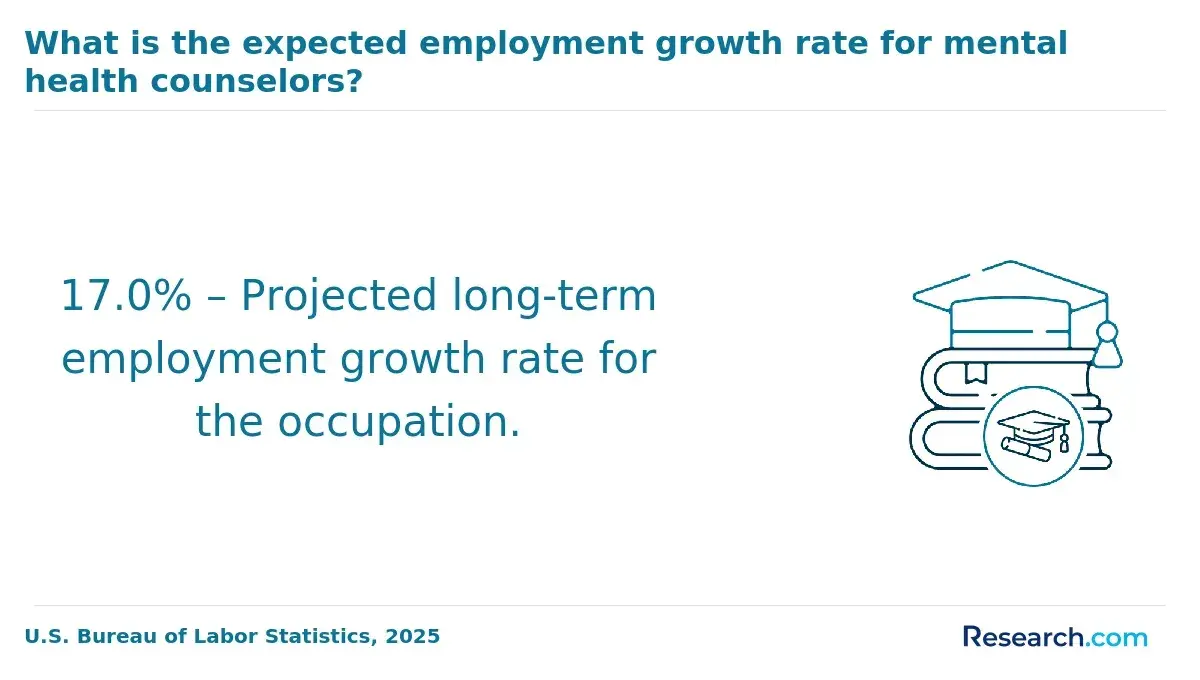
For clinical mental health and addiction-related counseling roles, the U.S. Bureau of Labor Statistics reports a May 2025 national median annual wage of $59,350 and projects 18% employment growth from 2025 to 2035. Neither figure predicts an individual graduate's Miami salary.
School counseling is a different credential route: the U.S. Bureau of Labor Statistics reports a May 2025 national median of $64,330 for school and career counselors and advisors. Compare programs against Florida Department of Education certification requirements, not clinical licensure rules.
Plan on roughly two to three years of master's study in a typical full-time counseling pathway, with a potentially longer timeline for part-time study. For clinical licensure in Florida, graduation is followed by separate supervised-experience and examination requirements, according to the Florida Board of Clinical Social Work, Marriage & Family Therapy and Mental Health Counseling.
What can I expect from a Counseling degree in Miami?
A counseling master's combines coursework in assessment, ethics, human development, and counseling methods with supervised practice. The first decision is which population and credential you want to serve: a clinical mental health route prepares students for behavioral health settings, a school route focuses on work with students, a marriage and family route centers on relationships, and rehabilitation counseling addresses disability and employment-related needs.
In Miami, placement logistics deserve as much attention as classroom delivery. Ask each program which local sites accept its students, who arranges placements, and whether your work schedule can accommodate daytime supervision. A useful second comparison is the most popular counseling programs, but enrollment interest alone cannot establish licensure fit or placement quality.
Where can I work with a Counseling degree in Miami?
The appropriate workplace depends on your specialization and whether you have completed any required credential. Clinical-track graduates may pursue supervised roles in community mental health, hospitals, or behavioral health organizations; school-track graduates may seek positions in Miami-Dade schools after meeting Florida certification requirements. Couples and family services and vocational rehabilitation offer other, distinct routes. Jackson Health System, Miami-Dade County Public Schools, and Florida's Division of Vocational Rehabilitation illustrate the types of local organizations to investigate - not promised employers or placement partners.
A master's degree does not, by itself, authorize independent psychotherapy practice in Florida. Before accepting a job offer, check whether the role requires registration as a supervised intern, a professional license, school certification, or another qualification (Florida Board of Clinical Social Work, Marriage & Family Therapy and Mental Health Counseling; Florida Department of Education).
Pay varies by occupation, license status, employer, and experience. The following figures are U.S. occupational medians, not Miami wages or starting salaries; use them to compare career directions rather than to forecast your first offer. Wage reference period: May 2025. Projection period: 2025-2035 (U.S. Bureau of Labor Statistics, Occupational Outlook Handbook and Employment Projections).
Career direction
National median annual wage
Projected U.S. growth
Clinical mental health or addiction counseling
$59,350
18%
School counseling
$64,330
3%
Marriage and family counseling
$66,940
14%
Rehabilitation counseling
$46,850
2%
The clinical and addiction figures reflect the relevant BLS occupational grouping; they are not separate Miami program-outcome measures. If earnings drive your decision, ask schools for recent, clearly defined outcomes and compare actual local job postings by credential level. A national median includes experienced workers and should not be treated as a new graduate's expected pay.
Barry University and Florida International University offer programs aimed at different counseling roles. The distinctions below are most useful when matched to a specific career goal; confirm current credit requirements, accreditation status, and placement policies with the program before applying (Barry University; Florida International University).
Barry University - M.S. in Clinical Mental Health Counseling: This is Barry's route for students targeting mental health counseling rather than school or couples-focused preparation. Its private-university setting is worth comparing with FIU's clinical option on total price, supervision arrangements, and fit with Florida's clinical licensure requirements.
Florida International University - M.S. in School Counseling: FIU's school-focused route is distinct from its clinical and rehabilitation options. It is a practical comparison point for prospective school counselors who want to assess public-university costs alongside Florida certification alignment and school-site placement access.
Barry University - M.S. in Marital, Couple, and Family Counseling: The named specialization makes relationships and family systems the central career choice rather than an elective interest within general clinical counseling. It best fits applicants who intend to investigate Florida's marriage and family therapy licensure route.
Florida International University - M.S. in Clinical Mental Health Counseling: FIU offers a clinical route within a public university, creating a direct alternative to Barry's clinical program. Florida residents should compare the schools' actual graduate charges and clinical placement policies - not assume institution type alone determines value.
Florida International University - M.S. in Rehabilitation Counseling: This option specifically targets rehabilitation counseling, setting it apart from the mental health and school tracks in the comparison. It merits attention if disability services and vocational goals are a better fit than independent psychotherapy practice.
Barry University - M.S. in School Counseling: Barry provides a school-focused option within its counseling offerings and an alternative to FIU's public-university school route. Compare how each program supports school placements, certification preparation, and working adults before choosing between them.
These are program distinctions, not claims that a specialization guarantees a license or job. For either school, request the current catalog, program-level outcomes, and written guidance on the Florida credential relevant to your intended role.
A full-time counseling master's commonly takes about two to three years; part-time attendance can take longer. Your actual timeline depends on required credits, course rotation, prerequisites, and whether practicum and internship placements are available when you need them. Ask for a term-by-term plan rather than relying on an advertised minimum.
Separate degree completion from permission to practice independently. Florida clinical mental health counseling and marriage and family therapy routes include post-degree supervised experience and examinations; school counseling follows a different state certification process (Florida Board of Clinical Social Work, Marriage & Family Therapy and Mental Health Counseling; Florida Department of Education). An accelerated classroom schedule does not erase those later steps.
Online study can reduce commuting and make coursework easier to schedule around work. Campus study may make face-to-face collaboration and access to nearby faculty or placement contacts more convenient. Neither format removes supervised fieldwork; ask where you must complete it and whether the school will approve a site near your Miami home or workplace.
For an online program based outside Florida, obtain written confirmation that its curriculum and supervised training are designed to meet the Florida credential you seek. Authorization to enroll is not the same as licensure eligibility. Compare live-session times, in-person residencies, supervision requirements, and placement assistance before deciding that one format is more flexible (Florida Board of Clinical Social Work, Marriage & Family Therapy and Mental Health Counseling; Florida Department of Education).
There is no single reliable Miami counseling-master's average that captures differences in program length, residency status, and school-specific fees. NCES/IPEDS graduate tuition figures describe institutional charges, not necessarily the full price of a particular counseling track. Request a current program-level total from each school instead of applying a general graduate tuition average to your budget.
Compare tuition by required credits, mandatory fees, books, commuting, field-placement travel, and any unpaid hours that could reduce work income. At a public university, establish whether you qualify for Florida resident tuition; at either public or private nonprofit institutions, compare the net price after grants and employer support. The most affordable counseling programs can help you form a shortlist, but verify what each quoted cost includes.
Start with the Free Application for Federal Student Aid and each university's graduate aid office. Eligible graduate students may be considered for federal Direct Unsubsidized Loans; institutional scholarships, assistantships, employer tuition assistance, and program-specific awards may also be available. Eligibility and award amounts depend on the student and program, so do not assume an undergraduate aid package will carry over (Federal Student Aid; U.S. Department of Education).
Ask whether aid covers summer fieldwork terms and whether an assistantship's work hours conflict with required placements. Borrowing less is useful only in context: weigh net cost and foregone earnings against the time needed to finish and your realistic post-degree credential and job options.
View the chart data as a table
Projected job growth 2025-2035 by counseling career path (U.S., BLS) (Source: BLS)
Category
Value
Mental Health Counselors
18
Marriage & Family Therapists
14
Postsecondary Teachers
7
Psychologists
6
School & Career Counselors
3
Rehabilitation Counselors
2
All occupations
3
Applicants generally need a bachelor's degree and must meet the individual program's academic and application requirements. Schools may ask for transcripts, recommendations, a statement of purpose, an interview, or relevant prerequisite coursework; requirements can differ even between specializations at the same university (Barry University; Florida International University). Check the current admissions page for the precise track you intend to enter.
Prior counseling employment may strengthen an application but is not a substitute for checking educational eligibility. If you are changing fields, ask whether missing courses can be completed before enrollment, whether graduate transfer credits are accepted, and whether transferred courses will count toward Florida's credential-specific curriculum rules.
Expect study in counseling theory, interviewing, ethics, assessment, human development, and research, followed by supervised practicum and internship. Specialization changes the emphasis: school programs address students and school systems; clinical programs emphasize mental health assessment and treatment; marriage and family programs focus on relationship systems; rehabilitation programs connect disability-related counseling with independent living or employment goals (Barry University; Florida International University).
Compare course content, not just titles. Ask a prospective Florida licensure program to identify where each state-required topic and fieldwork requirement appears in its current curriculum. A broadly appealing degree name cannot replace that course-by-course check (Florida Board of Clinical Social Work, Marriage & Family Therapy and Mental Health Counseling).
The Miami programs considered here span clinical mental health, school, marital/couple/family, and rehabilitation counseling (Barry University; Florida International University). They are not interchangeable concentrations on the way to one universal "counselor" license. Start with the people you want to serve and the setting where you want to work, then identify the matching Florida credential.
Clinical mental health is the closer match for someone pursuing psychotherapy in behavioral health settings. School counseling fits applicants seeking school-based student support; marital and family study fits a relationship-centered practice goal; rehabilitation fits disability and vocational-service interests. If your goal is narrowly limited to skills development rather than a credentialed counseling career, a shorter course or certificate may be less costly - but it will not replace a required qualifying master's degree.
Choose the program that meets your intended credential requirements and fits your finances and schedule. A ranking can narrow the field, while the most valuable counseling programs offer another comparison lens; neither can decide how manageable a particular internship or debt load will be for you.
Use the following checks before paying an application deposit:
Name the exact Florida license or school credential you want, then ask the program for written documentation of how its curriculum and fieldwork align with that route (Florida licensing board; Florida Department of Education).
Verify current institutional accreditation and, where relevant to your goal, the specific program's CACREP status in the accreditor's directory; do not infer programmatic accreditation from the university's accreditation (CACREP; U.S. Department of Education).
Request a complete term-by-term cost and placement schedule, including fees, summer terms, site approval, and hours that may conflict with paid work.
Ask for recent program-specific completion, exam, and employment outcomes with their reporting years and definitions; be cautious if only university-wide results are offered.
Compare likely debt, lost earnings while studying, completion prospects, and realistic earnings over several years - not tuition or a national salary median in isolation.
A common costly mistake is enrolling first and checking credential eligibility later. The better sequence is to confirm the career route, verify program fit, and only then compare convenience and price.
View the chart data as a table
Programs by specialization (Source: Research.com)
Category
Value
Clinical Mental Health Counseling
2
School Counseling
2
Marriage, Couple, and Family Counseling
1
Rehabilitation Counseling
1
A master's can be an entry point to supervised clinical work, school counseling, family-focused services, or rehabilitation counseling, depending on specialization and subsequent credentials. Experience and licensure may later expand the roles for which a person qualifies; a doctoral degree may be relevant to some research or faculty goals. These are different pathways, not automatic promotions from one degree (U.S. Bureau of Labor Statistics; Florida licensing board; Florida Department of Education).
For career changers, the strongest return may come from a program that makes a specific desired role attainable. If you already work in a related field, ask prospective employers which credential changes your eligibility or responsibilities before committing to a master's. If they require a different profession's license, a counseling degree may be the wrong investment.
View the chart data as a table
Best score distribution across ranked programs (Source: Research.com)
Category
Value
90-90
1
91-90
0
92-91
1
92-92
1
92-92
1
93-92
2
National demand is strongest among the listed counseling directions for the occupational group covering substance abuse, behavioral disorder, and mental health counselors: the U.S. Bureau of Labor Statistics projects 18% growth from 2025 to 2035. That projection signals a broader market to investigate, not a Miami placement rate or a guarantee that new graduates will secure preferred jobs.
Locally, compare postings across schools, health systems, community behavioral health providers, family-service organizations, and vocational rehabilitation. Sort openings by required Florida credential and supervision status: an "independent license required" posting is not the same opportunity as a supervised entry-level role. This distinction makes job-board evidence more useful than counting every listing containing the word "counselor."
2027 Best Master's in Counseling Degree Programs Ranking in Miami
Investing in graduate education is a consequential decision. Research.com designed its counseling rankings to help readers compare programs using outcomes, accreditation, and cost rather than reputation alone. The team reviews multiple education datasets and applies the same scoring approach to online and on-campus programs; readers should still confirm current details directly with each school.
For the Best ranking, the graduate-outcomes-and-accreditation score combines program completion (40%), employment or doctoral admission (20%), licensure exam pass rates where applicable (20%), CACREP programmatic accreditation (16%), and federal Title IV eligibility (4%). Shares are adjusted when a criterion does not apply. Program cost contributes a smaller component - about 7% of the final score. Other counseling rankings order programs by the single dimension named in each ranking.
The ranking draws on these four data sources:
IPEDS database: institutional enrollment, awards, and cost information.
Peterson's database: program and institution information used in comparisons.
The result is a starting point for narrowing your options - not a substitute for checking a program's current curriculum, field-placement arrangements, and fit with your intended credential. Read more about how Research.com creates its rankings.
# 1 position
Barry University
Master
Counseling, MS – Clinical Mental Health Counseling
Delivery mode: campus
93.50
/ 100
Final score
Program length
~ 2-2 ½ years (full-time)
Specialization
Clinical Mental Health Counseling
Required credits
60 semester credits
GPA range
3.00 - 4.00
Program completion rate
95% (2024-25)
Employment or doctoral admission
95% (2024-25)
Application process
direct
GRE
no
Prerequisites
Bachelor's degree from a regionally accredited or internationally recognized college or university.
Accreditation
Accredited by the Council for Accreditation of Counseling and Related Educational Programs (CACREP), with institutional accreditation from the Southern Association of Colleges and Schools Commission on Colleges (SACSCOC).
Barry University earned a Research.com Counseling Program Score of 93.5/100, supported by 95% program completion rate and 95% employment or doctoral admission rate. The program is CACREP-accredited, valid through 2027-10-31.
# 2 position
Florida International University
Master
MS in Counselor Education: School Counseling Major
Delivery mode: hybrid
93.37
/ 100
Final score
Program length
The length of study is 2.5 years
Specialization
School Counseling
Required credits
60 semester credits
GPA range
3.20 - 4.00
Licensure exam pass rate
100% (2024-25)
Application deadline
Spring 2027: November 1, 2026, 5 p.m. EST; Fall 2027: March 15, 2027, 5 p.m. EST
Class size
31
Application process
direct
GRE
no
Prerequisites
Students entering with an undergraduate degree in an area other than education must enroll in general professional education courses as required by FLDOE to meet state certification requirements.
Additional requirements
Unofficial transcripts, autobiographical sketch/letter of intent, 3 letters of recommendation, resume, interview by admissions committee (if selected), proctored writing sample (if selected), pass the Florida Teacher Certification General Knowledge exam.
Accreditation
Accredited by the Council for Accreditation of Counseling and Related Educational Programs (CACREP), with institutional accreditation from the Southern Association of Colleges and Schools Commission on Colleges (SACSCOC).
Florida International University earned a Research.com Counseling Program Score of 93.37/100, with 100% licensure exam pass rate among the verified supporting factors. The program is CACREP-accredited, valid through 2030-03-31.
# 3 position
Barry University
Master
M.S. in Counseling – Marital, Couple, and Family Counseling
Delivery mode: campus
92.66
/ 100
Final score
Program length
2-2 ½ years (full-time)
Specialization
Marriage, Couple, and Family Counseling
GPA range
3.00 - 4.00
GRE
no
Prerequisites
Bachelor's degree from a regionally accredited or internationally recognized college or university.
Accreditation
Accredited by the Council for Accreditation of Counseling and Related Educational Programs (CACREP), with institutional accreditation from the Southern Association of Colleges and Schools Commission on Colleges (SACSCOC).
Barry University earned a Research.com Counseling Program Score of 92.66/100. The program is CACREP-accredited, valid through 2027-10-31.
# 4 position
Florida International University
Master
MS in Counselor Education: Clinical Mental Health Counseling Major
Delivery mode: campus
92.44
/ 100
Final score
Program length
The length of study is 2.5 years
Specialization
Clinical Mental Health Counseling
Required credits
60 semester credits
GPA range
3.20 - 4.00
Application deadline
Fall 2027 (fall intake only): February 15, 2027, 5 p.m. EST
Application process
direct
GRE
no
Prerequisites
Non-psychology majors must complete 9 hours of prerequisite psychology (introductory Psychology; Educational/Abnormal Psychology or Personality Theories; Research/Statistics), each with a C or better and a 3.0+ GPA across these prerequisite courses…
Additional requirements
Unofficial transcripts, autobiographical sketch/letter of intent, 3 letters of recommendation, resume, interview by the admissions committee (if selected), and a proctored writing sample (if selected).
Accreditation
Accredited by the Council for Accreditation of Counseling and Related Educational Programs (CACREP), with institutional accreditation from the Southern Association of Colleges and Schools Commission on Colleges (SACSCOC).
Florida International University earned a Research.com Counseling Program Score of 92.44/100. The program is CACREP-accredited, valid through 2030-03-31.
# 5 position
Florida International University
Master
MS in Counselor Education: Rehabilitation Counseling Major
Delivery mode: hybrid
91.92
/ 100
Final score
Program length
The length of study is 2.5 years
Specialization
Rehabilitation Counseling
Required credits
60 semester credits
GPA range
3.00 - 4.00
Application deadline
Spring 2027: November 1, 2026, 5 p.m. EST; Fall 2027: March 15, 2027, 5 p.m. EST
Class size
18
Application process
direct (FIU Graduate Application)
GRE
no
Prerequisites
Bachelor's degree with a 3.0 GPA in the last 60 credits of undergraduate work; GRE not required; unofficial transcripts, autobiographical sketch/letter of intent, 3 letters of recommendation, resume, interview and proctored writing sample if selected.
Additional requirements
Unofficial transcripts; autobiographical sketch/letter of intent; 3 letters of recommendation; resume; interview by admissions committee; proctored writing sample
Accreditation
Accredited by the Council for Accreditation of Counseling and Related Educational Programs (CACREP), with institutional accreditation from the Southern Association of Colleges and Schools Commission on Colleges (SACSCOC).
Florida International University earned a Research.com Counseling Program Score of 91.92/100. The program is CACREP-accredited, valid through 2026-10-31.
# 6 position
Barry University
Master
M.S. in Counseling – School Counseling
Delivery mode: campus
90.93
/ 100
Final score
Program length
~2-2 ½ years (full-time)
Specialization
School Counseling
GPA range
3.00 - 4.00
Program completion rate
85% (2024-25)
Employment or doctoral admission
90% (2024-25)
Application process
direct
GRE
no
Prerequisites
Bachelor's degree from a regionally accredited or internationally recognized institution; statement of purpose and goals; two professional recommendations including one from a former professor; resume; GPA 3.0 or higher.
Accreditation
Accredited by the Council for Accreditation of Counseling and Related Educational Programs (CACREP), with institutional accreditation from the Southern Association of Colleges and Schools Commission on Colleges (SACSCOC).
Barry University earned a Research.com Counseling Program Score of 90.93/100, supported by 85% program completion rate and 90% employment or doctoral admission rate. The program is CACREP-accredited, valid through 2027-10-31.
Frequently asked questions about Counseling degree in Miami
Is a counseling master's worth it in Miami?
It can be if the program qualifies you for a role you want and its total cost is manageable relative to your likely earnings. Check credential fit, fieldwork scheduling, debt, and the income you may give up while studying before deciding.
Does a Miami counseling master's automatically qualify me for a Florida license?
No. Florida evaluates education, supervised experience, examinations, and other applicable requirements separately. School counseling uses a certification route distinct from clinical licensure (Florida licensing board; Florida Department of Education).
How long is a counseling master's?
A typical full-time path takes about two to three years; part-time study may take longer. Ask each school for a schedule that includes practicum and internship terms.
Can I complete the degree online?
Some counseling coursework may be available online, but supervised fieldwork still requires an approved setting. Confirm where placements occur and whether the program fits your intended Florida credential.
Should I choose school or clinical mental health counseling?
Choose school counseling for a school-based student-support goal and clinical mental health counseling for a behavioral health practice goal. Compare the corresponding Florida certification or licensure requirements before applying.
Does CACREP accreditation matter?
It is a programmatic accreditation worth checking alongside institutional accreditation and Florida's current requirements. Verify the exact program in the CACREP directory rather than assuming every counseling degree at an accredited university has the same status (CACREP; Florida licensing board).
See What Experts Have To Say About Studying Counseling