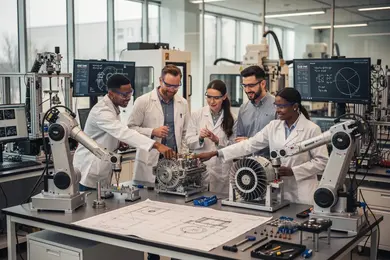
2027 Online Mechanical Engineering Degrees That Prepare Students for Design-to-Manufacturing Collaboration

Co-Founder and Chief Data Scientist
Choosing an online mechanical engineering degree is harder when your goal is not just design, but getting products built efficiently. The U. S. Bureau of Labor Statistics reported a 2024 median annual wage of $102,320 for mechanical engineers, making program quality, accreditation, and manufacturing-focused coursework especially important. This guide is for students, working technicians, military learners, and career changers comparing online options. You will learn how these degrees work, what they cost, which courses matter, and how to choose a program that supports design-to-manufacturing collaboration.
Key Things You Should Know
- For most engineering licensure and many employer-screened roles, prioritize an ABET-accredited mechanical engineering program; regional institutional accreditation alone is not the same as programmatic engineering accreditation.
- Online mechanical engineering degrees usually take about 4 years for first-time full-time students, while transfer students and working adults may finish faster or slower depending on lab access, course load, and accepted credits.
- According to BLS 2024 wage data, mechanical engineers had a median annual wage of $102,320, but manufacturing-related pay varies by industry, location, experience, software skills, and whether the role emphasizes design, production, quality, or automation.
What is an online mechanical engineering degree focused on design-to-manufacturing collaboration?
An online mechanical engineering degree focused on design-to-manufacturing collaboration teaches students how to turn engineering concepts into manufacturable, testable, cost-aware products. It is still a mechanical engineering degree, but the strongest programs connect core engineering science with product design, computer-aided design, materials selection, manufacturing processes, quality systems, and team-based projects.
The phrase design-to-manufacturing collaboration describes how design engineers, manufacturing engineers, quality engineers, suppliers, technicians, and project managers work together before a product reaches production. Instead of designing parts in isolation, students learn to ask practical questions: Can this part be machined, cast, molded, printed, assembled, inspected, repaired, and scaled within budget?
This degree path can fit several learners, but the best match depends on career goals and preparation. It is usually a strong fit for students who want mechanical engineering roles in product development, robotics, aerospace, automotive systems, medical devices, industrial equipment, energy systems, or advanced manufacturing. It may be less efficient for someone who only wants drafting work, technician-level manufacturing work, or short-term software training without the math and physics load of an engineering degree.
Common online formats include fully online lectures with local or virtual labs, hybrid programs with short campus residencies, and degree-completion programs for students who already have calculus, physics, and lower-division engineering credits. The practical difference is important: a mechanical engineering program needs credible lab, design, and assessment experiences, so "online" should not mean "light on engineering practice."
Students comparing online STEM degrees should also recognize that each field handles labs differently. For example, a program in animal science bachelor degree online may require different hands-on experiences than mechanical engineering, where design software, instrumentation, prototyping, and physical testing are central to career readiness.
How do online mechanical engineering programs compare with campus-based options for manufacturing careers?
Online and campus-based mechanical engineering programs can lead to similar manufacturing careers when the online program is academically rigorous, properly accredited, and includes meaningful lab and design work. The bigger difference is not whether the course is delivered through a screen; it is whether students can demonstrate engineering judgment, collaboration, and hands-on problem-solving.
The table below compares online and campus-based formats across factors that matter for manufacturing careers. Use it to identify which learning environment best matches your schedule, lab needs, and career stage.
| Factor | Online mechanical engineering | Campus-based mechanical engineering | Best fit |
| Schedule | Often more flexible, with asynchronous lectures and part-time options | More fixed class, lab, and project times | Online fits working adults; campus fits students who can study full time |
| Labs | May use lab kits, simulation, local proctoring, remote labs, or short residencies | Usually uses on-campus labs, machine shops, and testing equipment | Campus may be stronger for students who need frequent hands-on access |
| Team projects | Often managed through digital collaboration tools, video meetings, CAD files, and shared documentation | Often includes in-person build sessions and design reviews | Either can work if the program requires real design deliverables |
| Internships | Students may need to arrange local internships or employer-sponsored projects | Campus career centers may have established local employer pipelines | Online students should ask specifically about manufacturing employer connections |
| Networking | Can be strong for working professionals but requires intentional participation | More spontaneous access to faculty, labs, clubs, and peer groups | Campus may suit students who need structured community |
Online study can be especially practical for people already working in manufacturing, maintenance, quality, machining, CAD, or engineering technology roles. These students can often connect coursework to workplace problems, which may strengthen their portfolios.
Campus programs may be better for students who want frequent access to student design teams, research labs, machine shops, or intensive face-to-face mentorship. If you are deciding between formats, ask whether the online program includes a senior capstone that requires cross-functional design reviews, manufacturability analysis, and prototype validation.
Veterans and active-duty learners should also compare engineering support services, transfer credit policies, and military tuition benefits. Those exploring adjacent engineering fields may find it useful to review electrical engineering programs online for veterans when comparing how online engineering programs structure labs, advising, and military-friendly support.

Which accreditation and ABET standards should online mechanical engineering programs meet?
The most important quality signal for an online mechanical engineering bachelor's degree is ABET accreditation from the Engineering Accreditation Commission. ABET accreditation indicates that the program has been reviewed against engineering-specific standards for curriculum, faculty, continuous improvement, student outcomes, facilities, and institutional support.
Institutional accreditation is also important because it affects federal financial aid eligibility, transferability, and general academic recognition. However, institutional accreditation does not replace ABET accreditation for an engineering program. If a school says it is "accredited," verify whether that means the university is accredited, the engineering program is ABET-accredited, or both.
ABET's current engineering criteria emphasize student outcomes such as applying engineering design, conducting experiments, analyzing data, communicating effectively, recognizing ethical responsibilities, functioning on teams, and using engineering judgment. For design-to-manufacturing collaboration, these outcomes matter because employers need graduates who can explain trade-offs, document decisions, and work across design, production, and quality functions.
Before enrolling, students should confirm accreditation details through the school and ABET's program search. Focus on the exact degree name, delivery format, campus location, and accreditation status. A similar-sounding program in mechanical engineering technology, engineering management, or general engineering may be useful, but it may not satisfy the same employer, graduate school, or licensure expectations as an ABET-accredited mechanical engineering degree.
Licensure is another reason accreditation matters. Requirements for the Fundamentals of Engineering exam, Engineer in Training designation, and Professional Engineer license vary by state board. Many mechanical engineers in manufacturing never need a PE license, but students interested in consulting, public safety, HVAC, energy systems, or regulated engineering work should check their state's rules before choosing a program.
What core courses teach design-to-manufacturing collaboration in online mechanical engineering degrees?
A strong online mechanical engineering curriculum does more than cover equations. It teaches students how loads, materials, tolerances, production processes, cost, quality, and user needs interact. The most relevant courses are those that connect design decisions with manufacturing consequences.
The table below summarizes common courses and why each one matters for design-to-manufacturing collaboration. Course names vary by school, but the underlying competencies should be visible in the catalog.
| Course area | What students learn | Why it matters in manufacturing |
| Engineering graphics and CAD | 3D modeling, drawings, assemblies, tolerances, and documentation | Teams use drawings and models to communicate design intent to manufacturing and suppliers |
| Materials science | Material properties, failure modes, heat treatment, and selection | Material choices affect cost, durability, machinability, weight, and production methods |
| Manufacturing processes | Machining, casting, forming, welding, additive manufacturing, and process limits | Designs must match realistic production capabilities |
| Mechanical design | Stress, fatigue, mechanisms, fasteners, shafts, gears, and design safety factors | Products must function reliably under real operating conditions |
| Thermodynamics and fluid mechanics | Energy systems, heat transfer, pumps, flow, and thermal performance | Many manufactured products depend on heat, pressure, cooling, or fluid movement |
| Controls and mechatronics | Sensors, actuators, feedback, automation, and electromechanical systems | Modern manufacturing and product development increasingly involve smart systems |
| Quality engineering | Measurement, inspection, process capability, reliability, and root-cause analysis | Quality links design specifications to repeatable production outcomes |
| Senior capstone design | Team-based problem definition, prototyping, testing, documentation, and presentation | Capstone projects simulate the collaboration expected in engineering workplaces |
Students should look for programs that include modern tools used by employers. These may include CAD and CAE platforms, finite element analysis, product lifecycle management concepts, geometric dimensioning and tolerancing, design for manufacturability, additive manufacturing, and data-informed quality methods.
Because AI and automation are changing engineering work, the strongest programs also teach students how to evaluate software outputs rather than blindly accept them. Generative design, simulation, and automated inspection can speed up development, but engineers still need to validate assumptions, interpret constraints, and understand failure risk.
A practical way to judge the curriculum is to examine project requirements. Strong design-to-manufacturing programs typically ask students to produce several types of evidence:
- CAD models and engineering drawings that include tolerances, materials, and manufacturing notes
- Design calculations or simulations that justify the selected geometry, material, and safety margin
- Prototype, test, or lab reports that compare predicted performance with measured results
- Manufacturability or cost analysis that explains how a design could be produced at realistic volume
- Team documentation showing design reviews, revisions, risk analysis, and communication with stakeholders
What admission requirements and prior preparation are needed for these online programs?
Admission requirements depend on whether the program is a first-year bachelor's degree, a transfer-friendly bachelor's completion pathway, or a master's degree in mechanical engineering. For undergraduate applicants, schools usually expect strong preparation in algebra, trigonometry, precalculus or calculus, laboratory science, and technical writing.
Mechanical engineering is math-intensive. Students who are not ready for calculus may still be admitted by some institutions, but they may need prerequisite courses before entering the main engineering sequence. That can add time and cost, so placement results and transfer evaluations matter.
Applicants commonly need to prepare the following materials. Reviewing these items early helps avoid delays and prevents students from enrolling before they understand the workload.
- Official high school or college transcripts showing math, science, and general education preparation
- Transfer credit documentation for prior calculus, physics, chemistry, engineering graphics, programming, or technical courses
- Minimum GPA evidence, which varies by school and may be higher for engineering than for general admission
- Proof of English proficiency when required by the institution
- Work, military, or technical experience documentation if the program evaluates prior learning or offers professional pathways
- Access to required technology, including a reliable computer, engineering software compatibility, webcam, and internet connection
Students entering graduate mechanical engineering programs usually need a bachelor's degree in mechanical engineering or a closely related engineering field. Applicants from physics, engineering technology, or other STEM backgrounds may need bridge courses in thermodynamics, mechanics, fluids, materials, or controls.
One common mistake is assuming that manufacturing experience can replace the academic prerequisites of an engineering degree. Experience can strengthen an application and improve classroom performance, but most ABET-style engineering curricula still require the same math, physics, and design foundation.
How long do online mechanical engineering degrees take, and what do they cost?
A full online bachelor's degree in mechanical engineering typically requires about 120 to 130 credits. Full-time students often need about 4 years, while part-time students may need 5 to 6 years. Transfer students with an associate degree, prior engineering coursework, military training, or completed general education credits may shorten the timeline if the school accepts those credits into the major.
Graduate programs are shorter. An online master's in mechanical engineering commonly takes 1.5 to 3 years depending on whether the student studies full time, chooses a thesis, or balances coursework with employment. Students interested in research-heavy academic or AI-intensive engineering pathways may eventually compare doctoral options in adjacent fields, including a PhD in data science online, especially if their work involves manufacturing analytics, digital twins, or predictive maintenance.
Cost varies widely by residency, institution type, transfer credits, lab requirements, and whether engineering fees are charged separately. College Board's 2024 Trends in College Pricing reported average published tuition and fees of $11,610 for in-state students at public four-year institutions and $43,350 at private nonprofit four-year institutions for the 2024-25 academic year. Those figures are not specific to mechanical engineering, but they provide a useful benchmark for judging whether a program's pricing is unusually high or low.
When comparing costs, look beyond tuition alone. Online engineering students may encounter several categories of direct and indirect expenses:
- Tuition charged per credit or per term
- Engineering, lab, proctoring, technology, or distance-learning fees
- Software, computer hardware, calculator, webcam, and internet requirements
- Travel and lodging for required campus labs, orientations, exams, or capstone events
- Textbooks, digital course materials, lab kits, and prototyping supplies
- Lost income if the student reduces work hours to manage engineering coursework
Students can reduce total cost by transferring credits from regionally accredited community colleges, using employer tuition assistance, applying for engineering scholarships, choosing an in-state public option, and avoiding course withdrawals. However, the cheapest option is not always the best value if it lacks ABET accreditation, credible labs, or manufacturing-relevant design projects.
What careers can graduates pursue in design, manufacturing, and product development?
Graduates of online mechanical engineering programs can pursue roles across design, manufacturing, testing, quality, automation, and product development. The right role depends on internship experience, project portfolio, industry exposure, software skills, and whether the degree is ABET-accredited.
The table below outlines common career paths linked to design-to-manufacturing collaboration. It shows how responsibilities differ so students can choose electives, internships, and projects that match their target role.
| Career path | Typical responsibilities | Helpful preparation |
| Mechanical design engineer | Create components, assemblies, drawings, calculations, and prototypes | CAD, mechanical design, materials, FEA, GD&T, design reviews |
| Manufacturing engineer | Improve production processes, tooling, workflow, and manufacturability | Manufacturing processes, lean methods, automation, quality systems |
| Product development engineer | Move products from concept through testing, validation, and launch | Capstone projects, prototyping, test planning, cross-functional communication |
| Quality engineer | Analyze defects, improve inspection methods, and support process control | Statistics, metrology, root-cause analysis, reliability, documentation |
| Test engineer | Design experiments, run performance tests, analyze results, and report findings | Instrumentation, data analysis, mechanics, fluids, thermal systems |
| Automation or controls engineer | Support robotics, sensors, motion systems, and automated production equipment | Controls, mechatronics, programming, electrical fundamentals |
| Applications engineer | Help customers apply technical products, troubleshoot issues, and adapt designs | Communication, product knowledge, CAD, field testing, customer-facing projects |
Entry-level candidates should build evidence of applied ability before graduation. Employers often look for students who can discuss a design decision, explain a failed prototype, interpret test data, and show how they improved a part or process.
Useful early-career steps include the following:
- Complete at least one internship, co-op, undergraduate research project, or employer-sponsored manufacturing project.
- Build a portfolio with CAD models, drawings, design calculations, test summaries, and capstone documentation.
- Learn one major CAD tool deeply and understand how drawings communicate tolerances and manufacturing requirements.
- Seek projects involving real constraints such as cost, supplier limits, safety, reliability, assembly time, or inspection.
- Practice explaining engineering trade-offs to non-engineers, because manufacturing work often involves operations, finance, sales, and quality teams.
Students who prefer abstract theory over hands-on design, testing, and iteration may still succeed in mechanical engineering, but they should choose research, simulation, or graduate-school-oriented pathways carefully. Students who enjoy seeing a product move from model to shop floor are often better aligned with manufacturing-focused roles.
What salary ranges and earning potential exist for mechanical engineers in manufacturing fields?
Salary potential depends on occupation, industry, location, experience, credentials, and specialization. The BLS reported a 2024 median annual wage of $102,320 for mechanical engineers. This median is a national benchmark, not a promise of earnings for any individual graduate.
Manufacturing-related mechanical engineers may earn more or less than the national median depending on whether they work in transportation equipment, machinery, aerospace, energy, electronics, medical devices, consulting, or general manufacturing. Roles that combine mechanical design with automation, controls, simulation, quality analytics, or high-value product development may be more competitive because they connect engineering decisions to production efficiency and product performance.
The table below provides a practical way to think about earning potential by career stage. It does not guarantee pay, but it shows how responsibilities tend to change as engineers gain experience.
| Career stage | Common role examples | How earning potential usually changes |
| Entry level | Associate mechanical engineer, junior manufacturing engineer, test engineer I | Pay is often shaped by internships, software ability, location, and industry demand |
| Early career | Mechanical design engineer, manufacturing engineer, quality engineer | Engineers who can own subsystems, improve processes, and document results often become more competitive |
| Midcareer | Senior engineer, lead product engineer, process improvement engineer | Compensation may rise with project ownership, technical specialization, mentoring, and cross-functional leadership |
| Advanced | Engineering manager, principal engineer, manufacturing systems lead | Higher earning potential often depends on leadership scope, business impact, and specialized technical judgment |
Students evaluating return on investment should compare expected debt, time to completion, employer tuition support, and local labor markets. A lower-cost program with strong accreditation and good employer alignment may produce a better financial fit than a more expensive program with weak manufacturing connections.
Salary comparisons are most useful when tied to a specific job market. Before enrolling, search postings in your target region and note requested skills, preferred software, clearance requirements, internship expectations, and whether employers ask for an ABET-accredited engineering degree.
What is the job outlook and industry demand for mechanical engineers in advanced manufacturing?
Demand for mechanical engineers is supported by product development, infrastructure modernization, automation, clean energy systems, aerospace and defense needs, transportation equipment, medical technology, and advanced manufacturing. The BLS 2024 Occupational Outlook Handbook projects employment for mechanical engineers to grow 11% from 2023 to 2033, which indicates stronger-than-average national demand but does not guarantee hiring in every region or industry.
Advanced manufacturing is changing what employers expect from mechanical engineers. Traditional mechanics, materials, and thermal-fluid knowledge still matter, but employers increasingly value engineers who can work with digital design tools, robotics, additive manufacturing, simulation, sensors, inspection data, and continuous improvement systems.
Several trends are especially relevant for students choosing an online program:
- Automation and robotics: Engineers who understand mechanical systems, controls, sensors, and production constraints can contribute to automated manufacturing lines.
- Additive manufacturing: 3D printing is useful for prototyping and some production applications, but engineers must still understand material behavior, tolerances, finishing, and qualification.
- Digital twins and simulation: Manufacturers use models to test designs and processes earlier, but engineers need judgment to validate assumptions and interpret results.
- Supply-chain resilience: Design teams increasingly consider part availability, alternate materials, supplier capability, and redesign options.
- Quality and traceability: Regulated and high-reliability industries need engineers who can document design decisions, inspection results, and process changes.
These trends make collaboration skills more valuable, not less. AI and software can speed up modeling, documentation, and analysis, but manufacturing still requires engineers who can resolve trade-offs among design intent, cost, production capability, safety, and quality.
Students who want to stay employable should avoid treating the degree as a one-time credential. Plan to keep learning through software certifications, professional societies, employer training, graduate certificates, or targeted short courses in automation, quality, additive manufacturing, or data analysis.
How can students evaluate and choose a reputable online mechanical engineering program?
The best online mechanical engineering program is the one that matches your career goal, meets engineering quality standards, fits your schedule, and offers a realistic path to completion. Do not choose based only on a ranking, advertisement, or low tuition number.
Use the following steps before applying or enrolling. They are designed to help you verify quality, cost, and career fit rather than relying on broad claims.
- Confirm institutional accreditation and program-level ABET accreditation for the exact mechanical engineering degree you plan to complete.
- Review the curriculum for CAD, materials, manufacturing processes, mechanical design, controls, quality, labs, and capstone design.
- Ask how online labs work, including whether you need lab kits, local facilities, remote equipment, or campus residencies.
- Request a written transfer credit evaluation before committing, especially if you have community college, military, or prior engineering technology credits.
- Compare total cost, including fees, software, travel, hardware, and the financial impact of part-time versus full-time enrollment.
- Ask about internship support, employer partnerships, career services, capstone sponsors, and graduate outcomes for online students specifically.
- Check whether the program supports FE exam preparation if licensure could matter for your long-term career.
- Talk with current students or alumni about workload, faculty access, lab quality, team projects, and responsiveness of advising.
Several red flags should make you pause. Be cautious if a program avoids clear answers about ABET accreditation, offers very limited lab work, has no substantial design capstone, provides vague career outcomes, or pressures you to enroll before reviewing transfer credits and total cost.
It is also wise to compare engineering against other degree paths if you are undecided. A mechanical engineering degree is demanding and quantitative; students who mainly want information work, public service, or knowledge organization may find a different academic route more suitable. For a broader example of evaluating fit and outcomes in another field, guides that ask is library science a good degree can show how to compare career alignment before investing in a program.
A reputable online mechanical engineering degree should leave you with more than completed courses. By graduation, you should have a portfolio, technical vocabulary, lab evidence, design documentation, and the confidence to collaborate with manufacturing teams that have to build, inspect, and improve real products.
Other Things You Should Know About Mechanical Engineering
In 2027, online mechanical engineering degrees emphasize systems design, CAD, and advanced manufacturing techniques, preparing students for robust design-to-manufacturing collaboration. Courses often integrate real-world projects and virtual labs, enabling students to apply engineering principles effectively throughout the manufacturing lifecycle.
Online mechanical engineering can feel harder for students who need frequent in-person support or structured lab time. It can work well for disciplined learners who are comfortable with math, independent study, digital collaboration, and scheduled project work.
Internships are not always required, but they are strongly recommended. Manufacturing employers often value practical evidence, and internships help students apply CAD, testing, quality, and production concepts in real workplaces.
Strengthen algebra, trigonometry, calculus readiness, physics, spreadsheet use, technical writing, and basic programming. If possible, learn introductory CAD and become comfortable explaining how mechanical systems work.
References
- Can You Take Prerequisites Online? https://www.sophia.org/blog/higher-education/can-you-take-prerequisites-online/
- Mechanical Engineering Degrees, Online Included https://typesofengineeringdegrees.org/mechanical-engineering/
- Graduate careers advice: you and your product design degree https://gradireland.com/careers-advice/engineering/graduate-careers-advice-you-and-your-product-design-degree
- What careers can you do with a Product Design degree? | University for the Creative Arts https://www.uca.ac.uk/blogs/careers-with-a-product-design-degree/
- Accreditation - ABET https://www.abet.org/accreditation/
- Mechanical Design and Manufacturing and Automation- https://msec.scu.edu.cn/msec/Major/Mechanical_Design_and_Manufacturing_and_Automati.htm
- How to Evaluate If an Engineering Program Is a Good Fit - Your College-Bound Kid https://yourcollegeboundkid.com/2023/03/10/how-to-evaluate-if-an-engineering-program-is-a-good-fit/
- Mechanical Design and Engineering Technology https://lakeshore.edu/programs-and-courses/career-areas/manufacturing/mechanical-design-and-engineering-technology
- Online ABET-Accredited Engineering Degree Guide - Educating Engineers https://educatingengineers.com/online-engineering-schools/abet-accredited-degree/
- Mechanical Engineering Jobs in Demand by 2030 | CADD https://caddcentre.com/blog/mechanical-engineering-jobs-in-demand-by-2030/