2027 How to Compare Online Mechanical Engineering Degrees by Transfer Friendliness

Co-Founder and Chief Data Scientist
Transferring into an online mechanical engineering degree can save time, but only if your credits count toward the right requirements. The stakes are high: the U. S. Bureau of Labor Statistics projects 11% employment growth for mechanical engineers from 2023 to 2033, faster than average. This guide is for students with prior college, military, or technical coursework who want to finish efficiently without choosing a weak program. You will learn how to compare transfer policies, accreditation, labs, costs, and career outcomes before committing.
Key Things You Should Know
- Transfer-friendly means credits apply to calculus, physics, chemistry, engineering science, and upper-division requirements-not just total electives; ask for a degree audit before committing.
- BLS projects 11% growth for mechanical engineers from 2023 to 2033, and its May 2024 wage data reports a $102,320 median annual pay, so program quality and licensing alignment matter for ROI.
- Cost comparisons should include repeated credits, residency minimums, lab travel, proctoring, and tuition; College Board reported 2024-25 average published public four-year tuition and fees of $11,610 for in-state students.
How do you compare online mechanical engineering degrees for transfer-friendliness between schools?
The best way to compare online mechanical engineering degrees for transfer-friendliness is to look beyond how many credits a school accepts. A program may accept 90 credits in theory but still require you to retake core engineering courses if your previous classes do not match its sequence, lab standards, or accreditation expectations.
Use the following comparison points to separate truly transfer-friendly programs from programs that only sound flexible. The table summarizes what each factor means for a student trying to finish a mechanical engineering bachelor's degree online.
| Comparison factor | What to look for | Why it matters |
| Preliminary degree audit | A course-by-course review before enrollment or before the deposit deadline | Shows which credits meet major requirements instead of only counting as electives |
| Major credit acceptance | Clear rules for calculus, physics, chemistry, statics, dynamics, thermodynamics, and materials | Mechanical engineering is sequential, so one missing prerequisite can delay several later courses |
| Residency requirement | The minimum number of credits you must complete at the new institution | A high residency requirement can reduce the value of transfer credits |
| Lab and design requirements | Transparent expectations for remote labs, campus visits, local labs, kits, or proctored design work | Labs and senior design often cannot be waived easily |
| Accreditation fit | Program-level engineering accreditation when professional licensure is a goal | Licensing boards and employers may care about the specific accreditation status of the engineering program |
After narrowing your list, request the same documents from every school so you can compare offers side by side. This process keeps the decision grounded in actual graduation requirements rather than admissions marketing.
- Send official or unofficial transcripts from every prior institution and ask for a written preliminary transfer evaluation.
- Ask which transferred courses satisfy the mechanical engineering major, which count only as general education, and which do not transfer.
- Request a remaining-course plan by term, including labs, senior design, and any campus visits.
- Calculate the number of credits you still need, not just the number accepted.
- Compare total cost to completion, including repeated courses, distance fees, lab materials, travel, books, and software.
A common mistake is choosing the school that accepts the largest credit total. The better choice is usually the school that applies the most credits to required degree slots and offers the most predictable path through upper-division engineering courses.
What makes an online mechanical engineering program transfer-friendly for prior college credits?
A transfer-friendly online mechanical engineering program has clear rules, predictable sequencing, and staff who understand engineering transfer pathways. The key issue is not whether your old credits appear on a transcript; it is whether they reduce the exact courses you must still complete for graduation.
Transfer-friendly programs usually share several practical features. These features are especially important for students coming from community colleges, previous engineering programs, military technical training, or related majors such as physics, mathematics, or engineering technology.
- Published equivalency guides for common feeder colleges, especially for calculus, calculus-based physics, chemistry, and engineering fundamentals.
- Acceptance of lower-division math and science courses when they include the right lab or lecture components.
- Dedicated transfer advisors who can explain prerequisites and course sequencing before enrollment.
- Transparent limits on transfer credits, age of credits, grade minimums, and repeated courses.
- Flexible start terms or multiple course offerings per year for bottleneck courses such as thermodynamics, fluid mechanics, and machine design.
- Options for students who completed engineering technology or applied science credits, with clear explanations of which courses may not substitute for engineering science requirements.
Be cautious if a school says credits are "likely" to transfer but will not provide a written evaluation. Mechanical engineering curricula are tightly structured, so vague assurances can lead to expensive surprises after enrollment.
How can you verify accreditation and quality of online mechanical engineering degrees?
Accreditation is one of the most important quality checks for an online mechanical engineering degree. Institutional accreditation confirms that the university meets broad academic and administrative standards, while programmatic engineering accreditation evaluates whether the engineering program itself meets discipline-specific expectations.
For mechanical engineering, ABET accreditation is often the key program-level standard in the United States. It can affect eligibility for the Fundamentals of Engineering exam, Professional Engineer licensure pathways, graduate school admission, and employer confidence, although exact requirements vary by state board and employer.
Use this quality checklist before applying or transferring. It is designed to help you verify claims instead of relying only on a program page or an admissions conversation.
- Confirm the university's institutional accreditation through a recognized U.S. accreditor.
- Check whether the specific mechanical engineering program-not just the college of engineering-is ABET-accredited.
- Ask whether the online version, degree-completion version, or transfer pathway is included under the same accredited program.
- Review senior design, lab, and assessment requirements to see whether online students complete the same outcomes as campus students.
- Ask the program for recent outcomes such as retention, graduation, FE exam participation when available, employer partnerships, and graduate school placement data.
A major red flag is a school that promotes "engineering" broadly but awards an engineering technology, applied technology, or general studies degree when your goal is mechanical engineering practice. Those degrees can be valuable, but they may not serve the same licensing or employment purpose as an accredited mechanical engineering degree.
What admission and transfer credit policies do online mechanical engineering programs typically require?
Admission and transfer credit policies vary by university, but online mechanical engineering programs typically expect strong preparation in math and science. Because the major builds course by course, transfer students are often evaluated more closely than first-year applicants.
Most programs will ask for a combination of academic records and prerequisite evidence. The details below are common, but students should confirm each requirement directly with the school before assuming eligibility.
- Official transcripts from all colleges attended, even if credits were earned years ago or at a school you do not plan to transfer from.
- A minimum college GPA, often with a separate expectation for math, science, or engineering prerequisite courses.
- Completion of calculus, chemistry, and calculus-based physics before upper-division engineering admission.
- Course descriptions or syllabi for engineering, lab, or technical courses that do not have a preapproved equivalency.
- Minimum grades for transferred courses, especially in major prerequisites.
- English, communication, humanities, and social science general education credits that meet the receiving university's distribution rules.
Students comparing affordability should also compare how transfer rules affect the actual bill. A low tuition rate can become less competitive if the program rejects major prerequisites, which is why researching mechanical engineering degree online cost should include the number of credits left after evaluation.
Another common mistake is assuming that technical training automatically replaces engineering courses. Military, manufacturing, drafting, CAD, or engineering technology credits may help with electives, but mechanical engineering programs often require calculus-based theory courses for the major.
How does transferring into an online mechanical engineering program affect time to graduation and costs?
Transferring can reduce time to graduation, but only when accepted credits fit the degree map. The most important number is not "credits accepted"; it is "credits remaining in the exact sequence required to graduate." A student who transfers 70 credits but still needs the first course in a three-course engineering sequence may take longer than expected.
Cost comparisons should include tuition and the hidden costs created by course sequencing. College Board's 2024 Trends in College Pricing reported average published tuition and fees of $11,610 for in-state students at public four-year institutions in 2024-25, but online engineering students may face additional program, technology, lab, software, and travel costs depending on the school.
This table explains common cost drivers for transfer students. It helps you identify expenses that are easy to miss when comparing only per-credit tuition.
| Cost or time factor | How it affects transfer students | What to verify |
| Repeated prerequisites | Rejected or outdated math and science courses can add semesters | Whether each prerequisite satisfies a specific course requirement |
| Residency credits | Schools may require a minimum number of credits completed through their institution | The exact number of institutional credits required for graduation |
| Course rotation | Upper-division engineering courses may be offered only once per year | Whether missed prerequisites delay the next available course |
| Lab participation | Some programs require campus residencies, approved local labs, or mailed kits | Travel dates, lab fees, equipment requirements, and local-site approval rules |
| Senior design | Capstone work may require team meetings, synchronous sessions, or industry-sponsored projects | How online students complete design reviews, prototypes, and presentations |
To estimate your real cost, create a completion budget rather than a one-year tuition estimate. Include remaining credits, required fees, books, software, hardware, transportation, lost work hours for residencies, and the cost of any courses you must retake.
How do online and campus mechanical engineering programs differ in curriculum and lab requirements?
Online and campus mechanical engineering programs usually cover similar core subjects, but they may differ in delivery, lab logistics, team design work, and access to physical equipment. A well-designed online program should not feel like a lighter version of engineering; it should provide an alternative way to meet the same learning outcomes.
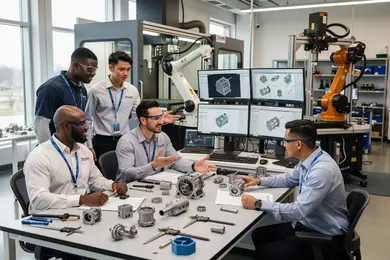
The biggest difference is how hands-on requirements are handled. Mechanical engineering is not purely theoretical, so students should understand how experimentation, measurement, CAD, manufacturing concepts, and design validation are taught online.
| Program feature | Online mechanical engineering | Campus mechanical engineering |
| Lectures | Often asynchronous, synchronous, or hybrid with recorded materials | Usually scheduled in person with live classroom attendance |
| Labs | May use lab kits, simulations, remote instrumentation, local partners, or short campus residencies | Typically completed in university labs on a weekly schedule |
| Team projects | Often coordinated through video meetings, shared CAD tools, and online project management | Often supported by in-person meetings, machine shops, and design studios |
| Student support | Depends heavily on virtual tutoring, advisor access, and digital library resources | May offer easier access to faculty offices, labs, clubs, and peer study groups |
| Flexibility | Better for working adults when courses are asynchronous or part time | Better for students who want full-time immersion and regular lab access |
Online is often a strong fit for disciplined students who already have lower-division credits and need flexibility. Campus may be better for students who want daily access to labs, research groups, competition teams, or a traditional engineering cohort.
If you are comparing hands-on science degrees more broadly, the way schools manage labs in online exercise science programs can also illustrate why "online" does not always mean fully remote; some applied programs still require in-person skill checks or field experiences.
What mechanical engineering courses and prerequisites are most likely to transfer successfully?
The courses most likely to transfer successfully are lower-division classes with standardized content and clear equivalencies. The courses least likely to transfer cleanly are specialized, upper-division engineering courses, especially when the receiving program uses a different sequence or requires a specific lab component.
Mechanical engineering students should pay close attention to prerequisites because a single missing course can block multiple upper-division classes. The following categories are commonly reviewed in transfer evaluations.
- High-transfer potential: English composition, public speaking, humanities, social sciences, general chemistry with lab, calculus I through differential equations, and calculus-based physics with lab.
- Moderate-transfer potential: statics, dynamics, engineering graphics, CAD, programming for engineers, circuit fundamentals, and introductory materials science.
- Lower-transfer certainty: thermodynamics, fluid mechanics, heat transfer, machine design, controls, vibrations, manufacturing processes, and senior design.
- Often limited to electives: non-calculus physics, technical drafting, algebra-based engineering technology courses, vocational machining, and software courses without engineering problem-solving outcomes.
Students with programming, robotics, controls, or automation interests should compare how much computing they want in their career. If software development is becoming the main goal, a computer science degree online may be a more direct path than forcing those interests through mechanical engineering electives.
Before enrolling, ask for a prerequisite map showing exactly where your transferred courses fit. If a school cannot show how your math, physics, and engineering credits unlock later courses, you may be at risk of repeating work or waiting for annual course rotations.
How do online mechanical engineering degrees prepare graduates for licensing and professional practice?
An online mechanical engineering degree can support professional practice when it provides the same academic foundation expected of engineering graduates: mathematics, engineering science, design, experimentation, ethics, and communication. For students interested in licensed engineering work, accreditation and state board rules are especially important.
The typical U.S. pathway toward Professional Engineer licensure includes an engineering degree, the Fundamentals of Engineering exam, supervised engineering experience, and the Principles and Practice of Engineering exam. Requirements vary by state, so students should confirm details with the licensing board in the state where they plan to practice.
Online students should ask targeted questions about licensure preparation. These questions are useful because not every engineering-related degree leads to the same professional options.
- Is the mechanical engineering program ABET-accredited, and does that status apply to online students?
- Are graduates eligible to sit for the FE exam in the states where the program commonly serves students?
- Does the curriculum include engineering ethics, design under constraints, experimental methods, and capstone design?
- Does the school provide FE exam advising, review materials, or student outcome data?
- Are faculty members licensed engineers or active researchers in areas relevant to your goals?
Licensure is not required for every mechanical engineering job, especially in manufacturing, product development, aerospace suppliers, robotics, and private industry roles. However, it can be important in consulting, public infrastructure, energy systems, HVAC design, and work involving approval of engineering documents.
What career paths, industries, and salary ranges can follow an online mechanical engineering degree?
Mechanical engineering is broad, which is one reason transfer students should choose programs based on long-term fit rather than speed alone. Graduates may pursue roles in manufacturing, automotive systems, aerospace, energy, HVAC, robotics, materials, product design, quality, testing, and maintenance engineering.
BLS May 2024 wage data reports a $102,320 median annual wage for mechanical engineers in the United States. That figure is a midpoint across industries and experience levels, so it should be used as a labor-market reference, not as a promised outcome for any specific graduate.
The table below connects common mechanical engineering career directions with the kind of work they involve. It can help you decide whether a program's electives, labs, and senior design options match the industries you care about.
| Career direction | Typical work focus | Program features to look for |
| Manufacturing engineering | Production systems, process improvement, tooling, quality, and automation | Manufacturing processes, CAD/CAM, quality systems, robotics, and industry projects |
| Product design | Designing, modeling, testing, and improving mechanical components or consumer products | Machine design, materials, finite element analysis, prototyping, and capstone design |
| Thermal and fluids engineering | Heat transfer, fluid flow, HVAC, energy systems, and propulsion-related applications | Thermodynamics, fluid mechanics, heat transfer, energy systems, and strong lab work |
| Robotics and automation | Mechanical systems, sensors, controls, motion, and automated equipment | Controls, mechatronics, programming, dynamics, circuits, and interdisciplinary projects |
| Test or quality engineering | Measurement, reliability, compliance, failure analysis, and product validation | Statistics, materials testing, instrumentation, lab methods, and technical communication |
Some mechanical engineers later move into analytics-heavy roles, especially in manufacturing optimization, predictive maintenance, and operations. If that direction becomes more appealing than design or physical systems, a data science master online may be a useful graduate-level comparison after the bachelor's degree.
How should working adults choose an online mechanical engineering program that fits long-term goals?
Working adults should choose an online mechanical engineering program by starting with the end goal: licensure, promotion, career change, graduate school, or completion of an unfinished degree. The right program is the one that fits your credits, schedule, finances, and career target-not simply the fastest or cheapest option.
Use this decision process before enrolling. It is designed to prevent the most common transfer mistakes: overvaluing accepted credits, underestimating labs, ignoring accreditation, and choosing a program that does not match the desired job market.
- Define your target outcome, such as mechanical engineer, manufacturing engineer, product designer, HVAC engineer, automation engineer, or preparation for graduate study.
- Confirm whether ABET accreditation or PE licensure matters for that outcome in your state or industry.
- Get written transfer evaluations from at least two schools and compare credits remaining, not credits accepted.
- Ask for a term-by-term plan that includes prerequisites, lab requirements, senior design, and course rotation.
- Calculate total cost to completion, including retaken courses, fees, materials, software, travel, and reduced work hours.
- Evaluate student support for online learners, including tutoring, advising, faculty access, career services, library access, and technical support.
- Check whether the program offers electives or projects aligned with your industry goals, such as robotics, energy, manufacturing, aerospace, or biomechanics.
Mechanical engineering is a strong fit if you enjoy applied math, physical systems, design trade-offs, testing, and problem-solving under constraints. It may be a poor fit if you want a low-math degree, a program with no lab expectations, or a career focused mainly on software, healthcare service delivery, or business management.
Students drawn to biomechanics, sports equipment, rehabilitation technology, or human performance should compare the engineering design path with health-science options.
Other Things You Should Know About Mechanical Engineering
Employers usually care more about the institution, accreditation, skills, projects, internships, and technical competence than the delivery format. If the transcript and diploma come from the same accredited program as the campus option, the online format may not be obvious unless you choose to discuss it.
Useful tools include CAD software, spreadsheet modeling, basic programming, MATLAB-style numerical tools, and simulation or finite element analysis platforms. You do not need to master all of them before enrolling, but comfort with technical software can reduce the learning curve.
Some can, especially if they study part time and already completed lower-division math and science courses. Full-time work becomes harder during intensive labs, advanced design courses, and senior capstone projects, so students should plan for heavier terms in advance.
Employers generally assess online mechanical engineering degrees by reviewing accreditation status and program reputation. In 2027, programs with transfer-friendly policies often reflect flexibility and comprehensive curriculum, which can reassure employers about the quality and rigor of a candidate's academic preparation.
References
- Qualification Checker https://www.internationalengineeringalliance.org/for-engineers/qualification-checker
- Is a master's in mechanical engineering worth it? | edX | edX https://www.edx.org/resources/is-a-masters-degree-in-mechanical-engineering-worth-it
- Classes Mechanical Engineers Take | University of Bridgeport https://www.bridgeport.edu/news/what-classes-do-mechanical-engineers-take/
- Online Mechanical Engineering Degrees 2025 https://www.affordablecollegesonline.org/degrees/engineering-programs/mechanical-engineering/
- Engineering Continuing Education Without High Training Costs https://schoolofpe.com/blogs/news/engineering-continuing-education
- What can you do with a mechanical engineering degree? https://www.hull.ac.uk/study/undergraduate/courses/mechanical-engineering-beng-meng-hons/what-can-you-do-with-a-mechanical-engineering-degree
- Your Guide to Mechanical Engineering Continuing Education https://www.pdh-pro.com/your-guide-to-mechanical-engineering-continuing-education/
- Licensure and Qualifications for Practice https://www.nspe.org/nspe-advocacy/explore-issues/professional-policies-and-position-statements/licensure-qualifications
- Assessing Preparation for Professional Engineering ... https://easychair.org/publications/paper/RqnM/open
- Mechanical Engineering Career Paths - Complete Guide | Vista Projects https://www.vistaprojects.com/mechanical-engineering-career-paths-guide/