2027 Best Generative AI Courses for Chief Data Officers

Co-Founder and Chief Data Scientist
Chief Data Officers often face challenges integrating advanced generative AI technologies into legacy systems while ensuring strategic alignment with organizational goals. Limited access to specialized training can hinder timely adoption and reduce competitive advantage. Navigating the complex landscape of generative AI requires both technical proficiency and leadership insight, which many professionals lack.
This article addresses these obstacles by presenting the best generative AI courses designed to equip Chief Data Officers with practical skills and strategic knowledge. It aims to guide readers toward flexible, accredited educational options that facilitate a successful transition into the evolving AI-driven business environment.
Key Things You Should Know
- Chief data officers benefit most from courses emphasizing AI ethics, governance, and practical integration, as 68% of firms in 2025 reported these skills critical for leadership roles.
- Top generative AI programs in 2026 combine hands-on machine learning projects with strategic data management, aligning with 72% industry demand for applied expertise.
- With AI adoption growing by 35% annually, many courses now include updates on latest frameworks and regulations, essential for CDOs to ensure compliance and innovation.
Advance Your Career with AI Online Courses
Artificial Intelligence: Implications for Business Strategy
This program provides an introduction to Artificial Intelligence and their implications for business strategy. Earn an official digital certificate.

Oxford Artificial Intelligence Programme
Explore this Oxford Artificial Intelligence programme offered in a flexible learning environment and explore topics like machine learning, automation, and robotics.

Implementing Agentic AI: Building Your Organizational Playbook
This online MIT Agentic AI course offers a practical approach to deploying AI agents in your organization, including a custom playbook. 3 weeks, exclusive launch price.

AI Adoption: Driving Business Value and Impact
This online MIT AI Adoption: Driving Business Value and Impact offers practical frameworks to close the gap between AI potential and business reality.

Artificial Intelligence in Pharma and Biotech
Discover the applications and limitations of artificial intelligence in pharma and biotech with this MIT online short course.

What makes a generative AI course specifically valuable for current and aspiring Chief Data Officers?
A generative AI course provides chief data officers (CDOs) with critical skills needed to navigate the growing expectations of generating measurable business value from complex data ecosystems.
NewVantage Partners' executive survey shows that 73% of large firms have increased pressure on CDOs to deliver tangible results from generative AI within 12 to 18 months, up from 41% in 2022. This rising demand underscores the importance of essential skills from generative AI training for data leadership roles.
Key components of an effective generative AI course include:
- Technical understanding: Mastery of AI architectures and training methods to evaluate risks and feasibility.
- Data governance and ethics: Ensuring responsible AI use and mitigating bias to maintain compliance and trust.
- Integration with business strategy: Translating AI outputs into actionable business insights aligned with organizational goals.
- Performance measurement: Defining KPIs and evaluation frameworks to precisely quantify AI's contribution.
Alongside theory, practical experience through case studies or projects-especially in finance, healthcare, or marketing-prepares CDOs to address challenges like scaling, budget limits, and collaboration. For those seeking to deepen their expertise, exploring most affordable data science master's programs can be a strategic step in career advancement.
Advance Your Career with AI Online Courses
Artificial Intelligence: Implications for Business Strategy
This program provides an introduction to Artificial Intelligence and their implications for business strategy. Earn an official digital certificate.
Oxford Artificial Intelligence Programme
Explore this Oxford Artificial Intelligence programme offered in a flexible learning environment and explore topics like machine learning, automation, and robotics.
Implementing Agentic AI: Building Your Organizational Playbook
This online MIT Agentic AI course offers a practical approach to deploying AI agents in your organization, including a custom playbook. 3 weeks, exclusive launch price.
Which generative AI skills and competencies do Chief Data Officers most need to master?
Chief Data Officers (CDOs) need a robust set of generative AI leadership skills for chief data officers to guide data and analytics transformations effectively. Core technical expertise includes understanding generative AI architectures such as large language models, diffusion models, and reinforcement learning frameworks, along with skills in training, fine-tuning, and deploying these models to maximize business value.
Data governance and ethics remain paramount. CDOs must design frameworks that ensure transparency, fairness, and accountability in generative AI outputs, tackling bias and meeting regulatory requirements. Strong competencies in data privacy and security help protect AI initiatives from misuse and vulnerabilities.
Essential generative AI competencies for data executives also cover strategic leadership to align AI projects with organizational objectives and measurable KPIs. This requires collaboration with data engineers, scientists, and domain experts to build scalable, maintainable AI systems.
Operational skills such as performance monitoring, cost management, and AI lifecycle oversight are critical for scaling AI deployments. Familiarity with cloud infrastructure and MLOps tools supports ongoing optimization.
Advanced analytical capabilities enable CDOs to interpret AI-driven insights accurately and make informed decisions. Effective communication skills allow them to explain AI benefits and risks to non-technical stakeholders clearly. Prospective leaders can strengthen their foundation through relevant programs like an online degree in mechanical engineering that build technical and analytical expertise.
These competencies align with Gartner's projection that by 2027, 80% of large enterprises will have a formal Chief Data & Analytics Officer (CDAO) or equivalent role, up from 45% in 2023, primarily driven by GenAI adoption initiatives.
How can Chief Data Officers choose the best generative AI course for their career goals?
Chief data officers (CDOs) evaluating generative AI courses for career advancement should focus on programs that closely align with their strategic goals and industry demands. With generative AI expected to generate $2.6-$4.4 trillion in annual value mainly across sectors like marketing, sales, software engineering, and customer operations, practical experience using models, real-world datasets, and industry-relevant simulations is essential.
Key factors to consider include:
- Depth of content covering foundational AI concepts versus advanced generative AI techniques
- Balance between technical skills such as model fine-tuning and leadership knowledge on integrating AI into enterprise strategy
- Instructor reputation, especially industry leaders or researchers known for innovation in generative AI
- Flexible formats suitable for working professionals, including part-time or modular options
- Certification credibility recognized by top tech firms and industry organizations
Top generative AI training programs for chief data officers in the US often tailor content by sector; for instance, retail-focused courses emphasize AI-driven marketing automation, whereas software engineering tracks concentrate on code generation and debugging.
Ethical considerations, data privacy, and governance topics must also be integral to courses, reflecting evolving regulatory landscapes. Transparent assessments like case studies and project work that highlight measurable business outcomes improve learning value.
Those seeking advanced credentials may explore online AI PhD programs to deepen expertise while balancing leadership development and technical mastery in generative AI.
What types of generative AI programs are available for Chief Data Officers (certificate, master's, executive)?
Generative AI programs for Chief Data Officers (CDOs) are generally offered as certificate programs, master's degrees, or executive education courses, each suited to different professional needs and time commitments. Certificate programs focus on practical skills like AI governance, ethical deployment, and operational integration.
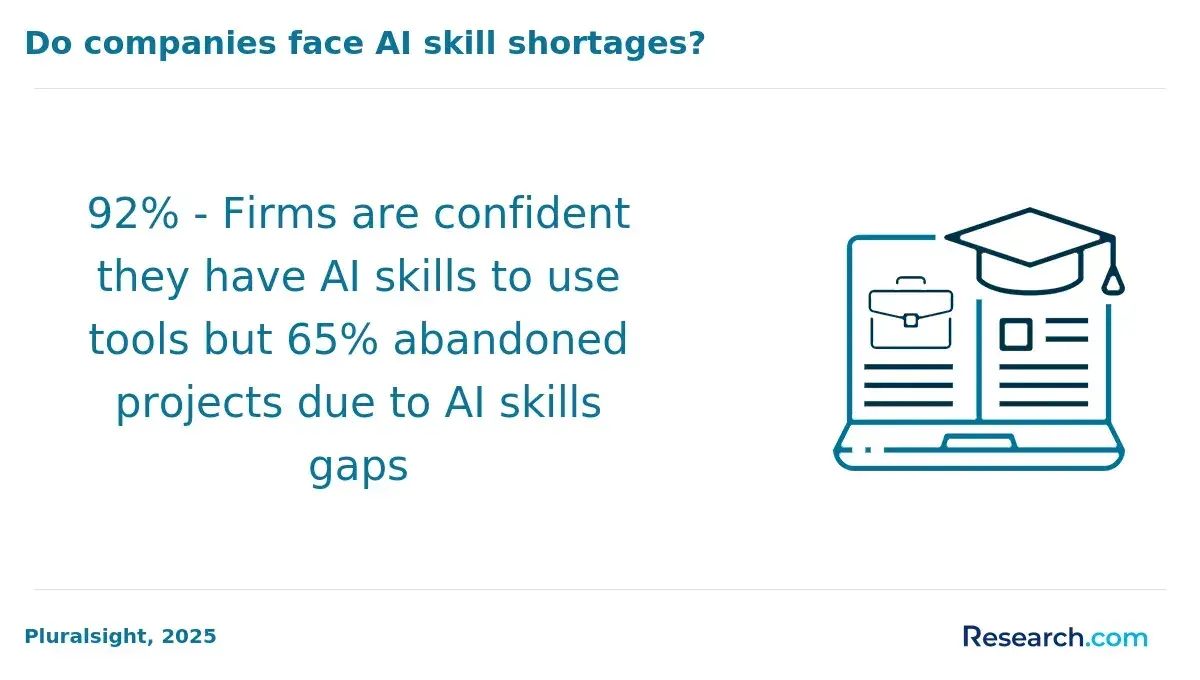
These programs, often lasting 3 to 6 months, address the moderate to severe skills gaps identified by 87% of executives in a recent PwC survey and are ideal for CDOs seeking immediate application of generative AI within their organizations.
Master's degrees in generative AI for data leaders provide a deeper theoretical and technical education, usually spanning 1 to 2 years. These programs blend data science, advanced machine learning, and leadership training, preparing CDOs to lead enterprise-wide AI transformations and build scalable AI governance frameworks. Such comprehensive education meets the needs of the 22% of leadership teams who feel very prepared to manage generative AI responsibly.
Executive master's degrees in generative AI target senior CDOs needing strategic-level education within a shorter timeframe. These courses, lasting from days to weeks, emphasize leadership, risk management, and AI policy development, enabling informed board-level decision-making without a long-term commitment.
CDOs may also consider exploring related military friendly online cybersecurity degree programs that complement AI expertise, especially given the growing emphasis on secure AI deployment.
How do online generative AI courses for Chief Data Officers compare with campus and hybrid options?
Online generative AI courses provide chief data officers (CDOs) with unmatched flexibility and accessibility compared to campus or hybrid formats. These programs allow busy executives to learn at their own pace without sacrificing depth, accommodating hectic schedules and eliminating travel time.
Unlike campus courses, which offer immersive, face-to-face networking and hands-on resource access, online options enable continuous study from any location. Hybrid models blend remote convenience with some direct interaction but can still involve logistical challenges for senior professionals.
Many online courses now include live sessions, project-based learning, and mentor feedback, narrowing gaps often associated with remote education. They frequently update content faster to keep pace with rapid advances in generative AI tools essential for data strategy leadership.
Additionally, online programs are often more cost-effective and scalable for organizations enrolling multiple participants. Virtual cohorts bring together CDOs from diverse industries, fostering knowledge sharing and enriched perspectives.
Research from MIT Sloan Executive Education highlights that participants in advanced AI and analytics executive programs report a median revenue or cost impact of $5.5 million within a year of course completion. When weighing options, CDOs should consider program intensity, networking needs, budget, and time availability, recognizing that online formats excel in flexibility and content currency, campus courses offer rich immersion, and hybrids provide mixed benefits.
What core topics and tools are covered in leading generative AI curricula for data leaders?
Generative AI curricula designed for chief data officers combine technical expertise with strategic leadership skills. Important focus areas include foundational machine learning, neural network architectures, and natural language processing methods critical to understanding models like GPT and diffusion models.
Hands-on experience with AI frameworks such as TensorFlow and PyTorch, alongside cloud-based platforms, prepares leaders for scalable model training and deployment. Ethical considerations like data governance, bias mitigation, and regulatory compliance are emphasized to ensure responsible AI use.
Key topics include AI lifecycle management covering dataset curation, performance monitoring, and retraining processes that keep AI systems robust and reliable. Integration into enterprise systems is also covered, highlighting AI's role in improving decision-making, automating workflows, and driving innovation.
Case studies from industries such as finance, healthcare, and marketing demonstrate challenges around data privacy and explainability. Project-based learning simulates real-world scenarios, helping chief data officers align AI initiatives with business goals while managing associated risks.
Deloitte's 2024 State of AI report shows organizations identified as "AI leaders" allocate 41% of their AI investment to talent development, significantly higher than the 21% spent by "AI starters." These leaders achieve 3.5 times greater financial returns, illustrating the clear advantage of deep executive education in AI.
How do accreditation, institutional reputation, and industry partnerships impact program quality in this area?
Accreditation plays a crucial role in ensuring generative AI programs for chief data officers meet recognized academic and professional standards. Accredited programs, such as those certified by ABET or AACSB, often incorporate essential AI governance and ethical frameworks. This is increasingly important as a Gartner survey found that almost 70% of enterprises pilot generative AI, yet only 9% have formal governance in place.
Institutional reputation signals a program's success in producing competent graduates and impactful research. Top-tier universities attract expert faculty and provide advanced resources, enhancing the quality of instruction and positively impacting graduate outcomes. Moreover, a respected institution's name can boost employer confidence and career opportunities for graduates aspiring to data leadership roles.
Strong industry partnerships connect students with real-world applications, offering hands-on experience through projects with leading technology companies. These collaborations provide access to proprietary tools and expert insights, deepening understanding of enterprise AI use cases and expanding professional networks vital for career growth.
Prospective students should focus on programs that combine accredited status, strong institutional reputation, and active industry collaborations. Together, these elements prepare chief data officers to design and implement generative AI strategies aligned with evolving governance needs and industry standards.
What are the typical admission requirements and time commitments for generative AI programs for executives?
Generative AI executive programs typically require a bachelor's degree in business, technology, or related fields, though significant professional experience may substitute for formal education. Candidates usually need five to ten years of leadership experience with a focus on strategic decision-making or data-driven accountability. Many programs assess applicants' proficiency in AI fundamentals through statements of purpose or professional references.
Program durations vary widely, ranging from intensive one- to two-week boot camps to part-time certificate courses lasting three to six months. Weekly time commitments often range from 6 to 12 hours, balancing asynchronous online modules and live sessions. Advanced courses may include project work or capstone experiences requiring additional hours.
Employers value executives with specialized AI expertise; for example, Robert Half's 2025 technology salary guide reports that U.S. Chief Data Officers with proven AI strategy skills earn median compensations over $420,000, about 18% higher than those without such experience. This trend highlights the career advantages of targeted generative AI education.
Applicants should review program prerequisites carefully and consider preparatory bridge courses to meet admission requirements. Flexibility and alignment with professional schedules are crucial for maximizing learning outcomes while managing work responsibilities.
How much do generative AI courses for Chief Data Officers cost, and what funding options exist?
Generative AI courses designed for Chief Data Officers typically range from $2,000 to $10,000, influenced by factors such as program depth, length, and the reputation of the provider. Executive programs at prestigious universities are generally priced at the higher end, whereas online certificates from top platforms tend to be more affordable and flexible. Some offerings include tiered pricing based on access levels or additional mentorship services.
Funding options significantly ease these expenses. Many organizations allocate professional development budgets for senior staff, enabling Chief Data Officers to seek sponsorship. Employers may cover full or partial costs, especially when AI governance and risk management are key strategic concerns. Several universities and private providers offer scholarships or early-bird discounts for executives who enroll by specific deadlines.
- Tax benefits under IRS Section 162 allow deductions for educational expenses aimed at maintaining or enhancing job skills, depending on employer policy.
- Veterans and minority executives should investigate grants targeting increased STEM leadership diversity.
IBM's AI Governance survey reveals that 55% of companies deploying generative AI have encountered significant AI-related incidents, yet only 28% have dedicated AI governance executives. Investing in targeted education helps mitigate compliance, security, and reputational risks. Aligning funding strategies with the need for advanced AI governance skills ensures responsible technology deployment and oversight.
How do generative AI credentials influence CDO salary growth, promotion prospects, and long-term career outlook?
Generative AI credentials provide chief data officers (CDOs) with notable advantages in salary growth, promotions, and career longevity. Employers commonly award raises between 10% and 20% to those demonstrating expertise in generative AI, reflecting the significant value placed on AI-driven innovation within data strategies.
Holding recognized credentials signals a CDO's advanced ability to integrate generative AI into business operations, often making them prime candidates for executive roles. Promotions frequently depend on successfully leading AI initiatives, such as automating data workflows and generating AI-powered insights that deliver measurable business impact.
A survey by Emeritus and Fortune reveals that 76% of C-level executives prefer short, hybrid executive programs for AI upskilling, combining online convenience with in-person elements.
This format suits demanding schedules and accelerates skill acquisition, positively influencing salary discussions and job responsibilities. Additionally, 61% of organizations are increasing AI learning budgets, expecting CDOs to spearhead ongoing AI advancements.
Benefits of generative AI credentials for CDOs include:
- Enhanced salary increases of 10% to 20%
- Higher chances of executive promotion
- Better capacity to navigate regulatory and innovation challenges
- Stronger leadership in cross-functional AI projects
Without such credentials, CDOs risk slower progression and diminished influence as AI-driven data strategies become mainstream. Pursuing accredited executive programs in generative AI is a strategic move for long-term career resilience.
Other Things You Should Know About Artificial Intelligence
Top recommended courses for Chief Data Officers in 2027 include "Generative AI Masterclass" by MIT, aimed at C-level executives, and "Advanced Generative AI for Strategic Leaders" by Stanford, focusing on strategic implementation and data governance. These programs offer deep dives into AI with a focus on leadership and ethical decision-making.
Ethical considerations in artificial intelligence include fairness, transparency, privacy, and accountability. Bias in data sets can lead to unfair outcomes, and opaque algorithms may reduce trust. Chief Data Officers must ensure that AI systems comply with ethical standards and regulatory requirements while promoting responsible use.
Artificial intelligence can both enhance and challenge data privacy. AI algorithms often rely on large data volumes, which increases the risk of exposing personal information if not properly secured. Chief Data Officers need to implement robust data governance frameworks to protect privacy while enabling AI-driven insights.
Artificial intelligence supports but does not fully replace human decision-making in most business contexts. It excels at analyzing large datasets and identifying patterns, but human judgment remains crucial for interpreting results and considering ethical and contextual factors. Chief Data Officers play a key role in balancing AI automation with human oversight.
References
- 5 Essential Skills Every Successful CDO https://athena-solutions.com/5-essential-skills-for-cdo/
- 10 Essential CDO Tools for Effective Data Management https://www.huwise.com/en/blog/10-essential-cdo-tools/
- Institute’s address: https://iiitb.ac.in/executive-programme-in-generative-ai-for-leaders-2
- How to Become a Chief Data Officer: MSc Data Management Path https://www.airtics.org/beyond-the-dashboard-how-a-masters-in-data-management-prepares-you-for-the-chief-data-officer-cdo-role/
- Ultimate Guide: How to Choose the Right AI Training Course to Boost Your Career - ONLC https://www.onlc.com/blog/how-to-choose-ai-training-courses/
- How do you become a Chief Data Officer? https://www.mygreatlearning.com/blog/how-to-become-a-chief-data-officer/
- AI+ Chief AI Officer — LEXX https://lexx.com/live/training-courses/ai-chief-ai-officer/
- How AI and Data Science Certificates Impact Salary Growth https://skillup.online/blog/how-ai-and-data-science-certificates-impact-salary-growth/
- Certified Chief AI and Data Strategy Officer (CASO) Program https://aventistraining.com/certified-chief-ai-and-data-strategy-officer/
- Cross https://www.datacamp.com/business/ai-curriculum