A Psychologist Says Those Born In The 1960s Were The Last To Have A Truly Happy Childhood

Co-Founder and Chief Data Scientist
They absorb bad news without falling apart, know how to put setbacks in perspective, and seem to possess an inner calm that's difficult to shake. For many observers, baby boomers have developed a mental strength that both intrigues and impresses younger generations.
Yet this resilience isn't magic. It was built through their childhood experiences in the 1950s, 60s, and 70s, during an era when children were allowed to go out alone, work early, and experience long stretches of boredom. Behind these everyday scenes lies real psychological training, often invisible. And some of these experiences would be almost unthinkable today.
Research in psychology shows that free play and unsupervised activities, typical of baby boomer childhoods, durably strengthen autonomy and resilience. Peter Gray, in a study published in the American Journal of Play in 2011, emphasizes that these experiences foster risk management, self-confidence, and the ability to resolve conflicts.
The World That Shaped a Generation
In France and elsewhere, the baby boom generation includes people born between 1946 and 1964, in a context of reconstruction, economic growth, and often large families. Parents worked long hours, streets were less supervised, screens didn't exist. Childhood unfolded outdoors, in apartment courtyards, fields, and stairwells, with simple rules: come home for dinner, respect adults, figure things out among children.
Psychologists have shown that real responsibilities given early—household tasks, autonomy in getting around, small jobs—help develop an "internal locus of control," meaning the conviction that one's actions directly influence outcomes. The foundational work of H. Lefcourt conducted in 1982 demonstrates that this mechanism plays a major role in resilience and the ability to face adversity.
This environment gave rise to a first series of formative experiences.
When Freedom Meant Learning to Navigate Risk Alone
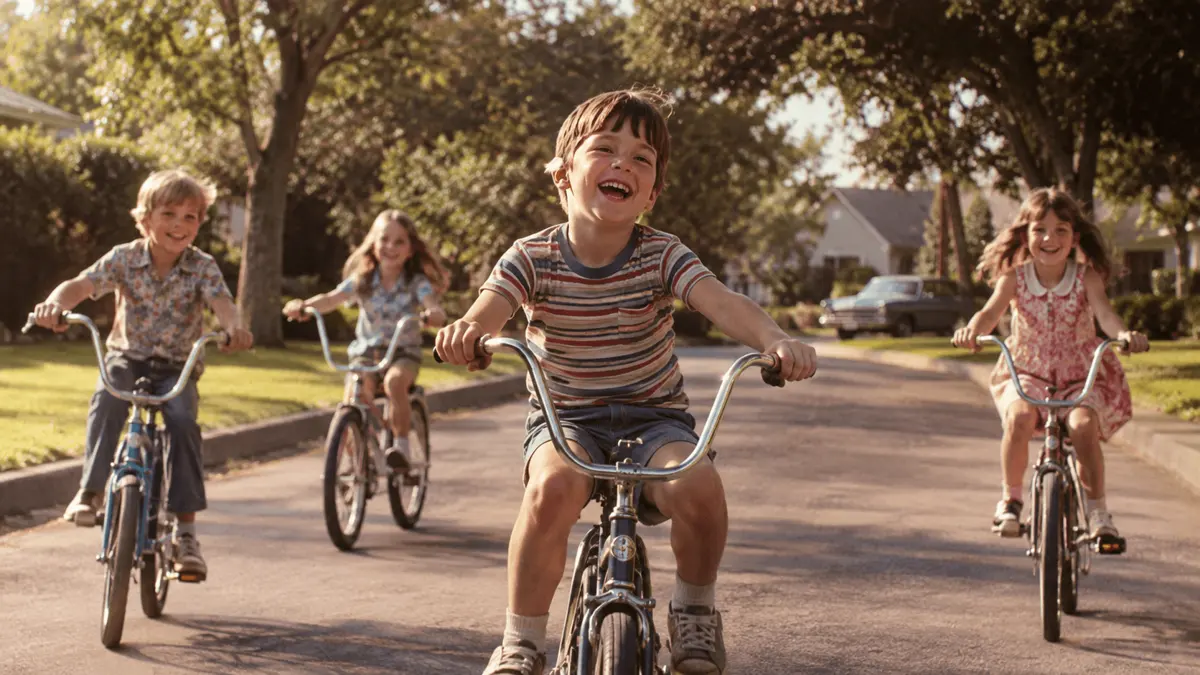
Playing outside without supervision, for example, required evaluating risks, managing small fears, and finding solutions on one's own in case of a fall or dispute. Walking several kilometers on foot to school, or crossing town by bike to visit a friend, trained a real tolerance for discomfort and mental endurance that's rare today.
These daily trips taught how to maintain a goal despite fatigue or weather, without questioning everything at the slightest difficulty.
Added to this freedom of movement was a life far less saturated with entertainment. Without smartphones or streaming platforms, boredom was part of the landscape. Baby boomers learned to spend entire afternoons inventing games, building forts, tinkering with whatever they had on hand. This "empty" time nourished a strong tolerance for boredom and lasting creativity, but also the ability to be alone with one's thoughts without constantly seeking distraction.
The Weight of Real Responsibility
In many households, children also participated in real tasks: watching younger siblings, preparing meals, running errands, mowing the lawn, or helping on the family farm. These useful chores built a solid sense of responsibility and what psychologists call an internal locus of control: the impression that one's actions have a real effect on the world.
Managing conflicts "in real life," without messaging or social media, occupied an important place as well. A dispute in class meant facing the other person's gaze the next day, sometimes apologizing in person, figuring out how to continue coexisting. This constant face-to-face confrontation with daily tensions developed refined social skills: reading body language, managing anger, the ability to say things directly.
When "No" Meant No
Hearing categorical "no's" from parents, without detailed explanations or systematic compromise, also played a role: it reinforced tolerance for frustration, meaning the ability to bear not getting what one wants without falling apart or dramatizing everything.
These seemingly small moments—the long walk to school, the afternoon spent inventing games, the chore done without reward, the direct confrontation after an argument—accumulated into something larger. They formed a psychological foundation that would prove invaluable decades later, when facing the inevitable challenges of aging, loss, and change. The strength people over 60 display today wasn't forged in adulthood. It was quietly built in childhood, one unsupervised afternoon at a time.