
World Online Ranking of Best Computer Scientists - 2026 Report

Co-Founder and Chief Data Scientist
For the 2026 edition, the Research.com team, led by Chief Data Scientist Imed Bouchrika, PhD., evaluated over 14,600 scientist profiles from multiple bibliometric databases. Selection was based on several metrics, including the D-index (Discipline H-index), with a threshold of 30 for most computer science publications. Additional criteria considered the proportion of contributions within the discipline, as well as notable awards, research impact, and professional accomplishments included in the report.
How computer science innovations are redefining the future of technology
Recent developments in computer science continue to reshape fields such as artificial intelligence, healthcare, and quantum computing. In 2025, new studies in quantum machine learning and related research papers reported that Quantum Neural Network (QNN) applied to meteorological datasets showed stronger adaptability to sudden atmospheric changes, particularly in short-term wind and temperature prediction tasks.
These findings suggest that hybrid quantum-classical systems may become useful in future climate modeling, although current limitations in hardware stability and quantum noise still restrict large-scale deployment.
Another important development in medical AI research is a tool called NEDA-DL that uses deep learning to examine MRI and PET images. The system is trained to look at brain scan data and spot early signs of Alzheimer’s disease that may be difficult for humans to detect at an early stage. It combines two types of AI models to improve accuracy and uses high-speed computing to process the images more efficiently.
These developments show that computer science is increasingly combining AI, advanced computing, and specialized data from different fields to address complex problems. Many of these tools are still being tested, but they are already improving how researchers analyze weather patterns, medical images, and other large datasets.
The key findings for the 12th edition of the best computer scientists ranking
- Computer scientists from the United States continue to dominate this year’s ranking report, with 529 leading researchers. China remains in second place, followed by the United Kingdom, Germany, and Canada among the top contributing countries.
- The top computer scientist in 2026 is Professor Yoshua Bengio from the University of Montreal in Canada, who has a D-index of 224.
- For the institutional ranking, MIT leads with 37 scientists, followed by Stanford University with 36 and Carnegie Mellon University with 34.
- The average Discipline H-index is 197.9 for the top 1% of scientists, compared to 100.12 for all 1,000 scientists in the ranking.
The full ranking for the 2026 list of best computer scientists can be found here:
WORLD’S BEST COMPUTER SCIENTISTS RANKING
Countries with the highest number of leading computer scientists
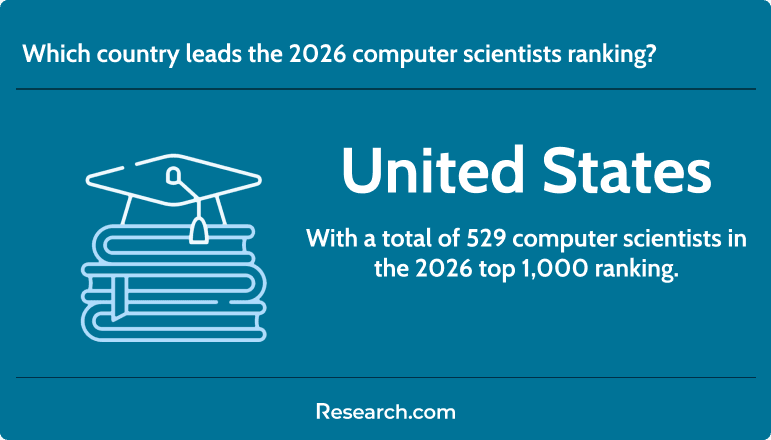
The United States maintained its position as the leading country in computer science research, with 529 scientists included in the top 1,000 ranking. Despite that, the country recorded a decline of 32 scientists from the previous year’s total of 561.
China retained the second spot and continued to strengthen its global research presence with 145 scientists, up from 131 in the previous edition. The United Kingdom remained third with 54 scientists, while Germany secured fourth place with 41 scientists, reflecting modest growth from last year’s 38. Canada saw a decline from 31 to 27 scientists but continued to hold the fifth position overall.
Several countries in the lower half of the top 10 experienced ranking shifts this year. Switzerland moved ahead with 26 scientists, while Australia followed closely with 24. Singapore maintained a strong presence in eighth place with 18 scientists, and Israel entered the upper tier with 16 scientists. France returned to the top 10 rankings with 12 scientists, replacing Belgium from the previous edition.
Within the top 1% of scientists, most researchers are based in the United States, followed by Germany, with Canada and Switzerland also represented. This shows that top research output is concentrated but still spread across several countries.
Please note that the country associated with a scientist is based on the affiliated research institution according to MAG, not on their actual nationality.
Institutions with the highest number of leading scientists
MIT ranks first in the 2026 list with 37 scientists, moving ahead of Stanford University and Carnegie Mellon University, which previously shared the top spot with 38 scientists each. Stanford now has 36 scientists, followed by Carnegie Mellon with 34.
The University of California, Berkeley has 27 scientists this year, down from 32 in the previous edition. Microsoft and Google remain strong, with 23 and 19 scientists.
For the 2026 ranking, the top positions are still dominated by U.S.-based universities and major technology companies. MIT, Stanford University, Carnegie Mellon University, Microsoft, and Google all appear among the highest-ranked institutions.
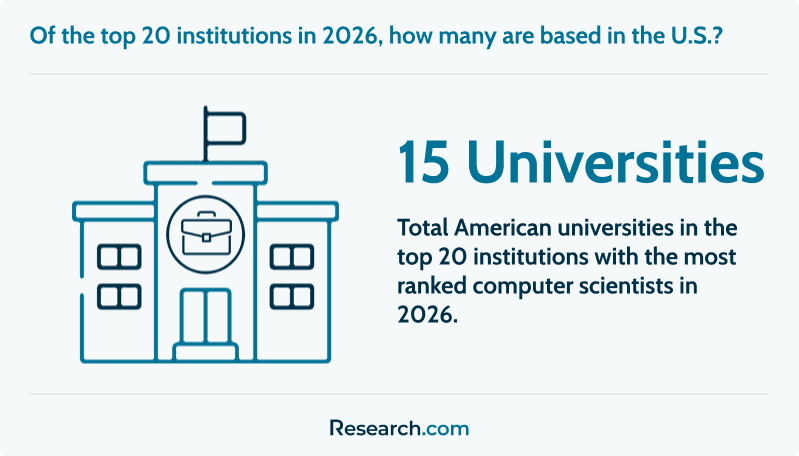
Among the top 20 institutions, 15 are based in the United States, while the remaining five include Tsinghua University and the Chinese University of Hong Kong from China, ETH Zurich and École Polytechnique Fédérale de Lausanne from Switzerland, and the University of Oxford from the U.K.
Online universities and shifting computer science enrollment trends
Online universities are supporting more computer science research by helping students and researchers work together across different countries. They use tools like virtual labs and online platforms to study areas such as artificial intelligence, data science, and cybersecurity. This connects online universities more closely with academic research in computer science.
In 2025, enrollment in Computer and Information Science programs in the U.S. declined, with undergraduate numbers falling by 8.1% to about 606,000 students and graduate enrollment dropping by 14% to around 190,000 students. Even with this decline, online and hybrid learning continue to grow as universities rely more on digital tools for teaching and research.
Online universities are also helping students move into related fields like data science and data analytics, which are still seeing stronger enrollment growth. Many traditional universities are also expanding their online programs to keep students engaged in computer science education.
H-index ranking—leaders, averages, and distribution
For North America, Professor Yoshua Bengio of the University of Montreal in Canada leads the region with a D-index of 224. His research focuses on artificial intelligence and deep learning systems.
In Europe, Professor Luc Van Gool of INSAIT in Bulgaria leads the region with a D-index of 200, reflecting strong work in computer vision and artificial intelligence.
For Oceania, Professor Rajkumar Buyya of the University of Melbourne in Australia ranks highest with a D-index of 171.
In Asia, Professor Dacheng Tao of Nanyang Technological University in Singapore leads the region with a D-index of 176.
For the Middle East, Professor Ian F. Akyildiz of the Technology Innovation Institute in the United Arab Emirates leads with a D-index of 141, with research focused on computer networks.
Across the dataset, the average Discipline H-index is 197.9 for the top 1% of scientists, compared to 100.12 for the full top 1,000 group.
For 2026, scientists in the top 1% of the ranking publish an average of 1,243.0 papers, compared with 530.94 for the full group of 1,000 scientists.
Their average citation count reaches 270,752.7, while the overall average across all scholars in the ranking is 58,203.21.
You can learn more about the methodology used to create this report here.
About Research.com
All research was coordinated by Imed Bouchrika, Ph.D., a computer scientist with a well-established record of collaboration on a number of international research projects with different partners from the academic community. His role was to make sure all data remained unbiased, accurate, and up-to-date.
Research.com is the number one research portal for science and educational rankings. Our mission is to make it easier for professors, research fellows, and students to progress with their research and find the top experts in a wide range of scientific disciplines. Research.com is also a leading educational platform that helps students find the best colleges, academic opportunities, and career paths.


