2027 Using Two Calendar Years of Employer Benefits for a Data Science Master's

Co-Founder and Chief Data Scientist
If your employer resets education benefits each calendar year, a data science master's that spans December and January may qualify for two annual benefit allocations. That can lower your out-of-pocket cost, but only if your program's charges, your employer's reimbursement rules, and the timing of payment line up. This guide helps working professionals determine whether a two-year strategy is feasible and what to confirm before committing to a program.
Key Things You Should Know
- A calendar-year reset can let you use employer education benefits in both 2026 and 2027, but enrollment across two years alone does not guarantee two reimbursements.
- In 2026, up to $5,250 of qualifying employer educational assistance is generally excluded from federal taxable wages per employee; your employer may reimburse less, more, or nothing.
- Before enrolling, confirm which date determines your benefit year, when grades and claims are due, and whether you can afford tuition while awaiting reimbursement.
How can you use two calendar years of employer benefits for a data science master's?
The strategy is to schedule eligible courses and reimbursement claims so that employer benefits are available in two separate calendar years. For example, a student might complete an eligible term in 2026 and another in 2027. The deciding detail is which event your employer assigns to each benefit year: course start, tuition charge, payment, course completion, claim approval, or reimbursement.
Ask benefits or payroll staff for the written rule before choosing courses. An employer that counts the reimbursement date may treat a December course paid back in January differently from one that counts the course's start date. Also check whether unused benefits expire on December 31, whether a new allocation becomes available on January 1, and whether eligibility requires continued employment on the reimbursement date. Do not accelerate courses merely to reach a second allocation if the workload would put your grades or continued eligibility at risk.
What employer tuition assistance benefits can help pay for a data science master's?
Employers may offer direct tuition payment, reimbursement after successful course completion, a fixed annual education allowance, or support limited to job-related study. Policies differ on graduate courses, required fees, books, accredited institutions, minimum grades, manager approval, and how long you must remain employed afterward. A federally tax-favored educational assistance program and an employer's actual promise to pay are not the same thing: the employer sets its own eligibility and reimbursement terms.
Request the plan document and written approval for the specific degree and courses. If employer support will not cover the full bill, compare scholarships and other financial support for data science graduate students without assuming that separate awards can be applied to the same expense twice.
How much can employer education benefits reduce your master's degree costs?
Your potential savings are the eligible charges your employer actually pays across both years - not automatically twice the federal tax exclusion. In 2026, Internal Revenue Code Section 127 generally allows up to $5,250 of qualifying employer educational assistance per employee to be excluded from federal taxable wages. If an employer provides that full amount in each of two years and the applicable limit remains the same in the second year, the combined excluded assistance would be $10,500. Confirm the later year's tax limit when it is published; an employer can also set a lower allowance.
To compare programs fairly, separate the costs below before subtracting confirmed employer support. The table identifies which costs may remain even when tuition is reimbursed.
| Cost component | What to include in your estimate |
| Tuition | Charges for the credits you expect to complete, including any published rate changes |
| Mandatory fees | Required student, course, technology, or graduation fees |
| Situational costs | Books, software, travel, or campus visits that apply to your program |
| Cash-flow and financing costs | Payments due before reimbursement and any borrowing costs |
| Opportunity cost | Work hours or earnings you would give up to study |
Subtract only benefits your employer has approved for the relevant expense and year. A lower-priced program may leave you owing less than a higher-priced program with the same benefit, so compare current online data science master's tuition options using total expected cost, not tuition alone.
How do you coordinate employer benefits with a data science program's payment schedule?
Schools usually bill according to academic terms, while employers may allocate benefits by calendar year. Reimbursement after grades are posted can leave a substantial gap between the tuition deadline and the date you receive money. Map both timelines before accepting an offer.
Use this sequence to test whether your proposed schedule actually captures both benefit years:
- Get the school's term dates, tuition due dates, refund policy, and expected dates for final grades.
- Get the employer's approval deadline, benefit-year definition, claim deadline, grade requirement, and reimbursement timetable in writing.
- Assign each planned course to the benefit year the employer - not the school - will use, and check whether enough eligible charges fall in each year.
- Confirm how you will pay each bill before reimbursement arrives; ask the school whether an employer-sponsored payment arrangement is available.
- Keep approvals, itemized bills, proof of payment, grades, and reimbursement records for each claim.
A common mistake is assuming a December course will consume the current year's allowance when the employer will not process it until after grades arrive in January. Another is assuming a university will defer payment simply because an employer has promised reimbursement. Resolve both issues before registering.
Are employer benefits for graduate education taxable income?
Qualifying employer educational assistance is generally excluded from federal taxable wages up to the applicable annual Section 127 limit, which is $5,250 in 2026. Graduate-level study can qualify; the tax exclusion does not require every course to relate to your current job. The employer must administer a qualifying plan, and the tax treatment of payments above the limit depends on whether another applicable exclusion is available. State tax treatment can differ.
Ask payroll how the benefit will appear on your pay records, particularly if reimbursements or other covered education payments cross calendar years. If your employer pays more than the annual exclusion or combines multiple education benefits, seek individualized tax advice rather than assuming the entire amount is tax-free.
Which data science master's programs qualify for employer tuition assistance?
There is no universal list. Your employer may require an accredited institution, a degree-granting program, a field relevant to your role, or advance approval for every course. Some policies cover an online program but exclude standalone certificates; others restrict approved providers. A university's admission offer does not establish employer-benefit eligibility.
Send benefits staff the institution and program names, degree designation, course descriptions, delivery format, and itemized tuition and fees. Ask for written confirmation of both program eligibility and each reimbursable expense. If approval depends on job relevance, explain how the degree's statistics, programming, and data projects apply to your work rather than relying on the words "data science" in its title.
How do online and campus-based data science master's programs compare?
For a two-calendar-year benefit strategy, the useful distinction is scheduling flexibility, not whether one format is inherently better. Online programs may make it easier to remain employed and select terms around a benefit reset, but live sessions, fixed course sequences, or intensive projects can still limit flexibility. Campus-based study may suit students who value in-person access, provided travel and class times fit their jobs.
Compare the published calendar, course availability, attendance rules, and expected completion pace. A faster degree is not necessarily cheaper after employer benefits: finishing all eligible charges in one benefit year could forgo a second allocation. When weighing a shorter AI-focused alternative, compare accelerated AI master's program options against the employer's reset rule as well as the curriculum you need.
What coursework do data science master's programs typically include?
Relevant courses often cover statistics, programming, data management, machine learning, and applied projects. For this decision, course content matters in two ways: it must meet your learning goals and, where required, make a credible case for employer approval. Review required courses and their term-by-term availability; a compelling elective will not help your funding plan if it is unavailable in the benefit year you need.
If you intend to work with clinical data, for example, assess whether the curriculum offers appropriate domain projects and responsible data-use training. Graduate AI pathways into healthcare analytics may be worth comparing, but confirm that your employer would fund the alternative credential before changing programs.
What admissions requirements apply to data science master's programs?
Requirements vary by institution. Programs may assess prior quantitative coursework, programming preparation, academic records, recommendations, and professional experience. Check the specific program's published prerequisites and application deadlines before building a benefits schedule: a delayed admission decision or required preparatory course may shift eligible tuition into another year. Do not assume preparatory courses themselves qualify for reimbursement.
Applicants from outside computer science should distinguish formal admission requirements from skills that would help them succeed after enrollment. If you are also considering an AI degree, review non-CS background options for an AI master's, then compare each program's actual prerequisites and your employer's approval rules.
What careers, salaries, and job growth can a data science master's provide?
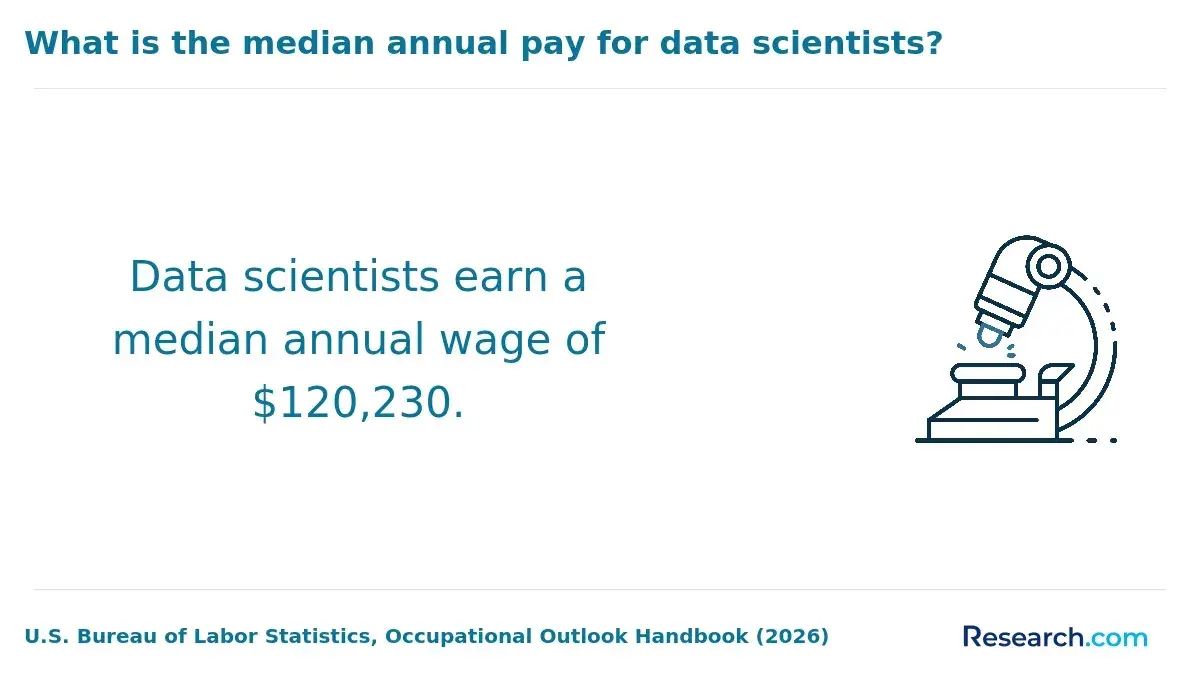
A master's can support preparation for data science and related analytical roles, but the credential alone does not establish eligibility for a particular job or guarantee a raise. According to the U.S. Bureau of Labor Statistics, the median annual wage for data scientists was $120,230 in May 2025. That is an occupation-wide figure, not an expected starting salary or a measured payoff from earning this degree.
BLS projects data scientist employment to grow 35% from 2025 to 2035. That outlook can justify examining the field, but your return depends on prior skills, work experience, location, target role, and what you pay after benefits. If you already work in analytics, consider whether the program would help you qualify for materially different responsibilities; if not, a less costly course or certificate may meet your goal without committing to a degree.
Other Things You Should Know About Data Science
Only if that employer's written plan covers spouses or dependents and your program meets its conditions. Many education benefits apply only to employees, so check before including this money in your budget.
Your plan may end future eligibility or require repayment of earlier assistance under a service agreement. Read the departure and repayment terms before accepting reimbursement.
Generally, you cannot use the same tax-free employer-paid expenses to claim an education tax credit. Other eligible expenses may qualify depending on your circumstances; consult current IRS guidance or a tax professional.
Possibly, but the program's leave, re-enrollment, course-sequencing, and maximum-completion rules control whether a pause is practical. Confirm those rules before relying on a break to reach the next benefit year.
References
- Frequently asked questions about educational assistance programs | Internal Revenue Service https://www.irs.gov/newsroom/frequently-asked-questions-about-educational-assistance-programs
- Data Science Master's Degree Fellowship | nih.gov https://card.nih.gov/job-training-opportunities/training-opportunities/data-science-masters
- 26 CFR § 1.6050S-1 - Information reporting for qualified tuition and related expenses. https://www.law.cornell.edu/cfr/text/26/1.6050S-1
- Guide to Tuition Reimbursement and Education Benefits | stanford.edu https://online.stanford.edu/guide-tuition-reimbursement-and-education-benefits
- Is a Master's in Applied Data Science Worth It? ROI & Payback Timeline | Eastern Connecticut State University https://www.easternct.edu/graduate-division/online/articles/is-a-masters-in-applied-data-science-worth-it/
- Strategic guide to tuition reimbursement - Purdue Business https://business.purdue.edu/graduate-programs/blog/posts/find-and-navigate-tuition-assistance.php
- Data Science Salary 2026: Trends, ROI & Career Guide | Syracuse University https://ischool.syracuse.edu/data-science-salary/
- Alumni Perspective: Do I Need a Master's Degree for Data Science? - School of Data Science https://datascience.virginia.edu/news/alumni-perspective-do-i-need-masters-degree-data-science
- and Ask For - Employer Tuition Reimbursement Benefits | Harvard Extension School https://extension.harvard.edu/blog/how-to-use-and-ask-for-employer-tuition-reimbursement-benefits/
- Is a Master's in Data Science Worth It? Explore the Facts. | Bellevue University https://www.bellevue.edu/articles/is-a-masters-in-data-science-worth-it/