
2027 Master's in Data Science vs. Master's in Biostatistics: Choosing Your Graduate Path

Co-Founder and Chief Data Scientist
A master's in data science and a master's in biostatistics can both lead to work with complex data, but they prepare you to answer different kinds of questions. The choice matters most if you are deciding between flexibility across industries and deeper preparation for health research. This guide compares the degrees on the factors that affect that decision: coursework, target roles, admissions preparation, format, cost, and evidence of program quality.
Key Things You Should Know
- Choose data science if you want to build predictive models or data systems across industries; choose biostatistics if you want statistical work centered on medical, public health, or clinical research.
- The U.S. Bureau of Labor Statistics (BLS) projects 35% employment growth for data scientists from 2025 to 2035, but that occupation-wide forecast does not predict outcomes for graduates of either degree.
- Compare required courses and projects before comparing degree titles: a health-data elective does not replace sustained biostatistics training, and a programming elective does not replace a data science program's computing depth.
What is the difference between a master's in data science and biostatistics?
Data science generally emphasizes extracting useful predictions or insights from varied datasets, often through programming, machine learning, and data engineering. Biostatistics applies statistical methods to health and life-science questions, where study design, uncertainty, and defensible interpretation are central. These are emphases, not exclusive boundaries: actual course requirements vary by program.
The distinction becomes clearer when you compare the work each degree is intended to support.
| Decision factor | Data science master's | Biostatistics master's |
| Typical questions | What can a model predict, and how can an organization use it? | What does a health study show, and how reliable is the inference? |
| Common emphasis | Computing, modeling, and working with data at scale | Study design, statistical inference, and health applications |
| Project fit | Building and evaluating an analytical workflow or model | Analyzing a clinical, epidemiologic, or other health-research question |
| Potential trade-off | Health-study methods may require additional coursework | Production software and data engineering may require additional coursework |
Some applicants want a middle ground rather than either specialization. Graduate-level data analytics programs are worth comparing if your goal is applied analysis rather than extensive machine-learning engineering or specialized health-research methods.
Which degree offers better career opportunities: data science or biostatistics?
Neither degree has universally better opportunities. Data science is usually the more adaptable choice if you want to pursue analytics or modeling roles across sectors. Biostatistics is more directly aligned with roles involving health studies, clinical trials, epidemiology, or life-science research. Employers may evaluate candidates by methods, programming ability, and domain experience as well as degree title.
Work backward from job descriptions. If the roles you want emphasize deployed models, software collaboration, and data pipelines, favor programs with substantial computing projects. If they emphasize study protocols, statistical analysis plans, or interpreting treatment effects, favor programs with rigorous inference and health-research coursework. A data scientist can work in healthcare, but access to health data does not, by itself, teach clinical study design.
How do data science and biostatistics salaries and job outlooks compare?
The BLS reports a $120,230 median annual wage for data scientists in May 2025. That is a U.S. occupation-wide figure, not a starting salary or an estimate of what a data science master's graduate will earn. Experience, location, employer, and job duties can materially change an individual offer.
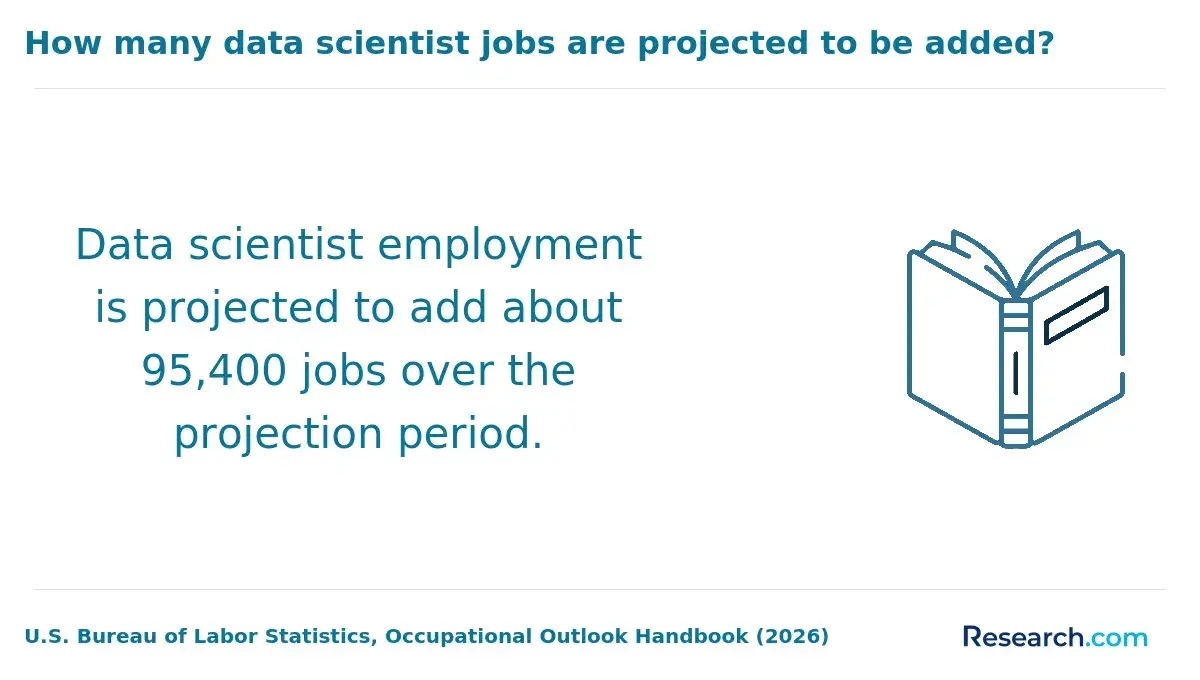
The BLS also projects 35% growth in data scientist employment from 2025 to 2035. This signals projected demand for the occupation, not guaranteed openings for new graduates. A direct degree-to-degree salary comparison is harder: "biostatistician" is not a separately reported occupation in the same BLS data scientist series, and broader statistician figures can include work outside biostatistics. For a fair comparison, examine compensation for the specific roles and locations you would pursue, rather than setting two differently defined occupational medians side by side.
What do you study in data science and biostatistics master's programs?
In a data science curriculum, look for the balance among statistical foundations, programming, machine learning, databases, and model evaluation. In biostatistics, look for statistical inference, regression, study design, and methods applied to health research. Both may teach coding and statistics; the difference is how much depth each requires and where students apply it.
Read the required-course sequence, not just the elective list. For a health-research goal, check whether students practice interpreting results in the context of a study design. For a model-building goal, check whether projects require reproducible code and evaluation beyond classroom exercises. If you expect to use sensitive health data or automated decisions, AI ethics coursework in master's programs offers another useful point of comparison; verify that the program you choose addresses the issues relevant to your intended work.
Are online or campus-based programs better for data science and biostatistics?
Format is a fit question, not a quality verdict. An online program may suit someone keeping a job or living far from campus; a campus program may suit someone who wants in-person research access and regular contact with faculty. In either format, confirm how students obtain project supervision, collaborate with peers, and access relevant datasets or research groups.
Ask whether courses are live or self-paced, whether exams require scheduled attendance, and whether a thesis, internship, or residency requires travel. If your interests are shifting toward AI development rather than either degree's core emphasis, faster online artificial intelligence master's degrees may be an alternative to investigate. A shorter advertised timeline is useful only if its workload and curriculum fit your goals.
What are the admission requirements for each master's degree?
Requirements differ by institution. Data science applicants may need to demonstrate programming and quantitative preparation; biostatistics applicants may need strong mathematics and statistics preparation. Neither a particular undergraduate major nor work in healthcare should be assumed to satisfy a program's prerequisites automatically.
Before applying, match your transcript and experience against each program's stated requirements. If you have a gap, ask admissions whether a specific course would formally satisfy it; self-study can improve readiness without necessarily fulfilling an admission requirement. Applicants coming from biology or public health should pay particular attention to mathematical preparation, while applicants coming from computing should examine their preparation in inference and study design.
How long do these master's programs take and what do they cost?
Neither degree title determines a standard completion time or price. Required credits, full- or part-time enrollment, course availability, and thesis or project requirements determine the practical timeline. Obtain each program's current published tuition and mandatory-fee schedule before making a financial comparison.
Compare like with like: calculate required credits multiplied by the applicable per-credit tuition, then add mandatory fees and any disclosed program charges. Separately budget for books or technology, travel if required, and income you may give up by reducing work hours. Do not compare one school's tuition-only quote with another school's full estimated cost.
Online machine learning master's cost limits can provide a benchmark if you are also considering an ML-focused alternative. They are not a price estimate for data science or biostatistics degrees; verify each prospective program's own total.
Which accreditation should you look for in either graduate program?
First, verify that the university holds recognized institutional accreditation. Then examine any specialized accreditation the school claims for the relevant program or school, confirming that its scope actually includes the degree you would enter. Do not assume that an accreditation attached to a public health school applies to every data science program at the same university, or that specialized accreditation is required for every job.
Accreditation establishes a form of external oversight; it does not establish that a particular curriculum fits your target role. Check the accreditor's current directory and ask the institution about accreditation status if its marketing language is unclear.
Do data scientists or biostatisticians need licenses or certifications?
There is generally no single professional license required for every U.S. data scientist or biostatistician. Requirements can change with the role: an employer, research setting, or separately regulated profession may impose training or credential rules that the degree alone does not meet.
Certifications may help demonstrate a particular tool or method, but they should be evaluated against actual job postings rather than treated as a substitute for sound statistical work or relevant projects. If your intended position has a regulated component, confirm its requirements with the applicable employer or authority before choosing a program.
How do you choose a reputable data science or biostatistics program?
Start with your target work, then compare programs on the evidence most likely to affect your ability to do it. A prominent university name or attractive course title is not enough if the required curriculum misses the methods you need.
Use these checks to narrow a shortlist before contacting admissions or faculty:
- Identify several target roles and note the methods, tools, and domain knowledge their job descriptions request.
- Map those requirements to required courses, advanced electives, and the kind of project students can actually complete.
- Verify institutional accreditation, current total charges, course scheduling, and any in-person obligations.
- Ask how faculty supervise projects and what career-support or research opportunities are accessible to students in your chosen format.
- Request clearly defined outcome information, if available; do not treat an unexplained salary figure or a small set of success stories as a typical result.
Choose data science when cross-industry modeling and computing depth are your priorities. Choose biostatistics when your intended contribution is designing or analyzing health research and explaining statistical evidence. If your target is primarily AI-specific, how to evaluate AI degrees for career fit can help you test whether a third path better matches the work you want to do.
Other Things You Should Know About Data Science
Yes, but the transition depends on your skills and target role. A data scientist moving into health research may need more study-design and inference training; a biostatistician moving into software-heavy roles may need stronger engineering experience.
Not necessarily. Compare required statistical courses, research expectations, and electives. A concentration's title alone does not establish the same methodological depth as a dedicated degree.
Potentially. Doctoral programs set their own prerequisites and research expectations. If a PhD is a serious possibility, favor rigorous theory courses, opportunities to work with researchers, and a substantial research project.
Only if you have permission and can comply with applicable privacy, institutional, and data-use rules. Public or appropriately authorized datasets are safer portfolio choices; never assume that removing names alone makes restricted data shareable.
References
- Healthcare data scientist qualifications, skills, and job focus | nih.gov https://pmc.ncbi.nlm.nih.gov/articles/PMC7787353/
- Annual Earnings by Educational Attainment - COE https://nces.ed.gov/programs/coe/indicator/cba/annual-earnings
- Statistics Data Science Curriculum | stanford.edu https://statistics.stanford.edu/academic-programs/graduate-programs/statistics-data-science-curriculum
- Types of Studies - Public Health Doctoral Studies (PhD and DrPH) - Research Guides at George Washington University https://guides.himmelfarb.gwu.edu/PhD/types-of-studies
- The Major Payoff: Evaluating Earnings and Employment Outcomes Across Bachelor's Degrees - CEW Georgetown https://cew.georgetown.edu/cew-reports/major-payoff/
- Statistical Data Science Major | Department of Statistics | UC Template 2014 https://statistics.uconn.edu/undergraduate/statistical-data-science-major/
- Study designs - Oxford Centre for Evidence-Based Medicine https://www.cebm.ox.ac.uk/resources/ebm-tools/study-designs
- Data Science - UCSD Catalog https://catalog.ucsd.edu/curric/DSC-gr.html
- Prerequisites for Statistics Graduate Program | oregonstate.edu https://stat.oregonstate.edu/prospectives/statistics-ms-and-phd/prerequisites
- MS in Biostatistics and Data Science | cornell.edu https://phs.weill.cornell.edu/graduate-education-clinical-training/masters-track/biostatistics-data-science


