2027 Safe Patient Handling Training: Equipment, Team Roles, and Competency Review
Audited and Verified:
Our Editorial and Data Verification Process
Research.com uses government datasets, official education statistics and primary institutional information to support its career and degree guides. Our review process checks factual accuracy, occupational definitions, source dates and the requirements associated with the credentials discussed.
How This Article Was Fact-Checked
Our editorial team verifies salary estimates, employment projections, education requirements and program information against original data providers and official organizations. Salary figures are checked against the relevant occupational definitions and reporting periods. Information about licensure, accreditation and required in-person training is reviewed separately.
Fact-checked and verified on:

Co-Founder and Chief Data Scientist
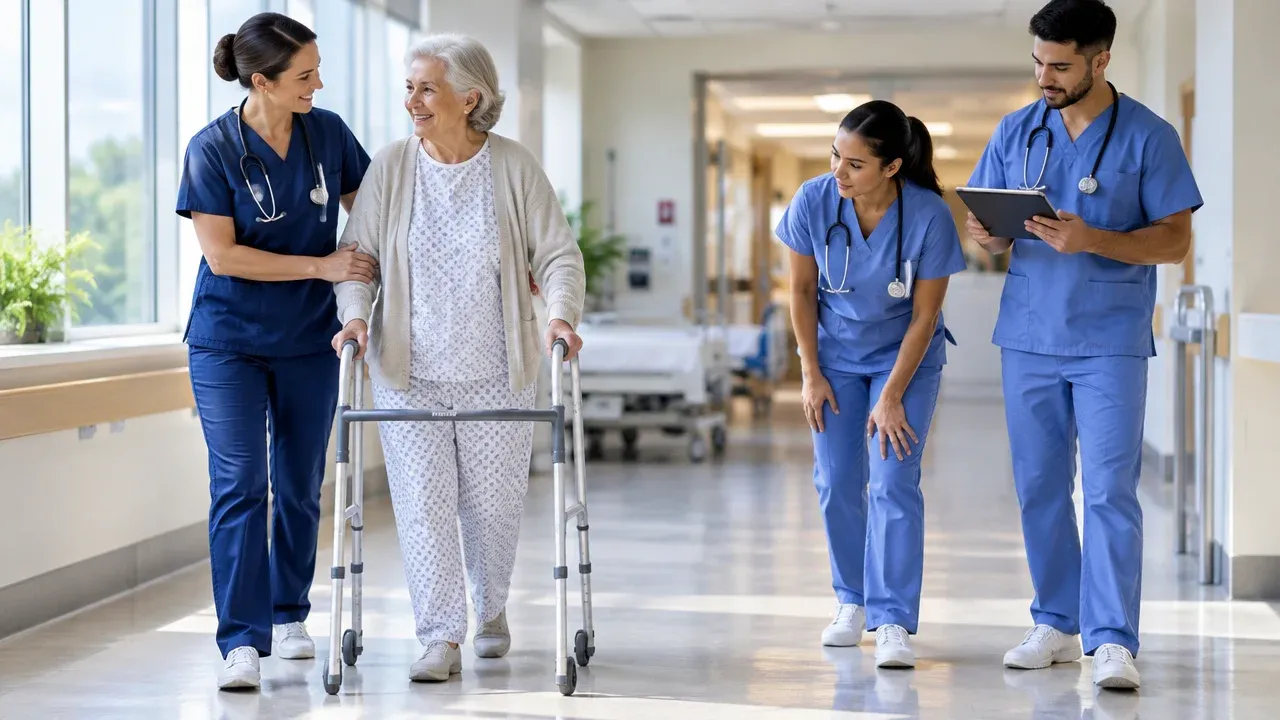
Knowing how to move a patient safely takes more than memorizing "proper body mechanics." Nursing students and new nurses must assess the patient's mobility, select appropriate equipment, coordinate the team, and demonstrate the skill under supervision. These decisions affect patient safety and staff injury risk in everyday care.
This guide explains what safe patient handling training should teach, how competency is checked, and what to ask a nursing program or employer before relying on its training.
Key Things You Should Know
- Safe patient handling training connects three decisions: what the patient can do, which device and staff are needed, and whether the planned move is safe to start.
- Common equipment includes powered lifts, sit-to-stand devices, transfer aids, and friction-reducing sheets; no single device suits every patient or transfer.
- Completion of a module is not proof of competence. Look for observed practice, equipment-specific assessment, feedback, and reassessment when a nurse changes units or devices.
What Is Safe Patient Handling Training in Nursing?
Safe patient handling training teaches healthcare workers to move, reposition, and assist patients while reducing avoidable harm to both patients and staff. It combines mobility assessment, equipment selection, communication, and practice under the facility's policies. It is not a promise that every transfer is risk-free, nor is it simply a lesson in lifting with the legs.
The starting point is the patient's condition: ability to bear weight and follow directions, balance, pain, lines or drains, and any change since the last mobility assessment. The plan may call for assisted movement, a mechanical device, or postponing the transfer while the team reassesses. Students entering nursing through a direct-entry nursing master's program guide should still expect supervised, hands-on instruction; a prior degree does not establish transfer competence.
What Equipment Is Used in Safe Patient Handling Programs?
Equipment choice depends on the task and the patient's assessed abilities. The following comparison helps distinguish devices students should learn to identify and use under instruction; actual indications come from the device instructions and facility policy.
| Equipment | Typical purpose | Key limitation to check |
| Full-body powered lift and compatible sling | Moving a patient who cannot safely perform the required standing transfer | Sling fit, attachment, weight rating, and device condition |
| Sit-to-stand lift | Assisting an appropriately assessed patient to rise and transfer | Whether the patient can participate as the device requires |
| Friction-reducing sheet or air-assisted device | Repositioning or lateral movement | Surface setup, device instructions, and team coordination |
| Transfer board, gait belt, or other transfer aid | Supporting selected assisted movements | Patient suitability and the aid's intended use |
A gait belt does not turn an unsafe manual lift into a safe one. Students should practice inspecting equipment and knowing where to find an alternative if a device is unavailable. That question also matters in advanced-practice placements: family NP programs that help arrange clinical placements do not determine which handling equipment a particular site provides.
What Roles Do Nurses and Team Members Have During Patient Transfers?
The responsible nurse assesses and communicates the patient's current needs, checks the applicable mobility plan, and escalates concerns when the planned transfer no longer fits. A nursing assistant or other trained team member may help within their role and facility policy. Rehabilitation professionals can advise on mobility goals and methods; the patient contributes preferences and information about symptoms or ability. Each participant needs to know the plan before movement begins.
For a complex transfer, the team should agree on who leads the count, operates the device, manages tubing or equipment, and watches the patient's response. Delegating a task does not remove the nurse's responsibility to use judgment and appropriate supervision. Even nurses considering accelerated FNP education comparisons need to distinguish advanced academic preparation from a facility's equipment training and assigned transfer roles.
Students commonly learn the principles in class, rehearse transfers with equipment in a skills lab or simulation, and then participate in patient care under clinical supervision. Simulation permits a pause to correct sling selection or communication; a real patient transfer adds changing symptoms, room constraints, and the need to follow the site's policy. Neither attendance nor a successful simulated move alone establishes readiness to work independently.
Ask when students first handle actual equipment, who observes them, and how they are taught to stop and seek help when the assessment changes. These questions are useful while exploring nursing schools with attainable requirements: ease of admission says little about the quality of supervised skills practice.
A meaningful assessment checks performance, not just recall. An instructor or designated evaluator should observe whether the learner assesses mobility, chooses and inspects an appropriate device, explains the plan, coordinates assistance, follows device instructions, responds to patient distress, and documents or escalates concerns as required. The exact checklist and passing standard belong to the school or employer.
Feedback should identify what to practice again. A nurse may also need reassessment after orientation, a change in patient population, or introduction of unfamiliar equipment. An RN-to-BSN pathway using applied projects may support safety-improvement work, but a project does not replace an employer's observed device competency.
Course names vary, but students often encounter mobility assessment in nursing fundamentals, equipment practice in skills lab, and application in adult-health or other supervised clinical courses. Concepts may also appear in patient safety, rehabilitation, and care of older adults. The useful question is not whether a catalog mentions "body mechanics"; it is whether students practice selecting equipment for different patient abilities and receive feedback on that choice.
For licensed nurses comparing nursing master's bridges for ADN graduates, prior bedside experience may provide familiarity, but the receiving program's coursework and a new employer's handling policies remain separate matters.
There is no universal safe patient handling certification that every US nurse must hold to perform transfers. Nurses must instead meet applicable licensure requirements and their employer's training, policy, and competency expectations. A course completion certificate, an optional professional credential, and observed authorization to use a specific facility device are different things.
If additional training is advertised, ask who awards it, what skills are actually assessed, and whether the intended employer recognizes it. This distinction also applies to nurses considering shorter psychiatric-mental health NP certificates: an academic certificate is not a substitute for local patient-handling orientation.
Online lessons can teach assessment principles, device features, and decision-making. Hands-on proficiency requires access to equipment, observation, and feedback, whether those occur in a campus lab, scheduled intensive, or approved clinical setting. A campus program likewise needs more than a demonstration students only watch.
Before enrolling, confirm where skills assessments occur, how often attendance is required, who supplies the equipment, and whether clinical sites train students on their own devices. "Online" does not mean transfers can be learned entirely at home or on an unrestricted schedule. The same scheduling check matters when comparing accelerated online PMHNP MSN programs, even though their academic focus differs from foundational handling instruction.
Compare programs by the training students can actually access, not by a general claim that safety is covered. Request a skills outline and ask how the school coordinates instruction with clinical-site equipment and policies. These questions help distinguish a credible plan from a catalog description:
- Which lifts and transfer aids can students practice with, and who observes their use?
- How are patient assessment, device selection, and stopping an unsafe transfer evaluated?
- What happens if a student misses a required lab or does not meet the competency standard?
- How are students oriented to unfamiliar devices at each clinical site?
Verify answers with the program for your entry term. Cost matters, but a lower advertised price does not resolve a gap in supervised training; that remains true when comparing lower-cost online PMHNP programs for later professional study.
What Career Benefits Does Safe Patient Handling Training Provide?
Training gives a new nurse a practical way to assess a transfer, request the right help, and recognize when the plan must change. It also supports clearer teamwork during orientation. It does not guarantee freedom from injury, higher pay, or immediate independence with every device and patient population.
When evaluating a first job, ask how long equipment orientation lasts, whether a trained helper is available on the shift, how damaged equipment is reported, and who reassesses a patient whose mobility declines. Those workplace supports may matter more to day-to-day practice than another degree. Nurses considering affordable master's progression for bachelor's-prepared RNs should make that educational decision for their target role, not as a replacement for unit-specific handling competence.
Other Things You Should Know About Nursing
Pause and ask about the concern, explain the proposed move, and notify the responsible nurse or clinician as appropriate. Respecting the patient's wishes does not make an unsafe manual transfer acceptable; follow the care plan and facility policy to identify another option.
Not necessarily. The team must check the patient's mobility needs and the rated capacity and compatibility of every component, including the sling. Size alone does not determine the safest transfer method.
Tell the supervising nurse or instructor and reassess the plan. Do not substitute an improvised manual lift for equipment that the assessment or site policy requires.
Follow the clinical site's reporting and escalation procedures, even if no injury is apparent. A near miss can reveal a problem with equipment, communication, or the transfer plan that needs attention.
- Patient Care Transfer Techniques - StatPearls - NCBI Bookshelf https://www.ncbi.nlm.nih.gov/books/NBK564305/
- Effectiveness of Safe Patient Handling Equipment and... - PMC https://pmc.ncbi.nlm.nih.gov/articles/PMC11382441/
- About Safe Patient Handling and Mobility | cdc.gov https://www.cdc.gov/niosh/healthcare/sphm/index.html
- Healthcare - Safe Patient Handling | Occupational Safety and Health Administration http://www.osha.gov/healthcare/safe-patient-handling
- Evaluation in Simulation-Based Education - The Nurse Educators' Guide to Simulation-Based Education https://pressbooks.montgomerycollege.edu/simulationeducationresources/chapter/evaluation-in-simulation-education/
- 5 things to consider when choosing a sit to stand lift for patient transfers | Arjo https://www.arjo.com/en-us/knowledge/blog/int/5-things-to-consider-when-choosing-a-sit-to-stand-lift-for-patient-transfers/
- Safe Patient Handling and Mobility | rehabnurse.org https://rehabnurse.org/about/position-statements/safe-patient-handling
- CCOHS: Safe Patient Handling Program https://www.ccohs.ca/oshanswers/hsprograms/patient_handling.html