2027 An Entry-Level Nursing Degree vs an Entry-Level Nursing Job: Two Different Meanings
Audited and Verified:
Our Editorial and Data Verification Process
Research.com uses government datasets, official education statistics and primary institutional information to support its career and degree guides. Our review process checks factual accuracy, occupational definitions, source dates and the requirements associated with the credentials discussed.
How This Article Was Fact-Checked
Our editorial team verifies salary estimates, employment projections, education requirements and program information against original data providers and official organizations. Salary figures are checked against the relevant occupational definitions and reporting periods. Information about licensure, accreditation and required in-person training is reviewed separately.
Fact-checked and verified on:

Co-Founder and Chief Data Scientist
"Entry-level" describes two different starting points in nursing: education designed for someone entering the profession and a job intended for someone beginning a particular role. Confusing them can lead you to enroll in the wrong program or apply for work you are not yet licensed to do. If you are choosing your first nursing pathway or preparing to apply for jobs, this guide explains which credentials lead to which roles, what happens between graduation and employment, and how to compare your options without paying for education you do not need.
Key Things You Should Know
- An entry-level nursing program prepares a newcomer for a credential; an entry-level job describes a hiring level. Neither phrase, by itself, identifies a license or legal scope of practice.
- Prelicensure ADN and BSN programs generally lead toward RN eligibility, while practical nursing programs lead toward LPN/LVN eligibility. CNA training is not a nursing degree or an RN pathway.
- An ADN commonly takes about two years of full-time nursing study and a traditional BSN about four years overall, but prerequisites and scheduling can change the timeline. Graduation alone does not authorize licensed practice.
What Is the Difference Between an Entry-Level Nursing Degree and an Entry-Level Nursing Job?
An entry-level nursing degree usually means a prelicensure academic route for someone who is not yet an RN, such as an associate degree in nursing (ADN) or a traditional bachelor of science in nursing (BSN). An entry-level nursing job means an employer is willing to consider applicants beginning that job. It may still require an active RN or LPN/LVN license, and "entry-level" at one hospital may not mean the same thing at another.
The distinction matters because education, permission to practice, and hiring are separate decisions. A school awards a degree or completion credential; a state regulator determines licensure; an employer decides whether you meet its job requirements and provides role-specific onboarding. For example, a newly licensed ADN graduate may qualify for a new-graduate RN position, while an experienced RN enrolling in an RN-to-BSN program is advancing academically rather than entering nursing for the first time.
If you are already an ADN-prepared RN, MSN bridge options for ADN-prepared RNs concern later academic advancement - not the qualification needed to begin RN practice. Start your search with the job title and required license, then work backward to the education that establishes eligibility.
Which Nursing Degrees Qualify Graduates for Entry-Level Nursing Jobs?
For a first RN job, the principal degree routes are a state-accepted prelicensure ADN/ASN or BSN program, followed by RN licensure. Some jurisdictions and employers also recognize approved hospital diploma routes. An accelerated BSN can serve applicants who already hold a non-nursing bachelor's degree, provided they meet its prerequisites; their earlier degree does not itself qualify them to work as an RN.
A degree title is not enough to establish eligibility. Check that the specific program and location prepare graduates for initial licensure in the state where you intend to apply. RN-to-BSN programs serve people who are already RNs; they are not substitutes for prelicensure education. Similarly, BSN completion programs using workplace-based projects address degree completion for licensed nurses, not initial RN clinical preparation.
For a first LPN/LVN job, the usual route is a state-approved practical or vocational nursing program, often awarding a certificate or diploma rather than a degree. A CNA role generally requires a state-recognized nursing assistant training and testing pathway, not a nursing degree. Match the program to the occupation you want before comparing degree names.
What Licenses and Exams Are Required for Entry-Level Nursing Jobs?
To practice as an RN, an applicant generally must meet the state board of nursing's eligibility requirements, complete an accepted RN program, pass the NCLEX-RN, and receive an RN license. LPN/LVN applicants follow the corresponding state process and take the NCLEX-PN. State requirements can also include an application, fees, and background review. Passing an exam is not the same as having an issued license.
Nursing assistants follow a different state-specific process, which commonly includes approved training, competency testing, and placement on a state registry or another form of state authorization. They do not take an RN or PN NCLEX exam. An employer may additionally require verification, health clearances, and demonstrated competencies before assigning patient care.
Do not confuse these first-license exams with later advanced practice requirements. Even when comparing 12-month family NP programs, the relevant applicant is already an RN considering further education; an NP program is not a shortcut around initial RN preparation, certification, or applicable state APRN requirements.
The useful comparison is not simply "which is fastest?" Each route targets a different first credential and set of responsibilities. The table shows the typical destination; program length and employer preferences vary.
| Pathway | Typical educational award | First credential sought | Best fit when your goal is... |
| Prelicensure ADN/ASN | Associate degree | RN license | Entering RN practice through an associate-degree route |
| Prelicensure BSN | Bachelor's degree | RN license | Entering RN practice with a bachelor's degree, including where an employer prefers one |
| Practical/vocational nursing | Usually a certificate or diploma | LPN/LVN license | Working in practical nursing within the state-defined scope |
| Nursing assistant training | Usually a training certificate, not a nursing degree | State-required CNA or nursing assistant credential | Providing delegated basic care and support under applicable supervision |
ADN and BSN graduates seek the same initial RN license; the degrees differ in academic scope, time, cost, and potential employer preferences, not in creating separate RN license classes. An LPN/LVN is a licensed nurse but does not have the same scope as an RN. A CNA is an important care-team member but is not an RN or LPN/LVN.
If RN practice is your firm goal, compare the full cost and time of ADN followed by optional BSN completion against a direct BSN. Choose an LPN/LVN route because that role fits your near-term goal - not on the assumption that every later RN program will award bridge credit. For a practical-nursing goal, assess LPN programs combining online learning and clinical training against your state's approval and in-person scheduling requirements.
Prelicensure RN programs combine sciences and nursing coursework with skills labs, simulation, and supervised clinical learning. Students typically study assessment, pharmacology, patient safety, infection prevention, clinical judgment, communication, documentation, and care across patient populations. Practical nursing programs cover relevant foundations and supervised care for the LPN/LVN role; nursing assistant training concentrates on basic care, observation, communication, and safety within the assistant's role.
The distinction between learning a skill and being ready to perform it independently is central. A student may practice recognizing a change in condition in simulation, then demonstrate assessment, communication, and escalation under supervision in a clinical setting. After licensure, the employer still evaluates setting-specific competencies during orientation.
Initial programs prepare generalist beginners rather than advanced practice specialists. For example, psychiatric NP MSN programs by duration address graduate preparation for an already licensed nurse; their specialized coursework cannot replace prelicensure foundations.
You may be able to complete some lectures online, but an initial RN or LPN/LVN pathway also requires approved hands-on learning. Labs, simulation, skills assessments, and supervised clinical experiences can require travel, fixed attendance times, or placement near your home. An "online" label therefore does not establish that the program is fully remote or compatible with a full-time work schedule.
Ask the program where each required clinical experience takes place, who secures placements, whether sites are available in your state, how often campus attendance is required, and what happens if a placement is delayed. These answers matter more than the proportion of recorded lectures. Postlicensure online programs have a different starting point: an existing nurse license. Even advanced nursing leadership doctorates online should not be mistaken for online initial RN preparation merely because both use remote coursework.
Requirements differ by school and route. ADN and BSN applicants may need specified science courses and labs, minimum grades, an entrance assessment, and a separate application to the nursing major. Accelerated BSN applicants typically need a prior bachelor's degree plus the program's prerequisites. Practical nursing and CNA programs set their own entry criteria. Before applying, confirm whether older science credits count and whether admission to the college also means admission to nursing.
An ADN is often described as roughly two years of full-time study and a traditional BSN as roughly four years overall. Those descriptions may exclude prerequisites, waiting for a cohort, repeated courses, or part-time enrollment. Practical nursing and nursing assistant preparation are generally shorter, but compare actual start-to-credential timelines rather than labels such as "fast track." If an entrance exam is your obstacle, review nursing programs that do not require TEAS scores while checking each program's other selection criteria.
For cost, request a written estimate covering the entire route: tuition and mandatory fees; books, equipment, uniforms, and technology; health and background requirements; travel to clinical sites; and examination and license applications. Add potential lost earnings if clinical schedules limit paid work. A lower tuition figure may not mean a lower total cost if a program takes longer or requires substantial travel. Graduate-level guides to nurse practitioner education address a later, licensed-RN decision and should not be used as price estimates for initial nursing education.
Check three separate questions before paying an enrollment deposit: Is the institution appropriately accredited? Does the specific nursing program hold applicable nursing program accreditation, such as ACEN or CCNE accreditation where relevant? And does the state board of nursing approve or otherwise accept that program for the initial license you seek? These are different determinations; one does not automatically establish the others.
Use the institution's and nursing accreditor's program records and the relevant state board's published information. Confirm the exact campus or delivery location, degree or practical-nursing track, and your intended licensing state. Ask the board or program for clarification if its status, out-of-state eligibility, or a newly launched track is unclear. For future study, the same habit applies when exploring faster online DNP routes, but a graduate program's status does not validate a separate prelicensure track.
Also request recent, clearly dated NCLEX outcomes and graduation information. Ask which cohort the results represent and how many students started and completed the program. A pass rate among test-takers alone cannot tell you how many entrants reached the exam.
Once licensed, a new RN may seek positions advertised as new-graduate or entry-level RN roles in settings such as hospitals, ambulatory care, long-term care, or community services. Duties vary by setting but can include assessment, planning and coordinating care, administering treatments within scope, documenting, and communicating changes in condition. A newly licensed LPN/LVN may pursue practical-nursing roles consistent with state law and employer policy. A qualified CNA may seek nursing assistant positions providing basic care and reporting observations to licensed staff.
Read postings for the required credential, not just "entry-level." Some units accept new graduates but require a structured residency or extended orientation; others require prior experience despite an entry-level-sounding title. Ask how preceptors, competency checks, staffing support, and escalation work during your first months. A first job should let you develop safe practice under appropriate support, not assume that clinical rotations made you independently ready for every specialty.
Later, an RN considering education for a different role can compare options such as a BSN-to-MSN program affordability guide. That is a separate decision from accepting a suitable first job; an MSN is not routinely needed to begin generalist RN work.
What Salary and Job Outlook Can Entry-Level Nurses Expect?
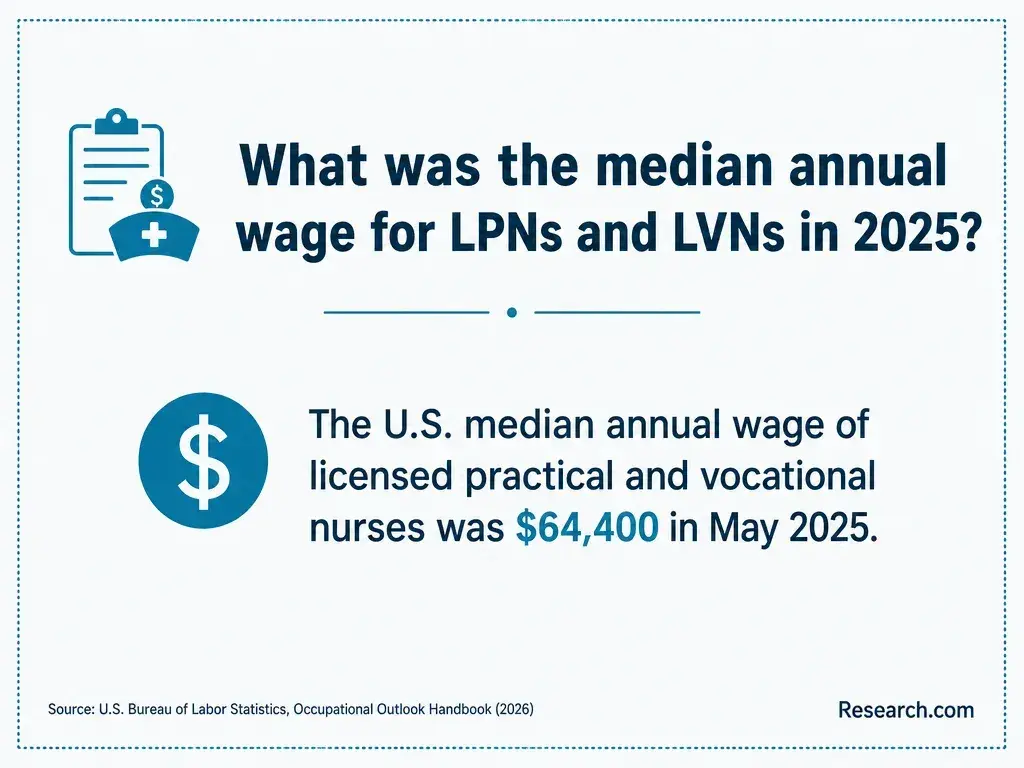
Use occupation-specific figures, not a single "nursing graduate salary." The U.S. Bureau of Labor Statistics reported a May 2024 median annual wage of $93,600 for registered nurses and $62,340 for licensed practical and licensed vocational nurses. These are medians across workers in each occupation, not starting offers or wage estimates by ADN versus BSN. CNA pay belongs to a different occupational category, so an RN wage should not be used to forecast CNA earnings.
BLS projections describe national employment across an occupation, not the likelihood of a new graduate finding a job in a particular city or unit. For a decision you are making now, check the latest BLS occupation profile and compare actual local postings by license, setting, shift, and experience requirement. Request pay ranges and orientation details from prospective employers; shift differentials, benefits, and hours can materially change an offer's value.
A higher wage in an advanced role should not be treated as the automatic return on an entry-level degree. For instance, planning the cost of nurse practitioner education would involve later graduate expenses and separate eligibility requirements, not just a comparison between an NP wage and a new RN's first paycheck.
Other Things You Should Know About Nursing
Often you can apply before graduation or licensure if the posting permits it. Ask when the employer requires proof of licensure and whether an offer depends on passing the NCLEX and receiving a license. Do not begin licensed RN duties before you are authorized to practice.
It is valuable supervised experience, but it is not employment as a licensed RN. List it accurately on applications and use examples from it to discuss your learning, communication, and safety habits.
No. A new-graduate nurse residency is employer-based transition support, not a substitute for a prelicensure program or a state license. Its length, supervision, and training content vary by employer.
No. It may qualify you to apply to certain accelerated nursing programs, subject to prerequisites, and your previous work may provide transferable skills. You would still enter licensed nursing practice as a new nurse.
- Registered Nurse (RN) License | Washington State Board of Nursing https://nursing.wa.gov/licensing/licensure-requirements/rn-license
- Licensure - Endorsement Information https://www.bon.texas.gov/licensure_endorsement.asp.html
- What You Need to Become a Registered Nurse in Texas | hc.edu https://hc.edu/articles/registered-nurse-in-texas/
- Nursing Roles | UAMS College of Nursing https://nursing.uams.edu/current-students/resources/nursing-roles/
- What is RN Degree? Is It Accurate to Say RN Degree? | beckfield.edu https://www.beckfield.edu/nursing-school/rn-degree/
- LVN vs RN: Complete Nursing Career Guide | American Career College https://americancareercollege.edu/blog/lvn-vs-rn-comprehensive-nursing-career-guide
- Difference Between CNA and LVN | Southern California Health Institute https://sochi.edu/what-is-the-difference-between-a-cna-and-an-lvn/
- The Levels of Nursing Practice in the Nursing Profession | ANA https://www.nursingworld.org/content-hub/resources/becoming-a-nurse/levels-of-nursing/
- Registered Nurse vs. Licensed Practical Nurse (RN vs. LPN) | allnursingschools.com https://www.allnursingschools.com/articles/registered-nurse-vs-licensed-practical-nurse/
- The Baccalaureate Degree in Nursing as Minimal Preparation for Professional Practice | aacnnursing.org https://www.aacnnursing.org/news-data/position-statements-white-papers/baccalaureate-degree-in-nursing-as-a-minimal-preparation