2027 RN-to-MSN Clinical Placement Policies for Nurses with a Non-Nursing Bachelor's Degree
Audited and Verified:
Our Editorial and Data Verification Process
Research.com uses government datasets, official education statistics and primary institutional information to support its career and degree guides. Our review process checks factual accuracy, occupational definitions, source dates and the requirements associated with the credentials discussed.
How This Article Was Fact-Checked
Our editorial team verifies salary estimates, employment projections, education requirements and program information against original data providers and official organizations. Salary figures are checked against the relevant occupational definitions and reporting periods. Information about licensure, accreditation and required in-person training is reviewed separately.
Fact-checked and verified on:

Co-Founder and Chief Data Scientist
An RN license and a bachelor's degree in another field may qualify you for an RN-to-MSN bridge, but neither credential tells you who will secure your graduate clinical placement. That distinction matters: a workable placement can determine whether you progress on schedule, especially if you study online or work full time.
This guide explains how schools approve sites and preceptors, what your prior degree may change, and which policies to obtain in writing before you enroll. You'll be able to compare programs by the clinical support they actually provide - not just by their advertised flexibility.
Key Things You Should Know
- An RN-to-MSN bridge generally requires an existing RN license; a non-nursing bachelor's degree does not replace initial nursing education or licensure.
- There is no single RN-to-MSN placement policy or universal clinical-hour total: site-finding responsibility, approved hours, and preceptor rules depend on the school and MSN track.
- Before enrolling, confirm in writing who finds sites, who approves them, where you may complete hours, and what happens if a placement falls through.
What Is an RN-to-MSN Program for Nurses With a Non-Nursing Bachelor's Degree?
For this reader, an RN-to-MSN program is a postlicensure route from an existing RN qualification into graduate nursing study. Some schools accept an associate degree or nursing diploma alongside a bachelor's degree in another subject. They may require undergraduate nursing bridge courses before MSN coursework, while others evaluate the two credentials together and prescribe a different sequence. The school decides which courses and credits apply; your prior bachelor's degree does not automatically fulfill upper-division nursing requirements.
Confirm the award sequence as well as the course sequence. A bridge may award an MSN without awarding a BSN, or it may offer a BSN along the way. If you already hold a bachelor's degree in nursing, you would ordinarily compare BSN-to-MSN options instead. If you are not an RN, an accelerated BSN or qualifying direct-entry program - not a postlicensure RN-to-MSN bridge - is the relevant starting point. For licensed associate-degree nurses comparing bridge structures, associate-degree RN to MSN options provide a separate route to investigate.
Can Nurses With a Non-Nursing Bachelor's Degree Enter an RN-to-MSN Program?
Yes, at schools that expressly accept an RN license plus a non-nursing bachelor's degree. Eligibility is program-specific: one school may admit you directly to an MSN bridge, while another may require an RN-to-BSN phase or reject a non-nursing bachelor's degree for that route. Admission to the university also does not guarantee admission to an NP, educator, or other particular MSN track.
Your earlier discipline can strengthen an application - statistics, teaching, management, and community-service experience may be relevant - but the nursing department must decide whether particular courses meet its requirements. Ask for a written review of transcripts and the resulting degree plan, including any missing sciences, nursing bridge courses, and clinical prerequisites. If you are still comparing entry requirements across nursing schools, understanding accessible nursing admissions can help frame that separate search; it does not establish eligibility for a specific graduate bridge.
How Do Clinical Placement Policies Work in RN-to-MSN Programs?
The central policy question is who is responsible for producing an approved placement. "Placement assistance" might mean introductions to sites, staff who contact potential preceptors, or a school-arranged assignment. None of those phrases alone guarantees a site near your home or a start date. The program's written policy should distinguish the student's search duties from the school's final approval and faculty oversight.
The following comparison shows why placement language matters more than a general promise of support. These are policy models, not guarantees that a particular school uses them.
| Policy model | What it typically means | Main risk to clarify |
| Student-identified site | You propose a site and preceptor; the program reviews them. | A willing preceptor may still fail program or site requirements. |
| School-assisted search | Staff provide leads or help with outreach; approval remains necessary. | Help may not extend to securing a confirmed position. |
| School-arranged placement | The program coordinates an assignment at an eligible site. | Travel, schedule, and preferred setting may be limited. |
For an APRN track, approval must cover the appropriate patient population, care activities, qualified preceptor, supervision, documented hours, and competency evaluation. An educator or leadership track may instead require an approved teaching or practice experience with different objectives. Ask whether hours at your workplace are allowed, whether a different unit or preceptor is required, and whether an employer conflict-of-interest rule applies. Do not start counting hours until the program has authorized the experience; employment shifts, volunteer work, and simulation are not automatically interchangeable with approved clinical hours.
If your goal is a non-APRN MSN and clinical access is the main obstacle, compare its actual practice requirements with RN-to-BSN programs without traditional clinical rotations. That alternative may meet a bachelor's-degree goal, but it does not replace graduate preparation required for a different role.
Programs commonly review an active RN license, prior nursing credential, non-nursing bachelor's transcript, grades, and readiness for graduate study. Requirements for statistics, anatomy and physiology, microbiology, or other sciences vary. A school may also specify minimum course grades, how recently sciences were completed, acceptable lab formats, and whether equivalent courses from your first degree count. Track-specific experience or recommendations may apply.
Clinical eligibility is a second checkpoint. Even after admission, a site may require health records, background screening, training, or other onboarding before it permits supervised practice. Obtain the admissions checklist and the clinical-readiness checklist for your intended entry term. If you are considering additional undergraduate nursing coursework, nursing schools with alternative admission assessments are a separate comparison; do not assume an undergraduate entrance-exam policy applies to an MSN bridge.
Online coursework does not make supervised clinical learning virtual. A student may complete approved hours locally, but the school must be willing and authorized to support that location, the site must accept the student, and the proposed preceptor must meet track requirements. Some programs restrict states or geographic areas; others require campus visits, in-person simulation, or scheduled live sessions in addition to local clinical work.
For working nurses, the useful scheduling question is not whether lectures are asynchronous. Ask when placements operate, whether daytime or weekday hours are likely, how far you may need to travel, and whether hours can be spread over a longer term. A fast advertised schedule - particularly for an NP track - can leave little room for a delayed site agreement. Compare that constraint when exploring fast-track mental health nursing graduate study; speed is valuable only if approved clinical access and course sequencing are feasible.
Check four separate matters: the institution's accreditation; the nursing program's accreditation and the scope covering the intended degree or track; the program's enrollment and clinical authorization in your state; and any education requirements set by the relevant certifier and state nursing regulator for your intended role. Nursing program accreditation may involve CCNE or ACEN, as applicable. An accredited school is not, by that fact alone, authorized to place you clinically in every state.
For an NP goal, ask the program to identify the exact population focus and explain how graduates meet the applicable certification and state APRN application requirements. A non-APRN MSN does not confer NP eligibility, and graduating from an NP program does not itself issue certification or an APRN license. If a later doctorate is part of your plan, a guide to DNP program admission accessibility addresses a different admissions decision; it cannot establish that an RN-to-MSN placement meets your current track's requirements.
Expect the degree audit to separate bridge work from graduate track work. Bridge courses may address upper-division nursing concepts, research or evidence appraisal, population health, and nursing leadership; the exact sequence depends on what your RN education and prior bachelor's degree already cover. Graduate courses and supervised experiences then follow the MSN concentration. For example, an NP track's advanced clinical preparation differs substantially from an educator track's teaching and evaluation work.
Ask which bridge courses must be completed before graduate enrollment, whether they carry undergraduate or graduate credit, and whether a BSN is awarded at any point. Those details affect both progression and future applications. Nurses who already have qualifying graduate preparation and seek a new population focus may instead investigate planning an accelerated PMHNP certificate; a certificate is not a shortcut that waives its own clinical and eligibility requirements.
There is no dependable single price or completion time for this applicant profile. Your transcript review determines how much bridge work remains; the MSN track determines its courses and supervised experiences. Part-time enrollment, course availability, site onboarding, and a delayed placement can extend the calendar even when the published curriculum looks short. Request a term-by-term plan tied to your evaluated credits rather than relying on an advertised fastest completion time.
Compare total cost using the same assumptions for every school: tuition and required fees for remaining credits; clinical compliance and onboarding expenses; travel or lodging for placements and campus visits; books and technology; and income you may forgo if clinical hours conflict with work. Ask how additional terms are charged and whether employer tuition assistance covers bridge-level courses. Lower-tuition BSN-to-MSN education options can offer a cost reference, but their published prices may not apply to an RN entering with a non-nursing bachelor's degree.
Outcomes depend on the MSN concentration, not merely the bridge label. An education track may support applications for teaching or staff-development roles; leadership and informatics tracks serve different functions and employer expectations. An NP track is intended to prepare graduates for its specified population-focus certification pathway, subject to the certifier's rules and state APRN requirements. Relevant RN experience, hiring criteria, and onboarding still matter in every case.
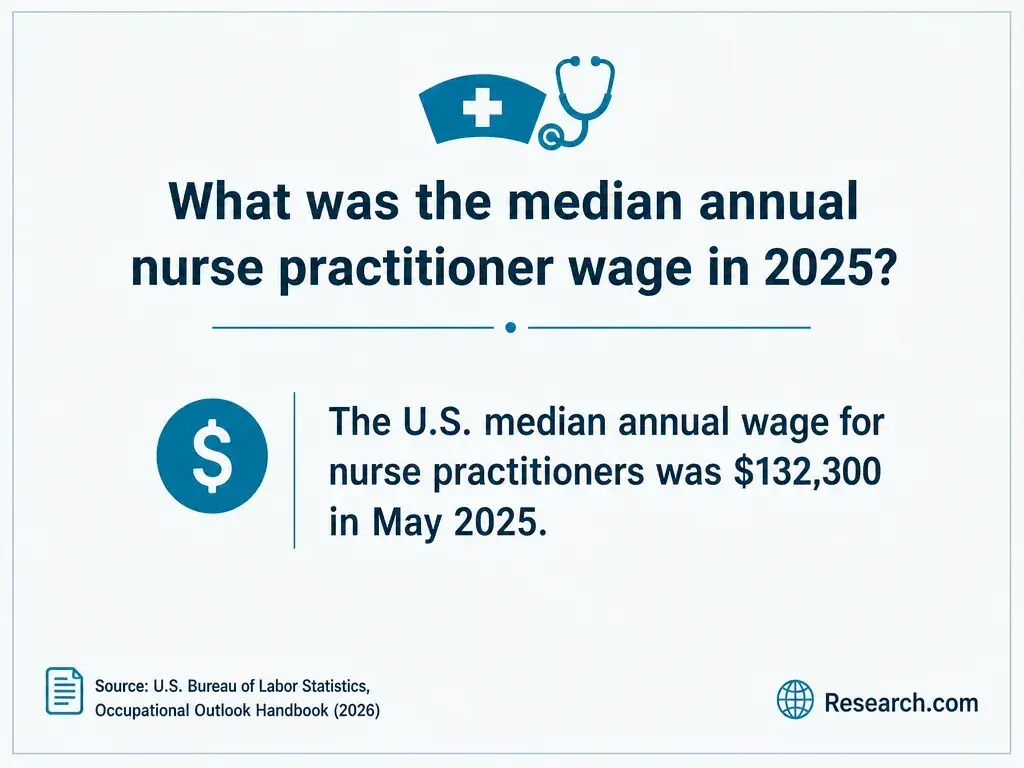
Salary comparisons should match the target occupation. U.S. Bureau of Labor Statistics wages for registered nurses or nurse practitioners describe people employed in those occupations, not the earnings of all MSN graduates or a guaranteed raise for completing a bridge. Compare local openings and pay for the role you intend to seek, then weigh them against tuition and potential lost work time. A compressed NP option, including 12-month family NP study schedules, is worth considering only if its clinical demands and subsequent credentialing steps fit your circumstances.
How Can Students Choose a Reputable RN-to-MSN Program?
Start with your intended role and the state where you expect to complete clinical work. Request the current catalog, a personalized degree audit, the track-specific clinical handbook, and written confirmation of state eligibility. Then compare schools on the terms most likely to affect completion:
- Confirm that the program accepts your RN credential and non-nursing bachelor's degree, and identify the exact degree awarded.
- Get the placement policy: who finds sites, who approves preceptors, which locations are permitted, and what support follows an unsuccessful search.
- Check whether the required experiences match the intended role and whether your employer can serve as an approved site.
- Compare term-by-term timing, required in-person attendance, and a total-cost estimate based on your evaluated credits.
- Verify accreditation scope, state eligibility, and any certification pathway with the responsible program and credentialing authorities.
If two programs make similar academic claims, a clear contingency policy for a lost placement may be more useful than a shorter advertised timeline. For an NP track, online NP tuition and fee considerations can inform the financial comparison, but clinical access and eligibility should be decided alongside price.
Other Things You Should Know About Nursing
Notify your clinical coordinator immediately. The program must decide whether completed hours count, approve any replacement, and explain the effect on your course timeline. Keep your documented hours and evaluations current.
Students can contact the school's disability services office to discuss reasonable accommodations and the process for coordinating them with clinical requirements. Approval depends on the circumstances; arrange the discussion before placement deadlines when possible.
Possibly, but leave, course-sequencing, and reentry rules differ. Ask whether a pause affects your reserved placement, required compliance records, financial aid, or the time allowed to finish the degree.
Do not make a private arrangement without the school's approval. Ask the program whether paid placement services are permitted, who contracts with the site, and whether any charge is included in its published cost estimate.
- 34 CFR Part 668 -- Student Assistance General Provisions | ecfr.gov https://www.ecfr.gov/current/title-34/subtitle-B/chapter-VI/part-668
- Become a Graduate Nursing Student Preceptor | Extended & Distance Education https://www.su.edu/nursing/become-a-nursing-preceptor/
- Nursing Transfer Credits | How to Apply | Chamberlain University https://www.chamberlain.edu/academic-resources/transfer-students
- Graduate Clinical Placements | Master of Science in Nursing Handbook 2025-2026 https://u.osu.edu/msnursinghandbook2025/clinical-requirements/specialty-clinical-locations-and-travel/
- Purdue Global Nursing Students: Tips to Find a Clinical Placement https://www.purdueglobal.edu/blog/nursing/how-to-find-clinical-placement/
- Transfer of Credit Policy | South University https://catalog.southuniversity.edu/transfer-of-credit-policy
- Second-Degree BSN | Texas A&M College of Nursing https://nursing.tamu.edu/degrees/second-bsn/index.html
- Section 4. Practicum Approval Process - Academic Guides | Academics at Walden University https://academicguides.waldenu.edu/nursing-practicum-manual/approval
- The Complete Guide to Nurse Practitioner Clinicals | Wilkes University Online https://onlinenursingdegrees.wilkes.edu/blog/nurse-practitioner-clinicals-guide
- More Than Disclosures: Understanding the State Oversight Layer in Nursing Program Compliance | WCET https://wcet.wiche.edu/frontiers/2026/03/19/nursing-program-compliance/