2027 Post-Master's AGPCNP Certificates for Nurses in Maryland: Gap Analysis and Primary Care Clinicals
Audited and Verified:
Our Editorial and Data Verification Process
Research.com uses government datasets, official education statistics and primary institutional information to support its career and degree guides. Our review process checks factual accuracy, occupational definitions, source dates and the requirements associated with the credentials discussed.
How This Article Was Fact-Checked
Our editorial team verifies salary estimates, employment projections, education requirements and program information against original data providers and official organizations. Salary figures are checked against the relevant occupational definitions and reporting periods. Information about licensure, accreditation and required in-person training is reviewed separately.
Fact-checked and verified on:

Co-Founder and Chief Data Scientist
An MSN or DNP does not automatically qualify you to practice as an adult-gerontology primary care nurse practitioner (AGPCNP). If you already hold a graduate nursing degree, the decision is whether a post-master's certificate can supply the population-focused coursework and supervised primary care experience your record lacks.
This guide is for Maryland nurses comparing certificate options, especially APRNs changing specialties and graduates of non-APRN tracks. It explains what to request in a gap analysis, how to assess clinical placements, and what to verify before committing to a program.
Key Things You Should Know
- A receiving school's formal gap analysis - not your degree title or years of practice - determines which prior courses and supervised hours it will accept toward its AGPCNP certificate.
- Expect review of the 3 graduate clinical foundations - advanced assessment, pathophysiology, and pharmacology - plus documented adult-gerontology primary care competencies and program-approved clinical experience.
- Graduation, national certification, and Maryland APRN authorization are separate steps. Confirm the certificate's eligibility for the AGPCNP examinations offered by ANCC or AANPCB before enrolling.
What is a post-master's AGPCNP certificate in Maryland?
A post-master's AGPCNP certificate is graduate preparation for an RN who already holds a qualifying graduate nursing degree and wants the adult-gerontology primary care nurse practitioner population focus. AGPCNPs prepare to provide ongoing care across adulthood and older age, including health promotion and management of common acute and chronic conditions. The certificate adds specialty preparation; it does not award another MSN or confer an NP license by itself.
Your starting point matters. An FNP or other certified APRN may have transferable graduate foundations but still need adult-gerontology-focused coursework and supervised care. An MSN-prepared nurse educator may need a more extensive NP sequence. An experienced RN without a graduate nursing degree generally needs a degree pathway first. Likewise, exploring RN-to-BSN nontraditional clinical formats addresses bachelor's completion, not the supervised NP preparation required for this certificate.
What are Maryland's requirements for AGPCNP certification and licensure?
The pathway has distinct decision-makers. The school determines certificate completion and documents educational preparation. The American Nurses Credentialing Center (ANCC) or American Academy of Nurse Practitioners Certification Board (AANPCB) determines eligibility for its adult-gerontology primary care NP examination and awards national certification. The Maryland Board of Nursing determines state authorization to practice as an APRN. Employers separately assess privileging and job-specific competence.
Before applying, ask the program to identify the certification examination its current curriculum supports and how it documents prior graduate courses and supervised hours. Check the certifier's current eligibility instructions and Maryland's current APRN application requirements directly; neither an existing RN license nor a school-issued certificate substitutes for those steps. An online practice doctorate for MSN-prepared nurses may serve a different goal, but a non-AGPCNP DNP track does not establish eligibility for AGPCNP certification.
Which Maryland schools offer accredited post-master's AGPCNP certificates?
The University of Maryland School of Nursing and Johns Hopkins School of Nursing are the most relevant Maryland-based schools to investigate for adult-gerontology primary care NP post-graduate study. Do not treat a school's AGPCNP degree track as proof that its corresponding certificate is accepting applicants. Certificate availability, eligible entry degrees, and course sequences can change by admission term.
This comparison identifies what each school must confirm for your proposed entry term; it is not a verified list of open certificate cohorts. Both schools report nursing-program accreditation through the Commission on Collegiate Nursing Education (CCNE), but applicants should verify that the relevant post-graduate certificate is within the accreditation scope and meets their certification and Maryland practice goals.
| Maryland school to contact | Certificate-specific confirmation to request |
| University of Maryland School of Nursing | Whether its adult-gerontology primary care NP post-master's certificate is accepting applicants; the written gap-analysis process; Maryland clinical-placement support. |
| Johns Hopkins School of Nursing | Whether its adult-gerontology primary care NP post-degree certificate is accepting applicants; eligible prior degrees; approved clinical geography and attendance requirements. |
Request a current curriculum and written certification-eligibility statement rather than relying on a general NP webpage. If your intended patients include children, online FNP certificate routes after an MSN may be worth comparing because FNP and AGPCNP are different population focuses.
Online delivery changes where you take didactic courses; it does not eliminate supervised primary care clinicals. An online or hybrid student may still have scheduled live classes, skills assessments, campus visits, and weekday clinical shifts. A campus-based option may make faculty contact easier but add commuting time. For a working nurse, the consequential distinction is often who arranges an approved preceptor and when clinical hours can be completed, not whether lectures are streamed.
Ask each school for a term-by-term attendance calendar, its clinical-site approval rules, and a written explanation of placement assistance. Confirm that it can enroll and place you where you live and intend to practice; Maryland-based enrollment does not itself guarantee approval of a clinical site in another state. Advertised speed in shorter online PMHNP certificate programs is not a useful proxy for AGPCNP clinical scheduling because the population focus and placement needs differ.
Programs require faculty-supervised, evaluated patient-care experiences that support adult-gerontology primary care competencies. Depending on the approved curriculum, sites may include outpatient primary care, geriatrics, or other appropriate longitudinal-care settings. The school decides which patients, sites, preceptors, evaluations, and hours meet its requirements, subject to applicable certification standards.
There is no dependable universal "remaining hours" figure for a post-master's applicant. A gap analysis must distinguish previously documented, supervised graduate clinical hours from RN employment, APRN employment, simulation, and informal shadowing. Even relevant prior NP hours may not cover the new population focus or be accepted by the receiving school.
Before paying a deposit, obtain the program's written answers to these placement questions:
- How many additional supervised direct-care hours and which patient populations does my individual gap analysis require?
- Who finds the site and preceptor, and who secures the affiliation agreement and faculty approval?
- Can I use my employer's clinic if a separate approved preceptor, appropriate learning activities, and unbiased evaluation are available?
- What happens to my course sequence and charges if an approved primary care placement is delayed?
Compare the entire clinical arrangement - not tuition alone - when considering affordable graduate pathways to NP preparation. A lower advertised price is less useful if placement delays add terms or travel.
A certificate typically addresses graduate-level advanced health assessment, pathophysiology, and pharmacology where prior work is insufficient, then adds adult-gerontology primary care diagnosis and management courses paired with supervised clinical practice. Content commonly includes health promotion, chronic disease management, age-related changes, prescribing principles, and care coordination. Actual course titles and sequence belong to the school's current curriculum.
The important question is equivalency, not whether an old transcript contains familiar course names. Faculty may examine syllabi, course level, credit, dates, and documented competencies before granting an exemption. For example, psychiatric-mental health NP management coursework is not interchangeable with adult-gerontology primary care management; comparing shorter MSN-PMHNP routes helps with a different intended role, not an AGPCNP gap.
Expect a school to assess your graduate nursing credential, RN license, academic record, and readiness for advanced clinical study. An existing APRN certification may be relevant, but it is not necessarily required for every post-master's applicant. Schools may also request references, a statement of goals, a résumé, and evidence that you can meet clinical-site screening requirements. Only the admitting program can say which requirements apply to your entry term.
For an efficient review, submit graduate transcripts, syllabi for the three advanced clinical foundations and relevant NP courses, clinical-hour logs with populations and settings, and any APRN certification documentation. Request the resulting gap analysis in writing, including remaining courses, clinical hours, and projected sequence. If you are not yet an RN, an accelerated BSN option beyond highly selective schools addresses initial nursing preparation; it does not provide direct entry into a post-master's AGPCNP certificate.
There is no responsible single Maryland timeline or price without a current school quotation and your gap analysis. The number and sequencing of remaining courses, clinical placement availability, and full- or part-time enrollment determine elapsed time. Compare schools using total remaining credits multiplied by the applicable tuition rate, then add mandatory fees and likely placement-related expenses. Ask whether a delayed clinical term triggers additional enrollment charges.
Build a personal estimate that includes tuition and university fees; books and technology; background checks and health clearances; travel or lodging for required visits; clinical commuting; certification and state application fees; and any income lost when clinical shifts replace paid work. Get each school's current rate and charge basis in writing. A fast-track DNP study option can be compared on time and cost only if you also want that degree and its specific track meets your AGPCNP objective; faster doctoral completion alone does not resolve a primary care clinical gap.
After meeting national certification and Maryland APRN authorization requirements, an AGPCNP may pursue adult primary care, geriatrics, chronic-care management, and related outpatient roles. Employers may additionally require experience, credentialing, prescribing-related approvals, and orientation to their patient population and systems. A certificate graduate should not assume that adult-gerontology primary care preparation qualifies them for an acute care NP position.
When comparing openings, check the actual patient ages, proportion of longitudinal versus acute care, preceptor or onboarding support, call expectations, and required certifications. If you hold an ADN rather than a graduate nursing degree, online ADN-to-MSN program comparisons address an earlier educational decision; confirm that any eventual graduate track includes the NP population focus you intend to practice.
What are AGPCNP salaries and job prospects in Maryland?
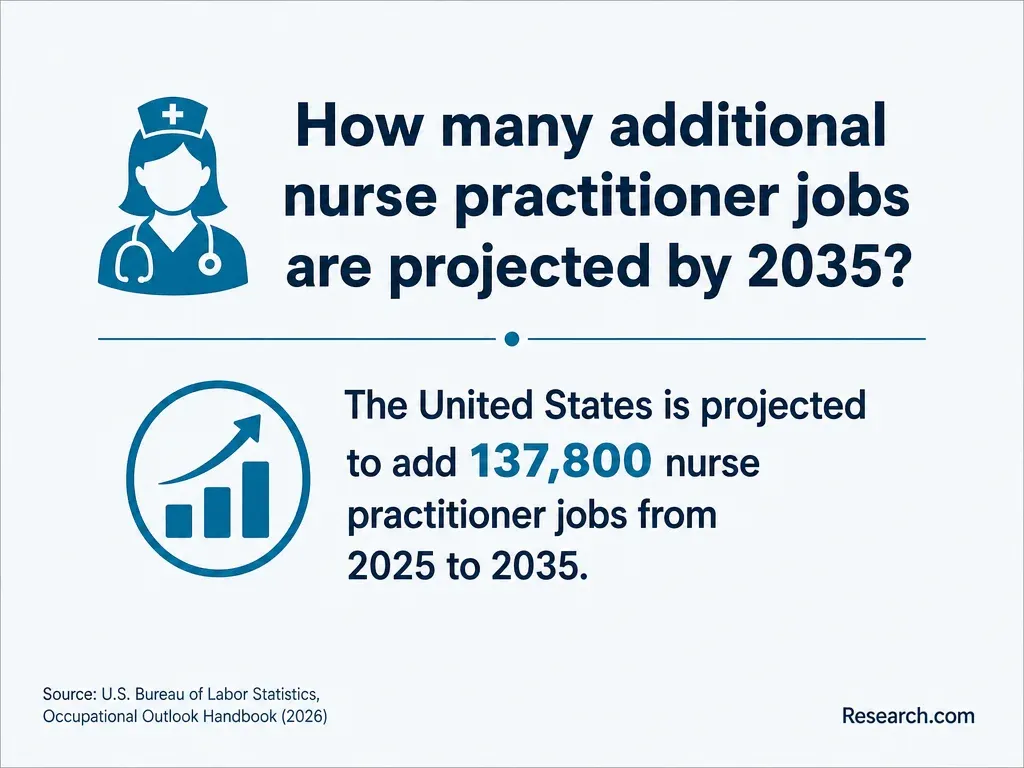
Maryland AGPCNP offers vary by setting, experience, schedule, responsibilities, and location. The U.S. Bureau of Labor Statistics reports wages for the broader nurse practitioner occupation, not a separate Maryland AGPCNP salary or a post-master's certificate wage premium. Its national nurse practitioner employment projections likewise describe the occupation as a whole. Use the latest BLS Occupational Outlook Handbook for national context and its Occupational Employment and Wage Statistics state estimates for a Maryland benchmark, then compare actual local postings and written offers for adult primary care roles.
A practical return-on-investment calculation compares your expected pay and schedule change with the certificate's full cost and any forgone earnings - not with the occupation-wide median. A BSN-prepared nurse considering less expensive MSN pathways after a BSN faces different education costs and eligibility steps than a nurse who already holds an MSN; the same NP wage statistic cannot predict either person's return.
Other Things You Should Know About Nursing
Not automatically. Check the patient's jurisdiction, your authorization to practice there, prescribing rules, and employer policies before providing care across state lines.
Adult-gerontology primary care preparation includes care beginning in adolescence, but confirm the certifier's defined population and an employer's age limits and privileging policy for the position.
No. A hospital or other facility makes its own credentialing and privileging decisions based on the proposed duties, preparation, experience, and applicable rules.
Potentially. Each credential has its own renewal requirements. Check both certifiers' rules and maintain the licenses and practice authority needed for each role you actually perform.
- .01 Definitions. | Library of Maryland Regulations https://regs.maryland.gov/us/md/exec/comar/10.27.03.01
- Advanced Practice Registered Nursing | Maryland.gov Enterprise Agency Template https://health.maryland.gov/mbon/pages/advanced-practice-index.aspx
- Cost of Attendance (Budget) | 2025-2026 Federal Student Aid Handbook https://fsapartners.ed.gov/knowledge-center/fsa-handbook/2025-2026/vol3/ch2-cost-attendance-budget
- Certification Procedures for Title IV of the HEA | ed.gov http://www.ed.gov/laws-and-policy/higher-education-laws-and-policy/higher-education-policy/ope-guidance-documents/frequently-asked-questions-certification-procedures-title-iv-of-hea
- Adult Gerontology Nurse Practioner (AGPCNP) Online Master's | Adelphi University https://onlineprograms.adelphi.edu/programs/ms-agpcnp-adult-gerontology-nurse-practitioner/
- Post-Master's AGPCNP Certificate - Nursing | Capella University https://www.capella.edu/online-nursing-degrees/nursing-certificate-programs/certificate-adult-gerontology-primary-care-nurse-practitioner/
- The Journey From Graduation to Practice for New Nurse Practitioners - ScienceDirect https://www.sciencedirect.com/science/article/pii/S1555415525003289
- Adult Gerontology Primary Care Nurse Practitioner | Edgewood University https://www.edgewood.edu/academics/programs/adult-gerontology-primary-care-nurse-practitioner-agpcnp-post-graduate-certificate/
- Post-Master's Adult-Gerontology Primary Care Certificate | Walden University https://www.waldenu.edu/online-certificates-programs/nursing-post-masters/adult-gerontology-primary-care-nurse-practitioner
- AANP vs. ANCC Certification: Which Exam Is Right for You? | Spring Arbor University https://online.springarbor.edu/news/what-you-should-know-about-aanp-and-ancc-exams