2027 Planning the Final Term of a Nursing Degree Program: Work Hours, Assessments, and Graduation Timing
Audited and Verified:
Our Editorial and Data Verification Process
Research.com uses government datasets, official education statistics and primary institutional information to support its career and degree guides. Our review process checks factual accuracy, occupational definitions, source dates and the requirements associated with the credentials discussed.
How This Article Was Fact-Checked
Our editorial team verifies salary estimates, employment projections, education requirements and program information against original data providers and official organizations. Salary figures are checked against the relevant occupational definitions and reporting periods. Information about licensure, accreditation and required in-person training is reviewed separately.
Fact-checked and verified on:

Co-Founder and Chief Data Scientist
The final term of a nursing degree can bring an unpredictable mix of clinical shifts, exams, job applications, and graduation deadlines. If you are finishing a prelicensure program - or balancing an RN-completion program with work - your schedule needs to account for requirements that cannot simply be moved to a convenient evening. This guide explains how to budget work hours, confirm assessments and clinical completion, and plan the steps between graduation and RN licensure. It also shows which program policies matter most when comparing pathways.
Key Things You Should Know
- Build your work schedule around required clinical days, assessments, and recovery time; there is no universal safe number of paid hours for a final-term nursing student.
- Confirm clinical-hour and competency sign-offs before making graduation plans. Completing coursework does not necessarily mean the school has cleared you to graduate.
- For initial RN licensure, plan separately for program completion, the state board application, NCLEX-RN authorization, and license issuance; each has its own timing.
What should you expect during the final term of a nursing degree program?
In a prelicensure ADN or BSN program, the final term often combines supervised clinical practice, simulation or laboratory work, remaining courses, and evaluations of clinical judgment and patient safety. An RN-to-BSN student already holds an RN license and may instead finish community-health experiences, a capstone, or other program-specific work. Your degree audit and current course syllabi - not a general description of the degree - define what remains.
Make one calendar with clinical dates, exams, assignment deadlines, required meetings, graduation clearance, and work shifts. Mark fixed obligations first: a clinical placement may set daytime, evening, or weekend hours that are not interchangeable with study time. Ask the program when it expects final grades and clinical evaluations to be posted, especially if an employer wants a start date.
Graduate pathways can have a different finish line. For example, comparing accelerated psychiatric nursing master's programs requires attention to specialty clinical and certification-related requirements, not just the academic calendar. Those requirements should not be confused with the final-term obligations of an initial RN program.
How many hours can nursing students work during their final semester?
There is no reliable hour limit that fits every student. The workable number depends on your clinical roster, commute, caregiving, course load, finances, and whether your employer can change shifts at short notice. Start with the hours you must be available for school, then allow time for preparation, sleep, travel, and unexpected clinical or assessment changes before accepting paid shifts.
Use a two-week calendar rather than an average week. Record the longest clinical day and its travel time, then test whether proposed work shifts leave adequate time to rest and prepare for the next supervised shift. If the plan only works when nothing changes, ask for fewer hours, a predictable schedule, or a temporary leave arrangement. Students supporting a household should also check how reduced earnings and enrollment intensity affect their budget and aid.
Flexible coursework can help without making clinical practice flexible. An LPN/LVN considering LPN-to-RN programs with online coursework should still ask who assigns clinical shifts and whether the program permits employment and clinical hours at the same site. Paid nursing work does not automatically satisfy supervised degree requirements.
What assessments must nursing students complete before graduation?
Expect the school to check both academic performance and demonstrated clinical competence. Depending on the program, final requirements may include course exams, a capstone, simulation assessments, clinical evaluations, documentation, medication-safety checks, and an exit or NCLEX-readiness assessment. An exit assessment is a school requirement where adopted; it is not the NCLEX-RN or an RN license.
Review the written progression policy for each assessment: the passing standard, number of attempts, remediation process, appeal route, and deadline for posting a final result. Ask faculty how an incomplete clinical evaluation or an unsuccessful assessment affects the degree-conferral date. This is more useful than assuming that passing every classroom course guarantees graduation clearance.
Assessment rules also change with the qualification. For instance, accelerated mental health NP certificate study is intended for eligible nurses pursuing additional graduate preparation; its specialty evaluations are not substitutes for prelicensure RN assessments.
Clinical completion can determine whether you graduate on the expected date. A course may require approved hours, specific experiences, satisfactory competency evaluations, and faculty or preceptor sign-off. Missing a shift because of illness or a site cancellation can require a make-up opportunity that depends on site capacity and the school's calendar. Simulation or paid employment counts only when the program and applicable regulator accept it for the particular requirement.
Ask the clinical coordinator when final hours and evaluations must be submitted, who arranges make-up time, and what happens if a placement ends early. Keep your own accurate record of completed experiences while following the school's documentation and patient-privacy rules. If a requirement is at risk, contact faculty promptly rather than waiting for the last week of term.
The same scheduling principle applies beyond initial RN education: post-master's family NP clinical training requirements involve a distinct, program-approved advanced-practice pathway. Prior RN work or prelicensure clinical hours should not be assumed to replace its supervised specialty experiences.
Begin checking the licensing process during your final term, but follow the board of nursing in the state where you seek initial licensure. Students generally need to apply to that board and register for the NCLEX-RN through the examination administrator. The board determines eligibility; an authorization to test comes only after applicable requirements are met. Ask your school when and how it reports completion, and check the board's instructions before paying fees or choosing an exam date.
A practical timeline has separate milestones: submit an application when your board permits it, arrange any required background-check materials, verify that the school has reported completion, wait for authorization to test, then schedule the examination. Passing the NCLEX-RN is not the same as receiving an active license; confirm license status with the board before practicing as an RN.
Students entering nursing through accelerated direct-entry nursing master's pathways should verify exactly when their program establishes eligibility for initial RN licensure. A master's-level program title alone does not establish NCLEX-RN eligibility or authorize practice.
Compare the schedule you will actually live, not just the delivery label. Online lectures may be asynchronous while simulations, exams, labs, and supervised clinical placements occur at fixed times and locations. A campus-based program may offer a more predictable clinical network near home; an online program may reduce commuting for coursework but require travel or student-arranged placements. Request a sample final-term calendar and ask who secures clinical sites.
The distinction is especially important for working parents and employed RNs. Some RN-to-BSN pathways without standard hospital rotations use other practice-based assignments, which may fit an RN's schedule better. That does not mean they have no experiential requirements, and it does not describe a prelicensure program preparing someone for initial RN practice.
Check three different questions: Is the institution accredited by a recognized institutional accreditor? What is the accreditation status and scope of the specific nursing program, where applicable? Is the prelicensure program approved or recognized by the relevant state board for the intended RN-licensure pathway? Nursing program accreditors such as ACEN and CCNE have different scopes, while state boards control licensure eligibility under their rules. None of these checks replaces the others.
Verify the exact campus, degree, track, and location with the school, accreditor, and board rather than relying on a general university claim. Also ask whether the school can enroll you and arrange required clinical education where you live. If you are reviewing nursing schools with flexible admission criteria, treat admission selectivity and licensure preparation as separate decisions; easier entry does not establish approval or a workable graduation schedule.
A traditional prelicensure BSN is commonly planned as a four-year undergraduate route, while an ADN is often described as a two-year nursing pathway; prerequisites, admission queues, repeats, and clinical sequencing can lengthen either. Accelerated BSN, bridge, and RN-to-BSN timelines depend heavily on prior credit and enrollment pace. If you are already in the final term, the useful number is your remaining cost and the financial effect of a possible extra term - not an advertised whole-program estimate.
Compare schools using a written remaining-cost estimate that includes tuition and mandatory fees, books and equipment, clinical travel, background or health-clearance costs, exam and licensure expenses, and earnings you may forgo by reducing work. Ask whether an incomplete clinical requirement triggers another course charge and how part-time enrollment affects aid. A shorter advertised program is not necessarily less expensive if it limits paid work or requires travel.
For an RN considering later graduate study, an online nurse practitioner affordability guide can frame additional cost questions. Graduate NP pricing and supervised clinical expenses should not be folded into the cost of finishing an initial nursing degree.
Graduates of an approved prelicensure pathway may pursue RN licensure, then seek entry-level registered nurse positions in settings such as hospitals, ambulatory care, and community services. Employers determine hiring and orientation requirements, and a new graduate still needs supervised onboarding and setting-specific competency development. An RN-to-BSN graduate already has an RN license; the additional degree does not create a new license or guarantee a promotion.
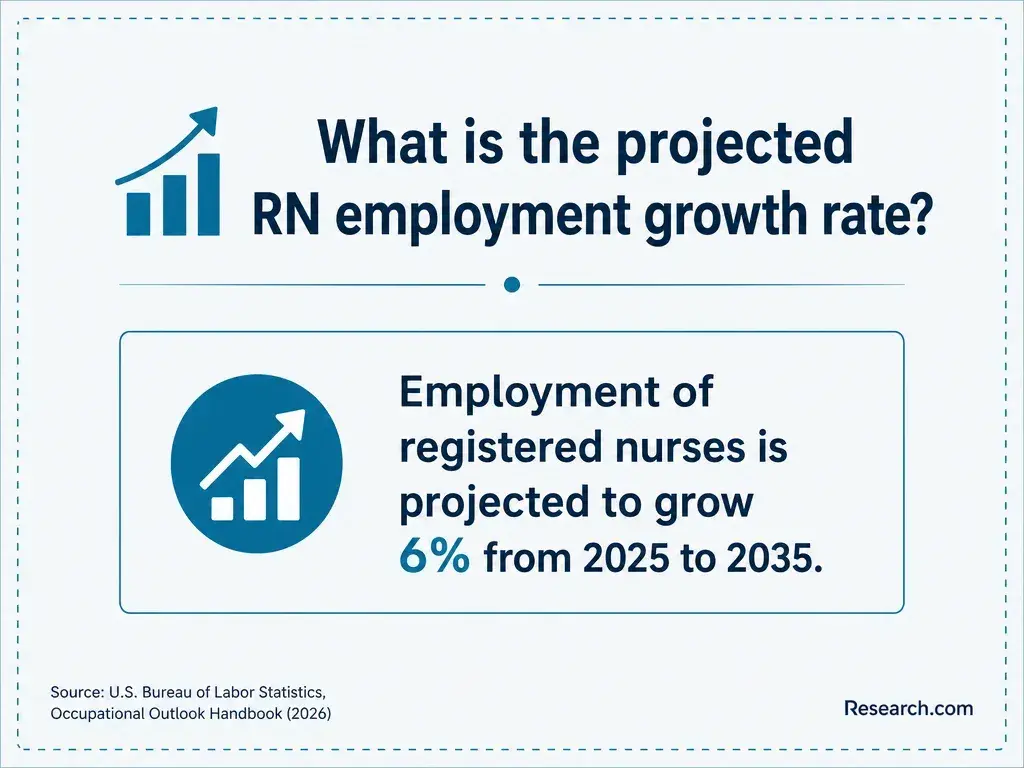
For pay and demand, use the U.S. Bureau of Labor Statistics' registered nurse occupation data as a market benchmark, then compare actual local offers. An occupation-wide median includes experienced nurses and varied settings; it is not a predicted new-graduate salary or a return on a particular degree. When evaluating an offer, weigh base pay alongside shifts, orientation length, preceptor support, staffing, and any repayment conditions attached to a bonus.
An ADN-prepared RN considering future advancement can explore MSN bridge options for ADN-prepared RNs, but graduate study is not necessary simply to start practicing in an RN role. The appropriate next credential depends on the intended job and its actual education and licensing requirements.
How can you choose a nursing program that supports licensure?
For a prospective prelicensure student, work backward from the state where you intend to seek your first RN license. Confirm the program's board status and ask for its written explanation of that state's eligibility pathway. Then examine the final-term details that can determine whether you finish on time: clinical-placement responsibility, required attendance, course sequencing, assessment and remediation rules, and when the school reports completion to the board.
Request published completion and NCLEX-RN results with the reporting year and cohort size. Use them as questions to investigate, not as a promise of your outcome; ask what happens to students who need to repeat a course or wait for a placement. If you are considering an accelerated second-degree route, understanding ABSN admission barriers is useful, but admission is only the first checkpoint. Choose a program whose documented clinical and graduation process you can realistically complete alongside your financial and family obligations.
Other Things You Should Know About Nursing
Possibly. Schools may let students participate in a ceremony while final requirements are pending. Commencement participation does not establish degree completion or NCLEX-RN eligibility; check the school's degree-conferral record.
It can. Aid eligibility may depend on enrollment intensity and whether courses apply to your degree. Ask the financial aid office to review your actual final-term schedule before reducing credits or adding an unrelated course.
Employers may make offers contingent on graduation, licensure, and other checks. Get the start-date and contingency terms in writing, and do not practice as an RN until the applicable board has authorized you to do so.
Contact your school's disability services office as early as possible to learn its documentation and approval process. School assessment accommodations and NCLEX accommodations are separate processes with their own requirements.
- 18VAC90-27-100. Curriculum for direct client care. | virginia.gov https://law.lis.virginia.gov/admincode/title18/agency90/chapter27/section100/
- Requirements | NYU Rory Meyers College of Nursing https://nursing.nyu.edu/current-students/clinical-affairs/requirements
- Assessment and evaluation: Nursing education and ACEN accreditation - ScienceDirect https://www.sciencedirect.com/science/article/pii/S1557308723001142
- Applying to Take the NCLEX | DePaul University - Chicago, IL https://csh.depaul.edu/academics/departments-schools/nursing/student-resources/applying-to-take-the-nclex
- What BS in Nursing Students Should Know About Clinicals | University of Colorado Anschutz Medical Campus https://news.cuanschutz.edu/nursing/what-bs-in-nursing-students-should-know-about-clinicals
- Utica ABSN Program: A Day in the Life of a Nursing Student https://acceleratednursing.utica.edu/blog/utica-absn-program-a-day-in-the-life-of-a-nursing-student/
- Degree Completion Conferral | The Chicago School https://www.thechicagoschool.edu/commencement/degree-completion-conferral/
- NURSING STUDENT HANDBOOK | Ocean County College - https://www.ocean.edu/nursing-student-handbook-spring-2026-website/
- Degree Conferral & Commencement | iu.edu https://facultystaffcentral.indianapolis.iu.edu/programs/conferral-commencement/index.html
- Clinical Placement Standards, Compliance, and Expectations | Current Students https://students.nursing.uw.edu/policies/policy-3-1-clinical-placement-standards-compliance-and-expectations/