2027 Paying for an Online BA in Psychology - Addictions: A Hospital's Education Assistance Policy
Audited and Verified:
Our Editorial and Data Verification Process
Research.com uses government datasets, official education statistics and primary institutional information to support its career and degree guides. Our review process checks factual accuracy, occupational definitions, source dates and the requirements associated with the credentials discussed.
How This Article Was Fact-Checked
Our editorial team verifies salary estimates, employment projections, education requirements and program information against original data providers and official organizations. Salary figures are checked against the relevant occupational definitions and reporting periods. Information about licensure, accreditation and required in-person training is reviewed separately.
Fact-checked and verified on:

Co-Founder and Chief Data Scientist
If you work at a hospital, an online psychology degree with an addictions focus may be easier to afford - but only if your program, courses, and employment status meet the hospital's education assistance rules. The advertised tuition is not necessarily what you will pay, and reimbursement may arrive after a bill is due. This guide shows you how to check the policy, calculate your likely out-of-pocket cost, and decide whether the degree supports your next role or whether a more direct qualification would serve you better.
Key Things You Should Know
- A hospital may cover approved tuition through direct payment or reimbursement; eligibility, annual limits, grades, and repayment obligations depend on its written policy.
- Under Internal Revenue Code Section 127, qualifying employer educational assistance is generally excluded from an employee's taxable income up to $5,250 per calendar year; that tax limit is not a promise that the hospital will pay $5,250.
- Get a degree audit, itemized charges, course schedule, and written employer approval before enrolling. An addictions concentration does not, by itself, qualify you to provide counseling or psychotherapy.
What is an online bachelor's degree in psychology with an addictions concentration?
It is an undergraduate psychology degree that combines broad study of behavior and psychological research with additional coursework on substance use, prevention, recovery, or service systems. A concentration is a defined set of requirements within a degree - not a separate counseling credential. Schools may offer similar subject matter as electives rather than an officially named concentration, so check what will appear on your academic record.
For a hospital employee, the distinction matters if the education assistance policy requires a degree to relate to a current job or an approved career path. Compare the official curriculum and degree title when choosing an accredited addiction psychology bachelor's, rather than relying on a program's description alone. Online classes can still include scheduled meetings or applied assignments; confirm those obligations against your shifts.
How can a hospital's education assistance policy help pay for an online psychology degree?
Hospitals may pay an approved school directly, reimburse you after you pass a course, or offer both arrangements. The controlling document is your employer's current policy - not the school's statement that it accepts employer benefits. Human resources or the benefits office must confirm whether your position, employment tenure, program, and intended start term qualify.
The following policy terms determine whether the benefit actually reduces your cost and whether you can afford the timing of payments.
| Policy term | Why it matters |
| Eligible programs and courses | Approval may cover the degree but exclude particular electives, repeated courses, or noncredit training. |
| Annual cap and covered expenses | Tuition may qualify while fees, books, or technology charges remain your responsibility. |
| Payment timing | Reimbursement may require you to pay the school before the hospital pays you. |
| Grades and employment status | A minimum grade, active employment, or continued service may be required. |
| Repayment provision | Leaving the hospital within a specified period may trigger repayment under the policy. |
Before committing, obtain written answers to the decisions that can change your bill:
- Ask the benefits office for the policy, annual benefit balance, eligible expense categories, approval deadline, and repayment terms.
- Submit the exact school, degree, concentration, and planned courses for approval before registering.
- Ask payroll how the benefit is administered for tax purposes, and ask the school when payment is due.
- Keep the approval, invoices, grades, and reimbursement records together; check each new term against the policy.
Federal tax treatment is separate from employer eligibility. Internal Revenue Code Section 127 generally permits up to $5,250 in qualifying employer educational assistance to be excluded from an employee's taxable income per calendar year, subject to applicable rules. It does not require your hospital to offer that amount. If your actual goal is to become a licensed therapist rather than move into nonclinical addiction services, comparing the value of shorter clinical counseling degrees can help you avoid spending an employer benefit on a degree that does not meet the target profession's requirements.
How much does an online BA in psychology with an addictions concentration cost?
There is no reliable single price for this degree. Your estimate depends on the school's tuition structure, credits remaining after an official evaluation, required fees, and which charges the hospital approves. Request an itemized estimate for your own enrollment plan rather than comparing advertised per-credit rates in isolation.
Use these cost categories to build a term-by-term budget; they separate the school's charges from costs and timing that employer assistance may not solve.
| Cost category | What to verify |
| Tuition | Per-credit or per-term rate, required credits, and possible rate changes |
| Mandatory charges | Technology, course, graduation, and other fees |
| Learning and applied costs | Books, software, travel, or unpaid time if an experience is required |
| Employer contribution | Approved amount, expense exclusions, payment date, and annual cap |
| Remaining obligation | Charges due before reimbursement, less confirmed aid that can be applied |
Ask the school for a degree audit and a projected bill by term, then ask the hospital which specific charges it will cover. Federal aid and employer assistance can interact, and the same educational expense generally cannot be used twice to claim tax benefits. If a later master's degree is part of your plan, compare the combined education budget with economical routes to graduate psychology study before using all available cash or borrowing capacity on the BA.
Verify that the institution holds accreditation recognized by the U.S. Department of Education for the period you will attend. Then confirm the exact degree and concentration in the school's catalog. An online BA in psychology does not need APA accreditation; APA accreditation applies to specified professional psychology programs and training, not general psychology bachelor's degrees.
For hospital advancement, recognition is also an employer policy question. Ask HR or the hiring manager whether the degree satisfies the education requirement for the particular position you want. An accredited degree may meet a bachelor's requirement without replacing required experience, a professional license, or a state-recognized addiction credential. If you are weighing an eventual counseling program, accredited mental health counseling education by program pace is a separate comparison: professional-program recognition and supervised training matter for that later pathway.
Expect a psychology foundation - such as developmental, social, biological, and abnormal psychology - alongside statistics and research methods. Addiction-focused requirements may address substance use across the lifespan, prevention, treatment systems, recovery, and ethics. Actual course names and availability vary, so inspect the catalog and a sample course rotation before requesting hospital approval.
Prioritize courses that fit the work you hope to do. Research methods and statistics help you assess evidence; addiction and community-service courses may be useful for outreach or care coordination. A course about counseling techniques or psychological assessment is academic study, not permission to deliver therapy or administer restricted assessments. If your interests have shifted toward justice settings rather than addiction services, forensic psychology master's pathways under two years represent a different later specialization - not a reason to assume a forensic elective will meet an addictions concentration requirement.
Requirements depend on whether you apply as a first-year or transfer student. Schools commonly request prior transcripts and evidence that you meet their undergraduate admission standards; a hospital's willingness to pay does not establish admission. Ask separately whether there are additional requirements to declare the psychology major or concentration.
If you have completed college courses, obtain a written evaluation showing not just accepted credits, but which credits satisfy general education, psychology core, concentration, and remaining residency requirements. This is especially important before asking a hospital to approve a course you may not need. For a broader comparison of psychology degree options for college transfer students, use the resulting degree audits - not an advertised maximum transfer allowance - to estimate your cost and completion date.
Your timeline depends on applicable transfer credit, course sequencing, and how many classes you can sustain alongside hospital shifts. An online course may be asynchronous yet still have weekly deadlines; required live sessions or applied work can further limit scheduling. Ask an advisor for a term-by-term plan that includes the next available offering of every required addictions course.
Compare that plan with the hospital's annual benefit cycle. A slower pace may allow more approved tuition to fall in separate benefit years, but it also extends the time before you finish and may expose you to future tuition changes. If graduate study is essential to your goal, factor its separate timeline into the decision; online psychology master's completion planning is not a substitute for confirming the BA sequence first.
For a hospital employee, the most useful comparison is between your current experience and the duties of a target opening. Depending on the employer and jurisdiction, a psychology BA may support applications for nonclinical roles in behavioral-health outreach, program support, patient navigation, intake administration, research support, or service coordination. Hiring managers may still require experience with documentation, referrals, privacy procedures, or particular populations.
Request the job description for an internal role before choosing courses. Compare its education, experience, and credential requirements with your degree plan, then ask whether a supervised project or existing hospital experience would address a gap. Addiction-focused coursework does not authorize diagnosis or treatment. Likewise, understanding pay and entry requirements in forensic psychology careers concerns different jobs and should not be treated as evidence of what an addictions-focused BA will qualify you to do.
There is no universal addiction counselor license awarded with a psychology BA. States and credentialing bodies set different educational, supervised-experience, examination, and title requirements. Some recovery-support or peer roles have distinct training or certification routes; eligibility for those routes also needs to be checked rather than inferred from the degree.
Start with the regulator or certifying body for the state and job title you intend to pursue. Ask whether this degree's coursework counts toward its requirements, what additional supervised experience is necessary, and whether a qualifying graduate degree is required. If your goal is substance-use-disorder counseling, an addiction counseling degree comparison resource can help identify programs to investigate, but only the applicable credential authority can confirm eligibility. Do not assume that hospital employment supplies approved clinical supervision.
What salaries and job outlook can psychology addictions graduates expect?
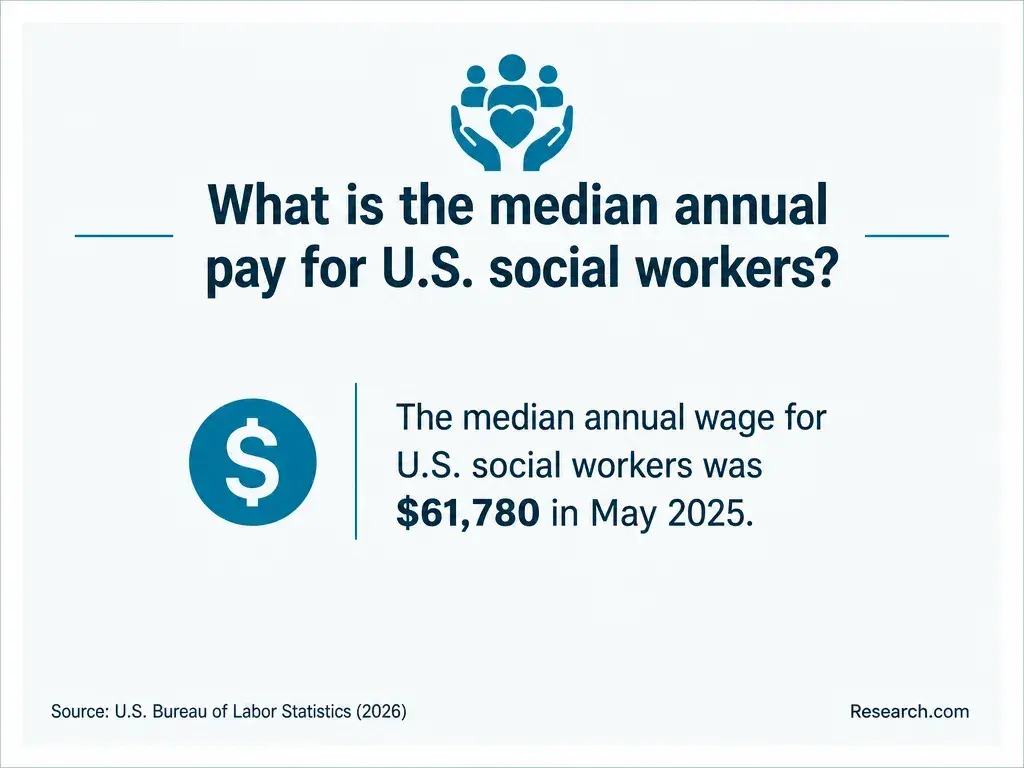
No occupation-wide statistic predicts the pay of graduates from this BA. For context, the U.S. Bureau of Labor Statistics reported a $59,190 median annual wage in May 2024 for the combined occupation of substance abuse, behavioral disorder, and mental health counselors. That figure includes workers with different degrees, credentials, employers, and experience levels; it is not a starting salary for a hospital employee with a psychology bachelor's degree.
BLS projects growth for that counselor occupation, but its outlook should not be applied automatically to unlicensed support or coordination jobs. For a useful return-on-investment check, compare actual local postings and your hospital's pay bands with the degree's remaining cost and any repayment obligation. If you are considering a different specialty, short-format forensic psychology graduate program choices involve different costs and career requirements; their outcomes are not a salary forecast for addictions-focused BA graduates.
Other Things You Should Know About Psychology
Do not assume so. Some employers offer dependent education benefits, but eligibility and tax treatment may differ from assistance for employees. Check the specific hospital policy.
Contact your academic advisor before dropping or withdrawing. Ask how the change affects tuition liability, course sequencing, financial aid, and any hospital reimbursement tied to completion or grades.
Potentially, but the same expenses generally cannot support both tax-free employer assistance and tax-free 529 treatment. Keep itemized records and seek tax advice for your circumstances.
Only if you can afford them without the benefit. Retroactive approval is not guaranteed; request written authorization before the school's payment and withdrawal deadlines.
- Employer-offered educational assistance programs can help pay for college | Internal Revenue Service https://www.irs.gov/newsroom/employer-offered-educational-assistance-programs-can-help-pay-for-college
- Cost of Attendance (Budget) | 2025-2026 Federal Student Aid Handbook https://fsapartners.ed.gov/knowledge-center/fsa-handbook/2025-2026/vol3/ch2-cost-attendance-budget
- Staying Eligible | Federal Student Aid https://studentaid.gov/understand-aid/eligibility/staying-eligible
- Fact Sheet #28A: Employee Protections under the Family and Medical Leave Act | U.S. Department of Labor https://www.dol.gov/agencies/whd/fact-sheets/28a-fmla-employee-protections
- Federal Aid Policies | Johns Hopkins https://publichealth.jhu.edu/offices-and-services/office-of-student-affairs/financial-aid/federal-aid-policies
- Employer Tuition Reimbursement: How It Works and How to Pay for College | Winston-Salem State University https://ramsonline.wssu.edu/blog/employer-education-benefits/
- Employer Tuition Assistance: How to Use Your Workplace Education Benefits | American College of Healthcare Sciences https://achs.edu/blog/employer-tuition-assistance-workplace-benefits/
- Behavioral Health | Community College of Denver https://www.ccd.edu/program/behavioral-health
- Tuition Assistance Program - UT Southwestern, Dallas, Texas https://www.utsouthwestern.edu/employees/hr-resources/tuition-assistance/
- Complete Withdrawals and Leave of Absence - Campus Offices https://campus.collegeforcreativestudies.edu/academic-advising/tag/complete-withdrawals-and-leave-of-absence/