2027 Online SLP Master's Programs for Georgia Residents: Eligibility, Tuition, and Clinical Placements

Co-Founder and Chief Data Scientist

Reviewed by Rhea Paul, PhD
SLP Education & Research Expert
Georgia residents considering an online master's in speech-language pathology need more than a flexible class schedule: the program must support Georgia licensure, provide supervised clinical education, and be authorized to enroll students in the state. This guide explains how to evaluate online SLP options, verify accreditation and state disclosures, estimate your full cost, and avoid enrollment mistakes that could delay licensure. It is designed for aspiring clinicians, career changers, and working adults comparing distance-based graduate programs.
Key Things You Should Know
- Georgia applicants should choose a master's program with Council on Academic Accreditation in Audiology and Speech-Language Pathology (CAA) accreditation or confirm directly with the Georgia licensing board that the degree meets its educational standard.
- Online SLP programs still require substantial hands-on clinical education: the ASHA certification pathway generally includes at least 400 supervised clinical hours, followed by a Clinical Fellowship after graduation.
- National demand remains strong: the U.S. Bureau of Labor Statistics projects 17% employment growth for speech-language pathologists from 2025 to 2035, with about 12,500 annual openings on average.
What online speech-language pathology master's programs accept Georgia residents and meet licensure standards?
Georgia residents can consider online or distance-based master's programs in speech-language pathology when the institution is authorized to enroll Georgia students, the program has appropriate CAA accreditation status, and its curriculum can support Georgia's professional licensure requirements. "Online" does not mean entirely remote: clinical practicum, skills assessments, and occasional campus experiences may still be required.
Programs commonly considered by applicants seeking distance-based SLP education include Emerson College, Baylor University, New York University, and other CAA-accredited institutions with online or hybrid pathways. Admission availability, required residencies, and Georgia licensure disclosures can change by cohort, so applicants should confirm current eligibility directly with each school before submitting an application. Start broad with this guide to online SLP masters programs, then narrow options based on Georgia-specific authorization and clinical-placement policies.
The comparison below shows the questions that matter more than a program's marketing label. A program may be CAA-accredited yet still be a poor fit if it cannot place students near your home, requires travel you cannot manage, or does not accept new students from Georgia.
| Decision factor | What Georgia applicants should verify | Why it matters |
| CAA accreditation status | Confirm current accreditation or candidacy in ASHA EdFind and on the university site. | CAA status is a central safeguard for clinical education quality and future certification planning. |
| Georgia enrollment eligibility | Ask whether the institution is authorized to enroll Georgia residents for your intended start term. | State authorization can affect whether the school may legally deliver the program to you. |
| Georgia licensure disclosure | Read the school's professional-licensure disclosure and ask whether it has determined curriculum compatibility for Georgia. | A general statement about national preparation is not the same as a Georgia-specific determination. |
| Clinical education model | Ask who secures sites, whether Georgia placements are regularly available, and whether travel may be required. | Placements are required and can determine whether the program is practical to complete. |
| Residency requirements | Confirm campus visits, simulations, intensives, and their timing. | Travel, lodging, and missed work can materially change the program's affordability. |
| Schedule | Check live-session times, attendance rules, and full-time clinical-semester expectations. | Even an asynchronous academic curriculum may have fixed clinical obligations. |
Choose an online program if you need geographic flexibility and can participate fully in required clinical experiences. Consider a Georgia campus-based or hybrid option instead if you want a more established local placement network, need close in-person faculty access, or cannot travel for required intensives.
How does Georgia's SLP licensure board treat out-of-state online graduate programs?
Georgia generally evaluates an applicant's education and supervised experience against its licensure rules rather than treating an online degree as automatically unacceptable. The key issue is whether the degree, practicum, examination, and post-graduate supervised experience satisfy the requirements administered by the Georgia State Board of Speech Language Pathology and Audiology.
An out-of-state program should not be assumed to qualify simply because it is delivered online, located at a well-known university, or accepts Georgia residents. CAA accreditation is a strong indicator of an appropriately structured professional program, but a prospective student should still read the university's Georgia professional-licensure disclosure and verify current board requirements before enrolling.
Before paying an enrollment deposit, take these steps to create a written record of your due diligence.
- Confirm that the degree is a qualifying master's-level SLP program and check its current CAA accreditation status.
- Request the school's written professional-licensure disclosure for Georgia, including any known curriculum or placement limitations.
- Review Georgia board requirements for academic preparation, supervised clinical experience, the Praxis examination, and post-graduate supervision.
- Ask whether the school has previously supported graduates seeking Georgia licensure, while recognizing that prior outcomes do not replace an individual board review.
- Save emails, catalog pages, clinical-handbook language, and licensure disclosures for your records.
Licensure rules can change, and board staff - not a university recruiter, employer, or ranking site - make the most authoritative interpretation of Georgia requirements. Applicants with unusual academic backgrounds, international coursework, prior licensure in another field, or incomplete prerequisites should seek clarification before beginning the program.
What tuition, fees, and cost of attendance should Georgia residents expect for online SLP programs?
For Georgia residents, online SLP cost is usually driven by the institution's graduate tuition model rather than by Georgia public-university residency rules. Many private online programs charge one rate for all distance learners, while public institutions may use separate in-state, out-of-state, or online rates. Do not compare a per-credit figure at one school with a total-program estimate at another without confirming the required credits and fees.
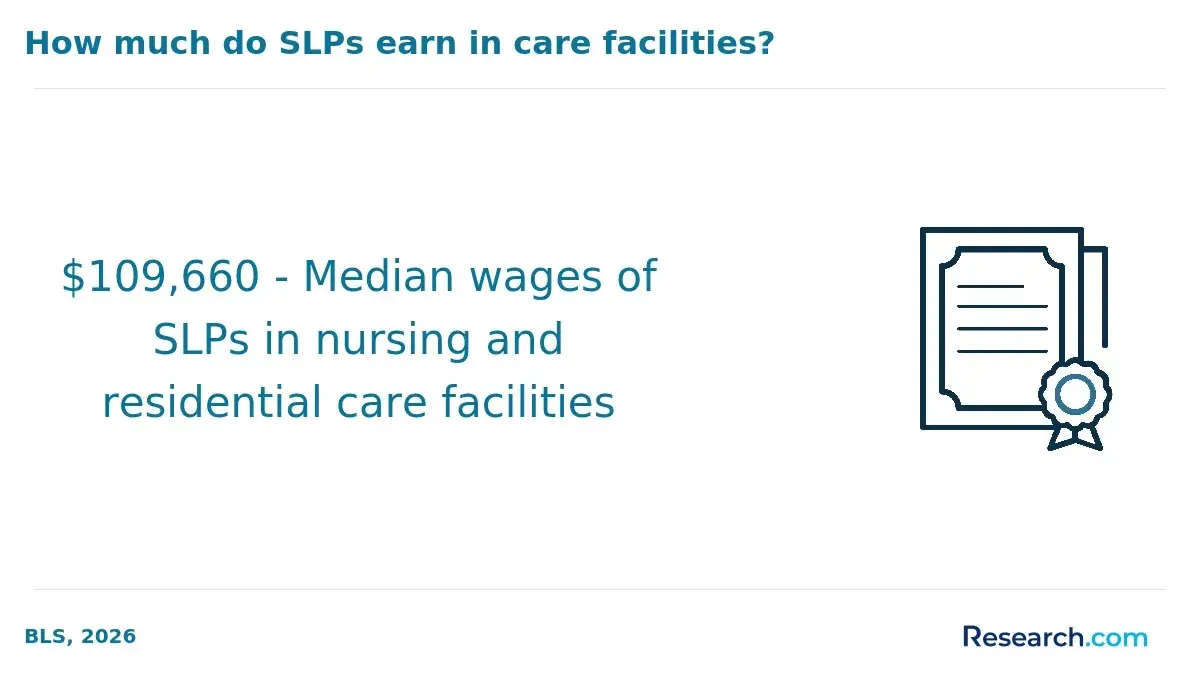
Tuition matters because SLP is a graduate-entry profession, but earnings should be treated as context rather than a repayment guarantee. The national median annual wage for speech-language pathologists was $97,870 in May 2025, according to the U.S. Bureau of Labor Statistics. Local wages vary by setting, experience, hours, employer, and region; use this overview of speech pathology salary pathways to compare settings rather than assuming one salary outcome.
A complete budget should include expenses that a tuition advertisement may exclude. The following cost categories help applicants compare offers on the same basis.
| Cost category | What may be included | How to evaluate it |
| Tuition | Per-credit, per-term, or cohort tuition for all required graduate credits. | Multiply the published rate by required credits only when the school confirms the rate applies to your cohort. |
| Mandatory university fees | Technology, student services, clinical education, graduation, or distance-learning fees. | Request a term-by-term estimate, since some fees apply every semester. |
| Clinical education expenses | Background checks, drug screening, immunizations, CPR training, liability coverage, health documentation, and site-required testing. | Ask whether the estimate includes every clinical semester and whether sites impose separate requirements. |
| Travel and residency costs | Airfare or mileage, lodging, meals, parking, and time away from work for intensives or distant placements. | Build a separate travel reserve; these costs are often not included in tuition estimates. |
| Technology and materials | Computer equipment, headset, webcam, software, textbooks, and assessment materials. | Check technical requirements before purchasing equipment. |
| Income trade-off | Reduced work hours or lost wages during full-time practicum and externship terms. | Plan cash flow for the clinical phase, when schedule flexibility can shrink sharply. |
The most useful question for an admissions or financial-aid office is: "What is the estimated direct institutional cost to complete this specific program at the current rate, excluding and including required clinical fees?" Then ask what rate increases, if any, could apply to future terms. Compare that answer with your likely borrowing, employer tuition assistance, scholarships, federal aid eligibility, and the cost of reduced work hours.
Which online SLP master's programs offer clinical placements within Georgia, and how are they arranged?
Online SLP programs that enroll Georgia residents must provide a path to supervised clinical education, but no responsible applicant should interpret that as a promise of a placement in a particular Georgia city, school district, hospital, or pediatric clinic. Placement availability depends on affiliation agreements, supervisor capacity, site requirements, student readiness, and the program's clinical model.
Distance-based programs typically use one of three approaches: a centralized clinical team secures placements, the student identifies possible sites for university approval, or the school uses a shared model. The details matter because the student may bear different amounts of outreach, travel, and scheduling risk.
| Placement model | How it typically works | Best question to ask |
| University-arranged | A clinical education office develops and approves sites, then assigns students when capacity is available. | Does the school arrange all required placements for Georgia residents, and what happens if no local site is available? |
| Student-assisted | The student may suggest contacts or locations, but the university must approve the site and execute an affiliation agreement. | How much outreach is expected from students, and can I begin suggesting sites before the clinical term? |
| Shared responsibility | The school leads compliance and approval while the student helps identify geographic preferences or potential sites. | What is the written division of responsibilities between the student and clinical-placement team? |
| Travel-required contingency | The program may place a student outside the immediate home area when local capacity is insufficient. | What distance, housing, transportation, and schedule contingencies should I budget for? |
Georgia school districts and health systems may have their own onboarding rules, including background checks, immunization documentation, confidentiality training, and specific supervision standards. These requirements can add time before a placement begins. A prospective student should ask each program for its clinical handbook and a written explanation of its Georgia placement process before committing.
Do not resign from a job, sign a lease, or assume a particular local site will be available until the university confirms your placement. A program with a transparent contingency plan can be a better choice than one that makes broad promises but will not explain how clinical shortages are handled.
What institutional and programmatic accreditations must an online SLP program have for Georgia licensure?
Accreditation has two separate layers. Institutional accreditation evaluates the university as a whole, while programmatic accreditation evaluates the speech-language pathology degree's professional curriculum, faculty, assessment, and clinical education. For an aspiring Georgia SLP, both deserve attention.
The most important programmatic credential is accreditation by the Council on Academic Accreditation in Audiology and Speech-Language Pathology (CAA), which is associated with the American Speech-Language-Hearing Association. Verify the program's current status in ASHA EdFind rather than relying on an old web page, a university logo, or a statement that a school is merely "seeking" accreditation.
The distinctions below prevent a common and costly mistake: confusing university accreditation with professional-program accreditation.
| Credential or status | What it indicates | How to use it in your decision |
| Institutional accreditation | The university meets standards set by an institutional accreditor recognized in the U.S. higher-education system. | Confirm it for federal-aid and degree-recognition reasons, but do not treat it as proof of SLP licensure eligibility. |
| CAA accredited | The specific SLP program has been accredited by CAA. | This is generally the strongest starting point for students planning ASHA certification and state licensure. |
| CAA candidacy or developing status | A newer program may be progressing through an accreditation process under defined conditions. | Read the status carefully, ask about the effect on your cohort, and obtain written clarification before enrolling. |
| Unaccredited professional program | The school may be accredited institutionally without CAA approval for its SLP degree. | Do not assume it will support Georgia licensure or ASHA certification; obtain direct board guidance first. |
CAA accreditation is not a substitute for every Georgia application requirement. Graduates may still need to satisfy examination, supervised post-graduate experience, documentation, and other state requirements. Treat accreditation as the essential foundation, then verify the full licensure pathway.
How do state authorization and distance-education reciprocity affect Georgia residents enrolling in online SLP programs?
State authorization concerns whether a college may provide distance education to a student located in Georgia. It is separate from professional licensure. A university may be able to enroll Georgia residents but still disclose that it has not determined whether its curriculum meets Georgia's SLP licensure requirements; the reverse is also not enough if the school lacks authority to deliver the program to you.
Many institutions participate in interstate distance-education reciprocity arrangements, commonly through State Authorization Reciprocity Agreement processes, but participation does not eliminate program-specific restrictions. Clinical education is especially important because students complete in-person training at Georgia sites and may face separate affiliation, supervision, or regulatory conditions.
Use these checks before applying, especially if you may move during the program.
- Confirm in writing that the university can enroll a student physically located in Georgia for your start term.
- Ask whether authorization changes when a student completes clinical education in Georgia or another state.
- Read the school's Georgia professional-licensure disclosure rather than relying on a general distance-learning authorization statement.
- Notify the program before relocating, because moving to another state can affect authorization, placement eligibility, and disclosure requirements.
- Ask whether an unresolved authorization issue could delay enrollment, clinical participation, or graduation.
State authorization is not merely administrative paperwork. If a school cannot serve your location, it may be unable to let you start or continue the program. Get this answer before paying a nonrefundable fee.
What admission prerequisites do online SLP master's programs commonly require from Georgia applicants?
Most entry-level SLP master's programs expect applicants to have foundational coursework in communication sciences and disorders or equivalent prerequisite courses. Requirements vary considerably: applicants with a bachelor's degree in communication sciences and disorders may be ready for direct entry, while career changers may need a post-baccalaureate sequence, leveling courses, or a longer curriculum.
Common prerequisites include anatomy and physiology of speech and hearing mechanisms, phonetics, speech and hearing science, language development, audiology, speech-language disorders, research methods, and statistics. Programs may also require coursework in biological sciences, behavioral or social sciences, statistics, and physical sciences to align with certification standards.
The table separates the requirements that are frequently expected from those that vary most by program. Verify each item in the current admissions page and graduate catalog.
| Admission component | Typical purpose | Georgia applicant consideration |
| Bachelor's degree | Shows completion of undergraduate education. | A degree outside communication sciences may be acceptable, but usually requires additional prerequisites. |
| Prerequisite coursework | Builds the academic foundation for graduate clinical training. | Request a transcript review early; do not self-assume that similarly named courses will transfer. |
| GPA review | Helps programs assess academic readiness. | Minimum GPA policies and holistic-review practices vary by institution. |
| Recommendations and personal statement | Provide evidence of professional readiness, communication, and commitment. | Use recommenders who can address academic, clinical, or professional performance specifically. |
| Observation or relevant experience | May demonstrate informed interest in the profession. | Confirm whether observation hours are required, recommended, or optional before arranging them. |
| Interview or skills assessment | Allows the program to assess fit and communication skills. | Online interviews may be scheduled during business hours and require reliable technology. |
Applicants who already know they need both undergraduate preparation and graduate education should compare sequencing options carefully. Some 5 year accelerated speech pathology programs combine undergraduate and graduate study for eligible students, but they are usually a different path from an online master's designed for adults who already hold a bachelor's degree.
A common mistake is applying before completing prerequisite planning. A better approach is to obtain written confirmation of missing courses, identify whether they can be taken online or locally, and map their completion against the program's application deadline and cohort start date.
How do Georgia-based clinical sites, school districts, and healthcare employers view online SLP degrees?
Georgia employers and clinical sites typically focus on whether an applicant holds the required graduate degree, is eligible for or holds Georgia licensure, has appropriate supervised clinical preparation, and can perform the role. The delivery format alone is generally less important than CAA accreditation, clinical competence, documentation, communication skills, and fit for the setting.
For school-based roles, districts may also consider Georgia educator credentialing rules, job-specific certifications, and experience with school-age populations. Healthcare employers may emphasize medical placements, swallowing or neurogenic-disorder exposure, documentation systems, and the ability to work within an interdisciplinary team. A degree marketed as online does not remove the need for rigorous in-person clinical training.
Applicants can make their preparation easier for employers to understand by documenting their clinical settings, populations served, supervision, and relevant competencies. During interviews, describe the substance of your training rather than leading with the delivery format. For example, explain the client populations and clinical responsibilities you completed while protecting client confidentiality.
The national employment outlook supports careful program selection rather than rushed enrollment. The Bureau of Labor Statistics projects 17% growth in SLP employment from 2025 to 2035, but job availability, pay, caseloads, and hiring preferences can differ across Georgia regions and employers. A program with strong, varied clinical education may provide more value than one that is simply the fastest or most convenient.
What consumer-protection risks do Georgia residents face with online SLP programs, and how can they verify quality?
The largest risks are enrolling in a program without confirming CAA status, treating a general online-learning statement as a Georgia licensure guarantee, underestimating clinical travel costs, and assuming a school will find a local placement regardless of capacity. These mistakes can lead to unexpected expenses, delayed graduation, or a degree that does not efficiently support the intended professional pathway.
Use reputable comparison resources for initial research, including this overview of speech language pathology programs, but make enrollment decisions using primary documents from the university, CAA, and Georgia's licensing board. Rankings, social-media posts, and recruiter statements are not substitutes for written disclosures.
These red flags merit a pause and a request for documentation before you apply or pay a deposit.
- The school cannot clearly identify the program's current CAA accreditation or candidacy status.
- A representative promises Georgia licensure eligibility but will not provide the university's written Georgia disclosure.
- Published tuition excludes recurring program fees, clinical costs, or required travel without explaining the exclusions.
- The program says placements are "available" but will not describe who secures them, when they are confirmed, or what happens if a local site cannot be found.
- The school pressures you to enroll before it completes a transcript review or answers questions about prerequisite deficiencies.
- Outcome claims lack a reporting period, denominator, definition, or distinction between program-wide outcomes and Georgia-specific outcomes.
A practical verification file should include the current program webpage, CAA listing, catalog, tuition schedule, clinical handbook, state authorization statement, Georgia licensure disclosure, and written answers from admissions. Read refund, withdrawal, leave-of-absence, and teach-out policies as carefully as promotional materials. If a claim affects your ability to become licensed, ask for it in writing.
How do online SLP program outcomes for Georgia residents compare on Praxis pass rates and job placement?
There is usually no public, standardized outcome dataset limited to Georgia residents enrolled in every online SLP program. Most programs report outcomes for the program as a whole, not by the student's residence or eventual licensure state. That limitation means applicants should not infer Georgia-specific results from an institution-wide Praxis pass rate or employment statistic.
CAA-accredited programs are expected to make outcome information available, commonly including Praxis examination performance, program completion, and employment information. When comparing results, use the same reporting period and ask how each school defines its denominator. A high percentage based on a very small cohort or on only first-time test takers may not be directly comparable with another program's figure.
The table identifies the outcome measures worth requesting and the questions that make them interpretable.
| Outcome measure | What it can tell you | Question to ask the program |
| Praxis pass rate | Whether reporting graduates met the examination benchmark under the school's stated method. | What reporting years, number of test takers, and first-time versus eventual pass definitions are used? |
| Program completion rate | How many students completed within the published time frame. | Does the rate include part-time students, leaves of absence, and students who changed cohorts? |
| Employment rate | How many reporting graduates obtained employment, often in the field, under the school's definition. | What counts as employment, when were graduates surveyed, and how many graduates responded? |
| Clinical Fellowship support | How the program prepares graduates for the transition to post-graduate supervised practice. | What career support, supervisor guidance, and Georgia-specific resources are available after graduation? |
Use outcomes as a screening tool, not a promise. A strong choice combines transparent results with Georgia enrollment authorization, CAA accreditation, clear licensure disclosures, realistic placement support, and a cost you can sustain. If a school will not provide current outcome reporting or explain its methodology, compare it cautiously with more transparent alternatives.
Other Things You Should Know About Speech Language Pathology
You may complete much of the academic curriculum online, but professional SLP preparation includes supervised clinical education that occurs in person. Eligibility for Georgia licensure depends on the degree, clinical preparation, examination, post-graduate supervision, and current board requirements - not simply on whether classes were online.
Not always. Many programs accept applicants from other majors, but those applicants commonly need prerequisite or leveling coursework. Request a formal transcript review from each program because required courses and transfer policies differ.
No. Some programs arrange placements, some require student assistance, and many use a shared model. Ask for the clinical-placement policy in writing and confirm the school's plan if a nearby Georgia site is unavailable.
The sequence depends on Georgia's current licensing rules and the type of authorization you seek while completing supervised post-graduate practice. Review the board's current application instructions and ask your program's clinical education office how graduates typically document their degree, Praxis result, and fellowship supervision.
References
- Master of Science in Speech Language Pathology https://www.south.edu/program/master-of-science-in-speech-language-pathology/
- Speech-Language Pathology | PennWest Global Online https://online.pennwest.edu/programs/speech-language-pathology-grad/index.php
- Best Online MSLP Programs with No GRE Required for 2026 https://www.speechpathologydegrees.com/online/mslp-no-gre-required
- Online Master's in Speech Pathology Programs: 2026 Guide https://speechpathologymastersprograms.com/