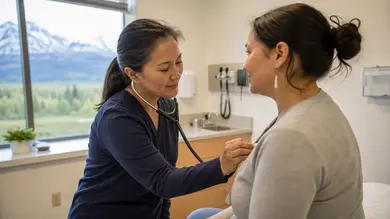
2027 Online Family Nurse Practitioner (FNP) Programs for Arizona Residents: Costs and Clinical Training

Co-Founder and Chief Data Scientist
Can you earn an FNP degree online without leaving Arizona - and complete clinical training near home? For registered nurses comparing programs, the answer depends on the school, its hands-on requirements, and whether it approves local preceptors. Tuition can also change with residency and program format.
This guide distinguishes online options offered by Arizona institutions from out-of-state alternatives, explains the costs and clinical arrangements to verify, and helps you decide whether a program fits your budget, schedule, and plans to practice in Arizona.
Key Things to Know About Online FNP Programs in Arizona
- Arizona-based options to investigate include Northern Arizona University's FNP pathway and Grand Canyon University's online FNP master's pathway; confirm the current degree format and required campus visits directly with each school.
- Online tuition is not automatically in-state tuition. Compare the full program price - including required fees, travel, and clinical expenses - rather than a per-credit rate alone.
- Online coursework does not replace supervised clinical training. An Arizona rotation needs school approval, a qualified preceptor, and a site that can support the program's required patient experiences.
What online FNP programs are available in Arizona?
Arizona institutions offer FNP pathways with online coursework, but "online" does not necessarily mean that every requirement can be completed remotely. A family nurse practitioner (FNP) program prepares registered nurses for primary care across the lifespan. Depending on the school, the credential may be an MSN, a DNP, or a post-master's certificate; clinical rotations remain in person.
The following Arizona-based institutions are starting points for a direct program inquiry, not a claim that their formats, admissions, or campus requirements are identical. Ask for the current catalog and a written breakdown of online classes, intensives, and clinical placement rules.
| Arizona institution | FNP option to investigate | Decision-relevant question |
| Northern Arizona University, Flagstaff | Graduate FNP pathway | Which courses and required visits can a student complete from their home community? |
| Grand Canyon University, Phoenix | Online MSN family nurse practitioner pathway | What in-person requirements apply, and what help does the school provide with preceptors? |
| University of Arizona, Tucson | DNP family nurse practitioner pathway | How much of the pathway is online, and which activities require attendance in Tucson? |
These are distinct pathways, not interchangeable online MSN choices: a DNP generally has a different degree structure from an MSN. Confirm current intake, accreditation of the nursing program, and the requirements for your intended certification before applying. A university's Arizona address alone does not establish that a particular FNP track is fully online or open to every applicant.
Can Arizona residents enroll in online FNP programs based in other states?
Arizona residents may be able to enroll in an out-of-state online FNP program, but they must verify Arizona enrollment eligibility and clinical-placement permission for the specific program. Examples to investigate include Georgetown University in Washington, DC, and Duke University in Durham, North Carolina; neither school's location establishes that an Arizona applicant or proposed Arizona clinical site will be accepted.
Ask each out-of-state school to confirm, in writing, whether it currently enrolls Arizona residents, permits FNP clinical rotations in Arizona, and has any restrictions affecting your intended certification or Arizona advanced practice application. State authorization to deliver education, permission to place a student at a clinical site, and eligibility for a professional credential are separate questions. For the consequences of a mismatch, see checking FNP program licensing compatibility explained.

How much do online FNP programs cost in Arizona?
The cost of an Arizona-based online FNP program depends on its degree, required credits, tuition policy, and clinical expenses; a reliable price comparison requires current, program-specific quotes. An Arizona average for undergraduate college tuition and fees would not describe graduate FNP pricing, and a per-credit rate alone would understate what a student may pay. Without comparable current program quotes, there is no defensible statewide FNP tuition range to apply to an individual school.
Request a written estimate for your entry pathway and expected completion schedule. It should separate tuition from the expenses that can change the affordability of an otherwise attractive program:
- School charges: required program, technology, course, and graduation fees.
- Clinical preparation: screening, immunizations, insurance, and other compliance costs the school requires.
- Attendance costs: travel or lodging for campus visits and approved clinical rotations.
- Schedule costs: income you may forgo if clinical days reduce your paid nursing hours.
For a fair comparison, multiply each school's current applicable tuition rate by the credits you must complete, then add mandatory charges and a realistic clinical-travel budget. Ask whether a post-master's applicant needs fewer courses and whether previously earned credits actually transfer; do not assume either.
Do Arizona residents pay in-state tuition for online FNP programs?
Arizona residence may qualify a student for a public university's resident rate, but it does not guarantee a lower price for every online FNP program. Public institutions determine residency under their applicable policies; a private institution may instead use a uniform program rate, and a particular online pathway may have its own tuition schedule. An out-of-state school can likewise charge one online rate or differentiate by residence.
When comparing an Arizona public option with an out-of-state alternative, ask for the FNP program's resident, nonresident, and online rates where applicable, plus mandatory fees for your enrollment term. Confirm your residency classification with the institution rather than relying on an Arizona mailing address or a general undergraduate tuition page. If you plan to move during the degree, also ask whether the move affects your rate or permission to continue clinical work.
Are there scholarships or grants for FNP students in Arizona?
Arizona FNP students may find scholarships, employer support, or service-based funding, but eligibility depends on the student, program, and funding cycle. School nursing scholarships are a useful first inquiry; Arizona-based health employers may also offer tuition benefits tied to continued employment. Federal aid and nationally administered service programs can provide other possibilities, though they are not Arizona-specific awards and may carry service commitments.
Ask a school's financial aid office which awards apply specifically to graduate nursing or post-master's certificate students, whether part-time enrollment qualifies, and when applications close. For service awards, check the approved practice-site and service-obligation rules before counting the award toward your budget. The guide to family nurse practitioner master's funding options can help you organize those questions. Do not assume that a scholarship advertised for Arizona nursing students covers graduate FNP study.
How many clinical hours do online FNP programs require for Arizona students?
Arizona students must complete the clinical hours required by their specific FNP program and intended certification pathway; online enrollment does not remove that requirement. Do not rely on a single advertised hour figure across MSN, DNP, and post-master's pathways: schools may count and schedule supervised patient-care hours differently, and a DNP may include additional project or practice requirements that are not interchangeable with FNP clinical hours.
Ask each school for its current total of supervised direct patient-care hours, the number assigned to each term, and how experiences must be distributed across ages and care settings. Then map the expected clinical days against your work schedule. The workload planning for employed FNP students guide is useful here: a program can be academically part-time while still requiring substantial weekday availability for rotations.
What types of clinical sites are available to FNP students in Arizona?
Arizona FNP students may train in approved primary care settings that provide the patients and supervision their program requires. Potential settings include family medicine practices, community health centers, pediatric primary care, and other outpatient clinics. A site's willingness to take a student is only one condition: the school must approve its patient mix, preceptor qualifications, affiliation arrangements, and ability to document required experiences.
Location affects the search. A student in metro Phoenix or Tucson may have a different set of nearby clinics than a student in a smaller or rural Arizona community, but neither setting guarantees an opening. If your goal is rural primary care, ask whether the program will approve a proposed rural site and what happens if it cannot supply enough of the required age-group experiences. Do not assume that your current RN employer qualifies as an FNP clinical site simply because it provides healthcare.
Can Arizona students complete FNP clinical rotations near home?
Arizona students can sometimes complete FNP rotations near home, provided the school approves both the site and preceptor and the rotation meets its clinical requirements. "Local clinicals" is therefore a possibility to verify, not a promise that enrollment reserves a placement in your ZIP code.
Use this sequence before committing to a school; it distinguishes general placement assistance from an actual approved rotation:
- Ask whether the school finds Arizona preceptors, supplies leads, or requires students to identify their own sites.
- Give the clinical office your home area and any proposed sites; ask whether existing agreements cover them and how long new approvals usually take.
- Confirm which rotations require particular patient ages or settings and whether more than one site may be needed.
- Get the approval process and contingency plan in writing before arranging time off work or travel.
Start these conversations well before the first clinical term. A nearby clinic may decline students, a proposed preceptor may not meet faculty criteria, or an agreement may take longer than expected. No clinical hours should be assumed to count until the program authorizes the placement.
How can Arizona students determine if an FNP program aligns with their goals?
An FNP program aligns with an Arizona student's goals when its credential, clinical support, total cost, and intended practice pathway all work together. Start with the role you want: FNP training focuses on family-oriented primary care, so it should not be treated as an automatic substitute for preparation in an acute care specialty.
Before applying, request answers you can compare across schools:
- Entry and credential: Does the pathway accept your current nursing degree and license, and does it lead to the MSN, DNP, or certificate you need?
- Practice plans: Does the program say its curriculum supports your intended national FNP certification and an Arizona advanced practice application? If you expect to practice elsewhere, check that jurisdiction separately.
- Delivery and placement: Which visits are in person, who secures preceptors, and can your proposed Arizona sites be reviewed before enrollment?
- Financial fit: What is your written estimate through completion, including fees and likely travel?
For application planning, use the guide to application requirements for FNP degrees. Treat accreditation, state authorization, national certification, and Arizona licensure as separate checks: none is an automatic substitute for the others.
Is an online FNP program worth the investment for Arizona students?
An online FNP program may be worth the investment for an Arizona RN who wants a primary care advanced practice role and can afford both the degree and its supervised clinical time. It is a weaker fit if the required rotations would make work or caregiving arrangements unmanageable, if placement support is unclear, or if the credential does not match the intended job.
Arizona permits nurse practitioners to practice with substantial professional autonomy under state rules, but graduation alone does not grant that authority. The Arizona State Board of Nursing's advanced practice requirements, national certification, and any applicable prescribing requirements still matter. Workforce demand can make the path appealing, yet statewide occupation data would not predict an individual graduate's salary or job offer; compare actual Arizona openings in the settings where you intend to work with your full education cost.
If you are considering both family and acute care practice, compare the added curriculum and clinical burden with your career goals rather than assuming one FNP credential covers both. The guide to dual-track MSN program eligibility outlines questions to raise before choosing that route.
Other Things You Should Know About Family Nurse Practitioner
Not necessarily for every application, but schools set their own RN licensure requirements. Ask the program what license it requires at admission and before an Arizona clinical rotation; those may be different checkpoints.
No. RN compact privileges and advanced practice authority are distinct. Check the Arizona State Board of Nursing's requirements for the nurse practitioner credential you intend to seek.
It may be. Eligibility and required coursework depend on your prior graduate preparation, and the school must assess your transcript. Ask how its certificate supports FNP certification and your intended state application.
Only if the FNP program approves the site, qualified preceptor, and specific supervised experiences in advance. Ordinary RN work hours are not automatically FNP clinical hours.
References
- Cost of Attendance (Budget) | 2025-2026 Federal Student Aid Handbook https://fsapartners.ed.gov/knowledge-center/fsa-handbook/2025-2026/vol3/ch2-cost-attendance-budget
- Apply for a License | azbn.gov https://azbn.gov/licenses-and-certifications/apply-license
- Tuition and Fees - Phoenix https://www.gatewaycc.edu/pay-college/tuition-and-fees
- Tuition Costs and Fees | ASU https://tuition.asu.edu/cost/tuition-fees
- Arizona Board of Regents approves tuition and fees for 2022-23 academic year | Arizona Board of Regents https://www.azregents.edu/news-releases/arizona-board-regents-approves-tuition-and-fees-2022-23-academic-year
- Eligibility & State Authorization | University of Arizona Online https://online.arizona.edu/about/eligibility-state-authorization
- Health and Safety Requirements | maricopa.edu https://www.maricopa.edu/degrees-certificates/healthcare-education/health-safety-requirements
- Family Nurse Practitioner Graduate Certificate - ASU degree https://degrees.asu.edu/masters-phd/major/ASU00/NUFMPGRCE/family-nurse-practitioner-graduate-certificate
- DNP Clinical Placements | University of Arizona College of Nursing https://nursing.arizona.edu/resources/dnp-clinical-placements