2027 Online Family Nurse Practitioner (FNP) Programs for Wisconsin Residents: Costs and Clinical Training

Co-Founder and Chief Data Scientist
Choosing an online family nurse practitioner program in Wisconsin means deciding more than where to take classes: tuition, campus visits, and clinical placements can change whether a program fits your life.
This guide is for registered nurses considering programs at Wisconsin institutions, as well as Wisconsin residents weighing out-of-state alternatives. It explains how to compare costs, check where clinical training can happen, and assess whether a program supports your intended path to practice in Wisconsin.
Key Things to Know About Online FNP Programs in Wisconsin
- Wisconsin-based options include online FNP coursework at Concordia University Wisconsin in Mequon and Herzing University, which has a Wisconsin campus in Madison; confirm each program's current campus, visit, and enrollment requirements.
- Wisconsin residence does not automatically mean a lower online tuition rate. Compare a current, program-specific quote for every credit, required fee, and clinical-related expense.
- Online coursework does not replace supervised, in-person FNP clinical training. Confirm the program's required hours and whether it can approve sites and preceptors near your Wisconsin home.
What online FNP programs are available in Wisconsin?
Wisconsin-based online FNP options include programs at Concordia University Wisconsin and Herzing University. An FNP is a family nurse practitioner: an advanced practice nurse educated to care for patients across the lifespan. "Online" generally describes the coursework, not the required in-person clinical training.
The table identifies institutions physically located in Wisconsin, rather than treating every program open to Wisconsin residents as a Wisconsin program. Delivery details and entry routes can change, so use it as a shortlist to check against each school's current catalog.
| Wisconsin institution | FNP option to investigate | What to confirm directly |
| Concordia University Wisconsin, Mequon | Online nursing graduate coursework with an FNP pathway | Current degree route, any required campus attendance, and clinical placement support |
| Herzing University, Wisconsin campus in Madison | Online MSN-FNP pathway | Which campus administers enrollment, current tuition, and approval of Wisconsin clinical sites |
An MSN is a master of science in nursing; some nurses instead pursue a doctoral route or a post-master's certificate. The credential matters because a nurse who already has an MSN may need a different course sequence than an RN entering a first graduate nursing program. For that comparison, see this guide to online FNP training for master's-prepared nurses. Do not assume a Wisconsin school's general online nursing listing means its FNP pathway has no campus visits.
Can Wisconsin residents enroll in online FNP programs based in other states?
Yes, Wisconsin residents may be able to enroll in out-of-state online FNP programs, but eligibility must be confirmed for the particular program and clinical location. Walden University is based in Minnesota, and Chamberlain University is based in Illinois; either is an out-of-state alternative to investigate, not a Wisconsin institution or a promise of admission.
Ask each school to confirm in writing that it currently enrolls Wisconsin residents in its FNP program, can approve clinical training at your proposed Wisconsin location, and has assessed whether the curriculum meets Wisconsin's relevant professional requirements. State authorization to provide distance education is a separate question from whether a nursing program supports certification or Wisconsin practice credentials. If you expect to move during school, disclose both your present and proposed locations before enrolling.
How much do online FNP programs cost in Wisconsin?
There is no single Wisconsin online FNP price: the bill depends on the institution, credential, number of required credits, tuition policy, and fees. Without a current program-specific tuition schedule, a quoted total or statewide price range would risk comparing unlike costs. Wisconsin undergraduate tuition averages are not a reliable substitute for graduate FNP pricing.
Request a written estimate from each Wisconsin school that separates tuition from mandatory program fees. Then ask about books, background checks, immunizations, clinical tracking systems, certification preparation, campus travel, and any cost of arranging placements. A less expensive per-credit rate can still produce a higher total if the program requires more credits or travel. The FNP tuition and fees explained guide can help you identify charges to include in that comparison.
Use the same calculation for every offer: required credits multiplied by the applicable tuition rate, plus mandatory fees and your estimated clinical and travel expenses. Ask when rates may change; an old webpage or an undergraduate tuition figure is not a dependable graduate-program quote.
Do Wisconsin residents pay in-state tuition for online FNP programs?
Wisconsin residents do not automatically receive an in-state rate for an online FNP program. A public university may apply a residency-based graduate rate, while a private institution or a particular online program may use one rate regardless of residence; the school's published policy controls.
For each Wisconsin institution, ask the graduate nursing office which rate applies to your exact pathway and whether separate online, differential, or clinical-course charges apply. For an out-of-state school, ask whether its online rate is flat or residency-based rather than assuming Wisconsin residence creates a discount. If a school offers a regional arrangement or employer rate, get written confirmation that this FNP pathway qualifies. Admission, tuition residency, and permission to complete Wisconsin clinical rotations are different determinations.
Are there scholarships or grants for FNP students in Wisconsin?
Wisconsin FNP students may find scholarships or service-based support, but eligibility is usually narrower than "Wisconsin resident." Start with the nursing school's graduate aid office and your employer, then check current Wisconsin-administered health workforce opportunities and federal programs such as the Nurse Corps Scholarship Program or National Health Service Corps funding where the degree and intended service site qualify.
Award rules may depend on enrollment status, financial need, employer affiliation, specialty, or a commitment to work in an approved shortage-area setting. Do not count a service award as guaranteed aid: placement and service obligations can outlast graduation. Submit the FAFSA when the school requests it, ask whether graduate FNP students qualify for institutional scholarships, and compare the written aid offer with your full program cost - not tuition alone.

How many clinical hours do online FNP programs require for Wisconsin students?
The clinical-hour requirement for a Wisconsin student is set by the enrolled FNP program and its applicable education and certification standards, not by the student's ZIP code alone. FNP students complete supervised direct patient care even when lectures and assignments are online. A doctoral program may also require practice hours beyond those devoted specifically to FNP patient care.
Ask for the current curriculum's direct-care FNP hours, any additional degree-level practice hours, and the number of terms in which they must be completed. That distinction prevents a misleading comparison between an MSN-FNP and a DNP-FNP total. It also determines how much time you may need away from paid RN shifts. The understanding family nurse practitioner program completion times guide is useful when weighing a shorter calendar against a heavier weekly clinical schedule.
Before accepting an offer, obtain the school's current clinical handbook rather than relying on an older hour figure. Ask whether hours at your existing workplace are permitted and how the school counts pediatric, adult, and other experiences toward its requirements.
What types of clinical sites are available to FNP students in Wisconsin?
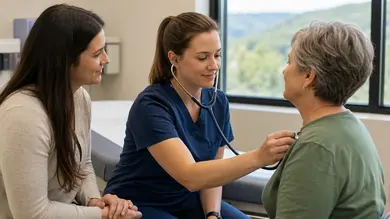
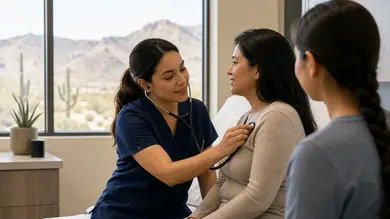
Wisconsin FNP students may train in approved primary care settings such as family medicine clinics, community health centers, pediatric practices, and other outpatient sites that provide the patient populations their program requires. A nearby hospital job does not necessarily supply the longitudinal, across-the-lifespan primary care experience an FNP curriculum expects.
The useful question is not whether a clinic exists locally, but whether it will accept a student, has a qualified preceptor, and can enter the school's required affiliation agreement. A site in Milwaukee, Madison, or another part of Wisconsin should not be assumed to represent availability throughout the state. Ask programs what kinds of Wisconsin sites recent students used, without treating those past placements as a guarantee that a site is open now.
Can Wisconsin students complete FNP clinical rotations near home?
Many Wisconsin students can propose clinical rotations near home, but a nearby placement is possible only if the program approves the site and preceptor and the organization agrees to host the student. "Complete clinicals locally" is not the same promise as "the school will find your preceptor."
Ask admissions and the clinical office to explain their placement process before you pay a deposit. These questions expose differences that can affect both your schedule and your costs:
- Does the school identify Wisconsin sites and preceptors, help with outreach, or require students to secure them independently?
- Who obtains affiliation agreements, and how long can approval take before a rotation begins?
- Which preceptor credentials, patient ages, and practice settings will the school accept?
- What happens if an approved site withdraws or no qualifying placement is available near home?
Begin those discussions well ahead of the first practicum term. Do not commit to an informal arrangement at your workplace until the program approves it; travel or a delayed course can materially change the price of an otherwise affordable program. This overview of preceptor placement support for online FNP students explained can help you distinguish placement assistance from a placement guarantee.
How can Wisconsin students determine if an FNP program aligns with their goals?
A Wisconsin student can assess fit by checking whether the program supports the intended credential, practice location, budget, and weekly workload - not simply whether classes are online. Confirm the program's nursing accreditation and its stated preparation for the FNP certification examination you plan to pursue. Then ask the Wisconsin Department of Safety and Professional Services how the resulting credentials relate to your intended advanced practice role and, if applicable, prescriptive authority.
Use the same questions for every Wisconsin-based school and out-of-state alternative. Record each school's answer and the date it was given:
- Will the program enroll me while I live in Wisconsin, and what changes if I move?
- Which courses or campus activities require travel, and when?
- What are the current total charges and the school's actual placement responsibilities?
- Does my RN background meet admission requirements, and does the curriculum match my intended patient population and practice state?
If your academic record is a concern, review the school's stated admission rules rather than assuming one GPA cutoff applies everywhere; this guide to understanding GPA considerations for FNP admission outlines questions to raise. The biggest avoidable mistake is treating accreditation, online enrollment permission, certification preparation, and Wisconsin practice eligibility as one approval - they address different questions.
Is an online FNP program worth the investment for Wisconsin students?
An online FNP program may be worth the investment for a Wisconsin RN who wants family-focused advanced practice and can manage the full cost and supervised clinical workload. It is less compelling if the available placements require unmanageable travel, the program does not support the intended practice state, or the financing depends on aid that has not been awarded.
Wisconsin's interest in expanding access to care does not guarantee an individual graduate a job or a particular salary. For a useful return-on-investment check, compare current Wisconsin nurse practitioner wage and employment information from the U.S. Bureau of Labor Statistics with actual local job postings, remembering that occupation-wide figures cover specialties beyond FNP. Weigh those possibilities against your written program estimate, likely RN earnings forgone during clinical terms, borrowing costs, and the work settings you would accept. Make the decision from that combined picture, not from an advertised tuition rate or a statewide workforce headline alone.
Other Things You Should Know About Family Nurse Practitioner
Generally, yes: FNP pathways are designed for nurses with RN preparation. Schools set their own rules for RN licensure, prior degrees, and experience, so check the requirements for your chosen entry route.
No. Graduation and national FNP certification are separate steps. Ask which certification examination the curriculum prepares you to take and verify that you meet the certifier's current eligibility rules.
No. The state where you seek to practice sets its own licensing and advanced practice requirements. Check that state's nursing authority before choosing a program if relocation is likely.
Not necessarily. FNP preparation spans care across the lifespan, but a particular job still depends on its patient population, employer expectations, your competencies, and applicable practice rules.
References
- Advanced Practice Registered Nurse (APRN) - DSPS https://dsps.wi.gov/a-z-professions-list/advanced-practice-registered-nurse-aprn/
- Wisconsin Legislature: N 8.05(3) https://docs.legis.wisconsin.gov/document/administrativecode/N%208.05(3)
- Family Nurse Practitioner Clinical Practicum Information and Process | Bellin College https://catalog.bellincollege.edu/family-nurse-practitioner-clinical-practicum-information-and-process
- Graduate Clinical Placements | Master of Science in Nursing Handbook 2025-2026 https://u.osu.edu/msnursinghandbook2025/clinical-requirements/specialty-clinical-locations-and-travel/
- APP Student Preceptorships | MCW Advanced Practice Providers | Medical College of Wisconsin https://www.mcw.edu/departments/mcw-advanced-practice-providers/app-student-preceptorships
- What are Nursing Intensives? | Herzing University https://www.herzing.edu/blog/what-are-nursing-intensives
- Clinical Information - Nursing Students - UW-Madison https://students.nursing.wisc.edu/clinical-information/
- Clinical Placement Services for FNP Programs | Texas Woman's University https://onlinenursing.twu.edu/clinical-placement-services
- Academic Residencies, Labs, and Intensives Requirements | Academics at Walden University https://academics.waldenu.edu/handbook/learning-modalities/residency-lab-intensive-requirements
- Master of Science in Nursing - Family Nurse Practitioner (FNP) | Concordia University Wisconsin https://www.cuw.edu/academics/programs/family-nurse-practitioner-masters/index.html