2027 Online Ed.D. in Leadership and Learning in Organizations: How to Evaluate a Course in Public Policy and Administration
Audited and Verified:
Our Editorial and Data Verification Process
Research.com uses government datasets, official education statistics and primary institutional information to support its career and degree guides. Our review process checks factual accuracy, occupational definitions, source dates and the requirements associated with the credentials discussed.
How This Article Was Fact-Checked
Our editorial team verifies salary estimates, employment projections, education requirements and program information against original data providers and official organizations. Salary figures are checked against the relevant occupational definitions and reporting periods. Information about licensure, accreditation and required in-person training is reviewed separately.
Fact-checked and verified on:

Co-Founder and Chief Data Scientist
A course titled "Public Policy and Administration" can sound relevant to any public-service leader. Its value in an online Ed.D. depends on what it actually teaches: interpreting policy, working within public budgets and governance, implementing decisions, or evaluating their effects on organizational learning. For government, education, and nonprofit professionals considering doctoral study, that distinction matters more than the course title.
This guide shows how to inspect the syllabus and assignments, place the course within the degree, and decide whether it advances your work - or whether more focused training would serve you better.
Key Things You Should Know
- A strong course connects policy decisions to administration: authority, budgets, implementation, stakeholder effects, and evidence of results - not just policy history or leadership theory.
- Confirm whether the course is required or elective, when it is offered, and whether its assignments address the public-sector problem you want to study; a course title does not establish a formal concentration.
- Career value depends on experience as well as coursework: the US Bureau of Labor Statistics reports a $133,000 median annual salary for training and development managers in 2025, not an expected salary for Ed.D. graduates.
What Is an Online Ed.D. in Leadership and Learning in Organizations?
An online Ed.D. in leadership and learning in organizations is a practice-oriented doctorate concerned with how people and institutions learn, lead change, and use evidence to improve their work. Depending on the university, students may study adult learning, organizational systems, research methods, and leadership while completing an approved dissertation, dissertation in practice, or other doctoral project. "Online" describes delivery; it does not establish that classes are self-paced or entirely remote.
For a public-service professional, the degree makes the most sense when the goal is to lead and evaluate organizational improvement across functions - not merely to learn a particular policy rule. An MPA may offer more concentrated preparation in government administration; a policy certificate or employer-sponsored course may be more efficient for a narrower skills gap. Compare the full curriculum and financial commitment, rather than a single appealing course, when considering organizational leadership doctoral tuition planning.
What Does a Public Policy and Administration Course Cover?
A public policy and administration course should explain both what a policy seeks to accomplish and how an organization carries it out. Exact coverage varies by institution. For an Ed.D. student, the most useful version connects government decisions to workforce learning, service delivery, institutional governance, or education practice.
The following comparison separates plausible course emphases. A syllabus may combine them, but its readings and graded assignments reveal which receive substantial attention.
| Course emphasis | What students examine | Connection to organizational leadership |
| Policy analysis | Problem definitions, alternatives, evidence, trade-offs, and distributional effects | Supports recommendations to decision-makers, but may give limited attention to execution |
| Public administration | Authority, budgeting, accountability, interagency work, and implementation | Explains why an approved policy can be difficult to put into practice |
| Evaluation | Measures, data limitations, unintended effects, and reporting | Helps leaders assess implementation without treating every observed change as a policy effect |
Consider a district or agency introducing a staff-development requirement. A useful assignment would ask who has authority to approve it, what staff time and funding it requires, whose access may differ, and how implementation could be assessed. A course focused solely on writing a persuasive policy position would serve a different purpose.
Before enrolling, use the syllabus to check the substance behind the title:
- Identify the assigned policy level - federal, state, local, or institutional - and whether it matches your responsibilities.
- Read the assignment descriptions for an implementation plan, budget analysis, policy brief, or evaluation design, rather than relying on catalog language.
- Ask whether students may examine a real organizational issue, what data they would need, and which permissions or review processes apply.
How Do You Evaluate an Online Ed.D. Program's Accreditation?
Institutional accreditation is a baseline check on the university, not a verdict on one policy course. Confirm the institution's current accreditor and status through the accreditor and the US Department of Education or Council for Higher Education Accreditation listings. Then verify that the Ed.D. is an awarded degree at that institution and that the published curriculum applies to your intended entry term.
Ask the program which unit offers the policy course, whether it counts toward Ed.D. requirements, and whether enrollment is assured or subject to elective availability. Do not infer specialized accreditation, a policy concentration, or school-administrator licensure from the university's institutional accreditation. If licensure is your objective, request the program's written licensure disclosure and check the relevant state authority separately.
The strongest curricular fit pairs policy study with skills for leading and assessing implementation. Leadership and organizational-change courses can address stakeholder conflict and decision authority; adult-learning coursework can inform staff development; methods and evaluation courses can help test whether an initiative is reaching its intended audience. Budgeting and governance matter especially when a proposal must survive public accountability and limited resources.
Look at the sequence, not just the course list. A policy assignment completed before methods training may be a reasoned proposal, whereas later doctoral work may require a defensible evaluation design and authorized data access. Ask for sample learning outcomes and assessment criteria: does the course require students to distinguish a policy's stated intent from its implementation and measurable results? Exposure to these topics alone does not establish advanced policy-analysis or research expertise.
Online Ed.D. admissions rules vary. Programs may require a completed master's degree, relevant professional experience, transcripts, recommendations, a statement describing a practice problem, or an interview. Check the specific program's rules rather than assuming an education major, a fixed number of management years, or a prior publication is universally required.
Public-sector and education applicants can strengthen their case by documenting decisions they made, people they coordinated, and a policy or learning challenge they are positioned to examine. Applicants with an education specialist degree should distinguish eligibility from credit transfer: Ed.S. progression into an online Ed.D. depends on the receiving university's written evaluation. Prior graduate credits considered during admission do not automatically shorten the doctorate.
There is no reliable universal completion time or total price for an online Ed.D. Programs differ in required credits, course availability, enrollment pace, and the time needed for an approved doctoral project. A single policy elective might be offered infrequently, so ask whether taking it could affect your sequence or graduation date.
Request a term-by-term cost estimate that separates tuition and mandatory fees from books, technology, required travel and lodging, and possible continuation charges during the doctoral project. Account for work time as well. Public employers may offer education assistance, but reimbursement can depend on approval, grades, continued employment, or whether the course relates to your job. Use Ed.D. program costs for prospective doctoral students as a starting point for comparison, then obtain a current written estimate and your employer's actual policy. No salary increase should be assumed in the calculation.
Online delivery can reduce routine travel, while campus study may make informal faculty contact easier. Neither format establishes better policy instruction on its own. Compare access to policy faculty, discussion with public-sector peers, library resources, advising, and feedback on applied assignments. Online cohorts may still require live meetings, group work, or campus convenings.
For a working professional, request the class meeting schedule, attendance rules, residency dates, and a sample workload for both ordinary and project-intensive terms. A campus option may be practical if it provides relevant local-government partnerships; an online option may be preferable if it permits continued employment without sacrificing faculty guidance. When comparing tuition-focused education doctorate program choices, add required travel and time away from work to the published charges.
Policy and administration coursework can support advancement for experienced agency managers, district or university administrators, workforce-development leaders, and nonprofit directors who must translate decisions into programs and evaluate implementation. Relevant work may include coordinating stakeholders, managing resources, developing staff, and reporting results. The Ed.D. can deepen that practice; it does not substitute for sector knowledge or supervisory experience.
If your target is a policy analyst role centered on legislative analysis or government finance, compare the Ed.D. curriculum with an MPA or focused policy study. If you already lead a public institution, ask whether the doctorate's applied work addresses a problem your employer can support. Higher-education employees can also investigate higher education leadership doctorate tuition assistance, subject to their employer's eligibility and reimbursement terms.
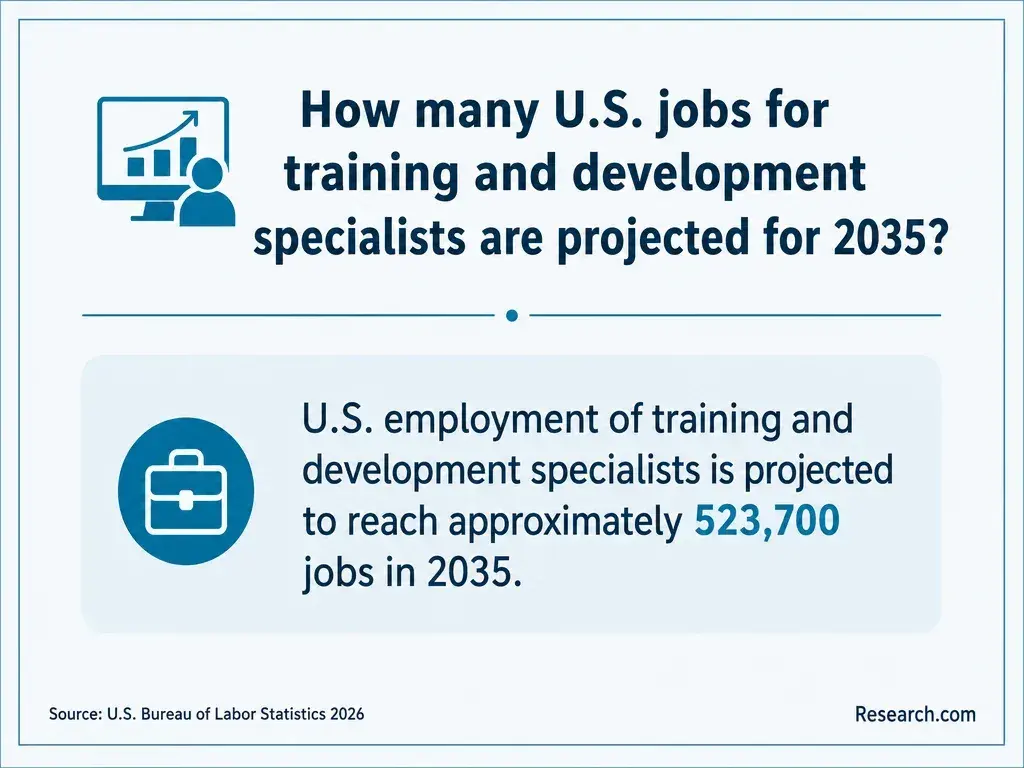
Occupational statistics describe jobs, not the earnings or placement outcomes of a particular Ed.D. cohort. The US Bureau of Labor Statistics reports a 2025 median annual salary of $133,000 for training and development managers and projects 6.4% employment growth for that occupation from 2025 to 2035. Those figures may be relevant to a leader overseeing workforce learning, but they do not predict the pay or promotion prospects of a government or education employee.
For a personal decision, examine the job classification, salary schedule, hiring rules, and experience requirements of positions you would actually seek. Ask a program for clearly defined graduate outcomes, including cohort size and the period measured, if it publishes them. A course that improves an existing leader's ability to implement policy may be valuable even without a change in job title.
Which Professional Certifications or Licenses Might Ed.D. Graduates Need?
Most organizational leadership and public-policy roles do not have a single license conferred by an Ed.D. Employers may value role-specific credentials or experience, but requirements depend on the position. School principal and superintendent roles are different: states set their own preparation, experience, examination, and licensure rules, and a general leadership doctorate should not be presumed to satisfy them.
Before choosing a program for a regulated role, compare its written preparation and licensure disclosures with the state authority's requirements for the position. If your goal is policy implementation rather than licensed school administration, prioritize demonstrable budgeting, stakeholder engagement, evaluation, and leadership experience over an unrelated credential.
Other Things You Should Know About EdD Leadership
Not necessarily. Check the syllabus for required statistical software or data assignments. Comfort interpreting evidence and explaining its limitations is often more important than coding.
Yes. Nonprofits operate within funding rules and public policies and may help implement public programs. The course is most useful when its assignments connect those constraints to the organization's decisions.
Usually, if you follow university rules and remove restricted organizational information. Label it as coursework rather than an adopted policy or completed evaluation.
Confirm the assignment scope with the instructor, document which version of the policy you analyzed, and explain how the change affects your assumptions and recommendation.
- Student Learning Outcomes | missouristate.edu https://www.missouristate.edu/PSP/MPA/Learning_Outcomes.htm
- MPP vs. MPA: What's the Difference? | Public Affairs Master's Degree Programs at Northeastern https://publicaffairs.northeastern.edu/articles/master-public-policy-mpp-vs-master-public-administration-mpa/
- MPA Program Learning Outcomes | txst.edu https://www.polisci.txst.edu/graduate-programs/master-of-public-administration/about/naspaa-accreditation/mpa-learning-outcomes.html
- MPA Student Learning Outcomes | Marist University https://www.marist.edu/management/graduate/public-admin/outcomes
- Executive Doctor of Education in Higher Education Administration | The Marxe School https://marxe.baruch.cuny.edu/homepage/academics/higher-education-administration-program/executive-doctor-of-education-in-higher-education-administration/
- UNC EdD Online: Organizational Learning and Leadership https://online.unc.edu/online-doctoral-programs/online-edd-organizational-learning-and-leadership/
- What Is Public Administration? - SPIA https://spia.uga.edu/blog/what-is-public-administration/
- Educational Leadership and Policy Studies (ELPS) | luc.edu https://catalog.luc.edu/course-descriptions/elps/
- Course Modes & Definitions - Office of the University Registrar https://registrar.washington.edu/classrooms/course-modes/
- Doctor of Education in Leadership - Online EdD Degree | CityU of Seattle https://cityu.edu/programs-overview/doctor-education-leadership/