2027 Online Ed.D. in Leadership and Learning in Organizations After an MBA: Admission and Credit Questions
Audited and Verified:
Our Editorial and Data Verification Process
Research.com uses government datasets, official education statistics and primary institutional information to support its career and degree guides. Our review process checks factual accuracy, occupational definitions, source dates and the requirements associated with the credentials discussed.
How This Article Was Fact-Checked
Our editorial team verifies salary estimates, employment projections, education requirements and program information against original data providers and official organizations. Salary figures are checked against the relevant occupational definitions and reporting periods. Information about licensure, accreditation and required in-person training is reviewed separately.
Fact-checked and verified on:

Co-Founder and Chief Data Scientist
An MBA may make you eligible for an online Ed.D. in Leadership and Learning in Organizations, but it does not necessarily shorten the doctorate. That distinction matters if you are weighing another substantial investment while working in management, training, or organizational development.
This guide separates admission eligibility from credit transfer, explains how business coursework may support an application, and identifies the program policies to check before you estimate your time or cost. You will also see when the Ed.D. adds something your MBA does not - and when experience or targeted training may be the better next step.
Key Things You Should Know
- A completed MBA can satisfy a program's master's-degree requirement if the institution accepts its credential; an education master's is not universally required.
- MBA credits used to establish admission eligibility are not automatically transferred into Ed.D. requirements. Obtain a written, course-level evaluation before expecting savings.
- The U.S. Bureau of Labor Statistics reports a $133,000 median annual salary for training and development managers in 2025, but that occupational figure is not an expected salary for Ed.D. graduates.
What is an online Ed.D. in Leadership and Learning in Organizations?
It is a practice-oriented education doctorate focused on how organizations develop people, lead change, and use evidence to improve performance. Despite "education" in the degree name, this type of program may serve professionals in business, healthcare, government, nonprofits, and higher education - not only school administrators. Exact degree titles and curricula vary by university.
An MBA typically emphasizes business functions such as finance, strategy, operations, and management. A leadership-and-learning Ed.D. may build on that foundation through adult learning, organizational change, program evaluation, and applied inquiry.
If you want to develop researchers rather than lead practice-based improvement, compare the Ed.D. with a research-focused PhD; if your questions center on business scholarship, consider whether a DBA fits better. An Ed.D. concentration selection guide can help you distinguish organizational learning from school-administration tracks.
Can an MBA satisfy online Ed.D. admission requirements?
Often, yes - but the admitting program decides. Where a completed master's degree is required without a specified field, an MBA may meet that condition. Other programs may specify relevant graduate coursework, professional experience, grades, or preparation in research methods. An MBA's title alone neither establishes eligibility nor makes an applicant competitive.
Separate three questions when contacting admissions: Does the completed MBA meet the degree requirement? Does your professional work meet any experience requirement? Do you need preparation in learning theory or research methods? An MBA graduate who has led employee development, evaluated a training initiative, or implemented organizational change can explain that work as evidence of fit. Describe your actual responsibilities and decisions rather than relying on a managerial title.
Send the program your transcript, degree-conferral information, and a brief account of relevant work. Ask admissions for its eligibility decision; questions about applying individual courses to doctoral requirements belong with the office responsible for transfer-credit or degree audits.
Can MBA credits transfer into an online Ed.D. program?
Possibly, but admission and transfer are separate decisions. A school may accept your MBA as the required prior degree while applying none of its courses to the Ed.D. Another may consider a methods or organizational-behavior course for a limited substitution. Doctoral-level requirements, minimum grades, course age, institutional recognition, and rules about credits already used toward a completed degree can all matter.
The distinctions below prevent the most costly misunderstanding: being allowed to apply is not the same as having fewer doctoral courses to complete.
| Decision | What it means for an MBA graduate | What to confirm |
| Admission eligibility | The MBA meets a prior-degree or graduate-study condition. | Accepted degree, institution, transcript, and any grade rules. |
| Transfer credit | Approved prior credits count toward the Ed.D.'s required credit total. | Credit limits, eligible course levels, grades, and whether previously applied credits qualify. |
| Course substitution or waiver | A prior course replaces a requirement or removes a prerequisite, possibly without reducing total required credits. | Which requirement changes and whether replacement credits are still needed. |
Gather official transcripts and, for potentially relevant courses, syllabi showing content, assignments, credit hours, and grades. If coursework uses quarter credits or comes from multiple institutions, request an explicit evaluation. Ask for a written degree audit showing both credits accepted and requirements remaining; even approved transfer may not shorten a fixed cohort or project sequence.
If you also have unfinished doctoral study, that is a different evaluation from MBA transfer. Consider resuming doctoral education through an Ed.D. completion route, then ask whether your prior doctoral work - not your MBA - qualifies under that route's rules.
Requirements vary, but programs commonly review prior graduate study, academic performance, professional experience, a statement of purpose, recommendations, and a résumé. Some also request writing samples, interviews, or entrance tests; none of these should be treated as universal. Check the requirements for your intended entry term rather than relying on an older program description.
For an MBA applicant, the strongest statement connects a real leadership or learning problem to the doctorate's methods and curriculum. For example, leading a training rollout demonstrates implementation experience, while identifying what evidence would show whether employees applied the training demonstrates readiness for applied inquiry. Do not claim access to employer data or approval for a future project unless you have it.
If you lack formal research coursework, ask whether the program offers introductory methods courses, expects prior preparation, or permits a prerequisite. A gap in learning theory may be manageable; whether it affects eligibility is a program decision, not a general rule for business graduates.
Relevant coursework may address adult learning, leadership development, organizational culture, change implementation, and the design and evaluation of workplace learning. Research preparation can include qualitative interviews, quantitative analysis, or mixed methods, followed by a capstone or dissertation in practice. Verify the actual course sequence and final project: similar program names do not establish identical requirements.
The value beyond an MBA lies less in another general management credential than in examining how people learn and how organizational changes work. A finance-trained manager, for instance, may already know how to budget a development initiative but need stronger skills in diagnosing a performance gap, selecting valid measures, and interpreting results without overstating causation. If those skills are the only objective, a focused evaluation course or supervised workplace project may be more efficient than a doctorate.
Expect the program's published course and project sequence to be a better starting point than the number of credits on your MBA transcript. Your MBA may help you enter the program without additional master's study, but it will shorten completion only if approved credits or substitutions actually change the remaining requirements and schedule.
Ask for a term-by-term plan that includes course availability, live class meetings, group work, any campus convenings, and the final research or practice project. A program advertised as accelerated may still require fixed cohort progression or project approvals that cannot be compressed. Use comparing Ed.D. completion timelines to frame your questions, then confirm each school's published duration and your individual degree audit.
If work responsibilities change, ask in advance how part-time enrollment or a leave affects course sequencing, project supervision, and the maximum time allowed to finish. Online access changes where you study; it does not necessarily make attendance or deadlines self-paced.
Without a named program and entry term, there is no reliable single price. Compare schools using the tuition charged for your required credits or terms, then add mandatory fees, books or technology, required travel and lodging, and any additional enrollment needed to finish the project. An MBA lowers this bill only if the Ed.D. approves credits that reduce what you must take or pay for.
Employer assistance can change your out-of-pocket cost, but a reimbursement policy is not a funding guarantee. Check annual limits, eligible degree types, minimum grades, continued-employment obligations, and whether you must pay tuition before receiving reimbursement. When reviewing organizational leadership doctorate tuition comparisons, recalculate each option against its required credits, fees, and your likely schedule rather than comparing advertised rates alone.
Also weigh the opportunity cost: time spent in classes, group meetings, and applied research may displace paid work or other career development. If your employer chiefly wants evidence that you can improve training or lead change, a sponsored project or targeted coursework could offer a less costly way to demonstrate it.
Online delivery does not, by itself, determine whether a doctorate is accredited. Verify the university's institutional accreditation with the accreditor and confirm that the exact online Ed.D. is an authorized degree offering. Any specialized accreditation or recognition must be checked for its actual scope rather than inferred from the school's name.
For professional advancement, compare the degree with the requirements of the role you want. An employer may value applied leadership research yet still require sector experience or a specific credential. A general organizational leadership Ed.D. does not automatically qualify someone for teacher, principal, or superintendent licensure; ask the program and relevant state licensing authority if that is your goal.
Affordability and recognition should be assessed together. If you use lower-tuition pathways to an education doctorate to build a shortlist, confirm each option's accreditation, degree title, delivery requirements, and fit with your employer's advancement rules before comparing price.
The most plausible next step depends on the work you already do. An MBA graduate managing training or talent initiatives may use doctoral study to take on more complex learning strategy, evaluation, or organizational-development responsibilities. Someone with operations experience might apply those skills to internal change leadership or consulting - but must still demonstrate relevant projects and stakeholder work.
Potential roles include training and development manager, organizational-development leader, management analyst, or administrator in an organization where learning and change are central responsibilities. These are career directions, not positions conferred by the degree. Build evidence through a responsibly scoped workplace project, documented decisions, and outcomes you are authorized to share. For a substantial move into learning and development, practical design or facilitation experience may matter more initially than a doctorate.
What salaries and job outlook can Ed.D. graduates expect?
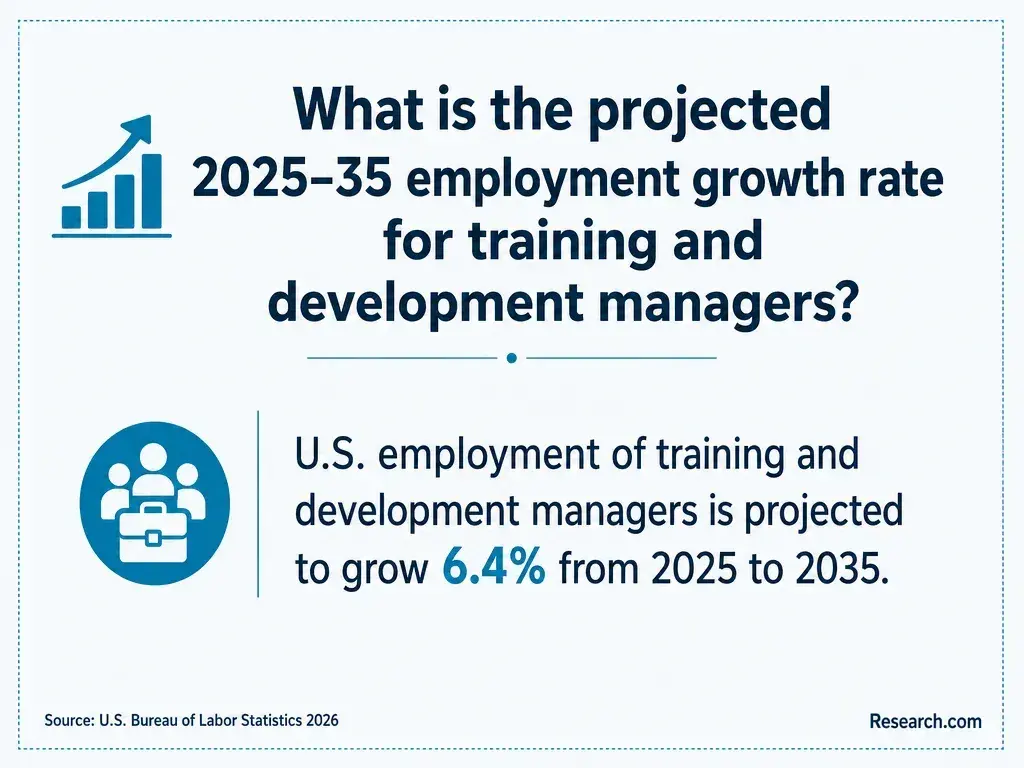
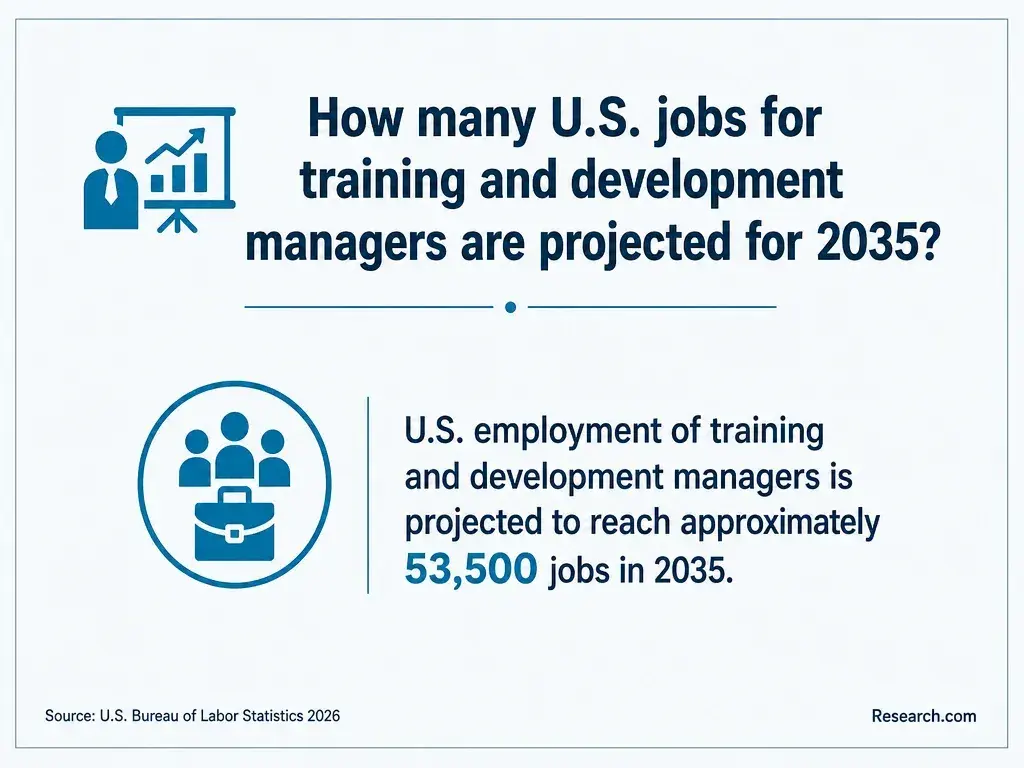
There is no reliable single salary or growth rate for "Ed.D. graduates": U.S. Bureau of Labor Statistics figures describe occupations, not outcomes for holders of a particular degree. For training and development managers, the BLS reports a 2025 median annual salary of $133,000 and projected employment growth of 6.4% from 2025 to 2035. That is context for an experienced manager considering a relevant role - not a starting salary or return-on-investment estimate for an MBA-to-Ed.D. pathway.
Match any occupational benchmark to the job you actually seek and your experience level. Before enrolling for a hoped-for promotion, review real postings or your employer's advancement criteria for required experience, degree preferences, and compensation structure. If the Ed.D. is optional and the immediate gap is leading larger projects, gaining that responsibility first may be the stronger move.
Other Things You Should Know About EdD Leadership
Some programs may review an application while the MBA is in progress, but admission or enrollment may depend on proof of conferral by a stated deadline. Ask admissions what documentation it accepts.
Possibly, if the program accepts that type of sample and the work is yours to share. A strong business capstone can show analytical writing, but it does not automatically replace doctoral research.
Only if the program approves the project and the organization permits the necessary access. Faculty oversight, privacy rules, and any required research or ethics review are separate considerations.
It may if your main goal is advanced inquiry into business practice. Favor a leadership-and-learning Ed.D. when your intended work centers on developing people, evaluating learning, or leading organizational improvement; compare actual curricula and projects before deciding.
- How Long Does It Take to Get an EdD? Full Online Timeline Guide | Alverno College https://edd.alverno.edu/articles/how-many-years-is-a-doctorate-in-education/
- Online Doctorate in Education Leadership and Innovation | NYU https://leadershipinnovation.steinhardt.nyu.edu/
- Education Policy, Organization & Leadership, EdD | University of Illinois Urbana-Champaign Course Catalog https://catalog.illinois.edu/graduate/education/education-policy-organization-leadership-edd/
- Shaping Tomorrow With a Doctor of Education in Leadership and Innovation Degree | Purdue Global https://www.purdueglobal.edu/blog/education/doctor-education-leadership-innovation-shaping-tomorrow/
- Can I transfer credits into a doctoral program? | Capella University https://www.capella.edu/blog/phd-doctorate/can-i-transfer-credits-into-a-doctoral-program/
- EDLPS: EDD Program | Florida International University Catalog https://catalog.fiu.edu/programs/EDLPS:EDD/requirements-uz47h
- How Do Transfer Credits Work When You Go Back to School? | Whitworth Online https://online.whitworth.edu/news-articles/how-do-transfer-credits-work-when-you-go-back-to-school/
- UNC Charlotte Academic Policy: Ed.D. Degree Requirements https://provost.charlotte.edu/policies-procedures/academic-policies-and-procedures/edd-degree-requirements/
- Online Doctorate in Education and Leadership (Ed.D.) | Rockhurst University https://onlinedegrees.rockhurst.edu/online-edd-programs
- How Long to Get an Ed.D. Degree? | University of Bridgeport https://www.bridgeport.edu/news/how-long-to-complete-educational-leadership-degree-edd/