2027 Online BA in Psychology - Addictions for Work in Jail Reentry Planning Teams: Compare Degree Fit and Hiring Requirements
Audited and Verified:
Our Editorial and Data Verification Process
Research.com uses government datasets, official education statistics and primary institutional information to support its career and degree guides. Our review process checks factual accuracy, occupational definitions, source dates and the requirements associated with the credentials discussed.
How This Article Was Fact-Checked
Our editorial team verifies salary estimates, employment projections, education requirements and program information against original data providers and official organizations. Salary figures are checked against the relevant occupational definitions and reporting periods. Information about licensure, accreditation and required in-person training is reviewed separately.
Fact-checked and verified on:

Co-Founder and Chief Data Scientist
Jail reentry teams help people prepare for housing, treatment, benefits, and community support after release. If you want to join one, an online BA in psychology with an addictions focus may build relevant knowledge - but its value depends on the job's duties, hiring rules, and your existing experience. This guide compares degree pathways with the qualifications employers may request, explains where supervised experience matters most, and helps you decide whether a full bachelor's degree or a more targeted route is the better next step.
Key Things You Should Know
- An addictions-focused psychology BA can prepare you for nonclinical reentry coordination, but it does not authorize substance-use counseling, diagnosis, or therapy.
- Hiring requirements depend on the position: support roles may accept relevant experience, while clinical jobs require a qualifying credential and state-specific supervision or licensure.
- A bachelor's degree commonly requires about 120 semester credits; before enrolling, compare your remaining credits and placement access against the requirements of actual reentry job postings.
What is an online BA in psychology with an addictions focus?
It is a bachelor of arts degree that combines psychology's foundations - behavior, development, research, and statistics - with coursework on substance use, recovery, and service systems. "Addictions focus" might mean an officially recorded concentration, a minor, or a selection of electives. Check the catalog and transcript policy rather than assuming those labels are interchangeable.
For reentry work, the useful question is not whether a program sounds clinical. It is whether its courses and applied opportunities prepare you to understand recovery needs, communicate respectfully, evaluate evidence, and coordinate services within a nonclinical role. Compare addiction psychology degree options for undergraduate students against those specific needs.
Can an addictions-focused psychology degree prepare you for jail reentry planning?
Yes, for parts of the work. A reentry planner may help arrange identification documents, housing applications, benefits, transportation, treatment appointments, and a handoff to community providers. Psychology coursework can improve understanding of motivation, stress, substance use, and the barriers people face after release. It cannot replace knowledge of local services or training in an agency's procedures.
The strongest preparation pairs coursework with supervised, nonclinical experience in corrections, a community reentry organization, or a substance-use service agency. Ask whether an internship permits meaningful referral, documentation, and coordination work rather than observation alone. Jail access, background screening, supervision, and permission to handle records may limit placements. Client information should never become a class project or portfolio sample without appropriate authorization.
Some students also consider justice-oriented study; online forensic psychology tuition, admissions, and outcomes can provide a comparison point. Forensic coursework may explain legal settings, but neither concentration grants correctional authority or clinical credentials.
What jobs can you get with an addictions psychology bachelor's degree?
Potential titles include reentry coordinator, case-management assistant, community resource navigator, recovery-support specialist, and program assistant. Employers use these titles differently. One "case manager" might arrange referrals and track appointments; another might need a social-work license or substantial experience. Read duties and minimum qualifications, not just titles.
The table separates plausible bachelor's-level work from positions that usually call for a different qualification. It is a guide to screening postings, not a promise of eligibility.
| Role or function | Typical work | Qualification to check |
| Reentry or resource coordinator | Discharge planning, referrals, and follow-up | Required degree, justice-setting experience, and facility access rules |
| Recovery-support worker | Nonclinical encouragement and connection to services | Whether the employer requires a state-recognized peer credential |
| Program or case-management assistant | Records, appointments, and service tracking | Experience requirements and limits on independent decisions |
| Substance-use counselor | Assessment or treatment within an authorized scope | State credential, qualifying education, supervision, and employer rules |
If your target postings prioritize corrections experience over a particular major, an entry-level agency role may be a more direct first move. A criminal-justice or human-services degree can also fit some positions; accelerating a forensic psychology bachelor's degree is worth considering only if its curriculum and schedule still leave room for relevant field experience.
There is no single US license called "jail reentry planner." A jail, county agency, nonprofit, or health provider sets qualifications for a particular job, subject to applicable state rules. Some coordination jobs accept a bachelor's degree in psychology, social work, criminal justice, or a related field; others emphasize experience, require a BSW, or impose civil-service conditions. Security screening and confidentiality training may be separate hiring requirements.
Scope of practice is the decisive distinction. Coordinating an appointment with a treatment provider is not the same as diagnosing a substance-use disorder or delivering counseling. Those services may require a state addiction-counselor credential, a qualifying counseling or social-work degree, supervised practice, and other steps. If treatment is your intended job, compare the state board's rules with the curriculum before choosing a BA. Accelerated online master's preparation in mental health counseling is a separate educational pathway, not an automatic extension of an undergraduate addictions focus.
An online BA can make coursework easier to combine with employment, but asynchronous classes do not guarantee flexible internships. Jail visits, agency supervision, scheduled meetings, and background checks occur on the host site's timetable. Campus programs may offer easier access to local partners, while online programs may work well for students who already have an approved placement nearby.
Before choosing either format, ask who finds and approves sites, whether your current job can count, what hours require in-person attendance, and what happens if a facility denies access. Also check where statistics and research support are delivered. If graduate study is a possibility, compare those learning conditions with fast-track graduate psychology programs; a shorter online calendar alone does not establish professional eligibility or better placement access.
Prioritize courses that match reentry tasks: addiction science; developmental and social psychology; research methods and statistics; ethics and confidentiality; and coursework addressing community services, cultural responsiveness, or justice-system transitions. These subjects help a planner interpret evidence and communicate across agencies. A course about counseling techniques does not qualify a student to provide counseling.
Look for a supervised opportunity to practice referral mapping, clear documentation, and evaluation of a service process without exposing client records. If you may later seek graduate training, check its prerequisites before choosing electives. An online forensic psychology master's graduation plan, for example, should be evaluated for its research and admissions expectations - not mistaken for a route to licensed forensic assessment.
First confirm the institution's accreditation and that it applies to the school awarding the degree. Then confirm the exact degree name, whether addictions is a formal concentration, course availability, internship rules, and any published outcomes. Request the current catalog and written answers from an academic advisor or field-placement coordinator. Institution-level accreditation does not establish that a BA meets an addiction-counselor board's educational requirements.
Do not look for APA accreditation as a quality test for a general psychology BA: APA's professional accreditation has a different scope. If your eventual goal is licensed counseling, evaluate the specific graduate program and the relevant state board rules separately. The same distinction matters when assessing shorter clinical mental health master's program outcomes; speed and institutional accreditation alone do not answer licensure-eligibility questions.
Freshman applicants and transfer applicants face different admissions and credit-evaluation processes. A bachelor's degree commonly totals about 120 semester credits, but completion time depends on credits that actually satisfy general education, major, concentration, and residency requirements. An accepted transfer course does not necessarily replace a required psychology course.
Compare the total remaining cost, not an advertised per-credit rate alone. Include required fees, books, travel, possible unpaid placement hours, and the earnings you might give up to attend a placement. Ask each school for a degree audit, a term-by-term course plan, and its fieldwork policy before estimating your finish date. Comparing substance use counseling undergraduate tuition versus salary outlook may also help if you are weighing a counseling-oriented bachelor's against psychology; verify whether either route meets your state's credential rules.
Choose a credential only after matching it to your target job and state. Peer-recovery credentials, addiction-counselor credentials, and employer training serve different purposes and may have different eligibility, supervision, examination, and renewal rules. A short certificate with "addictions" in its name should not be assumed equivalent to a state-recognized credential.
For a nonclinical coordinator, employer-approved training in motivational interviewing, overdose response, confidentiality, or local referral systems may be more immediately useful than another degree. If postings instead require licensed treatment, map the full qualifying education and supervised-practice path, including cost. Paying for an online mental health counseling degree becomes relevant at that point, but counseling licensure and addiction credentials still need separate state-specific checks.
What salaries and job outlook apply to addictions and reentry careers?
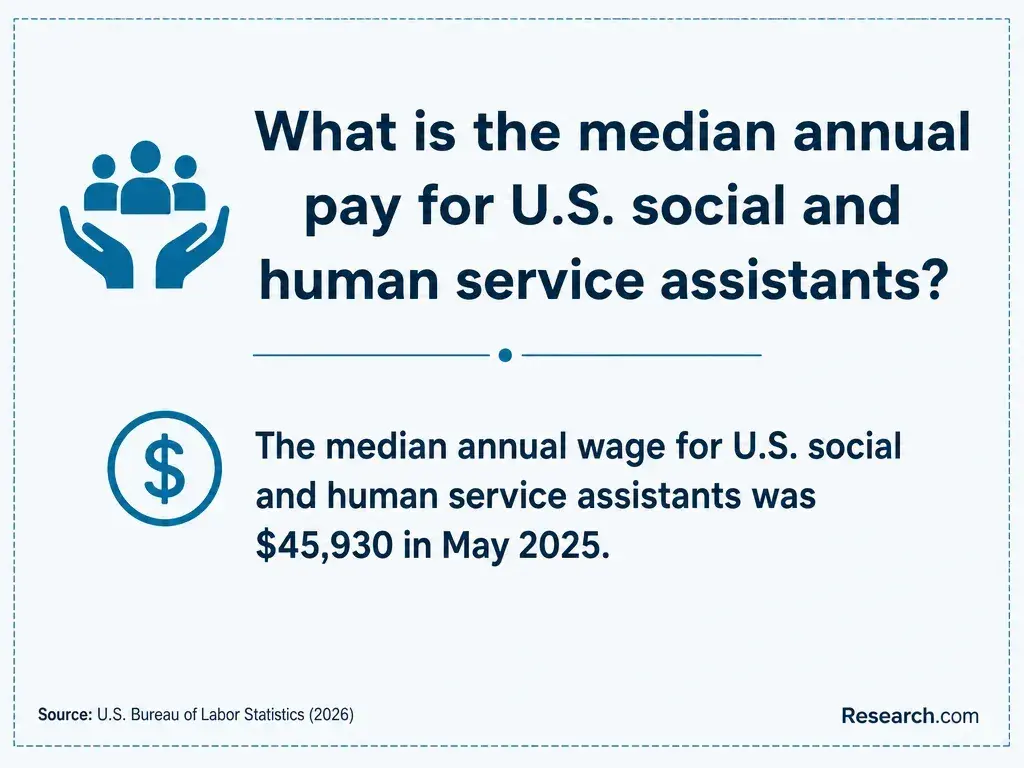
There is no single federal wage category for jail reentry planners. Pay depends on whether the position is classified as human-services support, case management, counseling, or another occupation, as well as its employer and location. For context - not as a forecast for BA graduates - the US Bureau of Labor Statistics reported a May 2024 median annual wage of $45,120 for social and human service assistants. A reentry posting may fall outside that occupation, so its published pay range is the better figure for a personal budget.
For the job outlook, match the posting's duties to a BLS occupation before using any projected growth rate. Then compare local openings, required credentials, and public-sector pay schedules. A graduate degree is worth considering only if it unlocks the work you actually want; graduate psychology tuition and program value should be weighed against the fact that a general psychology master's does not itself confer a counseling license.
Other Things You Should Know About Psychology
Possibly. The program must approve the site, supervisor, duties, and learning objectives; existing employment does not count automatically.
It may strengthen an application, especially when it demonstrates referrals and dependable client support. Check whether the posting requires paid experience or defines acceptable equivalents.
Not without the necessary agency permission and academic oversight. Use approved, appropriately protected information; removing names alone may not resolve confidentiality obligations.
Ask which majors meet the minimum qualification, whether a credential is mandatory, what experience substitutes for education, and which duties are reserved for licensed staff.
- Models of Care for People Re-Entering the Community After Incarceration - NCBI Bookshelf https://www.ncbi.nlm.nih.gov/books/NBK603370/
- THE NEED FOR UNIFORM STANDARDS ISSUE BRIEF | ASPE https://aspe.hhs.gov/reports/credentialing-substance-use-disorder-counselors-need-uniform-standards-issue-brief-0
- Five Things About Reentry | National Institute of Justice https://nij.ojp.gov/topics/articles/five-things-about-reentry
- Credentialed Alcoholism and Substance Abuse Counselor (CASAC) | ny.gov https://oasas.ny.gov/credentialing/casac
- Psychology careers guide | apa.org https://www.apa.org/education-career/guide/careers
- Online Bachelor's Degree in Psychology in Addictions | Purdue Global https://www.purdueglobal.edu/degree-programs/psychology/bachelor-psychology-addictions/
- Licensure & Certification | ECU https://dars.ecu.edu/programs/clinicalcounseling/licensure-certification/
- Correctional Counselor Career Info (Types, Requirements & Salary) | allcriminaljusticeschools.com https://www.allcriminaljusticeschools.com/specialties/correctional-counselor-training/
- Guide to Becoming a Correctional Treatment Specialist | allpsychologyschools.com https://www.allpsychologyschools.com/careers/correctional-treatment-specialist/
- PSCS A/D Certified Associate Counselor - State of Maryland https://www.jobapscloud.com/MD/sup/BulPreview.asp