2027 Online BA in Psychology - Addictions After CLEP Introductory Psychology Credit: Compare Transfer Credit and Remaining Coursework

Co-Founder and Chief Data Scientist
Passing CLEP Introductory Psychology may remove a course from your online BA, but it does not necessarily shorten the degree - or satisfy a psychology-major requirement. That distinction matters if you are comparing programs with addictions coursework and trying to avoid paying for credits you already earned.
This guide shows transfer and returning students how to read a credit evaluation, identify remaining courses, estimate a realistic completion schedule, and check whether the degree fits an addiction-services career goal.
Key Things You Should Know
- College Board recommends 3 semester hours of credit for CLEP Introductory Psychology at a qualifying score, but each college decides whether to award credit and where it applies.
- Credit that satisfies introductory psychology may still leave statistics, research methods, upper-division psychology, addictions courses, general education, and residency requirements.
- Compare programs using a written degree audit and remaining billable credits - not an advertised transfer maximum or the fact that CLEP appears on your transcript.
What Is an Online BA in Psychology After CLEP Introductory Psychology Credit?
It is a bachelor of arts program in which the college has evaluated your CLEP exam for possible academic credit. The BA remains a full undergraduate degree; the exam potentially replaces one introductory course, not the psychology major. "Addictions" may describe a formal concentration, a group of electives, or simply available courses. Check which designation will appear in the catalog and, if relevant, on your transcript.
A psychology BA with addictions electives suits students who want broad psychological-science preparation alongside study of substance use, prevention, and recovery. If your primary goal is a state-recognized substance use counseling credential, comparing online substance use counseling degrees may be more useful than choosing by the psychology major's title alone.
How Does CLEP Introductory Psychology Credit Transfer to Online Psychology Programs?
The receiving institution - not College Board - determines whether your score earns credit. Its psychology department or registrar may then decide whether that credit substitutes for an introductory major course. Finally, the degree audit determines whether the substitution reduces what you must take to graduate. These are separate decisions.
The same accepted exam can have different effects across schools. Use this comparison when reviewing written evaluations, then examine each institution's policy on comparing psychology transfer credit limits.
| Evaluation outcome | Effect on the degree | What to confirm |
| Introductory psychology equivalency | May satisfy a major prerequisite or general education requirement | Whether the major accepts exam credit for that specific requirement |
| General elective credit | Adds credits but may not remove a required course | Whether elective space remains in the degree audit |
| No credit awarded | Does not reduce required coursework | Minimum score, score-report rules, and any appeal process |
Send the official CLEP score report and transcripts from every prior college. Ask the registrar or transfer-credit office for an evaluation and the psychology department for any major-course substitution; obtain an updated degree audit before enrolling. If an equivalency appears wrong, provide the exam description and request the school's formal review rather than assuming an advisor's informal estimate is binding.
What Coursework Remains After Transferring CLEP Psychology Credit?
Even when CLEP satisfies introductory psychology, most of the BA remains. Requirements commonly include statistics, research methods, upper-division work in areas such as development and social psychology, general education, electives, and a capstone. Addictions coursework might examine substance use across the lifespan, prevention, recovery systems, and research evidence. The exact courses and sequence depend on the catalog governing your degree.
Check prerequisites carefully: an introductory psychology waiver may let you enter a later course sooner, but statistics may still precede research methods, which may precede a capstone. If you are considering a different emphasis, shorter routes through forensic psychology bachelor's coursework illustrate why a specialty label and a fast advertised timeline should be checked against your own remaining requirements.
Request an audit that labels each requirement as completed, in progress, or outstanding. Ask whether prior statistics or methods coursework needs a separate equivalency review and whether required addictions courses are offered regularly online. A course about addiction treatment is academic preparation, not authorization to treat clients.
The relevant calculation is the coursework still required after all credits are applied, divided by the number of credits you can realistically complete each term. A CLEP award equivalent to one course may save no time if another required course occupies that term or a prerequisite is offered only later. Conversely, clearing an introductory prerequisite could help you start the major sequence earlier.
When choosing an accelerated psychology degree route, compare a term-by-term plan rather than advertised completion time. Ask when statistics, methods, addictions electives, and the capstone run; whether courses are asynchronous; and whether live meetings or an approved placement could limit your pace. Check minimum credits that must be earned at the institution and whether part-time enrollment changes the schedule.
Confirm that the institution holds recognized institutional accreditation and that the accreditation covers the school awarding the degree. This matters for the degree's standing and can affect access to federal student aid. Also verify that the online BA and any advertised addictions concentration actually appear in the school's current catalog.
Do not reject a general psychology BA because it lacks APA accreditation: APA does not accredit general undergraduate psychology programs. A useful forensic psychology program review before enrollment applies the same principle to another specialty - check the institution and the precise credential, rather than assuming a specialization name establishes professional recognition. For an addiction-counseling goal, separately check the applicable state credentialing rules.
Schools generally ask for an application and prior academic records, but admission to the university, admission to the psychology major, and acceptance of CLEP credit may follow different rules. A transfer applicant may need official college transcripts and proof of secondary-school completion; major entry may also depend on completed prerequisites or academic standing. Confirm the requirements for your intended entry term.
Ask admissions when to submit the official CLEP report and when you will receive a degree audit. If graduate study is a longer-term goal, do not confuse BA admission with later graduate eligibility: faster routes through forensic psychology graduate coursework still require applicants to meet each graduate program's own admissions and preparation standards. Preserve room in your BA plan for statistics and research experience if those are relevant to your next step.
CLEP saves tuition only when its accepted credit reduces billable coursework. If it fills an unused elective slot while you still must take introductory psychology, the financial benefit may be small. Compare each school's written audit with its tuition rate, mandatory fees, residency requirement, and charges for any required course or placement. Do not multiply an advertised per-credit price by all accepted transfer credits; those are not credits you will necessarily buy.
If your objective is addiction-services work rather than a broad psychology education, inexpensive undergraduate substance use counseling degree choices offer an alternative to compare. Request a cost estimate based on your remaining courses, including terms in which you may need to enroll below your usual pace. Check financial-aid eligibility with the school before relying on aid for a proposed schedule.
Graduates may pursue nonclinical roles in human services, recovery-support organizations, community outreach, research support, or program administration, subject to employer requirements. Work may involve documenting services, coordinating referrals, helping run prevention programs, or supporting data collection - not independently diagnosing or treating substance use disorders.
Choose applied coursework and experience around the work you want to do. For a recovery-service role, look for supervised opportunities to practice respectful communication, referral boundaries, confidentiality, and accurate documentation. For research support, prioritize statistics, methods, and responsible data handling. Career paths at higher degree levels are different: master's-level forensic psychology employment pathways should not be treated as outcomes promised by this addictions-focused BA.
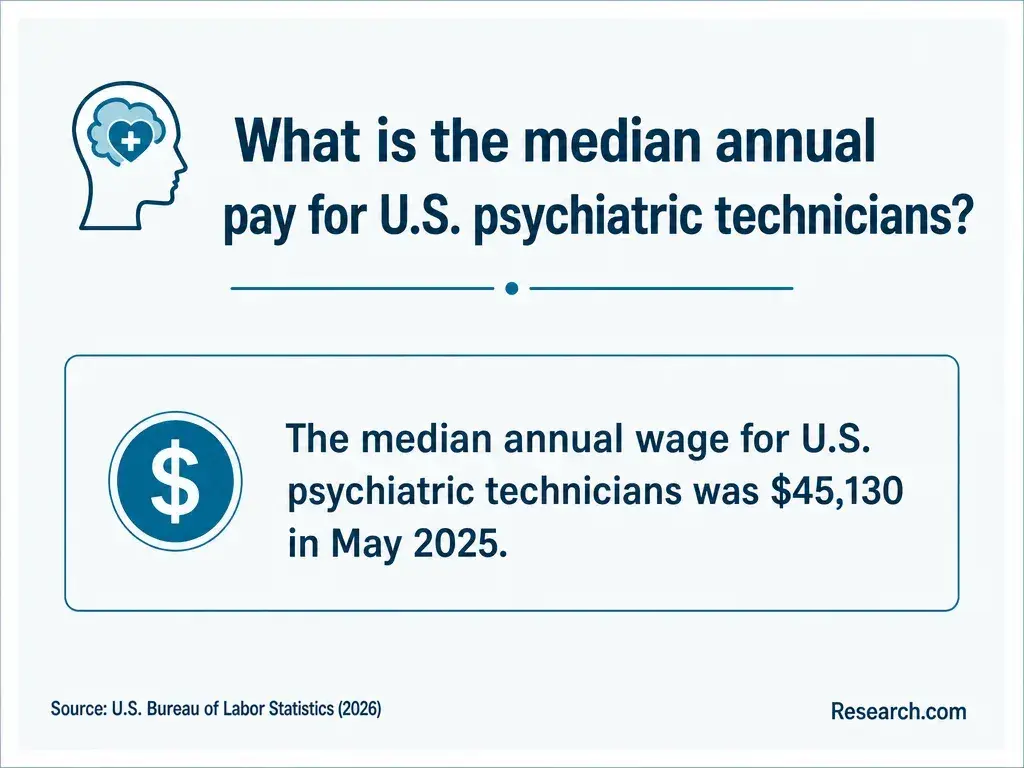
There is no single salary or employment projection for "psychology BA graduates." Pay depends on the occupation, location, employer, experience, and any required credential. The US Bureau of Labor Statistics reported a May 2024 median annual wage of $45,120 for social and human service assistants, an occupation that includes some support-service work. That occupation-wide median is not a starting salary or an earnings estimate for holders of this degree; some positions do not require a bachelor's degree.
For outlook, use the BLS projection for the specific job you intend to seek, then check local postings for qualifications and pay. Do not use counselor wages or growth figures as a BA outcome: counseling jobs can require a qualifying graduate degree, supervised experience, and licensure. If that is your destination, short counseling master's formats and career planning belong in a separate time-and-cost comparison.
Does a Psychology Bachelor's Degree Qualify You for Licensure or Certification?
No psychology BA, CLEP credit, or addictions concentration alone qualifies someone to practice as a licensed psychologist or independently provide psychotherapy. Addiction counselor and peer-support credentials vary by state and role; required education, supervised experience, examinations, and permitted duties must be checked with the relevant regulator or certifying body.
Before committing to the BA, identify the exact job title and jurisdiction you are targeting. Compare its credential requirements with the program's documented coursework and any approved experience - not merely its addictions-related course titles. If a different undergraduate route better matches those requirements, investigate its admission rules and undergraduate substance abuse counseling education funding alongside its remaining-credit cost.
Other Things You Should Know About Psychology
Possibly. Obtain written approval first: schools may restrict exam credit after enrollment or after you have attempted an equivalent course.
Usually it is recorded as credit rather than a graded course, but transcript and GPA treatment are set by the receiving school. Check its policy if a future application asks for graded prerequisites.
Do not assume the credit transfers automatically from that transcript. The new school may require your official CLEP score report and make its own equivalency decision.
Ask the registrar which attempt, if either, applies. Schools commonly limit duplicate credit for equivalent learning, so counting both toward graduation is not a safe assumption.
- College Level Examination Program (CLEP) | louisiana.gov https://doe.louisiana.gov/families-and-students/preparing-to-graduate/college-level-examination-program-(clep)
- Academic Years, Academic Calendars, Payment Periods, and Disbursements | 2024-2025 Federal Student Aid Handbook https://fsapartners.ed.gov/knowledge-center/fsa-handbook/2024-2025/vol3/ch1-academic-years-academic-calendars-payment-periods-and-disbursements
- College-Level Examination Program (CLEP) | dantes.mil https://www.dantes.mil/clep/
- Credit for Prior Learning - PA College Transfer https://collegetransfer.pa.gov/Administrators/Credit-for-Prior-Learning
- CLEP | FIU Center for Testing and Career Certification https://dasa.fiu.edu/all-departments/center-for-testing/exams-offered/clep/
- Evaluation of Transfer Credit | Cal Poly Academic Catalog https://catalog.calpoly.edu/academic-standards-policies/evaluation-transfer-credit/
- College Level Examination Program (CLEP) | nmsu.edu https://records.nmsu.edu/_assets/transfer-credit-interior/clep-credit.html
- CLEP-College Level Examination Program | paradisevalley.edu https://www.paradisevalley.edu/students/testing-services/clep-college-level-examination-program
- Online Bachelor's Degree in Psychology in Addictions | Purdue Global https://www.purdueglobal.edu/degree-programs/psychology/bachelor-psychology-addictions/
- Applied Psychology: Addictions Studies, B.S. - CPS, CPSO | University of New Hampshire https://www.unh.edu/program/bachelor-science/applied-psychology-addictions-studies