
2027 Online BA in Psychology - Addictions for Food Assistance Program Staff: Compare Transferable Skills and Degree Requirements
Audited and Verified:
Our Editorial and Data Verification Process
Research.com uses government datasets, official education statistics and primary institutional information to support its career and degree guides. Our review process checks factual accuracy, occupational definitions, source dates and the requirements associated with the credentials discussed.
How This Article Was Fact-Checked
Our editorial team verifies salary estimates, employment projections, education requirements and program information against original data providers and official organizations. Salary figures are checked against the relevant occupational definitions and reporting periods. Information about licensure, accreditation and required in-person training is reviewed separately.
Fact-checked and verified on:

Co-Founder and Chief Data Scientist
Food assistance staff already help people navigate stressful decisions, service barriers, and referrals.
An online BA in psychology with an addictions focus could deepen that work, but it may not be the most direct route to an addiction-services job. This guide compares the skills you already use with the coursework, time, cost, and credentials different roles require. It will help you decide whether to pursue the degree, choose a more targeted qualification, or build experience in your current organization first.
Key Things You Should Know
- Food assistance experience can support outreach, referrals, and service coordination; addiction counseling requires separate preparation and, where applicable, a state credential.
- Compare the program's actual degree audit, addictions coursework, schedule, and approved fieldwork - not just its "online" or "addictions" label.
- Before paying for a BA, check whether your target role requires a bachelor's degree, a different major, a state-recognized credential, or supervised experience instead.
What Is an Online Psychology Degree in Addictions for Food Assistance Staff?
It is generally a psychology bachelor's degree delivered primarily online, with addictions-related study offered as a formal concentration, a track, or electives. Those labels are not interchangeable: a concentration appears in an institution's published degree requirements, while taking an elective may not create a recognized specialization.
For a food assistance worker, the strongest fit is often an expanded nonclinical role: coordinating referrals, supporting prevention outreach, improving access to services, or evaluating a community program. Study of substance use and recovery can improve how you understand these systems without qualifying you to diagnose or treat a substance use disorder.
Compare the precise award and delivery arrangements among distance learning psychology degree options before assuming programs with similar names provide the same preparation.
How Can Food Assistance Staff Apply Transferable Skills to Addiction Psychology?
Eligibility interviews, resource navigation, documentation, and relationships with community partners are relevant to addiction-service support. The transfer is strongest when you can demonstrate a specific task rather than claim that client-facing experience is equivalent to counseling.
The comparison below separates work you may already know from preparation you would still need for an addiction-focused role.
| Food assistance experience | Potential application | Preparation to check |
| Explaining eligibility and services | Clear, nonjudgmental information and referral | Local treatment and recovery resources; referral boundaries |
| Coordinating with partner agencies | Connecting clients to appropriate support | Consent, information-sharing rules, and follow-up procedures |
| Recording service activity | Supporting outreach reporting or program evaluation | Research methods, data quality, and privacy safeguards |
| Responding to barriers such as transportation or food insecurity | Recognizing practical obstacles to accessing care | Trauma-informed communication and escalation protocols |
Ask a prospective employer which duties it assigns to support staff and which require a credentialed counselor. If counseling is the destination, compare academic routes into addiction counseling with your state's requirements rather than relying on transferable experience alone.
What Are the Degree Requirements for an Online Psychology Program in Addictions?
A BA normally combines general education, psychology-major requirements, electives, and the institution's graduation rules. An addictions focus may add specified courses or an approved capstone; it may also be only an elective grouping. Request a degree audit showing which requirements remain after transfer evaluation. Credits accepted by the university do not necessarily satisfy psychology prerequisites, the addictions focus, or required credits completed at that institution.
Check the sequence of statistics and research methods, upper-level course availability, minimum grades, and any internship or capstone approval. If you hope to study psychology at the graduate level, compare these requirements with your intended program's prerequisites before using electives on a narrow specialty. Planning a faster psychology master's degree is useful only after confirming that a proposed BA supplies the preparation that master's program actually expects.
Online study can reduce commuting, which matters when food assistance offices have fixed hours or unpredictable client demand. It does not automatically mean self-paced study. Live classes, group projects, timed exams, and locally arranged placements can be as difficult to schedule as campus commitments.
Campus study may make it easier to meet faculty, join research projects, or use established community partnerships. An online program can offer comparable academic subjects, but you should ask how remote students obtain advising, research supervision, and approved field experiences. If you are weighing a later counseling degree, accredited counseling study with accelerated schedules illustrates why online coursework and required supervised, in-person training must be evaluated separately.
Look first for a solid psychology core: introductory psychology, development, social or cultural psychology, statistics, and research methods. Addictions-related offerings may address substance use, learning and motivation, health psychology, prevention, or service systems. Exact course titles and whether they are required vary by school.
For food assistance work, methods and statistics are especially useful when interpreting outreach results or grant reports. Development and social psychology can help frame service barriers without stereotyping clients.
A course describing counseling techniques is academic exposure, not authorization to counsel. If your goal is a state-recognized substance use counseling pathway, compare the actual curriculum and credential alignment of cost-conscious substance use counseling undergraduate options against a general psychology BA.
Confirm the university's current institutional accreditation through the accreditor or the U.S. Department of Education's recognized-accreditor information. Institutional accreditation is an essential check for degree recognition and federal aid eligibility, but it does not establish that an addictions concentration meets a state counseling board's educational rules.
Do not require APA accreditation for an ordinary psychology BA: APA's professional accreditation does not cover general bachelor's psychology programs. If a school claims a separate professional approval or a route to certification, ask for the approving body, the exact program covered, and written guidance for your state.
Comparisons of accredited counseling program affordability comparisons concern a different degree and credential pathway; a counseling program's recognition cannot be transferred to a psychology BA.
Requirements depend on whether you are entering college for the first time or transferring. Schools commonly review prior education and transcripts; some separately control admission to the psychology major. A returning student should ask for a written evaluation of prior coursework, including any statistics, research, or human-services classes, and confirm how accepted credits apply to the degree audit.
Gather transcripts and course descriptions before comparing completion estimates. Ask admissions who approves transfer equivalencies, whether the addictions focus has separate entry rules, and whether an applied associate degree leaves additional general-education requirements.
Admission and financial aid are separate decisions: after identifying eligible schools, use bachelor's-level substance use counseling scholarship planning as a prompt to check aid opportunities and conditions for your specific program.
There is no reliable completion time or total price without a school-specific audit and enrollment plan. Previously earned credits may shorten the route only if they satisfy outstanding requirements; course sequencing, part-time enrollment, and required credits at the new institution can extend it. Compare the cost of remaining credits, not just advertised tuition per credit.
Request an estimate that separates tuition, mandatory online fees, books or software, and any placement-related travel or unpaid hours. Then compare that estimate with your employer's education-assistance policy and the wages or hours you might give up. Comparing affordable psychology colleges online can help build a shortlist, but the less expensive choice for a transfer student is the one with the better verified remaining-degree plan - not necessarily the lowest posted rate.
A psychology BA may strengthen applications for nonclinical outreach, intake, service-coordination, or program-support positions, especially alongside your food assistance experience. It does not guarantee a new title or promotion; public agencies and nonprofits may set specific degree, experience, civil-service, or credential requirements.
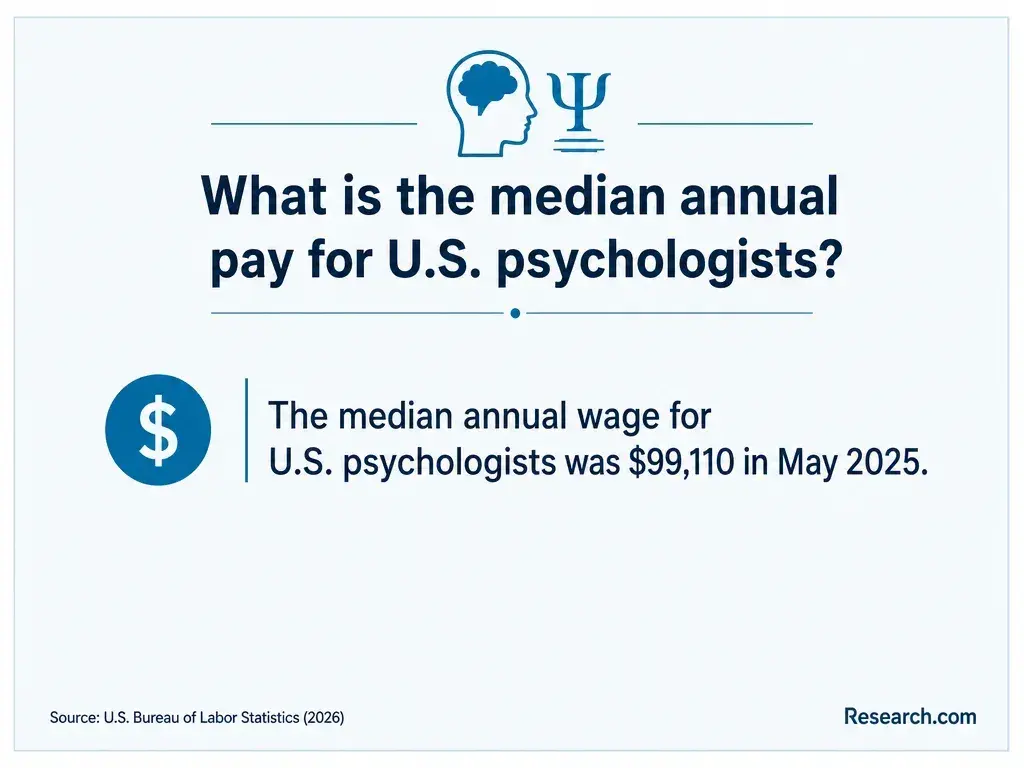
National wage figures need careful interpretation. The U.S. Bureau of Labor Statistics groups workers by occupation, not by psychology concentration, so the median for substance abuse, behavioral disorder, and mental health counselors is not an expected salary for a psychology BA graduate.
That occupation also includes positions with requirements beyond this degree. For a useful pay comparison, identify local postings whose duties and minimum qualifications you meet, then compare their published ranges with your current compensation and the degree's remaining cost.
If the target posting requires graduate education, assess whether that education is genuinely necessary for the role before committing to it. Planning the cost of a psychology master's should include the added time and expense without assuming a general psychology master's qualifies you for counseling.
Does an Addictions Psychology Bachelor's Degree Lead to Licensure or Certification?
Not by itself. A psychology BA with addictions coursework does not authorize psychotherapy, diagnosis, independent assessment, or use of a protected professional title. State substance use counselor credentials can have distinct requirements for approved education, supervised experience, examinations, and permitted duties; peer-support credentials may follow another route.
Start with the state regulator or certifying body for the exact job title you want. Ask whether a prospective degree meets its education rules and which requirements would remain after graduation. Do not substitute an appealing specialty name for that check: even forensic psychology master's accelerated curriculum planning describes a different academic direction, not an addiction-counseling credential.
If your aim is better referrals or program coordination rather than regulated counseling, targeted training and supervised nonclinical experience may be the more direct investment.
Other Things You Should Know About Psychology
Possibly, but only if the school approves the site, duties, supervision, and learning objectives. Existing employment alone does not satisfy an internship requirement.
Do not use them without agency permission and any required school review. A project can often be designed around public information or approved, non-identifiable operational data instead.
Compare the actual course plans. A BS may require more science or quantitative study, but the label alone does not determine addiction-service job eligibility or graduate admission.
For some outreach or referral goals, it may be sufficient. Check target job postings and credential rules first; training cannot replace a required degree or state-approved education.
- Cost of Attendance (Budget) | 2025-2026 Federal Student Aid Handbook https://fsapartners.ed.gov/knowledge-center/fsa-handbook/2025-2026/vol3/ch2-cost-attendance-budget
- STATE LICENSURE FOR SUBSTANCE USE DISORDER COUNSELING: IMPLICATIONS FOR BILLING ELIGIBILITY | ASPE https://aspe.hhs.gov/reports/state-licensure-substance-use-disorder-counseling-implications-billing-eligibility-0
- Undergraduate and Graduate Tuition and Fees | Purdue Global https://www.purdueglobal.edu/tuition-financial-aid/undergraduate-graduate-tuition-and-fees/
- Addiction Psychology, MS - ASU degree programs https://degrees.asu.edu/masters-phd/major/ASU00/LAADPSYMS/addiction-psychology-ms
- Applied Psychology: Addictions Studies, B.S. - CPS, CPSO | University of New Hampshire https://www.unh.edu/program/bachelor-science/applied-psychology-addictions-studies
- Transfer credit policies - Office of Admissions https://admit.washington.edu/apply/transfer/policies/
- Mental Health and Substance Abuse Social Workers | West Virginia University https://www.wvu.edu/academics/careers/mental-health-and-substance-abuse-social-workers/
- Online Substance Abuse and Addictions Degree | ASU Online https://asuonline.asu.edu/online-degree-programs/undergraduate/counseling-psychological-sciences/


