2027 Online AGPCNP Programs for Nurses in New Mexico: MSN Options and Primary Care Clinicals
Audited and Verified:
Our Editorial and Data Verification Process
Research.com uses government datasets, official education statistics and primary institutional information to support its career and degree guides. Our review process checks factual accuracy, occupational definitions, source dates and the requirements associated with the credentials discussed.
How This Article Was Fact-Checked
Our editorial team verifies salary estimates, employment projections, education requirements and program information against original data providers and official organizations. Salary figures are checked against the relevant occupational definitions and reporting periods. Information about licensure, accreditation and required in-person training is reviewed separately.
Fact-checked and verified on:

Co-Founder and Chief Data Scientist
For a New Mexico RN, finding an online adult-gerontology primary care nurse practitioner (AGPCNP) program involves more than finding remote classes. The MSN track must prepare you for the right population-focused certification, permit enrollment from New Mexico, and support supervised primary care clinicals you can complete.
This guide separates confirmed school offerings from options that need verification, then explains the clinical, licensing, scheduling, and cost questions to resolve before applying.
Key Things You Should Know
- An online AGPCNP MSN is a postlicensure advanced practice program for care of adults and older adults; online coursework does not eliminate supervised, in-person clinicals.
- Do not assume a New Mexico nursing school offers this exact MSN track. Confirm the degree, adult-gerontology primary care focus, enrollment authorization, and certification eligibility before applying.
- National AGPCNP certification pathways generally specify at least 500 faculty-supervised clinical hours; a school may require more, and its approved hours and sites control your graduation plan.
What Are Online AGPCNP Programs in New Mexico?
An online AGPCNP MSN prepares an already-licensed RN to assess, diagnose, manage, and coordinate primary care for adults across adulthood and aging. "Online" usually describes didactic coursework, not the entire degree: students still need program-approved supervised patient care, and some schools require live classes, simulation, or campus visits. A New Mexico resident may therefore consider both in-state schools and out-of-state programs that accept New Mexico students and approve clinical placements there.
Population focus is the first filter. AGPCNP preparation is not interchangeable with adult-gerontology acute care, family NP (FNP), or psychiatric-mental health NP (PMHNP) preparation. Choose AGPCNP if your intended work centers on ongoing adult and older-adult primary care rather than pediatric visits, inpatient acute care, or psychiatric specialty care. A nurse comparing specialties should not treat psychiatric NP certificate length options as substitutes for an initial AGPCNP MSN.
Which New Mexico Schools Offer Online AGPCNP MSN Programs?
No specific New Mexico-based online AGPCNP MSN offering is established here. A school's general NP listing - or a similarly named acute care track - is not evidence that it currently admits students to an adult-gerontology primary care MSN. The following are sensible institutions to check, not a list of confirmed AGPCNP MSN providers.
This comparison shows what a New Mexico applicant needs to establish before adding an in-state school to a shortlist.
| New Mexico school to check | What remains to be confirmed | Decision implication |
| University of New Mexico | Whether an AGPCNP primary care track is offered as an MSN for the intended entry term, rather than a different NP focus or degree | Do not substitute an acute care or other NP track because it is local. |
| New Mexico State University | Whether an online AGPCNP MSN exists and is accepting applicants, along with its clinical-site policies | Compare only a confirmed track against out-of-state AGPCNP options. |
| Other New Mexico nursing schools | Exact graduate award, population focus, delivery format, and admissions status | A general MSN or FNP program does not establish AGPCNP eligibility. |
Ask each graduate nursing office for its current track page, plan of study, and written answer about your entry term. If no suitable in-state MSN is available, compare out-of-state programs that explicitly enroll New Mexico residents; affordable online advanced practice nursing routes can help build a preliminary list, but price comparisons matter only after specialty and clinical eligibility are confirmed.
What Are New Mexico AGPCNP Licensure and Certification Requirements?
Graduation, national certification, and New Mexico advanced practice authorization are separate steps. An AGPCNP graduate typically needs an eligible population-focused graduate education, a passing result on an accepted national certification examination, and approval from the New Mexico Board of Nursing before practicing as a nurse practitioner. Maintain the RN license required for the pathway and check the board's current application, verification, and prescribing requirements before your final term.
For primary care AGPCNP certification, compare the current eligibility guides from the American Nurses Credentialing Center (ANCC) and the American Association of Nurse Practitioners Certification Board (AANPCB). Both require qualifying graduate preparation and supervised clinical education, but applicants must check the specific exam's documentation rules. An FNP pathway has a different population focus; one-year FNP admission requirements do not establish AGPCNP certification eligibility, regardless of how quickly a program can be completed.
Ask your prospective school to identify the certification examination its graduates are prepared to take and to confirm that its curriculum meets New Mexico requirements. Neither an MSN diploma nor a certification-exam pass alone authorizes practice before the board grants the applicable license or recognition.
Students complete supervised, direct patient care at sites approved by their program. Depending on a school's rules, suitable experiences may involve adult primary care, geriatrics, chronic-condition management, and preventive care in clinics or other appropriate settings. Certification pathways generally call for at least 500 faculty-supervised clinical hours, but the program may set a higher total or require particular encounters and experiences. Work shifts, simulation, and hours arranged without school approval should not be counted on to replace those requirements.
Clinical logistics can determine whether a seemingly flexible online MSN is feasible. Get written answers to the following before paying an enrollment deposit:
- Who identifies and secures sites and preceptors, and what happens if a proposed New Mexico site declines?
- What preceptor credentials, patient populations, documentation, and faculty oversight does the school require?
- When do clinicals begin, how many hours must be scheduled each term, and are weekday appointments necessary?
- Are site agreements, travel, immunizations, background checks, or campus visits the student's responsibility?
This is a different kind of clinical commitment from some RN-to-BSN coursework. BSN completion programs using workplace-based projects should not be used as a model for NP direct-care placements. An RN's existing job may be relevant experience, but only the AGPCNP program can approve a site, preceptor, schedule, and hours for its degree.
Expect graduate preparation in advanced health assessment, pathophysiology, and pharmacology, followed by adult-gerontology primary care coursework and supervised clinical practice. Specialty learning commonly addresses health promotion, complex chronic conditions, aging, diagnostic reasoning, treatment planning, and coordination across settings. Research appraisal, quality improvement, and professional practice may also appear in the plan of study.
Compare course descriptions and the clinical sequence, not just degree titles. A program should show how adult and older-adult primary care competencies are taught and evaluated; classroom completion is not proof of independent clinical competence. A nurse seeking psychiatric diagnosis and treatment instead would need a different specialty curriculum, such as those discussed in exploring faster online MSN-PMHNP programs. Speed cannot make one population focus qualify a graduate for another.
These are postlicensure programs. A typical applicant holds an active RN license and a BSN, although requirements for GPA, statistics, nursing experience, recommendations, and licensure in the clinical state differ by school. Admission to a university does not necessarily mean admission to its AGPCNP track or approval to begin clinicals.
An ADN-prepared RN should ask whether the school offers a genuine bridge into its AGPCNP track, what credential the bridge awards, and whether additional undergraduate coursework changes the time and cost. MSN pathways that accept ADN-prepared nurses are a starting point for that inquiry, not evidence that every bridge includes NP preparation. Nurses who already hold an MSN or DNP in another focus can instead ask about a post-graduate AGPCNP certificate and a formal review of prior coursework and clinical hours; prior experience does not automatically replace new population-focused training.
Time to completion depends on entry degree, transfer or bridge requirements, full- versus part-time enrollment, course sequencing, and access to approved clinical placements. Do not rely on a school's shortest advertised timeline until it confirms a term-by-term plan that includes your clinical schedule. A working RN should also ask when synchronous classes, weekday patient visits, and any required travel occur.
A useful cost comparison is an individualized written estimate, not a tuition-per-credit figure alone. Request total required credits and charges for tuition, mandatory fees, technology, books, travel or lodging for campus visits, clinical compliance, certification testing, and licensure. Budget for reduced work hours if clinical days conflict with paid shifts. Comparing online BSN-to-MSN program costs can provide context, but confirm that each quoted price applies to an AGPCNP track and your residency and enrollment status.
The meaningful difference is where and when learning activities occur - not whether a student must demonstrate clinical competence. This comparison helps distinguish a workable schedule from a format that only appears convenient.
| Factor | Primarily online program | Campus-based program |
| Coursework | Remote classes may be asynchronous or require live attendance. | In-person class times may be more predictable but require commuting. |
| Clinical care | In-person, school-approved sites are still required; local placement arrangements vary. | In-person clinicals remain required; proximity to campus does not guarantee a site. |
| Additional travel | May include simulation sessions or short residencies. | Usually includes recurring class or lab travel. |
| Best fit | RNs who can secure approved nearby clinicals and meet remote-course schedules. | RNs who prefer regular face-to-face learning and can manage attendance requirements. |
Choose based on the complete clinical and attendance calendar. A higher-level degree is not automatically the solution to a format problem: if an MSN AGPCNP track meets your intended role and licensing needs, exploring attainable DNP entry requirements is a separate decision, not a reason to assume a DNP will have fewer in-person obligations.
After obtaining the required certification and New Mexico practice authorization, an AGPCNP may seek adult primary care roles in ambulatory practices, geriatrics-focused services, community clinics, or other settings whose duties match primary care preparation. Employers may additionally expect experience, onboarding, and competency checks. An acute care position should not be assumed to fall within an AGPCNP graduate's preparation merely because its patients are adults.
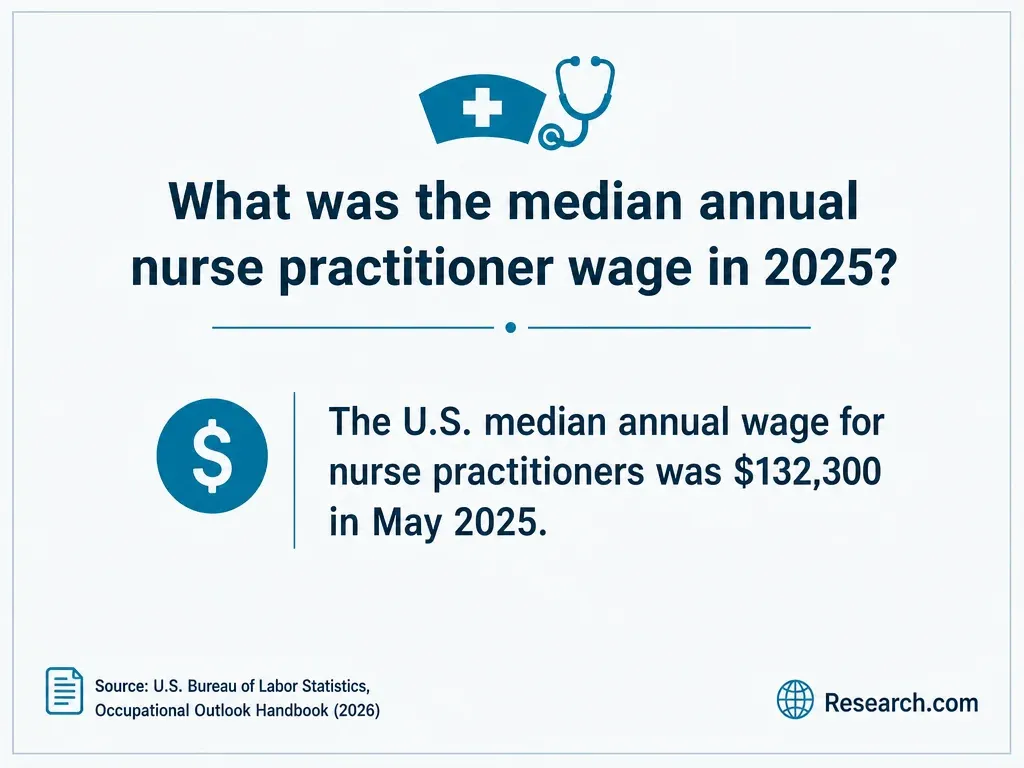
The U.S. Bureau of Labor Statistics reports nurse practitioner wages for the occupation as a whole, not a New Mexico AGPCNP MSN graduate salary. That distinction matters when weighing tuition against potential earnings: a local offer will depend on setting, experience, schedule, and responsibilities. Compare actual regional job postings and compensation terms rather than treating a national NP median as a promised return. A nurse considering psychiatric rather than adult primary care work can investigate lower-tuition psychiatric nursing graduate programs, but should compare the roles before comparing their prices.
How Can You Choose an Accredited AGPCNP Program?
Start with the exact AGPCNP MSN track, then verify the institution's accreditation, the nursing program's applicable accreditation and scope, and the track's certification preparation. Accreditation, permission to enroll a New Mexico student, clinical-site approval, and the state board's eventual licensing decision are related but distinct checks. Confirm each with the responsible school, accreditor, or regulator for your intended entry term.
Request the current plan of study, clinical handbook, New Mexico enrollment and placement policy, and a written total-cost estimate. Ask how many required visits or live sessions occur, who is responsible for placements, what happens if a site falls through, and which certification exam graduates are prepared to take. If a school advertises completion or exam-pass results, ask for the reporting year and cohort size before using them to compare programs.
Finally, match the pathway to your starting credential. Someone without an RN license cannot use a postlicensure AGPCNP MSN as a shortcut to advanced practice; MSN entry programs for non-nursing graduates address a different initial-licensure question and do not automatically lead to NP eligibility. The strongest choice is the program that confirms your eligibility, prepares you for the intended population focus, and provides a credible plan for completing approved clinicals - not simply the one labeled "online."
Other Things You Should Know About Nursing
Often, yes, but clinical terms may require daytime patient-care hours. Ask for a term-by-term schedule before assuming you can maintain full-time shifts.
No. AGPCNP preparation focuses on adults and older adults. If your intended job routinely includes children, investigate a population focus that prepares you for that care.
Not solely by holding New Mexico authorization. Practice requirements generally depend on where the patient is located; check that state's licensing and telehealth rules before providing care.
Ask about leave, reentry, course recency, and whether a placement can be resumed. Returning may require a new approval or clinical schedule, so obtain the school's policy in writing.
- Residency Requirements | NM HED https://hed.nm.gov/financial-aid/residency-requirements
- 16.12.2 NMAC - State Records Center & Archives - New Mexico https://www.srca.nm.gov/parts/title16/16.012.0002.html
- APRN Certified Nurse Practitioner - NM Board of Nursing https://www.bon.nm.gov/cnp/
- Tips for Getting a Nurse Practitioner Clinical Placement | Regis College Online https://online.regiscollege.edu/blog/nurse-practitioner-clinical-placement
- MS Adult-Gerontology Primary Care Nurse Practitioner | CU Anschutz Nursing https://nursing.cuanschutz.edu/degrees-programs/graduate-programs/ms/ag-pcnp
- MSN AGPCNP Primary Care Online | Chamberlain University https://www.chamberlain.edu/nursing-programs/master-of-science-in-nursing/adult-gerontology-primary-care-nurse-practitioner
- Tuition and Fees | New Mexico State University Academic Catalog https://catalogs.nmsu.edu/dona-ana/general-information/tuition-fees/
- Nurse Practitioner Clinical Placement FAQ | Carson-Newman University Online https://onlinenursing.cn.edu/news/nurse-practitioner-clinical-placement-faq
- Tuition & Fees | nnmc.edu https://catalog.nnmc.edu/content.php
- Becoming an Adult-Gerontology Nurse Practitioner (AGNP) | Herzing University https://www.herzing.edu/become/agnp