2027 Online AGPCNP Programs for Nurses in New Jersey: MSN Options and Primary Care Clinicals
Audited and Verified:
Our Editorial and Data Verification Process
Research.com uses government datasets, official education statistics and primary institutional information to support its career and degree guides. Our review process checks factual accuracy, occupational definitions, source dates and the requirements associated with the credentials discussed.
How This Article Was Fact-Checked
Our editorial team verifies salary estimates, employment projections, education requirements and program information against original data providers and official organizations. Salary figures are checked against the relevant occupational definitions and reporting periods. Information about licensure, accreditation and required in-person training is reviewed separately.
Fact-checked and verified on:

Co-Founder and Chief Data Scientist
An online adult-gerontology primary care nurse practitioner (AGPCNP) program can let a New Jersey RN complete much of an MSN remotely, but it cannot make supervised patient care remote. The consequential choice is whether a school's track, clinical-placement process, and schedule actually work where you live and practice.
This guide identifies New Jersey programs worth checking, explains how primary care rotations and credentials fit together, and gives you a practical way to compare offers before committing tuition or arranging time away from work.
Key Things You Should Know
- "Online" generally describes coursework, not clinicals: AGPCNP students need approved, supervised direct patient care with adult and older-adult populations.
- Seton Hall and Monmouth are New Jersey AGPCNP MSN leads, but confirm each track's current admissions, online format, campus visits, and placement rules before applying.
- Graduation is not practice authorization: graduates must meet national certification requirements and obtain New Jersey advanced practice nurse licensure; certifiers' eligibility rules include at least 500 faculty-supervised clinical hours.
What are online AGPCNP programs in New Jersey?
An AGPCNP MSN is a postlicensure graduate track preparing registered nurses to provide primary care to adults, including older adults. Its focus is ongoing assessment, diagnosis, treatment, prevention, and management of common and chronic conditions. Online or hybrid delivery changes where students take academic courses; it does not remove supervised clinical visits, skills assessments, or possible campus attendance.
Check the primary care designation. An adult-gerontology acute care NP track prepares clinicians for a different practice focus, and psychiatric-mental health preparation does not substitute for primary care training. Nurses considering a mental health practice change should compare postgraduate PMHNP certificate comparisons rather than assume an AGPCNP MSN covers that role.
Which New Jersey schools offer online AGPCNP MSN programs?
Seton Hall University and Monmouth University are two New Jersey schools to investigate for adult-gerontology primary care NP MSN study. Do not treat a school's general "online nursing" description as confirmation that this particular track is fully online or enrolling for your intended term. The comparison below separates the lead from the detail you need in writing.
| New Jersey school | AGPCNP MSN lead | Decisive format question |
| Seton Hall University | Adult-gerontology primary care NP graduate study | Which MSN courses, assessments, or intensives require live or on-site attendance for this entering cohort? |
| Monmouth University | Adult-gerontology primary care NP graduate study | Which courses can be completed remotely, and where must students attend in person? |
Ask each nursing department for its current AGPCNP MSN plan of study, not a general NP brochure, and confirmation that it can supervise your proposed New Jersey clinical sites. A nearby school offering only a DNP or post-master's route is not an interchangeable MSN option.
Likewise, a rapidly paced family NP program, such as those discussed in one-year family nursing advanced practice options, leads to a different population focus and should not be substituted solely because it starts sooner.
What are the clinical requirements for online AGPCNP programs?
Students complete faculty-supervised direct patient care in settings that support adult and older-adult primary care. Depending on the approved plan, these may include outpatient practices, community clinics, or other sites with suitable longitudinal primary care experiences.
National certification eligibility rules specify a minimum of 500 faculty-supervised clinical hours; a school may require more to satisfy its curriculum and competency standards. Request its current hour total and a breakdown by course rather than treating 500 as a promise of program length.
Before accepting an offer, establish who finds and approves preceptors, whether the school has placement restrictions by county or employer, and how it handles a placement that falls through. Also ask about required days per week, faculty site evaluations, and any simulation or campus visits.
RN employment does not automatically count as NP student clinical time: the school must approve the site, supervision, encounters, and documentation. For the same reason, RN-to-BSN capstone and practice requirements are not a substitute for graduate NP primary care rotations.
Start with eligibility for the specific track, not the university's reputation alone. Verify institutional accreditation and whether the MSN nursing program is accredited by the Commission on Collegiate Nursing Education (CCNE) or the Accreditation Commission for Education in Nursing (ACEN).
Then ask the program to confirm that its AGPCNP curriculum meets the relevant national certification eligibility requirements and supports a New Jersey APN application. These are separate checks: institutional accreditation alone does not establish NP exam eligibility.
Compare schools using written answers about clinical placement responsibility, permitted locations, total direct-care hours, in-person obligations, class meeting times, and recent AGPCNP certification-exam outcomes. If a school publishes a pass rate, ask for its reporting period and number of test-takers; a percentage from a tiny or mixed-specialty cohort is less useful than it looks.
Readers comparing price should use budget-conscious NP education pathways as a starting point, then confirm that any lower-cost option actually offers adult-gerontology primary care and accepts New Jersey students and placements.
AGPCNP coursework typically combines advanced pathophysiology, pharmacology, and health assessment with adult-gerontology primary care, diagnostic reasoning, health promotion, and management of chronic illness.
Supervised encounters require students to apply that learning to histories, examinations, treatment planning, patient education, referrals, and documentation under program and preceptor oversight. Coursework and simulation build readiness; neither independently establishes clinical competence or authority to practice as an NP.
Compare each school's course sequence with your schedule: a required clinical course may have fixed prerequisites even if lectures are asynchronous. An MSN in education or leadership does not supply AGPCNP population-focus preparation.
An RN considering a practice doctorate instead should check how a specific school applies prior graduate coursework and NP preparation; comparing DNP eligibility requirements is a separate decision from qualifying for initial AGPCNP practice.
These MSN tracks generally target licensed RNs with a BSN or another nursing background the school expressly accepts. Programs may assess undergraduate grades, prior nursing experience, recommendations, a statement of purpose, and readiness for graduate clinical work. Admission does not guarantee that an applicant's preferred clinical site will be approved.
An ADN-prepared RN should ask whether the school offers an actual bridge into its AGPCNP MSN, which undergraduate coursework remains, and when specialty clinicals begin. ADN-prepared RN graduate study options can help frame that discussion, but a bridge advertised for nursing leadership or education is not necessarily an NP route.
An experienced APRN changing population focus should instead request an individual review of transcripts, clinical-hour records, and required specialty competencies; prior practice does not automatically waive AGPCNP coursework.
Completion time depends on credits, whether courses run every term, enrollment intensity, prerequisite work, and clinical-site availability. A part-time plan can be easier to combine with RN employment but may extend tuition-bearing enrollment and delay certification. Ask for a term-by-term plan that shows exactly when in-person clinical days begin.
For a useful cost comparison, multiply each school's current tuition charge by the credits it says you must complete, then add mandatory fees, books and equipment, background checks, travel, potential campus visits, clinical-related expenses, and certification and licensing fees. Include lost RN income if rotations require reducing shifts.
Request written clarification of any transfer-credit decision and employer reimbursement conditions before calculating savings. Lower-tuition BSN-to-MSN education options offer a price comparison, but an education-focused MSN does not replace the required AGPCNP track.
New Jersey uses the title advanced practice nurse (APN). An AGPCNP graduate should confirm the New Jersey Board of Nursing's current application requirements, including active RN licensure, qualifying graduate preparation, national NP certification, and any other required documentation or checks. The board makes the state authorization decision. Graduating, passing a certification exam, and receiving an APN license are distinct steps.
This is an RN-to-advanced-practice route, not initial nursing licensure. A practical nurse seeking the starting RN credential needs a separate RN pathway; LPN-to-RN pathway options for working practical nurses address that earlier transition, not AGPCNP eligibility. Already-licensed RNs should verify any New Jersey practice and prescribing requirements applicable to their intended job before accepting an offer.
The two national primary care credentials to compare are the American Nurses Credentialing Center's AGPCNP-BC and the American Academy of Nurse Practitioners Certification Board's AGNP-C. Each organization sets its own current eligibility, examination, fee, and renewal rules. Confirm that your exact graduate track qualifies for the exam you intend to take; certification establishes a credential but does not itself grant a New Jersey APN license.
Choose the exam based on verified program eligibility and your preparation plan, not on the assumption that its name changes your legal scope. Family NP certification is a different population-focus credential. A nurse considering that route after a prior master's can examine a guide to accelerated post-master's FNP study, but an FNP certificate is not an AGPCNP certification shortcut.
What careers, salaries, and job outlook can AGPCNPs expect?
AGPCNPs may work in adult primary care practices, ambulatory systems, community clinics, and services for older adults. Evaluate an opening by its actual patient population, onboarding, consultation support, schedule, documentation workload, and prescribing expectations, not just the NP title. A new graduate may need substantial employer orientation even after completing supervised clinical hours.
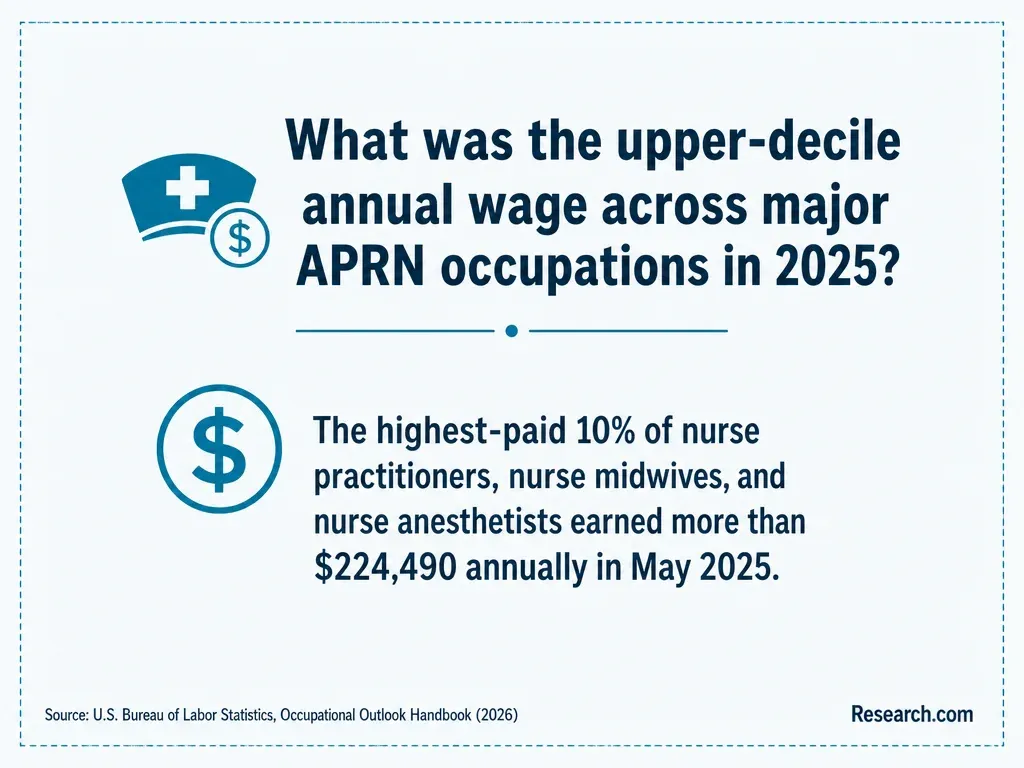
The U.S. Bureau of Labor Statistics reports wages and employment projections for nurse practitioners, not a separate AGPCNP category. Its occupation-wide median is therefore a benchmark, not a New Jersey AGPCNP starting salary or a return-on-tuition guarantee.
Compare local offers and their benefits against your full education costs and any RN earnings you would forgo. A later doctorate may fit a defined practice or leadership goal; a guide to shorter DNP programs is worth considering only after checking whether the job you want requires that additional degree.
Other Things You Should Know About Nursing Programs
Do not assume a New Jersey license is enough. Check the patient's location, that state's practice rules, and your employer's telehealth policies before providing care.
No. Whether you need one depends on the role's controlled-substance prescribing duties and applicable registration rules. Confirm the employer's expectations before applying.
That depends on the institution's credential and transcript policies. Ask the registrar for the exact wording if it matters to you.
Possibly. Check reimbursement caps, eligible programs, required grades, repayment clauses, and whether changing work hours for clinicals affects eligibility.
- 18VAC90-27-100. Curriculum for direct client care. | virginia.gov https://law.lis.virginia.gov/admincode/title18/agency90/chapter27/section100/
- Thirty College Credit Program | Civil Service Commission https://www.nj.gov/education/adulted/pathways/tccp/
- Out of State Nurse Practitioner Programs | ca.gov https://www.rn.ca.gov/education/outofstatenp.shtml
- Clinical Site Assignment | Department of Nursing - TCNJ https://nursing.tcnj.edu/graduate-policies/graduate-academic-policies/clinical-site-assignment/
- Adult Gerontology Nurse Practioner (AGPCNP) Online Master's | Adelphi University https://onlineprograms.adelphi.edu/programs/ms-agpcnp-adult-gerontology-nurse-practitioner/
- Primary Care Adult-Gerontology Nurse Practitioner | psu.edu https://www.nursing.psu.edu/primary-care-adult-gerontology-nurse-practitioner/
- RN to Adult-Gerontology Primary Care Nurse Practitioner | Spring Arbor University https://online.springarbor.edu/programs/master-of-science-in-nursing/rn-to-agpcnp
- MSN: Adult-Gerontology Primary Care Nurse Practitioner | gwu.edu https://nursing.gwu.edu/programs/msn/adult-gerontology-primary-care-nurse-practitioner
- MSN AGPCNP Primary Care Online | Chamberlain University https://www.chamberlain.edu/nursing-programs/master-of-science-in-nursing/adult-gerontology-primary-care-nurse-practitioner