2027 Nursing Workload During Admissions, Transfers, and Discharges: What New Staff Should Ask
Audited and Verified:
Our Editorial and Data Verification Process
Research.com uses government datasets, official education statistics and primary institutional information to support its career and degree guides. Our review process checks factual accuracy, occupational definitions, source dates and the requirements associated with the credentials discussed.
How This Article Was Fact-Checked
Our editorial team verifies salary estimates, employment projections, education requirements and program information against original data providers and official organizations. Salary figures are checked against the relevant occupational definitions and reporting periods. Information about licensure, accreditation and required in-person training is reviewed separately.
Fact-checked and verified on:

Co-Founder and Chief Data Scientist
A unit can have open beds and still be overwhelmed: each admission, transfer, or discharge creates assessment, communication, documentation, and coordination work. For a new nurse, the important question is not just how many patients are assigned, but how often those patients change and who helps manage each transition. This guide explains the work behind patient flow, offers questions to ask during interviews and orientation, and puts nursing education and career choices in perspective. Use it to judge whether a unit will support safe learning - not simply whether its staffing number sounds reasonable.
Key Things You Should Know
- Count transitions as well as patients: admissions, transfers, and discharges are 3 distinct sources of work that a census or nurse-to-patient ratio alone may not show.
- Ask about 2 kinds of support: who handles predictable coordination tasks, and who can provide clinical backup when several patients arrive or leave together.
- Check 4 workflow points: assignment timing, handoff responsibility, documentation expectations, and escalation when patient flow exceeds available capacity.
What Does Nursing Workload Include During Admissions, Transfers, and Discharges?
Patient flow is the movement of patients into, between, and out of care settings. It adds work even when the number of occupied beds stays the same. During an admission, an RN may need to review the handoff and orders, assess the patient, reconcile information, identify immediate risks, begin a care plan, and coordinate with other team members. The exact sequence depends on the patient, setting, and facility policy.
A transfer requires more than moving a patient or changing an electronic bed assignment. Sending and receiving teams need an accurate handoff, clarity about pending tests and treatment, and a plan for equipment, transport, and time-sensitive care. A discharge can involve evaluating readiness within the nurse's role, teaching, confirming follow-up arrangements, resolving documentation or prescription questions with the appropriate clinician, and communicating with the patient and caregivers.
Some tasks can be shared with a unit clerk, transporter, discharge coordinator, or other team member. Assessment, clinical judgment, and delegation remain subject to the nurse's license, employer policy, and patient needs. Students planning a first nursing degree should expect to learn these transitions under supervision; familiarity with the steps is not yet independent competence.
How Do Admissions, Transfers, and Discharges Affect Nurse Staffing Needs?
Census measures patients present; turnover measures movement. Two shifts with the same census can have very different workloads if one has multiple admissions and discharges. Timing matters too: an arrival during medication administration, a complex transfer near shift change, or several simultaneous discharges can concentrate work into a short period.
The comparison below shows why a staffing discussion should include more than an average patient assignment. These are workload characteristics, not recommended staffing ratios.
| What to examine | Why it changes workload |
| Admissions and transfers per shift | Each can require assessment, handoff review, coordination, and documentation. |
| Patient acuity and instability | Urgent clinical needs can interrupt planned transition tasks. |
| Discharge complexity | Teaching, equipment, caregiver needs, and follow-up coordination vary by patient. |
| Available team support | Clerical, transport, case-management, and experienced RN support affect what falls to the assigned nurse. |
Managers should consider transition volume and timing alongside acuity, staffing skill mix, and available support. A new hire can ask whether assignments are adjusted when an RN receives a complex admission, rather than assuming an open bed means spare capacity. Graduate leadership study may be useful for some managers, but admission-focused nursing practice doctorate comparisons are not a substitute for examining a unit's actual staffing practices.
What Should New Nurses Ask About Admission, Transfer, and Discharge Workflows?
Ask for a description of a recent busy shift, not just the usual patient ratio. During an interview or orientation, these questions can reveal whether the unit has a workable process and a clear route to help.
- Assignment: Who decides which nurse receives a new patient, and can assignments change after a complex admission or transfer?
- Handoff: What information must the sending team provide, and whom do I contact if it is incomplete or the patient's condition differs from the report?
- Timing: Who covers my other patients while I complete an initial assessment or time-sensitive discharge teaching?
- Responsibilities: Which tasks belong to the bedside RN, charge nurse, case manager, pharmacist, or discharge team?
- Escalation: When several transitions occur at once, who prioritizes work and provides clinical backup?
- Orientation: Will I manage these transitions with a preceptor before doing them independently, and how will readiness be assessed?
Listen for specific examples rather than assurances that "the team helps." An experienced RN considering RN-to-BSN education for working registered nurses can ask the same workplace questions: additional coursework may strengthen care-coordination knowledge, but it does not fix an unclear handoff process or inadequate on-shift support.
Prelicensure associate and bachelor's nursing programs prepare students for generalist RN practice, including assessment, communication, documentation, and care coordination. An ADN/ASN and a prelicensure BSN differ in curriculum breadth and degree award, but neither makes a graduate independently ready for every unit's patient-flow demands. State licensure and employer orientation come next.
An RN-to-BSN program serves someone who is already an RN; it is not an initial licensure route. Similarly, ADN-to-MSN bridge programs are academic advancement options for eligible nurses, not replacements for bedside onboarding. For a new nurse choosing a first job, a supervised transition-to-practice experience and reliable unit support usually bear more directly on admission and discharge readiness than pursuing another degree immediately.
Programs commonly build these skills through case work, simulation, supervised clinical experiences, and feedback on communication and charting. A student might practice receiving a handoff, recognizing missing information, prioritizing an assessment, and documenting what occurred. Clinical placements then expose students to real team roles and site-specific workflows under appropriate supervision.
When comparing programs, ask how students are evaluated: observing a discharge is different from performing assigned tasks with a supervisor and receiving feedback. Also ask whether simulations include competing demands, such as a new arrival while another patient needs discharge teaching. For BSN-prepared nurses considering affordable nursing master's study for BSN graduates, an educator or leadership track may deepen systems knowledge, but it should not be mistaken for validation of a particular unit competency.
For an initial RN pathway, confirm that the program meets the requirements of the state board of nursing where you intend to seek licensure. Check institutional accreditation and the nursing program's accreditation status separately; nursing accreditors such as ACEN and CCNE have different scopes, and accreditation is not the same decision as state board approval. The board determines individual licensure eligibility under its rules.
Graduation, eligibility to take the NCLEX-RN, passing the exam, and receiving an RN license are separate steps. Employment adds another: a hospital must orient and assess a nurse for its own workflows. If you are comparing nursing schools with more accessible admissions, verify regulatory status and clinical preparation before treating admission likelihood as the deciding factor.
Online coursework does not make prelicensure nursing clinical preparation virtual. Students still need program-approved supervised experiences, and schools may require in-person labs, simulation, campus visits, and clinical shifts at specified times. Campus-based programs also use simulation and placements; neither format guarantees exposure to a high-turnover unit or to every type of handoff.
Ask who arranges placements, whether a proposed site is eligible, and how faculty assess transition-of-care performance. Already-licensed nurses comparing advanced programs should verify population-specific clinical requirements rather than assuming their current job will count. For example, an online PMHNP certificate program guide may help identify programs to investigate, but psychiatric-mental health clinical requirements and site arrangements must be confirmed with each program and relevant credentialing authorities.
Requirements and timelines depend on the pathway. Prelicensure programs may review prerequisite sciences, grades, entrance assessments, and clinical-placement eligibility; accelerated routes may require a prior bachelor's degree. Postlicensure programs generally require an active RN license. Ask each school for a written plan showing course sequence, clinical scheduling, expected time to completion, and all charges relevant to your situation.
Compare total cost, not tuition alone: fees, books, equipment, health requirements, travel to clinical sites, exam expenses, and reduced work hours can matter. A shorter advertised format is not automatically cheaper or easier to combine with employment. That applies to advanced options such as short online DNP completion pathways, which are not necessary for a new RN to learn admission and discharge workflows. If your immediate goal is safer performance on a unit, ask first what paid orientation and continuing education the employer provides.
Bedside RNs on inpatient units often receive admissions and prepare transfers and discharges. Emergency department nurses manage arrivals and transfers under different time pressures; observation and procedural areas may have rapid turnover. Charge nurses coordinate assignments and escalation, while case managers and discharge planners help address transition needs within their roles. Duties vary by employer, and none of these titles alone establishes who completes a specific assessment or signs a particular document.
New graduates should compare roles by patient population, turnover, acuity, orientation, and access to experienced help - not assume a unit with shorter stays is easier. Advanced practice nurses may also contribute to admission or discharge decisions within their authorized role. An RN looking at shorter routes to family NP preparation is considering a different licensed practice pathway, not a shortcut to handling bedside patient flow.
What Are Nursing Salaries and Job Outlook Across Patient-Care Settings?
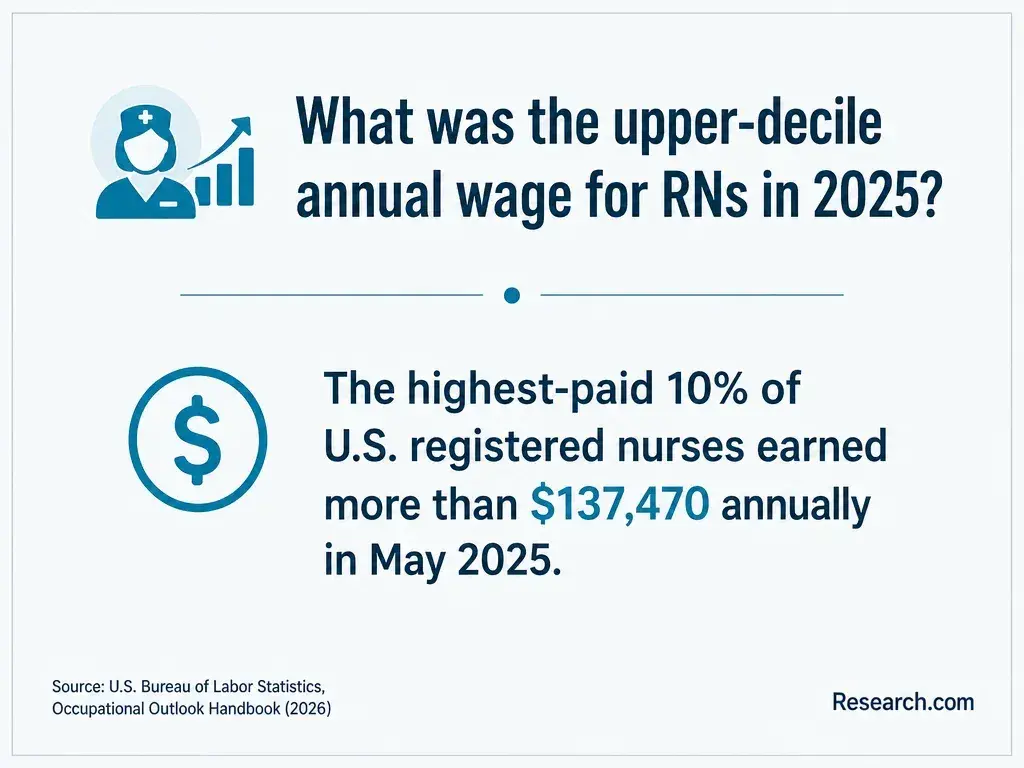
The U.S. Bureau of Labor Statistics reports wages and employment projections for the registered nurse occupation, not separate pay guarantees for admission nurses, discharge nurses, ADN graduates, or BSN graduates. Its occupational figures are useful for understanding the broader RN labor market, but they cannot predict an offer on a particular unit. Setting, region, shift differentials, experience, and employer pay structure can substantially change compensation.
Compare a job's pay with its workload and support: scheduled hours, weekend and night expectations, overtime practices, orientation length, and how the unit handles surges in patient flow. A nurse considering a specialty transition should likewise avoid assuming that a credential raises pay; short-format family NP certificates for graduate nurses involve separate education and eligibility questions, and any salary comparison should be tied to the actual role and offer.
Other Things You Should Know About Nursing
Update the appropriate team members and follow unit policy for orders, documentation, and bed-status communication. Do not assume the patient can leave because preparations are complete.
Pause and address the concern within your role, using an interpreter or other support when needed. Escalate unresolved clinical or medication questions to the appropriate clinician before the patient leaves.
Seek clarification from the sending team and promptly escalate any safety concern through the unit's chain of communication. Document according to policy; do not fill gaps by guessing.
Complete required records accurately and follow employer policy, but raise recurring late work with your preceptor or manager. Repeated overtime may signal a workflow or staffing problem that needs attention, not simply a need to work faster.
- Overcrowding in Emergency Department: Causes... - PMC https://pmc.ncbi.nlm.nih.gov/articles/PMC9498666/
- Discharge Planning and Transitions of Care | PSNet https://psnet.ahrq.gov/primer/discharge-planning-and-transitions-care
- DELEGATION AND SUPERVISION - NCBI - NIH https://www.ncbi.nlm.nih.gov/books/NBK610432/
- Delegation FAQ - Texas Board of Nursing https://www.bon.texas.gov/faq_delegation.asp.html
- Medication Reconciliation to Improve Quality of Transitional Care | Digital Healthcare Research | AHRQ https://digital.ahrq.gov/ahrq-funded-projects/medication-reconciliation-improve-quality-transitional-care
- Impact on Documentation Burden and Clinical Workflow | wiley.com https://onlinelibrary.wiley.com/doi/full/10.1111/jep.70189