2027 Nursing Student, Graduate Nurse, RN, and APRN: How Status Changes During Your Career
Audited and Verified:
Our Editorial and Data Verification Process
Research.com uses government datasets, official education statistics and primary institutional information to support its career and degree guides. Our review process checks factual accuracy, occupational definitions, source dates and the requirements associated with the credentials discussed.
How This Article Was Fact-Checked
Our editorial team verifies salary estimates, employment projections, education requirements and program information against original data providers and official organizations. Salary figures are checked against the relevant occupational definitions and reporting periods. Information about licensure, accreditation and required in-person training is reviewed separately.
Fact-checked and verified on:

Co-Founder and Chief Data Scientist
Finishing nursing school changes your qualifications, but it does not automatically change your legal authority to practice. That distinction matters when you apply for a job, describe your credentials, or choose your next degree.
This guide is for nursing students, new graduates, and RNs considering advanced practice. It explains what each status means, the steps between them, and how to assess programs and jobs without confusing graduation, licensure, certification, and clinical readiness.
Key Things You Should Know
- A graduate of an RN program is not an RN until the state board grants an RN license; passing the NCLEX-RN is a separate step in that process.
- ADN and BSN prelicensure routes can lead to RN eligibility, but APRN practice requires additional role- and population-focused preparation, certification where required, and state authorization.
- An ADN commonly takes about two years of full-time study and a traditional BSN about four; neither timeline includes every graduate's licensing wait, orientation, or later APRN education.
What is the difference between a nursing student, graduate nurse, RN, and APRN?
These terms describe different points in a career, not four interchangeable job titles. The decisive distinction is whether a state has authorized the person to practice in the role.
The comparison below shows what each status establishes - and what it does not.
| Status | What it means | Practice boundary |
| Nursing student | Enrolled in nursing education and developing knowledge and clinical skills. | Provides care only within the program's approved learning arrangements and applicable supervision rules. |
| Graduate nurse | Completed a nursing program but has not necessarily received an RN license. | Cannot assume RN authority. Some states permit limited, time-bound graduate practice under specific conditions; others do not. |
| Registered nurse (RN) | Holds an active RN license issued by a state board of nursing. | Practices within that jurisdiction's RN scope and must meet employer competency requirements. |
| Advanced practice registered nurse (APRN) | An RN who has met additional requirements for an advanced practice role and obtained the applicable state authorization. | Practices within a defined role, population focus, and state scope - not every advanced nursing specialty. |
"Graduate nurse" can be a school or employer description rather than a uniform legal title. If you hold an LPN/LVN license while completing RN school, that license still authorizes only your existing LPN/LVN scope until RN licensure is granted. For someone entering from another profession, nursing entry pathways for career changers must be checked for initial-licensure preparation; an online nursing degree label alone does not establish it.
What education and licensing requirements apply at each nursing career stage?
A student must meet school and clinical-site requirements to participate in supervised learning. After graduation, the applicant must satisfy the state board's RN licensing requirements, which generally include completion of an eligible program, an application, required screening, and the NCLEX-RN. The board - not the school or an employer - decides whether to issue the license. Check the board's rules before accepting a job advertised for "graduate nurses."
An RN considering advanced practice needs more than experience or a graduate degree title. APRN roles include nurse practitioner, clinical nurse specialist, nurse-midwife, and nurse anesthetist. The route depends on the intended role and patient population, graduate preparation, applicable national certification, and state APRN licensure or recognition. An MSN or DNP in education or leadership does not, by itself, qualify someone for an NP role.
For a licensed practical nurse, fast-track RN education for licensed practical nurses may build on prior coursework. Verify the actual nursing sequence and clinical requirements: an LPN/LVN license does not convert to an RN license through experience alone.
What nursing degree pathways lead from student to RN or APRN?
Choose the pathway according to your current credential and intended role. The same degree level can serve different purposes: a prelicensure BSN prepares an unlicensed student for RN eligibility, while an RN-to-BSN assumes the student is already licensed.
The main routes differ most in their entry point and whether they prepare you for a new license.
| Starting point | Possible route | Intended outcome |
| No RN license | Prelicensure ADN, diploma, traditional BSN, or eligible accelerated BSN | Preparation to seek initial RN licensure. |
| Licensed LPN/LVN | LPN/LVN-to-RN bridge | RN preparation, subject to the program's credit and clinical rules. |
| Licensed RN | RN-to-BSN | Bachelor's degree completion; it does not confer a new RN license. |
| Licensed RN seeking APRN practice | Role- and population-focused graduate program or eligible post-graduate certificate | Preparation to seek the specified certification and state APRN authorization. |
An ADN can be a direct route to RN eligibility when its program meets the relevant board's requirements; a BSN may better fit employers or later academic plans. For an RN who wants a graduate degree, ADN-to-MSN admission requirements deserve close review because bridge awards and prerequisites vary. Do not assume an RN-to-MSN track includes APRN preparation: confirm the exact specialty and credential awarded.
Online lectures can reduce commuting, but they do not make supervised patient care virtual. Prelicensure students should expect in-person labs, simulation, and clinical placements; some hybrid programs also require campus visits. Campus-based study may offer easier access to on-site practice and faculty, but clinical shifts can still occur away from campus and outside ordinary class hours.
For working RNs, online degree-completion coursework may fit employment better than a fixed campus schedule. Even so, ask about live sessions, local practice assignments, group work, and who arranges any required sites. RN-to-BSN education for working registered nurses may be worth comparing if avoiding new direct-care rotations matters to your schedule; verify each program's actual experiential requirements rather than relying on its delivery label.
Before enrolling across state lines, obtain written confirmation that the school can enroll you where you live and that its program meets the requirements for your intended licensing jurisdiction.
Prelicensure study commonly combines anatomy and physiology, microbiology, health assessment, pharmacology, and nursing care across patient populations. Labs and simulation let students practice assessment, communication, medication safety, and escalation before or alongside supervised clinical care. Faculty and clinical evaluators assess performance; completing a course or simulation does not establish independent competence.
APRN education adds advanced clinical content and supervised experiences matched to a specific role and population. Prior RN employment is valuable preparation, but a program and certifying organization decide whether documented experiences meet their requirements. A practice-focused doctorate can also include an improvement project; DNP project-based practice expectations should be evaluated separately from any APRN clinical hours. A DNP project does not automatically replace supervised advanced practice preparation.
Prelicensure programs typically review prior coursework and grades, required sciences and labs, and any school-specific entrance assessment. Admission to a university may be separate from selection for its nursing major. Clinical participation can also depend on health documentation and site screening, even after academic admission.
Postlicensure programs usually require an RN license; APRN tracks may additionally assess nursing experience, prior degree preparation, and readiness for the intended specialty. An RN applying to a new population focus should request a written review of prior graduate coursework and supervised hours. For example, psychiatric NP certificate coursework options are relevant to an eligible nurse seeking that focus, not a substitute for initial RN education.
Ask each school which prerequisites must be complete before application, whether science courses have age limits, whether it arranges placements, and which states its graduates can pursue licensure in. Those answers are more useful than assuming one program's admission rules apply everywhere.
A full-time ADN is often described as a two-year program, and a traditional BSN as a four-year degree, but prerequisites, course sequencing, and available clinical places can extend the calendar. Accelerated second-degree routes may shorten the nursing sequence while requiring substantial weekly availability. RN-to-BSN and graduate timelines vary with transferred credits, enrollment intensity, and clinical access; a shorter advertised curriculum does not shorten state licensing review or employer orientation.
Compare the total cost to reach the intended credential, not tuition alone. Include fees, books, equipment, screening, travel to clinical sites, examinations, licensing, and earnings you may give up while studying. For APRN applicants, placement travel and a delayed graduation caused by limited clinical availability can materially change the calculation. One-year family nursing advanced practice options are worth evaluating against required preparation, placement feasibility, and full cost - not speed alone.
Request a program-specific cost estimate based on your credits and expected pace, then confirm what financial aid or employer assistance actually covers. Neither a shorter duration nor a lower published tuition guarantees a lower final cost.
RNs work in settings such as hospitals, ambulatory clinics, community services, and home health, with duties shaped by state scope, patient needs, and employer policy. A new RN can apply to entry-level positions but should compare orientation length, preceptor access, staffing support, and the process for escalating concerns. Graduation and licensure do not make someone independently ready for every high-acuity specialty.
APRNs pursue jobs tied to their authorized role and population focus. For example, a psychiatric-mental health nurse practitioner position calls for different preparation from an RN mental health position. An RN considering that transition can examine psychiatric MSN study with condensed timelines, but should confirm the program's specialty preparation, supervised placements, certification eligibility, and state requirements before treating it as a career shortcut.
If your goal is education, informatics, or management rather than advanced clinical practice, RN experience, employer development, or a relevant non-APRN program may fit better than an NP track.
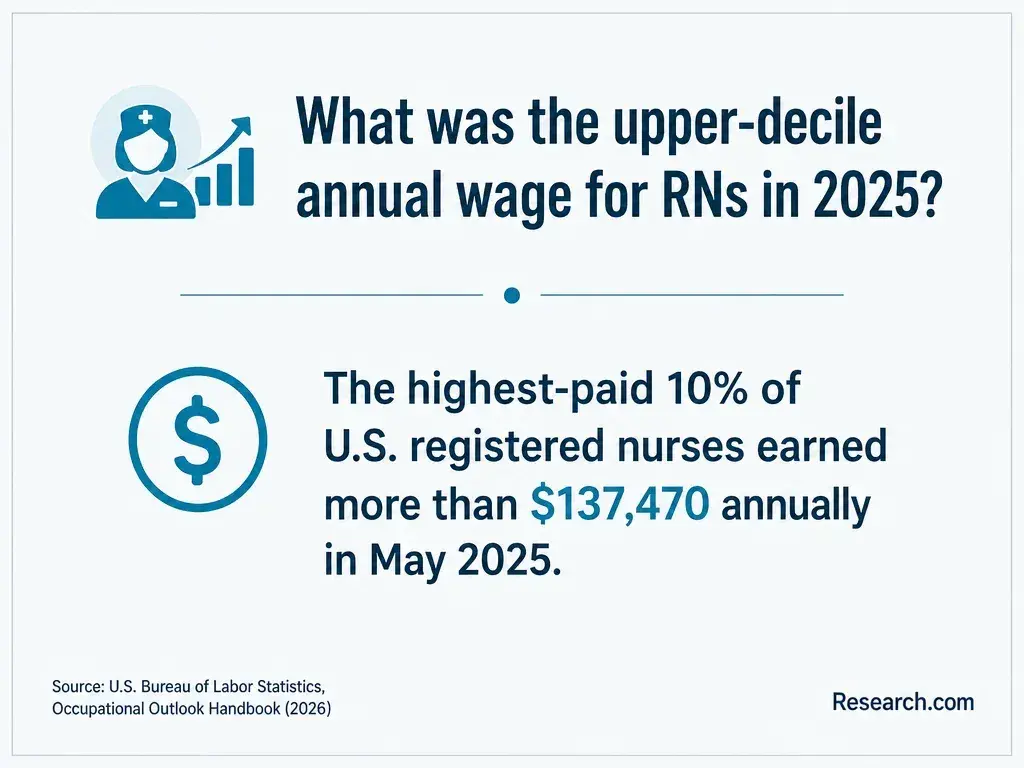
Pay varies by occupation, location, setting, experience, and schedule - not simply by degree. As dated national benchmarks, the U.S. Bureau of Labor Statistics reported a May 2024 median annual wage of $93,600 for registered nurses and $129,210 for nurse practitioners. These occupation-wide medians are not starting offers, and the NP figure does not represent every APRN role. Consult the latest BLS occupation-specific release and local job postings when evaluating a current offer.
The higher NP median should not be read as a guaranteed return on graduate tuition. Compare realistic local offers with the full expense of qualifying for the role, time away from work, and any change in hours or benefits. Comparing lower-cost NP programs can help frame that financial decision, provided the programs actually prepare you for your intended population focus and licensing state.
How do you choose an accredited nursing program and specialty certification?
Start with the credential you need, then verify each authority separately. Institutional accreditation concerns the school; nursing program accreditation, such as ACEN or CCNE accreditation where applicable, concerns the relevant program; state board approval or recognition affects the licensing pathway. A national certifying organization determines eligibility for its particular exam. None of these approvals substitutes for the others.
Before committing, use this check to resolve the questions that can change your career outcome:
- Confirm the exact degree, specialty track, and whether it prepares students for initial RN licensure, an existing RN's degree completion, or a defined APRN role.
- Check the school's institutional status, the nursing program's accreditation scope, and the requirements of the board in the state where you intend to practice.
- Ask who secures clinical placements, where attendance is required, and whether the program's graduates meet the intended certifying body's current eligibility rules.
- Compare total cost, completion evidence, and required onboarding with your schedule and career goal before accepting an offer.
For an APRN route, identify the specific certification and state authorization needed for the job; a general nursing specialty certificate is not an APRN license. Even shorter routes to a DNP degree should be checked for their actual track and outcomes. A DNP without the necessary advanced practice preparation does not create APRN eligibility.
Other Things You Should Know About Nursing
Do not represent yourself as an RN before the state board issues that license. Follow your state's rules on protected titles and any permitted graduate designation.
Do not assume it does. A permit's availability, conditions, and geographic reach depend on the issuing state. Check the board in each state where you expect to work.
Yes. Graduate enrollment does not automatically maintain an RN license. Track renewal deadlines and any continuing-competence requirements that apply to you.
Update your credential status when the board grants and records your RN license. Until then, describe graduation and examination results accurately without claiming an active license.
- Nurse Licensure Compact | Department of State https://www.pa.gov/agencies/dos/department-and-offices/bpoa/boards-commissions/nursing/nlc
- Requirements APRN - Florida Board of Nursing https://floridasnursing.gov/requirements-aprn/
- Practice - Guidelines - Texas Board of Nursing https://www.bon.texas.gov/practice_guidelines.asp.html
- Limited Permits | Office of the Professions - Nysed https://www.op.nysed.gov/professions/registered-professional-nursing/license-requirements/limited-permits
- APRN - Advanced Practice Registered Nurses | Ohio Board of Nursing https://nursing.ohio.gov/advanced-practice-registered-nurses-aprn
- 22 Tex. Admin. Code § 217.3 - Temporary Authorization to Practice/Temporary Permit | LII / Legal Information Institute https://www.law.cornell.edu/regulations/texas/22-Tex-Admin-Code-SS-217-3
- What Are Clinicals for Nursing School Students? | Faulkner University https://www.faulkner.edu/what-are-clinicals-for-nursing-school-students/
- BSN - Lower Division - Capstone College of Nursing https://nursing.ua.edu/academics/undergraduate/bsn/bsn-lower-division/
- How to Become a Registered Nurse (RN) | University of Saint Mary https://stmary.edu/traditional-bsn/how-to-become-an-rn
- Exam - US Educated - ND Board of Nursing https://ndbon.org/licensing/exam/exam-us/