2027 MLIS Programs for Public Library Reference Supervisors

Co-Founder and Chief Data Scientist
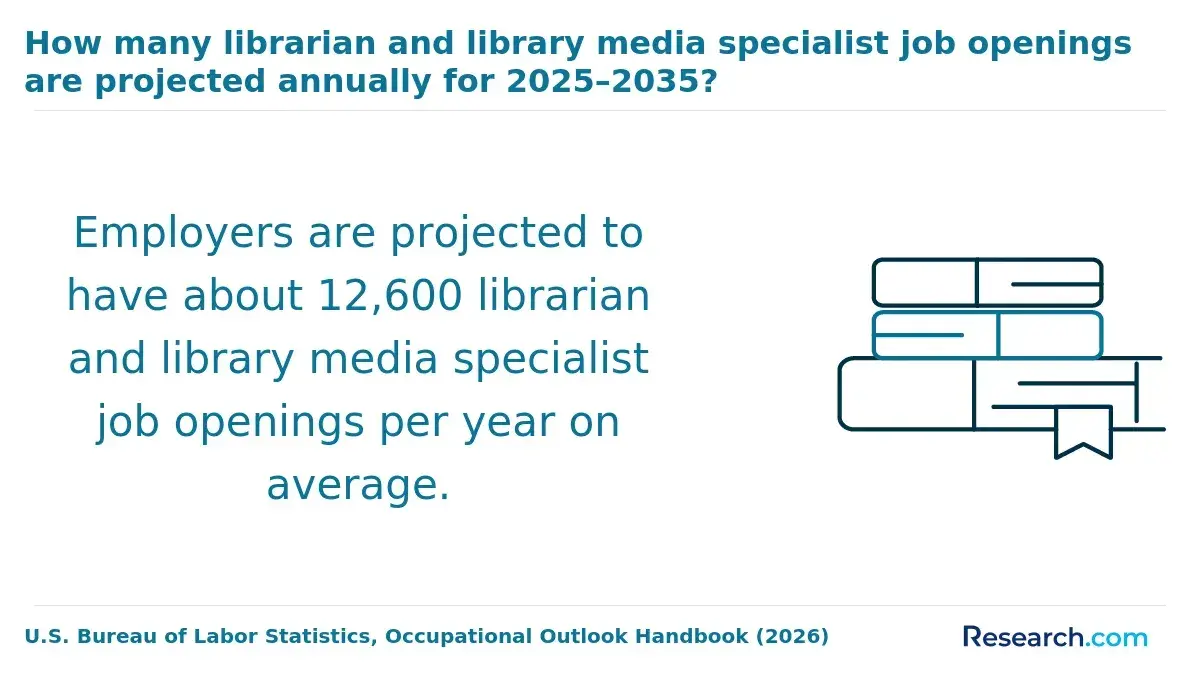
Choosing an MLIS for reference supervision means looking beyond a program's course titles: you need preparation to help patrons, manage staff, and improve service across a community. The U.S. Bureau of Labor Statistics projects 2.6% employment growth for librarians and media collections specialists from 2025 to 2035, making practical experience important alongside the degree.
This guide helps prospective students and working library employees identify relevant coursework, evaluate online options and costs, and decide whether an MLIS fits their next career step.
Key Things You Should Know
- Look for an ALA-accredited master's program with reference, public library, and management coursework; a relevant elective is not necessarily a formal concentration.
- Supervisory experience matters: build evidence of coaching staff, resolving service problems, and assessing community needs before applying for reference supervisor roles.
- The May 2025 median pay for the broader librarians and media collections specialists occupation was $68,270, it is not a reference supervisor salary or a promised outcome.
What is an MLIS program for public library reference supervisors?
It is a library and information science master's program chosen for its ability to prepare someone to lead public-facing reference services - not necessarily a degree with "reference supervision" in its name. An MLIS, MLS, or institution-specific LIS master's title may describe a relevant program; the curriculum and the specific program's accreditation matter more than the initials.
Reference supervisors commonly coordinate desk coverage, coach librarians and library technicians, handle complex patron questions, oversee research and digital-help services, and use service data to improve staffing or training. Their work also involves accessible service, patron privacy, community partnerships, and clear policies for difficult interactions. Duties vary by branch size: one supervisor may spend substantial time helping patrons directly, while another manages services across locations.
Do public library reference supervisors need an ALA-accredited MLIS degree?
There is no universal U.S. rule requiring every public library reference supervisor to hold an ALA-accredited MLIS. Individual library systems set their own hiring requirements, and some distinguish professional librarian classifications from supervisory positions open to experienced staff through other routes. If target postings require an ALA-accredited master's, however, choosing a program without that status could close off those jobs.
Check the specific degree in the current American Library Association directory of accredited programs, then compare that result with recent postings from libraries where you hope to work. Institutional accreditation and ALA program accreditation are different. ALA accreditation also does not establish that a program offers a particular public library concentration, elective, internship, or online format.
What career path leads to public library reference supervision?
There is no single route. A typical progression combines patron-facing work, professional reference responsibilities, and demonstrated leadership. Someone already supervising library assistants may need a different next step from a new graduate who has strong research skills but little experience managing people.
The following sequence shows how to build evidence for a supervisory application, rather than treating graduation as an automatic promotion:
- Gain public-service experience answering questions, helping patrons use digital tools, and referring specialized requests appropriately.
- Take responsibility for a service improvement, such as updating a research guide or documenting a recurring patron need.
- Seek opportunities to train colleagues, coordinate schedules or projects, and practice resolving service issues within library policy.
- Apply for librarian or lead-worker roles that broaden those responsibilities, then compare your experience with actual supervisor job descriptions.
Keep a record of what you changed and how you evaluated it. A concise account of staff training or a revised workflow is more useful in an interview than a list of software you have used. For experienced employees whose target systems do not require a master's, internal advancement or focused management training may be worth considering before taking on graduate-school costs.
Which MLIS specializations prepare students for reference supervision?
Public librarianship, reference and information services, and library management are relevant areas of study. Their availability varies: a school may document a formal concentration, offer a few electives, or allow an individualized project. Do not treat those options as equivalent without checking the catalog and recent course schedules.
This comparison connects common supervisory responsibilities to the preparation worth looking for. Use it to assess a program's actual courses and applied-work options, not to assume every program offers each one.
| Work to prepare for | Relevant study | Useful applied evidence |
| Leading reference service | Reference interviews, information sources, and information literacy | A research guide or evaluated service interaction |
| Serving the community | Public librarianship, outreach, accessibility, and collection development | A community-needs assessment or accessible program plan |
| Supervising staff | Library management, personnel practices, and service assessment | A training plan or documented workflow improvement |
| Guiding digital help | Digital services, privacy, and technology instruction | A patron-facing digital-help resource |
Ask whether the courses you need are required or elective, how recently electives have run, and whether a practicum or project can take place in a public library. A strong general MLIS with dependable course access and relevant work experience may serve you better than a named concentration whose useful electives rarely fit your schedule.
What do MLIS programs teach about reference services and management?
Reference coursework generally develops the ability to clarify a patron's question, select and evaluate sources, explain a search strategy, and recognize when a referral is needed. For a supervisor, those skills become a basis for coaching staff and setting consistent service expectations - not just answering harder questions personally.
Management study is useful when it addresses staffing, feedback, budgets, policy implementation, and assessment. Look for assignments that require decisions under realistic constraints: for example, planning desk coverage while maintaining accessible service, or using patron feedback without exposing private questions. Programs differ in how much personnel management they teach, so compare syllabi or course descriptions rather than relying on a management course title alone.
Digital reference now includes helping patrons navigate discovery tools, online forms, and AI-assisted search results. Supervisors need to help staff check the reliability of results, explain limitations, and protect patron privacy. Those are service and training responsibilities, not a reason to assume every program needs a specialized AI track.
Are online MLIS programs suitable for aspiring reference supervisors?
Yes, if the specific program meets your target employers' credential requirements and offers the coursework and applied learning you need. Online study can let a working library employee connect assignments to current service problems. It cannot, by itself, replace experience coaching people or handling in-person patron situations.
Check whether classes are asynchronous or have required live meetings, whether management and public-library electives fit your planned terms, and whether any practicum can be completed at your workplace or another local library. Online delivery does not guarantee flexible deadlines, remote placements, or the absence of campus visits.
If a conventional term schedule is difficult to manage, an alternative online library masters format may be worth examining. Compare its assessment method and course access with your need for supervised, patron-facing practice before choosing it.
What are the admission requirements for MLIS programs?
Applicants generally need a bachelor's degree and must submit materials specified by the program, which may include transcripts, a statement of purpose, recommendations, and a résumé. Schools set their own grade, testing, prerequisite, and international-applicant policies; do not assume a requirement applies everywhere because one program lists it.
Public library experience can strengthen an application, particularly when you can explain the service problem you want to learn to solve. It should not be assumed to replace a published degree requirement. If you have an unusual academic history or want graduate transfer credit considered, ask admissions for an individual review and get the applicable policy in writing.
Use an online MLIS admissions and tuition comparison as a starting point, then confirm requirements and deadlines on each program's current admissions page.
How long do MLIS programs take and what do they cost?
Completion time depends on required credits, course sequencing, enrollment pace, and the availability of electives or placements. A student working full time should map required courses term by term before relying on a program's shortest advertised timeline. Ask when the public-service and management courses run and whether a practicum must be completed during ordinary library hours.
To compare costs, multiply the applicable tuition rate by required credits, then add mandatory fees, books, equipment, and any travel or placement expenses. Confirm whether online students pay residency-based rates and whether additional terms add fees. Published tuition is not the same as total attendance cost, personal out-of-pocket cost, or the amount borrowed.
A guide to low tuition MLIS with strong career outcomes can help identify options to investigate. Before enrolling, request a current cost estimate from each school and compare it with your existing earnings, employer support, likely job requirements, and borrowing plans. Neither a low price nor a graduate degree guarantees a supervisory position.
What salary and job outlook can reference supervisors expect?
The U.S. Bureau of Labor Statistics reports a May 2025 median annual salary of $68,270 for librarians and media collections specialists and projects 2.6% employment growth for that occupation from 2025 to 2035. These figures describe a broad occupational group, not public library reference supervisors specifically. Pay and openings for a supervisor depend on the library system, location, bargaining arrangements, and scope of responsibility.
For a decision about graduate school, compare posted salaries for jobs you would actually seek with your current compensation and the full cost of attendance. A supervisory title may bring broader responsibility without a uniform pay increase. If your interests lean toward systems or digital services instead, library technology jobs salary information may help you compare career directions, but check the qualifications and duties of individual openings.
Do public library reference supervisors need certification or licensure?
Requirements depend on the jurisdiction and employer. Some public library positions are governed by state or local credential rules; others rely primarily on the library system's job classification. ALA accreditation is a property of the graduate program, not a personal license, and school librarian credentials should not be confused with public library requirements.
Check the state library agency's current rules and the exact wording of target job postings before selecting a degree or planning an application timeline. For an example of why location matters, the Illinois librarian credential timeline provides a state-specific starting point; verify any requirement that affects you with the responsible authority.
Other Things You Should Know About Library Science
It can combine patron feedback, observation, staff reflection, and patterns in questions or referrals. Measures should help identify training and access problems without recording more personal information about patrons than necessary.
That depends on library policy and the tasks involved. Volunteers may support some activities, but supervisors should define when questions must go to trained staff and who is responsible for privacy and service decisions.
Follow the library's established reconsideration policy, document the concern as required, and avoid making an immediate decision based on a single complaint. Staff should know whom to refer the concern to.
Possibly. Public libraries often provide service outside standard office hours, but schedules vary by system and position. Check the posted hours and ask about coverage and on-call expectations during interviews.
References
- Career and Internship Opportunities | Share and Distribute https://www.loc.gov/library-of-congress-resources/share-and-distribute/career-and-internship-opportunities/
- .01 Librarians in County Public Libraries. | Library of Maryland Regulations https://regs.maryland.gov/us/md/exec/comar/14.38.01.01
- Internships | Library of Virginia https://www.lva.virginia.gov/about/careers/internships
- Professional Development | NYSL - the New York State Library https://nysl.nysed.gov/libdev/cert/conted
- Public Librarian Certification | South Carolina State Library https://www.statelibrary.sc.gov/libraries-librarians/professional-development/public-librarian-certification
- Career path: Reference and information services | Wayne State University https://sis.wayne.edu/mlis/pathway/reference-information
- Admissions and Costs | rutgers.edu https://sci.rutgers.edu/academics/graduate-programs/master-information/admissions-and-costs
- What Can You Do With a Library Science Degree? | Syracuse University Online Master's Programs https://onlinegrad.syracuse.edu/information-science/mslis/library-science-careers/
- Library and Information Science, MLIS: Public Library | UW-Milwaukee Academic Catalog https://catalog.uwm.edu/community-engagement-professions/information-studies/library-information-science-public-mlis/
- Online Master's in Library and Information Science - Public Librarianship | UNC Greensboro https://www.uncg.edu/degrees/library-and-information-science-m-l-i-s-public-librarianship-concentration/