2027 Master's in Data Science vs. Master's in Computational Mathematics: Choosing Your Graduate Path

Co-Founder and Chief Data Scientist
A master's in data science and a master's in computational mathematics can both lead to quantitative work, but they prepare students to solve different kinds of problems. Data science usually emphasizes learning from data and delivering usable analyses or models. Computational mathematics generally goes deeper into mathematical modeling and numerical methods. If you are choosing between them, the deciding factor is not the degree title: it is whether the courses and projects match the work you want to do.
Key Things You Should Know
- Choose data science if you want substantial work in statistics, data pipelines, machine learning, and communicating results; choose computational mathematics if you want deeper training in numerical methods, simulation, optimization, or mathematical modeling.
- The U.S. Bureau of Labor Statistics projects 35% growth in data scientist employment from 2025 to 2035, but that occupation is accessible from more than one academic path and the projection does not predict an individual graduate's prospects.
- Compare required courses, admission prerequisites, project access, and total cost - not degree labels or advertised job titles - before applying.
What is the difference between a master's in data science and computational mathematics?
Data science focuses on extracting, testing, and applying insights from data; computational mathematics focuses on formulating mathematical problems and solving them with computational methods. Both can involve programming, statistics, and machine learning. The distinction is an emphasis, not a rule that applies to every university.
This comparison shows what to look for in actual course requirements. A program with an unusual mix of electives may sit between the two columns.
| Decision factor | Data science emphasis | Computational mathematics emphasis |
| Typical problem | Predict an outcome, explain a pattern, or support a decision using data | Model a system, develop an algorithm, or compute an approximate solution |
| Core methods | Statistical inference, machine learning, data management, and evaluation | Numerical analysis, optimization, differential equations, and mathematical modeling |
| Typical project output | An analyzed dataset, validated model, or decision-oriented report | A simulation, numerical solver, optimization method, or mathematical analysis |
| Potential limitation to check | Whether the program offers enough mathematical depth for research-heavy work | Whether it teaches data engineering and applied model evaluation for data-focused jobs |
If neither emphasis fits, comparing graduate data analytics degrees may reveal programs more focused on organizational decisions than mathematical method development.
Which master's degree offers better career opportunities and earning potential?
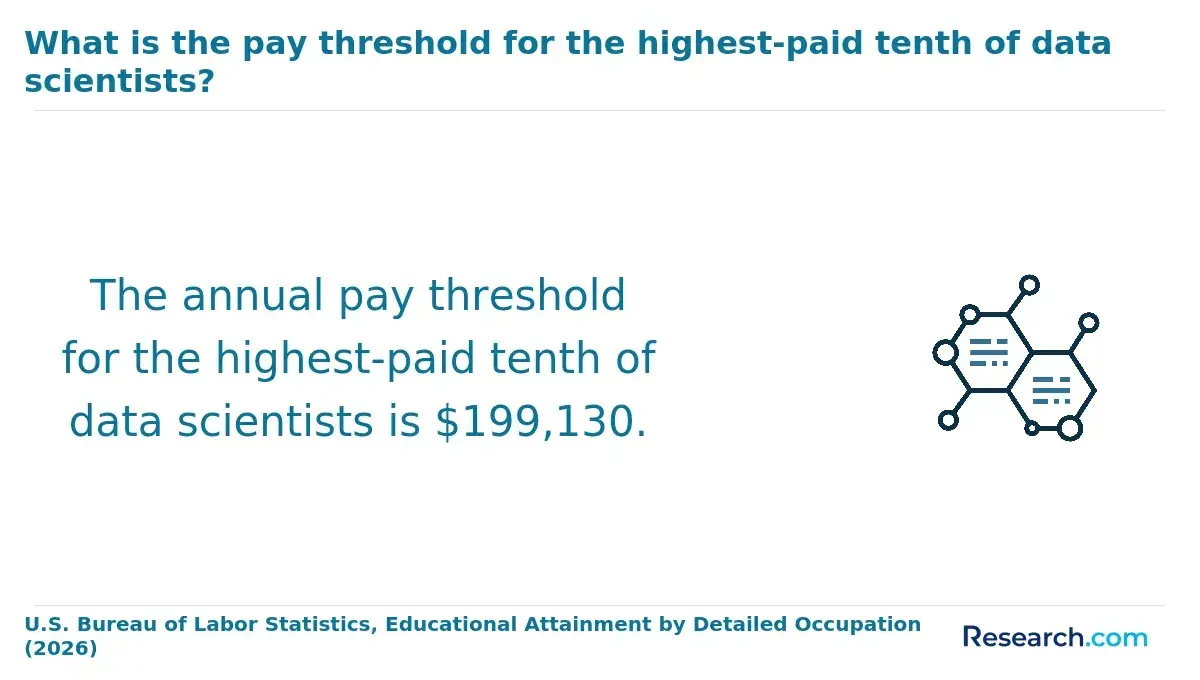
Neither degree has a universal earnings advantage. The U.S. Bureau of Labor Statistics reports a $120,230 median annual wage for data scientists in May 2025. That is an occupation-wide figure, not a salary for new master's graduates or evidence that a data science degree earns more than a computational mathematics degree.
Opportunity depends on the role you pursue and the experience you bring. A data science curriculum may provide more direct evidence for jobs centered on production data and model evaluation. Computational mathematics may be a stronger fit for specialized modeling or numerical work. Either graduate may need additional projects or experience to compete for a particular position; compare actual job requirements with required courses rather than treating labor-market growth as a placement promise.
What careers can you pursue with each master's degree?
Data scientist, applied machine learning practitioner, and analytics-focused roles are plausible targets for graduates whose work demonstrates statistical reasoning, programming, and handling real datasets. Computational mathematics can align with operations research, simulation, scientific computing, and modeling roles. There is considerable overlap: employers assess relevant skills and experience, not just the wording on a diploma.
The practical difference is the portfolio you can build. Someone seeking data scientist roles should be able to show how they cleaned data, selected a method, evaluated its limitations, and communicated a result. Someone seeking numerical modeling roles should be able to explain the mathematical formulation, computational approach, and accuracy of a solution. For AI-focused positions that also require moving and preparing data, examine AI master's programs with data engineering skills alongside either degree.
How do data science and computational mathematics curricula compare?
Both degrees can start with probability, linear algebra, and programming, then diverge. Data science coursework commonly concentrates on statistical learning, databases, data processing, and applied modeling. Computational mathematics coursework commonly concentrates on numerical linear algebra, differential equations, optimization, and simulation. These are tendencies; required courses and available electives establish what any specific program teaches.
Read beyond course titles. A machine learning course might emphasize deploying models, or it might emphasize the mathematics behind algorithms. Likewise, an optimization course might use real organizational data or focus on proofs and numerical convergence. Check syllabi, project descriptions, and whether a topic appears in a required course, an optional elective, or a substantial capstone. If you want both, favor a program that lets you pair rigorous mathematical courses with hands-on data projects without relying on electives that are rarely offered.
What are the admission requirements for each master's program?
Requirements vary by institution, but applicants should expect programs to assess quantitative preparation and programming readiness. Computational mathematics programs may place particular weight on advanced calculus, linear algebra, and differential equations. Data science programs may accept a wider range of undergraduate majors while still expecting evidence of statistics, mathematics, and coding. None of those general patterns substitutes for a program's published prerequisite list.
If your background has gaps, distinguish preparation from formal eligibility. A personal project or online course can help you learn and demonstrate initiative, but it does not necessarily satisfy a required credit-bearing course. Ask admissions staff which prerequisites must appear on a transcript, whether they can be completed before enrollment, and whether conditional admission or bridge coursework is available. Foundation pathways into artificial intelligence graduate programs offer another point of comparison if AI is your goal and prerequisite flexibility matters.
How long do these master's degrees take and how much do they cost?
There is no reliable degree-wide price or completion time: credit requirements, tuition rates, enrollment pace, and whether you must take prerequisite courses differ by program. Computational mathematics is not automatically longer because it is mathematically demanding, and an online data science degree is not automatically cheaper. Use each school's current catalog and tuition schedule to compare equivalent enrollment plans.
For a realistic budget, separate tuition from mandatory fees, course materials and computing costs, travel or campus requirements, and any prerequisite coursework. Also consider income you might forgo by studying full-time and financing costs if you borrow. Scholarships and employer tuition assistance can change your net cost, but confirm eligibility and conditions before counting on them. A common mistake is comparing one program's advertised tuition with another's full estimated cost.
Should you choose an online or campus-based graduate program?
Choose the format that lets you complete the right curriculum while getting the interaction your goals require. Online study can make continued employment easier; campus study may offer more convenient access to in-person research groups, computing resources, or local employers. Neither format alone establishes academic quality.
Ask whether lectures are live or recorded, when group work and exams occur, how projects are supervised, and whether any visits are required. These details matter especially if you work full-time or hope to collaborate closely with faculty on mathematical research. If scheduling is the main constraint, compare online graduate data science options while employed against online computational mathematics programs using the same workload and support criteria. Confirm that the institution can enroll students in your state before committing to an online option.
How can you verify a program's accreditation and academic quality?
Check the institution's current accreditation status through its accreditor and the U.S. Department of Education or Council for Higher Education Accreditation directories. Then verify that the specific degree and delivery format you intend to enter are offered by that institution. Do not assume that a university's accreditation means every individual program has separate specialized accreditation, or that specialized accreditation is required for either degree.
Academic fit requires a second check: examine required courses, faculty expertise, access to projects, and how often relevant electives are offered. Ask for program-level completion or employment information if outcomes matter to you. If a school does not publish comparable outcomes, do not treat a ranking or university-wide statistic as evidence of results for this master's program.
Do graduates need licenses or certifications for data science careers?
There is no general U.S. professional license required to work as a data scientist. Employers may value particular software skills or certifications, but a certification is not a substitute for demonstrating that you can solve the problems in a target role.
Some specialized work associated with mathematical modeling may intersect with regulated professions or restricted job titles. Requirements depend on the role and state, not simply on whether your degree says "data science" or "computational mathematics." If you intend to pursue a regulated engineering role, check the applicable state board and employer requirements before assuming either master's degree meets them.
How do you choose the right master's program for your goals?
Start with a target problem and role, then test each program against the preparation it would give you. This prevents an appealing degree title - or a list of possible careers - from substituting for evidence of fit.
Use these checks to make a short list and identify questions for program staff:
- Choose a target: data-driven prediction and decision support, or mathematical modeling and computational methods. If both appeal, decide which you want as your strongest skill.
- Compare required courses and substantial projects, not just electives. Identify the work samples you could produce for your target roles.
- Check prerequisites and gaps. Confirm formally required coursework rather than assuming independent study will count.
- Compare total cost, feasible completion pace, delivery requirements, and access to faculty or career support on the same basis for every school.
- Request program-specific outcomes where available, and ask how they were measured before using them to judge value.
Choose data science when your priority is working with datasets, evaluating models, and turning findings into decisions. Choose computational mathematics when you want deeper training in algorithms, simulation, or mathematically formulated systems. If mentorship and contacts in AI are particularly important, assess faculty access and networking opportunities through AI master's alumni as separate program features - not benefits to assume from any degree label.
Other Things You Should Know About Data Science
Potentially. Doctoral admissions committees will evaluate your research preparation, mathematical background, recommendations, and fit with a research area. If a PhD is a serious goal, ask whether you can complete a thesis or faculty-supervised research project.
That depends on each institution's policies on transfer credit and applying credits to multiple credentials. Get written guidance before enrolling in courses you hope to reuse.
Not necessarily. What matters is whether you can show role-relevant work. Confirm whether an internship is required by a program and whether an employer-sponsored project can meet its experiential requirement.
Use public or appropriately generated data to demonstrate the same methods. Explain your decisions and evaluation clearly, and obtain permission before describing any nonpublic work or results.
References
- Master's in Computer Science vs Master's in Data Science | jhu.edu https://ep.jhu.edu/news/masters-computer-science-vs-data-science/
- Profiling data scientists in the digital labour market | sciencedirect.com https://www.sciencedirect.com/science/article/pii/S0263237322000810
- What Can I Do With a Degree in Data Science? Career Paths & Skills | Harvard SEAS https://seas.harvard.edu/news/what-can-i-do-degree-data-science-career-paths-skills
- Master of Science in Applied and Computational Mathematics | University of Washington https://amath.washington.edu/master-science-applied-and-computational-mathematics-online
- Data Analyst vs Data Scientist: Salary & Career Paths | SIUE https://online.siue.edu/degrees/undergraduate/bsba/data-analytics-spec/analyst-vs-scientist-careers/
- Computer Science vs Data Science: What is Right for You? | South Dakota Mines https://www.sdsmt.edu/academics/academic-departments/electrical-engineering-and-computer-science/computer-science-vs-data-science.html
- M.S. in Scientific Computing | Department of Mathematics | NYU Courant https://math.nyu.edu/dynamic/graduate/ms-gsas/ms-scientific-computing/
- Data Sciences and Statistics | UW College of Arts and Sciences https://acms.washington.edu/data-sciences-and-statistics-0
- Computational Mathematics and Data Concentration, Data Science, Analytics and Engineering Degree, MS | ASU https://degrees.asu.edu/masters-phd/major/ASU00/ESDSECMDMS/data-science-analytics-and-engineering-computational-mathematics-and-data-ms
- Data Science vs. Computer Science: What's the Difference? | UCLA MSOL Data Science https://www.msol.ucla.edu/data-science-engineering/articles/data-science-vs-computer-science/