2027 Building Energy Efficiency Capstones: What to Look for in a Data Science Master's

Co-Founder and Chief Data Scientist
A building energy efficiency capstone can turn a data science master's degree into evidence of work you can show an employer, but only if the program gives you access to suitable data, technical guidance, and time to evaluate a real decision.
This guide is for prospective students interested in building analytics, energy management, or applied data science. It explains what a strong project looks like and how to tell whether a program can support one before you enroll.
Key Things You Should Know
- Look for a capstone that connects a specific building decision to usable meter and contextual data, a defensible baseline, and a deliverable someone could act on.
- Ask whether students can choose an energy topic, obtain approved data, and work with both data science and building-domain mentor. A general capstone requirement does not establish any of these.
- The U.S. Bureau of Labor Statistics projects 35% employment growth for data scientists from 2025 to 2035, but that occupation-wide forecast does not predict demand for building-efficiency specialists or outcomes from a particular degree.
What are building energy efficiency capstones in data science master's programs?
They are culminating projects that use data to investigate how a building uses energy and support a decision about reducing waste, managing peak demand, or evaluating an intervention. A project might forecast electricity use, identify unusual HVAC operation, compare buildings after accounting for weather, or assess whether a retrofit appears to have changed consumption.
The strongest topic begins with a decision, not an algorithm: for example, "Which operating hours warrant investigation?" is more useful than "Can I fit a complex forecasting model?" The capstone should identify who would use the result, what action they could take, and what the analysis cannot establish.
Do not assume that a program advertising a capstone offers building-energy projects. Topic approval, data access, and adviser expertise may determine whether your proposed work is feasible.
Why are energy-efficiency capstones valuable for data science careers?
A well-executed capstone shows how a candidate handles messy operational data and translates an analysis into a recommendation. That combination may be relevant to building analytics teams, energy service companies, utilities, facilities organizations, and employers hiring generalist data scientists for operational problems.
The project is most persuasive when you can explain its baseline, uncertainty, and practical limits, not just display a model score.
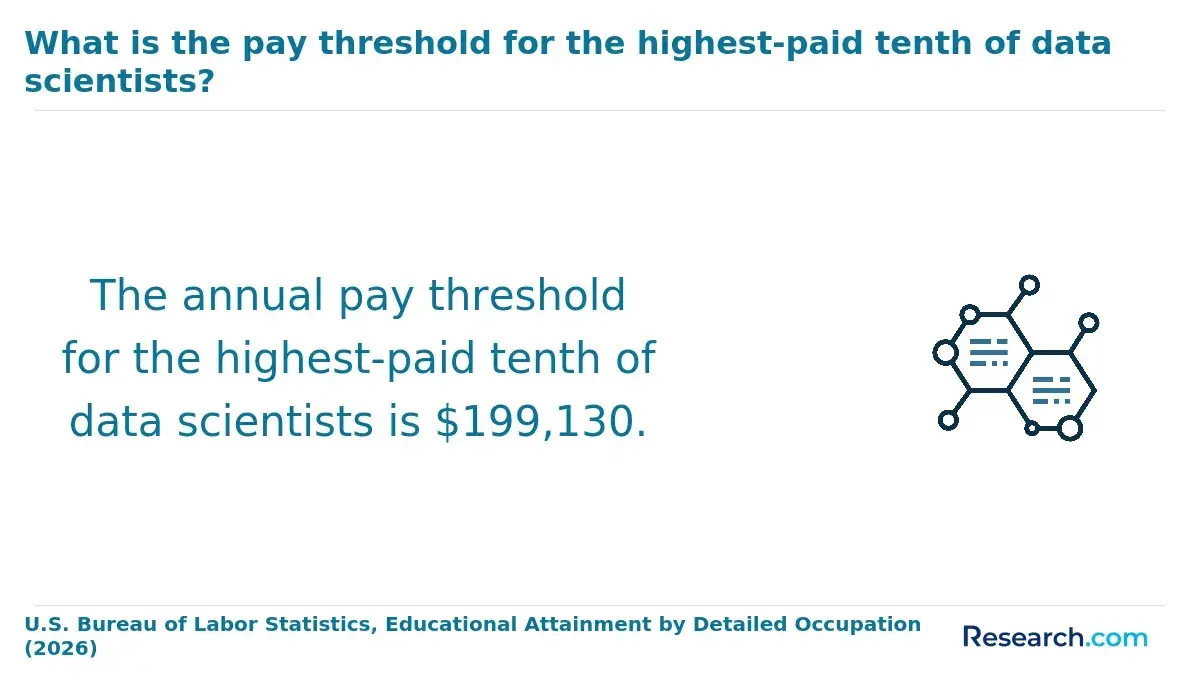
The U.S. Bureau of Labor Statistics reports a May 2025 median annual wage of $120,230 for data scientists. This is an occupation-wide figure, not an entry-level salary, an energy-sector salary, or an estimate of what a capstone will earn you.
Use it for broad career context, then examine actual roles and required domain experience. To assess whether a degree supports your intended role beyond a single project, compare data science programs by career preparation.
What do data science master's capstones in building efficiency typically involve?
Project requirements differ by school, but a credible proposal should specify its decision, data, evaluation plan, and final deliverable. The following sequence gives you a way to judge whether a proposed topic is substantial yet manageable within a degree.
- Define the decision: Identify a building, portfolio, or operating system and the person who could act on the findings.
- Confirm data access: Establish what meter readings, weather records, schedules, building characteristics, or equipment logs are available, at what frequency, and under what sharing restrictions.
- Build a baseline: Compare against a simple, appropriate reference before using more complex models; account for factors such as season and occupancy when the data permit.
- Evaluate honestly: Use time-aware validation for forecasts, report errors in decision-relevant units, and distinguish an observed change from a proven energy saving.
- Deliver usable work: Provide documented code or methods, a clear explanation of uncertainty, and a recommendation that fits the stakeholder's authority and budget.
A common mistake is to treat lower energy use after a retrofit as proof that the retrofit caused it.
Weather, operating hours, occupancy, and other changes may explain part of the difference. If those influences cannot be adequately assessed, frame the result as an association or a screening finding rather than verified savings.
Which data science courses prepare students for energy-efficiency capstones?
Prioritize preparation that matches the project's data and claims. Statistics and experimental reasoning support uncertainty estimates and intervention analysis; databases and data engineering help join meter, weather, and equipment records; time-series methods support forecasting and anomaly detection. Optimization or decision analysis can help when the goal is to choose among operating changes rather than predict consumption alone.
Course titles are not enough. Check syllabi and past assignments for work with temporal data, missing readings, validation, and interpretable results. Building science or energy-systems coursework is particularly useful if you lack experience with HVAC, controls, or energy measurement.
If an AI-focused degree is also on your shortlist, artificial intelligence master's foundation courses may help you assess preparation, but they do not replace building-domain knowledge or guarantee eligibility for a capstone topic.
What technical skills should building energy efficiency capstones demonstrate?
A strong portfolio artifact shows that you can clean and align time-stamped data, investigate missing or faulty readings, establish a comparison baseline, and communicate findings in energy terms such as electricity consumption or peak demand.
It should also show why the chosen method fits the question. A transparent statistical model can be more useful than a more complex model whose result a facilities team cannot interpret.
For a forecasting project, look for evaluation on later time periods rather than a random split that lets nearby observations leak into training and testing. For an anomaly project, explain how alerts would be checked and what false alarms would cost.
For a retrofit analysis, state which confounding factors remain unresolved. Document assumptions, code, data permissions, and any limits on publishing building-level information.
Choose an AI-heavy project only when its added complexity serves the building decision. If your main goal is advanced model development rather than energy operations, comparing inexpensive online graduate programs in AI may reveal a better academic fit; still confirm that the program permits the applied project you want.
How do online and campus data science programs support capstone projects?
Either format can support a strong capstone. What matters is whether the student can obtain data, receive timely feedback, and collaborate with someone who understands the building problem.
Online students may be able to use an employer's building data, subject to approval and confidentiality rules; campus students may find local collaborators through faculty. Neither opportunity should be assumed from the delivery format alone.
Ask how teams are formed, how often advisers meet, whether students can propose external partners, and what happens if a partner withdraws or data access fails. Request an example of a completed project and clarify whether its data and outputs were publishable. Industry contacts and alumni can help with introductions, but a network is not a substitute for an approved project and dependable supervision.
If cross-disciplinary connections are a priority, AI master's degrees with established alumni connections offer another comparison point; verify whether those connections extend to energy or buildings.
What accreditation should students verify when comparing data science master's programs?
Verify the institution's current accreditation with its recognized accreditor and confirm that the degree and delivery format you intend to enter are offered by that institution. Institutional accreditation speaks to institutional oversight; it does not certify that a data science program teaches building analytics or can arrange an energy-efficiency capstone.
For this decision, examine the catalog's project requirements separately from accreditation. Ask whether the capstone is required or optional, whether externally sourced data are permitted, and who approves the topic. Also confirm any state-related enrollment restrictions with an online program if you will study outside the institution's home state.
What admission requirements apply to data science master's programs?
Requirements vary by institution. Applicants should check the current admissions page for degree, transcript, quantitative preparation, programming, recommendation, and other application requirements rather than assume that a building or engineering background qualifies them or that it is necessary.
Preparation for the capstone is a separate question: someone with facilities experience may need more statistics and coding, while an experienced programmer may need energy-domain context. Before applying, ask whether prerequisite or bridge courses are available and whether they satisfy formal admission conditions or simply prepare students for graduate work.
If you hope to use employer building data, discuss the idea early without submitting confidential files; admission to a degree does not constitute approval of a data source or capstone proposal.
How much do data science master's programs cost and how long do they take?
There is no reliable single price or completion time for this topic. Schools differ in credit requirements, tuition schedules, fees, enrollment pace, and project rules.
Compare a current, school-specific estimate for the entire degree, not one term's tuition. Include mandatory fees, any required campus visits, software or computing needs, and the possibility that a data-access delay could extend your enrollment.
Ask whether capstone credits are included in the published degree total, when they can be taken, whether the project can span terms, and what additional enrollment costs would apply if it does. Employer tuition assistance may change your out-of-pocket cost, but confirm its eligibility and repayment conditions.
For a broader shortlist, affordable graduate study in data science is a starting point; verify each program's current total and capstone flexibility before treating it as a lower-cost choice.
What careers, salaries, and certifications follow energy-efficiency data science capstones?
Potential directions include data scientist roles involving operational data, building or energy analyst positions, and analytics work with utilities or facilities teams. Job titles and requirements differ.
Some positions emphasize modeling, while others require substantial knowledge of equipment, controls, or energy programs. A capstone can demonstrate relevant work, but it does not establish that you meet every employer's experience requirements.
When reviewing salary figures, separate broad data scientist statistics from pay for a specific building-energy role in your location. Likewise, treat certifications as role-dependent rather than automatic next steps. A building-operations credential may matter more for a facilities-facing position; a data-focused employer may put more weight on your methods and portfolio.
Check postings for the roles you want before paying for an additional credential. Your immediate next step is to shortlist programs, request capstone examples and policies, and compare whether each can support your proposed data source and career target.
Other Things You Should Know About Data Science Programs
Potentially. Look for a dataset with documented units, time coverage, and permitted uses, then confirm that your program accepts it. Public benchmarking data may be better suited to comparing buildings than diagnosing equipment-level faults.
No. A defensible forecast, diagnostic tool, or evaluation plan can be valuable without an implemented intervention. Describe estimated or observed effects accurately; do not claim verified savings without sufficient evidence.
Only if your employer and program permit it. Ask about confidentiality, aggregation, intellectual property, and whether a public portfolio version can omit sensitive data while still explaining your methods.
Have a fallback question and dataset before the project begins. Ask the program how topic changes are approved and whether a lost external partnership could affect your completion schedule.
References
- How the 1-100 ENERGY STAR Score is Calculated https://www.energystar.gov/buildings/benchmark/understand-metrics/how-score-calculated
- Measurement and Verification Options for Federal Energy https://www.energy.gov/cmei/femp/measurement-and-verification-options-federal-energy-and-water-saving-projects
- Energy and Cost Analysis Methodology | energycodes.gov https://www.energycodes.gov/methodology
- Building energy performance monitoring through the lens of data quality: A review - ScienceDirect https://www.sciencedirect.com/science/article/pii/S0378778822008726
- Capstone Projects - UVA School of Data Science https://datascience.virginia.edu/degrees/info/capstone-projects
- Applied Data Science (MS) Student Capstone Projects | Bay Path University https://www.baypath.edu/academics/graduate-programs/applied-data-science-ms/student-capstone-projects/
- Inside the Harvard Extension School Data Science Capstone https://extension.harvard.edu/blog/harvard-extension-school-data-science-capstone-experience/
- MSDS Capstone Projects - College of Information Science https://infosci.arizona.edu/ms-data-science/capstone-projects