2027 LPN-to-RN Bridge Programs in Oregon: Admission, Schedules, and Campus Requirements
Audited and Verified:
Our Editorial and Data Verification Process
Research.com uses government datasets, official education statistics and primary institutional information to support its career and degree guides. Our review process checks factual accuracy, occupational definitions, source dates and the requirements associated with the credentials discussed.
How This Article Was Fact-Checked
Our editorial team verifies salary estimates, employment projections, education requirements and program information against original data providers and official organizations. Salary figures are checked against the relevant occupational definitions and reporting periods. Information about licensure, accreditation and required in-person training is reviewed separately.
Fact-checked and verified on:

Co-Founder and Chief Data Scientist
For an Oregon LPN, the best RN bridge is not necessarily the one advertising the shortest or most flexible route. Advanced-placement credit, available clinical seats, and the days you must attend campus can change both your graduation date and your ability to keep working.
This guide explains how to compare Oregon programs by admission rules, actual schedules, in-person requirements, cost, and RN licensure eligibility - so you can request the right information before committing to a school.
Key Things You Should Know
- An LPN-to-RN bridge provides advanced placement into prelicensure RN education; an LPN license does not automatically waive nursing courses or clinical requirements.
- Plan for three distinct in-person commitments: skills or simulation sessions, supervised clinical shifts, and any required campus classes - even when lectures are online.
- Compare the number of remaining terms and credits only after a school evaluates your transcripts and LPN preparation; graduation is followed by the NCLEX-RN and an Oregon RN licensure decision.
What are LPN-to-RN bridge programs in Oregon?
An LPN-to-RN bridge is a prelicensure nursing pathway that recognizes some of a licensed practical nurse's previous education or demonstrated competencies while preparing the student for registered nurse practice. The usual destination is an associate-level nursing degree, though the award and amount of advanced placement depend on the school. An RN-to-BSN program is different: it generally assumes the student is already an RN.
"Bridge" does not guarantee entry into the second year. A school may award credit after transcript review, require a transition course or competency assessment, or place admitted LPNs into a particular nursing-course sequence. Ask for a written degree audit showing credits accepted, requirements satisfied, and courses and clinical experiences still required. Those are not always the same thing.
Advertisements for shorter LPN-to-RN program comparisons can provide context, but an advertised duration should not replace an Oregon school's individualized progression plan.
What are the admission requirements for Oregon LPN-to-RN programs?
Admission usually has two stages: eligibility to attend the college and selection for a limited-seat nursing pathway. Requirements differ by school and entry term. The table separates common screening areas from the questions that determine whether an LPN can actually enter the bridge.
| Screening area | What to confirm with the program |
| LPN preparation | Required Oregon license status, accepted out-of-state licenses, and documentation of practical nursing education or work experience. |
| Prerequisites | Required sciences and other courses; minimum grades; lab format; course-age limits; and when prerequisites must be completed. |
| Advanced placement | Whether placement depends on an exam, transition course, skills evaluation, or review of prior nursing courses. |
| Competitive selection | Application deadlines, entrance assessments if used, ranking criteria, and the number of available bridge seats. |
| Clinical clearance | Background screening, immunizations, CPR documentation, and any separate clinical-site requirements. |
Request an evaluation of both your general education and nursing coursework before assuming previous credits will shorten the sequence. If a particular RN program cannot apply enough of your LPN preparation, a conventional prelicensure route may be worth comparing; exploring accessible accelerated BSN pathways is most relevant when you also hold the prior degree those programs require.
Which Oregon LPN-to-RN programs offer online or hybrid classes?
No named Oregon bridge should be treated as an online or hybrid option without confirming its current LPN-entry cohort and course schedule. Schools may put lectures online while requiring students to attend campus for tests, skills, and simulation and travel to assigned clinical sites. A college's general "online nursing" description may refer to a postlicensure program rather than its LPN-to-RN track.
For each school you are considering, ask which bridge courses are asynchronous, which meet live online, which meet on campus, and whether clinical sites can be assigned near home. Request the schedule from the most recent comparable cohort and ask what can change before your entry term. This is particularly important if you work rotating LPN shifts or arrange childcare.
Do not confuse an online initial-licensure bridge with online ADN-to-MSN program comparisons: the latter concern academic advancement after RN licensure and do not replace RN clinical preparation.
There is no dependable statewide completion time. Your timeline starts with unfinished prerequisites, not just the first nursing class. It then depends on awarded advanced placement, the order in which remaining nursing courses run, whether a bridge cohort starts each term, and whether clinical seats are available. A missed prerequisite or once-a-year transition course can delay entry even when few credits remain.
Ask the program to mark your earliest eligible application term, expected nursing start term, and every required term through graduation on one calendar. Also ask whether part-time enrollment is permitted in the nursing sequence; taking fewer general-education credits does not necessarily make clinical courses part-time.
Accelerated direct-entry nursing master's pathways serve a different applicant - typically someone entering nursing without an LPN or RN license - and are not a shortcut for estimating an Oregon LPN's bridge timeline.
"Hybrid" describes where some instruction happens, not when a student is free. The following commitments may be scheduled separately and may change by term, so compare them against your work and caregiving calendar rather than against a single advertised class day.
| Commitment | Potential scheduling constraint |
| Online coursework | Live attendance, timed assessments, or fixed deadlines may still apply. |
| Campus labs and simulation | Students may need to travel for required skills practice and observed assessments. |
| Clinical rotations | Assigned site, start time, shift length, and weekday or weekend availability may vary. |
| Orientation and testing | Mandatory sessions may fall outside the regular weekly timetable. |
Before accepting a seat, ask for the earliest clinical start time, whether weekend or evening placements are guaranteed or merely possible, the maximum expected travel radius, and the policy for missed clinical days. Placement support matters at later levels of nursing education too, but FNP study options with school-supported placements address graduate practice, not an LPN-to-RN student's clinical assignments.
A bridge must prepare an LPN for the broader RN role, not simply repeat practical nursing instruction. Depending on the curriculum and credit evaluation, remaining study may cover advanced health assessment, pharmacology or medication safety, clinical judgment, care of patients with complex needs, mental health, maternal-child care, leadership, and RN-level delegation and coordination.
Students should expect faculty-supervised skills assessment, simulation, and approved clinical experiences. Working as an LPN builds valuable judgment but does not automatically count as supervised RN student clinical education. Ask which competencies are assessed in person and whether your existing workplace could be used as a clinical site; the school and site, not the student alone, determine whether that arrangement is acceptable.
Specialty study comes later. For example, short-format PMHNP master's options require a different level of preparation and should not be confused with mental health content in a prelicensure RN bridge.
A defensible price comparison requires each school's current tuition schedule and your individualized list of remaining credits. No single Oregon bridge price applies to every LPN: residency classification, transferred prerequisites, program fees, and the number of enrolled terms can change the total. Request a term-by-term estimate using these price lines:
- Tuition price: the applicable published per-credit rate multiplied by your remaining billable credits.
- Required school fees: nursing, laboratory, technology, and other charges listed for each enrolled term.
- Preparation and licensing prices: books, equipment, screening, immunizations, exam registration, and board application charges.
- Attendance costs: travel, parking, childcare, and wages lost when clinical shifts conflict with paid work.
Compare the resulting total with available aid and any employer reimbursement terms, including minimum grades or service commitments. For a longer-term academic plan, master's nursing education on a BSN graduate's budget is a separate postlicensure cost decision; it should not be included in the price of obtaining an initial RN license.
Check three different forms of recognition. Oregon State Board of Nursing (OSBN) approval concerns the prelicensure nursing program. Institutional accreditation concerns the college or university. Nursing program accreditation, where held, applies to the specified nursing program and degree; it is not established merely by the institution's accreditation. Verify the exact campus, degree, and track rather than relying on a school-wide statement.
Before paying an enrollment deposit, confirm the program's current OSBN status and ask the school whether its LPN-entry route leads to the same approved RN degree as its other prelicensure entrants. If future transfer or graduate study matters to you, check the receiving institution's policies as well; it decides which prior credits and credentials it will accept.
That distinction remains important much later if you consider planning applications to accessible DNP programs. A future doctoral program's admissions rules cannot establish whether an Oregon bridge currently qualifies its graduates to seek initial RN licensure.
An Oregon LPN must complete a qualifying RN program, apply for RN licensure through the OSBN, meet the board's applicable requirements, and obtain authorization to take and pass the NCLEX-RN. The board makes the licensing decision. Graduation, exam eligibility, an NCLEX pass, and an active RN license are distinct milestones; do not begin working under an RN title before you have the required authority to practice.
Well before graduation, review the OSBN's application instructions and ask your school how it reports program completion. Disclose any issue requiring board review accurately and early rather than assuming admission to school resolves licensure eligibility. If you expect to practice outside Oregon, check the other jurisdiction's requirements separately.
An RN bridge also does not confer advanced practice authority. Accelerated mental health NP certificate study is a later option for appropriately prepared graduate nurses, not a substitute for the RN licensing process.
What careers, salaries, and job outlook follow an Oregon LPN-to-RN program?
After licensure, an RN may pursue roles in hospitals, ambulatory care, long-term care, home health, or community settings. The transition can expand responsibility for assessment, care planning, patient education, and coordination, but employers may require orientation or experience for particular units. An RN license does not itself establish independent competence in a specialty.
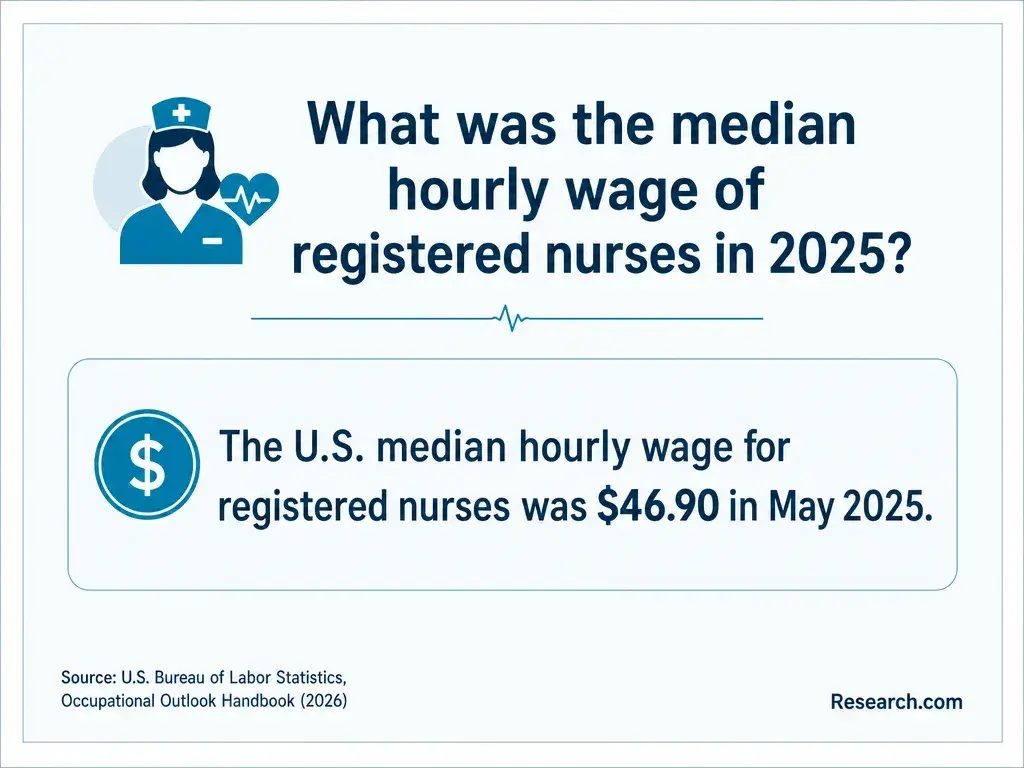
For national context, the U.S. Bureau of Labor Statistics reported a May 2024 median annual wage of $93,600 for registered nurses and projected 5% RN employment growth from 2024 to 2034. Those are occupation-wide US figures - not Oregon starting salaries, bridge-graduate earnings, or a promised raise over your current LPN pay. Compare actual local offers, shift differentials, benefits, and the cost of completing the bridge.
If your eventual goal is advanced practice, family NP certificate options for MSN-prepared nurses address a much later educational decision. The immediate career question is whether an RN license opens positions you want and whether the bridge's time and expense fit those opportunities.
Other Things You Should Know About Nursing
Often, if your license remains active and your employer can accommodate school obligations. Do not count on a fixed work pattern until you have the program's clinical and campus schedule.
Yes, subject to each school's rules. Track deadlines and prerequisite equivalencies separately; an evaluation or acceptance from one school does not transfer automatically to another.
Ask the program in writing whether your admission, prerequisite eligibility, and advanced-placement evaluation remain valid for the later term. Do not assume the same course sequence or clinical capacity will be available.
Contact the school's accessibility office early to discuss its process and the program's essential requirements. Accommodations are evaluated individually and may involve coordination with clinical sites.
- Oregon nursing program NCLEX pass rates. - OSBN https://osbnpublic.osbn.oregon.gov/approvedprograms
- Nursing Programs Outside Oregon: State of Oregon https://www.oregon.gov/osbn/pages/aprn-placements.aspx
- Clinical rotations request - Academic Departments https://departments.med.upenn.edu/academic-departments/locations/nursing-programs/nursing-at-penn/clinical-rotations-request
- Nursing | LBCC https://www.linnbenton.edu/future-students/explore-lb/programs/nursing.php
- LPN-RN | Chemeketa Community College https://www.chemeketa.edu/programs-classes/program-finder/nursing/lpn-rn/
- Nursing & Allied Health | Oregon Coast CC https://oregoncoast.edu/academics/programs/nursing-allied-health/
- How the BSN Online Clinical Experience Works | Chamberlain University https://www.chamberlain.edu/academic-resources/bsn-online-clinical-experience
- Program: Nursing - LPN to RN Track, AAS (PNRND) https://catalog.mohave.edu/preview_program.php
- Licensed Practical Nurse to Registered Nurse | treasurevalleycc.edu https://www.treasurevalleycc.edu/nursing/lpn-rn/index.cfm
- Nursing - LPN to RN Bridge | Health, Medical, and Fitness | Lane Community College https://www.lanecc.edu/programs-academics/areas-study/health-medical-and-fitness/nursing-lpn-rn-bridge