2027 LPN-to-BSN Pathways for Nurses in Alabama: Direct Bridges and RN-to-BSN Alternatives
Audited and Verified:
Our Editorial and Data Verification Process
Research.com uses government datasets, official education statistics and primary institutional information to support its career and degree guides. Our review process checks factual accuracy, occupational definitions, source dates and the requirements associated with the credentials discussed.
How This Article Was Fact-Checked
Our editorial team verifies salary estimates, employment projections, education requirements and program information against original data providers and official organizations. Salary figures are checked against the relevant occupational definitions and reporting periods. Information about licensure, accreditation and required in-person training is reviewed separately.
Fact-checked and verified on:

Co-Founder and Chief Data Scientist
An Alabama LPN who wants a BSN must choose a route that leads to RN licensure as well as a degree. A direct LPN-to-BSN track may combine those goals, while an LPN-to-RN program followed by RN-to-BSN study divides them into two stages. The distinction affects when you can work as an RN, how much clinical training you need, and whether advertised online coursework fits your schedule. This guide shows you how to compare the routes and what to confirm with a school before committing.
Key Things You Should Know
- A direct LPN-to-BSN route must include preparation for initial RN licensure; an RN-to-BSN program ordinarily requires an RN license before enrollment
- The two-stage alternative is LPN-to-RN, typically through an associate-degree nursing mobility program, followed by RN-to-BSN completion after RN licensure
- Compare each option at 3 checkpoints: credits that apply to the degree, required in-person clinical or campus attendance, and total cost through BSN graduation - not just the first program's tuition.
What Are LPN-to-BSN Pathways in Alabama?
An LPN-to-BSN pathway takes a licensed practical nurse from practical nursing preparation to a bachelor of science in nursing and, along the way, eligibility to seek RN licensure. It may be a single prelicensure BSN track that awards credit for prior LPN learning, or a sequence of LPN-to-RN education and later BSN completion. "Bridge" describes a route, not a guarantee of advanced standing: the receiving school decides which credits satisfy its degree and clinical requirements.
The distinction matters if you are already an Alabama LPN. You do not need to repeat practical nursing education merely to begin this progression. Someone who has not yet earned an LPN license is making a different entry-level decision; exploring faster routes into practical nursing education does not itself establish the fastest route to a BSN.
Can Alabama LPNs Enter a Direct LPN-to-BSN Program?
Potentially, but confirm that a school currently offers an LPN-entry, prelicensure BSN track open to Alabama students. A traditional BSN program may accept an LPN applicant without granting nursing-course credit; an RN-to-BSN program is not a direct LPN bridge. Do not infer availability from an old program listing or from a university's general BSN admissions page.
Ask the nursing department for the current entry-term plan of study and a written review of your LPN coursework. Confirm when you would enter the nursing sequence, which supervised clinical experiences remain, whether the program prepares graduates to apply for the NCLEX-RN, and whether nursing-major admission is separate from university admission. If the direct track is unavailable or highly selective, compare local LPN-to-RN mobility options rather than assuming you must restart a four-year BSN. A broader look at nursing admission options beyond highly selective programs can help frame that search, but each Alabama program's eligibility rules still control.
What RN-to-BSN Alternatives Are Available for Alabama LPNs?
The principal alternative is to complete an approved LPN-to-RN mobility program, obtain RN licensure, and then enter a postlicensure RN-to-BSN program. Alabama community-college nursing mobility pathways are worth investigating, but availability, advanced placement, and progression policies vary by college. An associate degree can let you seek RN licensure before finishing the BSN; it also means applying to and paying for a second program.
This comparison separates the credentials and the point at which each route may change your employment options.
| Route | Entry and award | RN licensure point | Best fit and main limitation |
| Direct LPN-to-BSN | LPN enters a prelicensure BSN track; earns a BSN | After completing the qualifying program and meeting examination and board requirements | Fits an LPN seeking one degree sequence; availability and required on-site training may limit choices |
| LPN-to-RN, then RN-to-BSN | LPN earns an RN-qualifying degree, commonly an associate degree; licensed RN later completes a BSN | After the first qualifying program, before RN-to-BSN study | Fits someone who wants an earlier RN employment opportunity; requires a second admission and credit review |
When comparing first-stage programs, distinguish online lectures from required labs and clinical placements. Listings of LPN-to-RN programs with online coursework are a starting point, not evidence that a particular Alabama student can complete RN preparation fully online or within an advertised timeframe.
For the prelicensure stage, check the Alabama Board of Nursing's current program information and ask the school to confirm that its specific track meets the requirements to apply for Alabama RN licensure. For both stages, verify the institution's accreditation and the nursing program's accreditation status and scope, commonly through ACEN or CCNE where applicable. Institutional accreditation, nursing accreditation, and state board approval answer different questions; none should be assumed from another.
Check each school separately if you plan to earn an associate degree at one institution and a BSN at another. Ask the RN-to-BSN school how the first degree's credits will apply, not just whether they will transfer. If your eventual goal is advanced practice, that would require another, role-specific educational and licensing review: affordable graduate psychiatric nursing options, for example, cannot replace approval of your initial RN-qualifying program.
Requirements depend on the first program you enter. A direct prelicensure BSN track or LPN-to-RN mobility program may assess your LPN license, transcripts, prerequisite sciences and labs, grades, entrance-test results, and clinical-placement eligibility. Schools can set course-age limits and separate deadlines for university admission and nursing-major admission. An RN-to-BSN program generally evaluates an RN license, prior RN education, transferable general education, and any remaining degree requirements.
Before applying, request a degree audit or written prerequisite review using transcripts from every school attended. Ask whether your anatomy and physiology or microbiology labs meet current rules, whether LPN experience earns credit by examination or another assessment, and when your RN license must be active for an RN-to-BSN application. Admission does not waive later background, health, or clinical-site requirements.
Keep future graduate eligibility separate from this decision. Family NP certificate options for MSN-prepared nurses serve a different entry group; an LPN license or future BSN alone does not qualify someone for a post-master's NP certificate.
There is no reliable statewide completion time for an individual LPN. The direct route depends on prerequisite completion, the amount of LPN credit awarded, when a nursing cohort starts, and the remaining clinical sequence. The two-stage route adds the LPN-to-RN program, RN licensing steps, and RN-to-BSN coursework; some students can begin the second stage soon after licensure, while others need additional general-education courses or must wait for an entry term.
Compare calendars rather than advertised program lengths. Request a term-by-term plan showing prerequisite work, clinical days, summer availability, the earliest possible NCLEX-RN application point, and the expected BSN graduation term. For a working LPN, ask how a missed course or clinical placement affects the next available sequence. A later goal such as fast-track mental health nursing graduate study should not be counted as part of the LPN-to-BSN timeline.
Compare the cost through BSN graduation, not the tuition for one term or the first credential. A direct route has one degree plan but may require more university-priced coursework. A mobility-to-RN route may begin with lower-cost community-college study, yet the later BSN, transferred-credit decisions, and an additional application can change the total. Neither structure is automatically cheaper.
Request an itemized estimate from each school that includes tuition by residency and enrollment status, mandatory fees, books and equipment, clinical compliance costs, travel, and any required campus visits. For the two-stage route, add RN examination and licensing expenses and the RN-to-BSN school's remaining-credit estimate. Compare what you can earn while studying as an LPN, and whether earlier RN licensure could change your income; do not assume a particular wage increase or employer reimbursement. Ask your employer about written eligibility, grade, service, and repayment conditions before treating assistance as guaranteed.
If advanced practice is a long-term goal, budget for it separately. Cost-focused nurse practitioner study options are not a substitute for a complete price comparison of the RN and BSN education you need first.
The curriculum depends on where you enter. A direct LPN-to-BSN track must include the RN-level nursing coursework and supervised clinical preparation needed for its prelicensure objectives. That may include more extensive assessment, medication and patient-safety work, clinical judgment, care coordination, and practice with patients across settings. Prior LPN employment is valuable preparation, but a school determines whether it satisfies any academic competency requirement.
A postlicensure RN-to-BSN program builds on completed RN education instead of repeating initial RN clinical training. Typical areas include evidence-based practice, population health, leadership, quality improvement, informatics, and professional writing. Some programs use approved workplace-based assignments; these are not the same as claiming that employment replaces prelicensure clinical experiences. Neither BSN route, by itself, prepares a nurse to practice as an NP. Short family nurse practitioner program options concern a later graduate-level decision with distinct admissions and clinical requirements.
Some coursework may be online, particularly in postlicensure RN-to-BSN programs. Initial RN preparation is not simply an online degree: expect to verify required supervised clinical practice, skills assessments, labs, simulation, and any campus visits. Even an asynchronous course can have fixed clinical shifts or group-project deadlines.
Ask for the actual schedule for your entry term: how often must you attend campus, where are clinical sites located, who arranges placements, and can required hours be completed around LPN shifts or caregiving? If you plan to use your workplace for BSN assignments, ask which activities need faculty approval and how patient information must be protected. Listings of BSN completion programs using workplace-based projects describe postlicensure options; they do not eliminate the clinical education required to become an RN.
What Careers, Salaries, and Job Outlook Follow an Alabama BSN?
The first professional change is becoming a licensed RN, not merely receiving a BSN diploma. After graduating from an RN-qualifying program, you must meet the Alabama Board of Nursing's applicable requirements, including the NCLEX-RN, before practicing as an RN. A BSN can support applications for RN roles and, with experience, positions involving care coordination, quality, education, or leadership. Employers may still require unit-specific orientation, experience, or additional credentials.
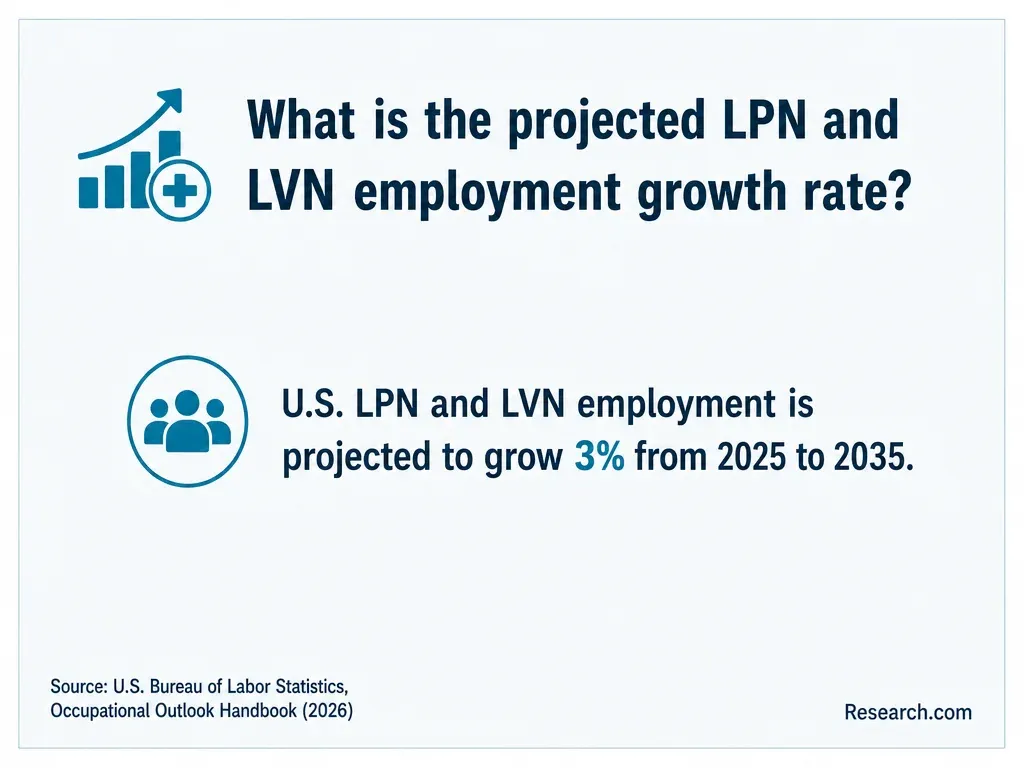
For wage context, the U.S. Bureau of Labor Statistics reported a May 2024 national median annual wage of $93,600 for registered nurses, compared with $62,340 for licensed practical and licensed vocational nurses. BLS projected RN employment growth of 5% from 2024 to 2034. These occupation-wide figures are not Alabama pay rates, BSN graduate starting salaries, or a forecast of an individual nurse's raise. Compare local offers by setting, shift differential, benefits, and experience requirements - especially if you could work as an RN while completing the BSN.
A BSN also does not confer advanced practice authority. Accelerated DNP program comparisons may become relevant to a later graduate goal, but the degree title alone does not establish NP preparation or licensure eligibility.
Other Things You Should Know About Nursing
Generally, an active LPN license lets you continue working within LPN scope. Whether employment fits your course and clinical schedule depends on the program and your employer; student status does not expand your licensed scope.
The school decides whether your license meets its admission policy. Separately, verify with the Alabama Board of Nursing what authorization you need to work as an LPN in Alabama; admission and practice authorization are different decisions.
Disclose the prior enrollment and request the new program's written transfer, repeat-course, and readmission policies. A university may accept general credits while declining to apply earlier nursing coursework to its clinical sequence.
Some schools may permit conditional application or limited early coursework, but their rules differ. Confirm exactly when an active RN license is required for admission, progression, and graduation before relying on that option.
- FAQs - Alabama Board of Nursing https://www.abn.alabama.gov/nursing-education/distance-out-of-state-nursing-programs/faqs/
- Nursing (RN to BSN) - UA Online - The University of Alabama https://online.ua.edu/degrees/rn-to-bsn/
- Nursing (RN) | lawsonstate.edu https://www.lawsonstate.edu/learn_at_lawson/programs_and_divisions/health_professions_programs/registered_nursing.aspx
- BSN Pathway | School of Nursing | The University of Alabama at Birmingham https://www.uab.edu/nursing/home/academics/undergraduate/bsn
- RN to BSN Nursing Post Licensure | una.edu https://www.una.edu/nursing/undergraduate/rn-to-bsn.html
- LPN to BSN Pathway | College of Nursing https://www.southalabama.edu/colleges/con/bsn/lpn-to-bsn.html
- Nursing | Calhoun Community College https://calhoun.edu/programs-training/explore-academic-programs/health-sciences/nursing/
- Becoming a Nurse Online - Mercer ABSN https://absn.mercer.edu/blog/becoming-a-nurse-online/
- School of Nursing | Troy University https://www.troy.edu/academics/colleges-schools/health-sciences/departments/school-of-nursing/index.html
- Associate Degree in Nursing (ADN) | Trenholm State Community College https://www.trenholmstate.edu/ad-nursing/