
2027 Lactation Consultant Nurse Careers: Skills, Education, Salary & Job Outlook

Co-Founder and Chief Data Scientist
Choosing a lactation consultant nurse career means deciding whether you want a nursing role centered on maternal-child health, patient education, and hands-on feeding support. The path is not casual: it usually requires nursing preparation, RN licensure, lactation-specific training, supervised clinical experience, and a recognized credential such as the IBCLC. For nurses who enjoy teaching, problem-solving, and working closely with families during a vulnerable period, the specialization can be both clinically meaningful and professionally durable.
The field also attracts attention because it can offer stronger earnings than some general nursing roles. Reported pay reaches up to $94,000 annually-about 30% above the nursing average-and demand is supported by a 6% industry rise by 2032. Those figures should be read as broad indicators rather than guarantees; actual salary and hiring conditions depend on location, employer type, certification, nursing background, and experience.
This guide explains what lactation consultant nurses do, the skills and credentials employers look for, how to enter the field, where the best opportunities tend to appear, and how to decide whether this career fits your goals.
Key Things You Should Know About Lactation Consultant Nurse Career
- The typical earning potential for a lactation consultant nurse is around $94,480 annually, with hourly wages averaging $45.42 and a range spanning from $63,720 to $132,680.
- This field offers stable and steady growth prospects, driven by ongoing focus on maternal-child health and breastfeeding support, with related nursing roles expected to grow about 6% from 2022 to 2032.
- Starting as a lactation consultant nurse generally requires an associate or bachelor's degree in nursing, an active RN license, and certification as an International Board Certified Lactation Consultant (IBCLC).
- Success in this role depends on strong clinical assessment abilities, patient education skills, empathetic communication, problem-solving, accurate documentation, and teamwork with other healthcare professionals.
- Career advancement can lead to senior consultant roles, lactation program coordination, nursing education positions, or leadership roles within maternal-child health programs.
What do Lactation Consultant Nurses do?
Lactation consultant nurses help parents and infants establish, maintain, or troubleshoot breastfeeding and chestfeeding. They combine nursing judgment with specialized lactation knowledge to assess feeding, identify barriers, teach practical techniques, and coordinate care when medical issues affect milk production, latch, weight gain, or parental comfort.
The role is most common in maternity units, neonatal intensive care units, pediatric settings, OB-GYN offices, outpatient clinics, community health programs, and private consulting practices. In every setting, the goal is the same: help families feed safely and confidently while supporting infant growth and parental well-being.
A day in the life of lactation consultant nurses
A typical day may include bedside hospital visits, outpatient appointments, chart review, phone follow-ups, care team meetings, pump education, and urgent support for parents experiencing pain, low supply concerns, infant weight issues, or anxiety about feeding. The work is highly personal, but it is also clinical. Lactation consultant nurses observe feeding mechanics, monitor infant intake and growth indicators, document findings, and communicate with physicians, midwives, pediatricians, nurses, dietitians, and speech-language specialists when needed.
The best lactation consultant nurses do more than provide encouragement. They translate clinical assessment into a realistic plan a family can follow at home, especially when feeding is complicated by prematurity, cesarean recovery, medications, multiples, tongue-tie concerns, medical devices, or a return to work.
What are the key responsibilities of Lactation Consultant Nurses?
Lactation consultant nurses are responsible for both direct patient support and clinical coordination. Their work starts with assessment, but it often extends into education, care planning, documentation, advocacy, and follow-up. Because feeding problems can change quickly, they must also know when to escalate concerns to the broader healthcare team.
Core responsibilities include:
- Assessing breastfeeding challenges by observing feeding sessions and evaluating latch, positioning, suck-swallow patterns, milk transfer, infant weight trends, and parental comfort.
- Teaching parents breastfeeding or chestfeeding techniques, feeding positions, hunger cues, hand expression, pump use, milk storage, and ways to recognize when additional help is needed.
- Creating individualized feeding plans for newborns and infants who need extra support, then revising those plans as weight, intake, stamina, or parental goals change.
- Helping address common issues such as nipple pain, engorgement, low milk supply concerns, oversupply, pumping difficulties, return-to-work planning, and supplementing when medically indicated.
- Documenting feeding observations, interventions, education provided, parent concerns, infant growth indicators, and follow-up recommendations.
- Communicating with nurses, pediatricians, OB-GYNs, midwives, neonatologists, dietitians, and other specialists to align lactation care with the larger treatment plan.
- Providing emotional support without judgment, especially when parents feel overwhelmed, discouraged, or pressured by conflicting feeding advice.
The most challenging vs. the most rewarding tasks
The hardest situations often involve medical complexity and high emotion at the same time. A premature infant may tire easily at the breast. A parent may be in pain and afraid the baby is not getting enough milk. A newborn may have slow weight gain, poor latch, or suspected oral restrictions. These cases require patience, careful assessment, and honest communication about what is safe, realistic, and sustainable.
The most rewarding part is seeing a family move from distress to confidence. A successful outcome may mean exclusive breastfeeding, partial breastfeeding, safe pumping, combination feeding, or simply a plan that protects infant health while respecting the parent’s circumstances. For readers still building the educational foundation for nursing, researching an accelerated online associate degree can help clarify one possible entry point into healthcare training.
What are the key skills for Lactation Consultant Nurses?
Lactation consultant nurses need a blend of clinical skill, teaching ability, emotional intelligence, and sound judgment. The role is not only about knowing breastfeeding science; it is about applying that knowledge in real time with tired parents, fragile newborns, and care teams that may have competing priorities.
Key hard skills
- Breastfeeding assessment: Evaluate latch quality, positioning, infant behavior, milk transfer, feeding duration, parental pain, and signs that feeding is or is not effective.
- Lactation education and counseling: Explain feeding options, techniques, and next steps using evidence-based language that families can understand and apply.
- Use of breastfeeding and pumping equipment: Teach safe and effective use of breast pumps, flanges, nipple shields when appropriate, supplemental nursing systems, storage containers, and cleaning procedures.
- Clinical data collection and reporting: Record relevant feeding observations, infant growth information, interventions, outcomes, and referrals accurately for continuity of care.
- Maternal-child clinical knowledge: Understand postpartum recovery, newborn behavior, common neonatal concerns, medication considerations, and when feeding concerns may signal a broader medical issue.
Key soft skills
- Active listening: Identify the parent’s goals, fears, pain points, cultural context, and practical limits before offering a plan.
- Empathy and interpersonal sensitivity: Build trust during a period when families may feel vulnerable, judged, exhausted, or discouraged.
- Clear verbal and written communication: Give instructions that are specific, safe, and consistent across family members and healthcare professionals.
- Teaching and group presentation skills: Educate individuals, prenatal classes, postpartum groups, and clinical staff without overwhelming them with jargon.
- Prioritization: Decide which issue needs immediate attention, which can wait, and when to involve another clinician.
The one overlooked skill that separates the good from the great
Interdisciplinary leadership is often what separates a competent lactation consultant nurse from an exceptional one. Feeding problems rarely exist in isolation. A strong lactation nurse can coordinate with neonatal, pediatric, obstetric, dietary, mental health, and community support teams so families do not receive fragmented or contradictory advice.
For example, a nurse who can organize a community workshop across multiple agencies may help reduce breastfeeding disparities that otherwise go unnoticed. In hospital settings, this same leadership can improve staff protocols, referral timing, discharge education, and follow-up support. These abilities may also support advancement in medical and surgical hospitals, the leading employers in this field.
Understanding what qualifications do lactation consultants need means looking beyond minimum credentials. Clinical competence matters, but communication, cultural humility, team leadership, and patient education often determine long-term effectiveness. Professionals who want to strengthen transferable skills may consider easy online college courses that build communication, leadership, or healthcare-related knowledge alongside formal nursing and lactation training.
Lactation Consultant Nurse Careers: A Step-by-Step Guide to Getting Started
The path to becoming a lactation consultant nurse is easier to manage when you separate it into nursing preparation, clinical experience, lactation education, supervised practice, and credentialing. Requirements can vary by employer and credentialing route, so verify current rules with your state nursing board, your school, and the certifying organization before enrolling or paying fees.
- Complete foundational nursing education. Start with an approved nursing program or another eligible healthcare pathway. Many lactation consultant nurses begin with an Associate Degree in Nursing (ADN) or a Bachelor of Science in Nursing (BSN).
- Earn RN licensure. Nursing graduates must meet state requirements and pass the NCLEX-RN before practicing as registered nurses.
- Gain maternal-child healthcare experience. Labor and delivery, postpartum, neonatal intensive care, pediatrics, public health, and OB-GYN settings can all build relevant clinical judgment.
- Complete lactation-specific education. Formal coursework should cover human lactation, infant feeding, counseling, clinical assessment, ethics, and care planning.
- Accumulate supervised lactation clinical hours. Hands-on practice under qualified supervision helps you move from theory to safe, individualized patient care.
- Pursue professional credentialing. Many employers prefer or require recognized lactation credentials, especially for specialized hospital or outpatient lactation roles.
- Continue professional development. Lactation care changes as evidence, equipment, hospital policies, and community needs evolve. Ongoing education protects both patients and your career mobility.
A common mistake is focusing only on the credential exam while underestimating the value of maternal-child nursing experience. The strongest candidates can combine lactation knowledge with broader clinical judgment, documentation skills, and the ability to work within a healthcare team.
What education, training, or certifications are required?
Most lactation consultant nurse roles require a nursing foundation and a lactation credential. A typical route begins with an Associate Degree in Nursing (ADN) or Bachelor of Science in Nursing (BSN), followed by RN licensure after passing the NCLEX-RN. From there, nurses pursue lactation-specific education and clinical experience.
The most widely recognized lactation credential is the International Board Certified Lactation Consultant (IBCLC), issued by the International Board of Lactation Consultant Examiners. Another recognized credential is the Certified Lactation Counselor (CLC), offered by the Academy of Lactation Policy and Practice. These credentials are not identical, and employers may prefer one over the other depending on the role, setting, and level of clinical responsibility.
On-the-job training is also important. Supervised clinical hours specifically in lactation may range from 300 to 1,000 hours, with supervision by a current IBCLC. Experience in labor and delivery or neonatal nursing is highly recommended because many feeding concerns are connected to birth, newborn transition, prematurity, maternal recovery, infant weight, or medical complications.
How to think about credential choices
- RN licensure: Required to practice as a registered nurse and often expected for hospital-based lactation consultant nurse positions.
- IBCLC: Often considered the standard credential for advanced lactation consulting roles and may improve competitiveness for specialized positions.
- CLC: Can support lactation counseling skills and may be useful in education, community, or support roles, though employer recognition can vary.
- BSN: May strengthen hiring options, especially in hospitals, leadership tracks, and organizations that prefer bachelor-prepared nurses.
Are advanced degrees or niche certifications worth the investment?
Advanced degrees such as a Master of Science in Nursing (MSN) or doctoral programs can be valuable for nurses who want leadership, teaching, research, advanced practice, or program administration roles. They are not always necessary for bedside or outpatient lactation consulting, where RN licensure, maternal-child experience, and IBCLC certification may matter more.
Niche certifications can add expertise, but they should serve a clear goal. Before paying for additional training, ask whether the credential is requested in job postings, recognized by your target employers, required for reimbursement or policy reasons, or connected to a specialty you plan to practice in. For many professionals, the practical sequence is nursing education, RN licensure, maternal-child experience, lactation training, supervised hours, and then IBCLC preparation.
If cost is a major factor, comparing the cost of online associate degrees can help you evaluate one possible starting point for nursing education before adding certification expenses.
What is the earning potential for Lactation Consultant Nurses?
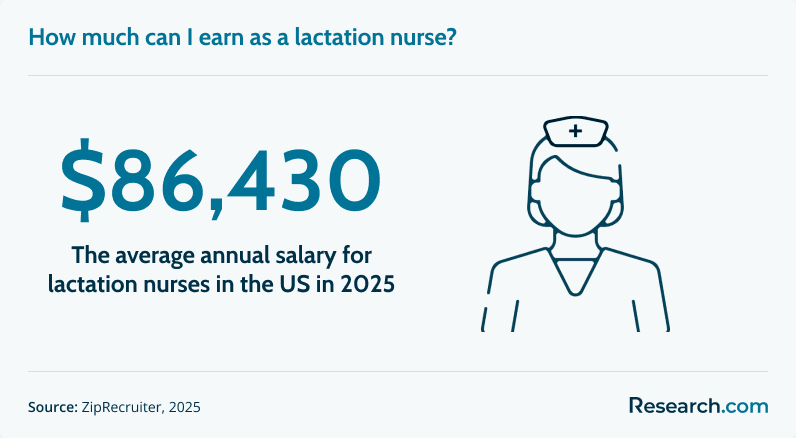
Lactation consultant nurse average salary 2025 data shows a median annual wage of $86,430. Entry-level positions start around $61,000 per year, while experienced senior nurses can earn up to $103,000 annually. These figures show meaningful earning potential, but they should not be treated as guaranteed outcomes for every worker or region.
Pay depends heavily on employer type, geographic market, union or nonunion setting, shift requirements, nursing degree, certification, years of experience, and whether the role includes leadership or program management. Nurses in California or large metropolitan areas often earn more because of demand and cost of living. Hospital-based roles may also differ from outpatient, community health, private practice, or home-visit consulting work.
Factors that can improve earning potential
- IBCLC certification: Specialized credentialing can make candidates more competitive for dedicated lactation roles.
- BSN preparation: Some employers prefer or reward bachelor-prepared nurses, especially in hospital systems.
- Maternal-child specialty experience: Labor and delivery, postpartum, NICU, pediatrics, and public health experience can strengthen salary negotiations.
- Leadership responsibilities: Lead consultant, program coordinator, educator, manager, or director roles may pay more than entry-level direct care positions.
- High-demand locations: Large metropolitan areas and states with higher healthcare wages can offer stronger compensation, though living costs may also be higher.
When evaluating salary, compare total compensation rather than wages alone. Benefits, paid leave, shift differentials, retirement contributions, continuing education support, malpractice coverage, and schedule flexibility can change the real value of an offer.
What is the job outlook for Lactation Consultant Nurses?
The demand for lactation consultant nurses is tied to the broader registered nurse labor market and to the ongoing need for perinatal, newborn, and breastfeeding support. The registered nurse growth rate is projected at 16% from 2014 to 2024, which is much faster than average. More recent data for healthcare practitioners suggest a 6% growth from 2021 to 2031, about average.
This is a stable specialty, but job availability can vary by region and employer. Large hospitals, maternity centers, NICUs, pediatric practices, public health agencies, and outpatient women’s health programs may have different staffing models and budget priorities. Some organizations hire dedicated lactation consultants, while others expect postpartum or neonatal nurses to hold lactation training as part of a broader role.
The key factors shaping the future outlook
- Hospital maternal-infant initiatives: Facilities that prioritize breastfeeding support, patient education, and postpartum follow-up may create more lactation-specific roles.
- Public health priorities: Programs focused on maternal and infant health can increase demand for community-based lactation support.
- Access and equity concerns: Employers may seek professionals who can serve diverse families, address language and cultural barriers, and support underserved communities.
- Staffing and reimbursement models: Budget decisions, insurance coverage, and care delivery models can influence whether lactation support is a dedicated position or part of another nursing role.
- Telehealth limits and opportunities: Virtual visits can help with education and follow-up, but many feeding assessments still require in-person observation and hands-on support.
Prospective lactation consultant nurses should research local demand before choosing a training route. Review job postings in your target area, note whether employers ask for RN licensure, BSN preparation, IBCLC certification, or prior maternity experience, and compare those requirements with your current background. If affordability is a concern, exploring online colleges that accept financial aid may help make prerequisite education more manageable.
What is the typical work environment for Lactation Consultant Nurses?
Lactation consultant nurses usually work where newborn and postpartum care happens: hospitals, birthing centers, pediatric practices, OB-GYN offices, outpatient lactation clinics, public health programs, and private practices. Most professionals in this field are employed in hospitals (55%), ambulatory healthcare services (25%), and private practices or birthing centers (20%). Some also provide home visits or limited remote consultations.
The work environment is patient-facing and often fast-moving. In a hospital, a lactation consultant nurse may visit multiple postpartum rooms, respond to NICU feeding concerns, join rounds, prepare discharge plans, and document care throughout the shift. In an outpatient clinic, appointments may be longer and more structured, with time to assess feeding, weigh the infant, review pumping routines, and create a follow-up plan. In private practice, the nurse may have more schedule control but also more responsibility for business operations, referrals, billing, and client communication.
Schedule expectations
The lactation consultant nurse work schedule depends on the setting. Hospitals may require rotating shifts, weekends, holidays, or on-call coverage because births and newborn feeding concerns do not follow a standard office schedule. Private practice, community health, and outpatient roles may offer more predictable hours, though evening or weekend appointments can still be common for working families.
Remote consultations can be useful for education, pumping questions, prenatal preparation, and follow-up discussions. However, many issues-such as latch, milk transfer, infant positioning, and feeding endurance-are best assessed in person. Anyone considering the field should be comfortable with close patient interaction, frequent teaching, emotional conversations, and collaboration with multiple healthcare professionals.
What are the pros and cons of Lactation Consultant Nurse careers?
Lactation consultant nurse careers can be deeply satisfying, but they are not easy. The work combines intimate patient education with clinical responsibility, emotional labor, and sometimes limited staffing or resources. A realistic view of both sides can help you decide whether this specialty fits your temperament and career goals.
Pros
- Meaningful patient impact: You help families through feeding challenges that can affect infant growth, parental confidence, bonding, and postpartum recovery.
- Specialized expertise: Lactation consulting allows nurses to build a focused clinical identity within maternal-child health.
- Strong teaching component: The role is ideal for nurses who enjoy explaining, coaching, demonstrating, and adjusting plans based on patient needs.
- Varied practice settings: Opportunities may exist in hospitals, clinics, public health, private practice, home visits, and education.
- Potential for advancement: Experience can lead to lead consultant, educator, program coordinator, manager, or director roles.
Cons
- Emotionally intense situations: Parents may be exhausted, in pain, worried about infant intake, or grieving a feeding experience that is not going as planned.
- Clinical complexity: Prematurity, oral-motor challenges, weight gain concerns, maternal health issues, and conflicting advice can make care planning difficult.
- Workplace constraints: Some settings may lack private consultation space, adequate visit time, or enough lactation staff to meet demand.
- Schedule demands: Hospital roles can include evenings, weekends, holidays, or unpredictable consult volume.
- Need for ongoing education: Maintaining competence requires continued learning in lactation science, equipment, policies, and patient counseling.
This career is a strong fit for nurses who value teaching, patience, evidence-based care, and emotional resilience. It may be less satisfying for those who prefer brief patient interactions, low-emotion settings, or predictable routines. If you want broader healthcare options alongside lactation work, researching dual major programs may help you compare complementary academic pathways.
What are the opportunities for advancement for Lactation Consultant Nurses?
Lactation consultant nurses can advance by taking on more complex patients, leading programs, training staff, moving into management, or building a specialized practice. Advancement is usually strongest for nurses who combine clinical credibility, certification, documentation skill, communication ability, and leadership.
Career advancement opportunities
- Entry-level lactation consultant nurse: Provides direct breastfeeding support in hospitals, clinics, or community settings while building experience with routine and moderately complex cases.
- Senior lactation consultant: Handles more complex referrals, mentors newer staff, helps improve protocols, and supports quality initiatives.
- Lead lactation consultant: Coordinates scheduling, education, policy updates, program metrics, and interdisciplinary communication.
- Lactation program manager or director: Oversees staffing, training, budgets, patient education programs, quality improvement, and organizational lactation strategy.
- Clinical educator: Teaches nurses, residents, midwives, doulas, students, or parent groups about lactation and infant feeding support.
- Private practice owner: Provides consultations, home visits, prenatal education, postpartum follow-up, and community-based services, often with greater autonomy and business responsibility.
Specialization options for lactation consultants
- Neonatal and pediatric lactation support: Focuses on premature infants, NICU feeding, medically fragile babies, and complex infant feeding concerns.
- Perinatal mental health and lactation: Supports families when anxiety, depression, trauma, grief, or feeding pressure affects postpartum well-being.
- Education and professional development: Designs training for healthcare providers, lactation teams, prenatal classes, and community programs.
- Private practice or community-based consulting: Offers individualized support through home visits, outpatient consults, advocacy, and outreach to underserved populations.
- Policy and quality improvement: Works on hospital protocols, breastfeeding-friendly initiatives, discharge planning, referral systems, and patient education standards.
The best advancement path depends on whether you want deeper clinical specialization, more leadership responsibility, greater schedule independence, or a move into education and program design.
What other careers should you consider?
If you are interested in lactation consultant nursing but unsure whether it is the right fit, compare it with related careers in maternal-child health, patient education, infant feeding, and care coordination. These options use overlapping skills but differ in training requirements, patient population, and day-to-day work.
- Registered nurse case manager: Coordinates care, referrals, services, and follow-up for patients with complex needs. This can suit nurses who enjoy advocacy, planning, and interdisciplinary communication.
- School nurse: Provides health assessment, education, medication support, and care coordination for children and adolescents in school settings.
- Childbirth educator: Teaches expectant and new parents about pregnancy, birth, postpartum recovery, newborn care, and feeding preparation, often outside the direct clinical nursing model.
- Speech-language pathologist: Works with communication and swallowing disorders, including infant feeding and oral-motor challenges. This path requires a different educational and licensure route.
- Registered dietitian: Provides nutrition assessment and counseling for infants, children, parents, and families, with a stronger focus on dietary science and medical nutrition therapy.
To choose among these paths, look at three questions: Do you want to remain in nursing? Do you prefer direct clinical care, education, therapy, or nutrition counseling? Are you willing to complete the required degree, licensure, and supervised experience for that profession? The right option should match both your interest in family health and the practical training route you are prepared to complete.
Here's What Professionals Say About Their Lactation Consultant Nurse Careers
- Janice: "Supporting families while they navigate breastfeeding is some of the most meaningful work I do. I love teaching mothers about proper latch techniques and helping them feel confident in their ability to nourish their infants. From prenatal consultations to ongoing support as long as they breastfeed, being there through every step is incredibly fulfilling. Seeing babies thrive because of my guidance reminds me why I chose this career."
- Raul: "One of the hardest parts of my role is helping mothers who are really struggling, especially in those first few weeks. I remember spending hours showing a new mom how the side-lying position could relieve pain and make nursing more comfortable for her and her baby. Staying accessible for follow-ups and answering questions weeks later has been essential in turning those difficult moments into progress. It's a demanding job emotionally and technically, but those breakthroughs make it worth every challenge."
- Melody: "I've witnessed so many transformations, like a premature baby who was underweight at birth and is now thriving on breast milk, all because of persistent support and tailored care. Helping mothers regain their confidence after setbacks is deeply rewarding. I often hear from clients that after our time together, they feel empowered and capable of breastfeeding successfully. Those moments affirm that patience and individualized attention truly make a difference."
Key Findings
- Lactation consultant nurses specialize in breastfeeding and chestfeeding support, combining RN-level clinical judgment with lactation-specific education and counseling.
- A common pathway includes an ADN or BSN, RN licensure through the NCLEX-RN, maternal-child healthcare experience, lactation coursework, supervised clinical hours, and credentialing such as the IBCLC.
- Supervised clinical lactation experience may range from 300 to 1,000 hours, with supervision by a current IBCLC.
- Lactation consultant nurse average salary 2025 data shows a median annual wage of $86,430, with entry-level positions around $61,000 per year and senior nurses earning up to $103,000 annually.
- Most professionals in this field work in hospitals (55%), ambulatory healthcare services (25%), and private practices or birthing centers (20%).
- The career can be highly rewarding for nurses who enjoy teaching, maternal-child health, and emotionally supportive care, but it can also involve complex cases, schedule demands, and high patient stress.
- Advancement opportunities include senior consultant, lead consultant, educator, program manager, director, private practice owner, and specialist roles in NICU, pediatrics, community health, or perinatal mental health.
Other Things You Should Know About Lactation Consultant Nurse
The International Board Certified Lactation Consultant exam is the main credential test for lactation consultants. In 2027, candidates must meet Lactation Education Accreditation and Approval Review Committee pathway requirements, complete the required clinical hours, and pass the IBCLC examination administered by the International Board of Lactation Consultant Examiners.
In 2027, lactation consultant nurses can obtain certifications through the International Board of Lactation Consultant Examiners (IBLCE), which offers the International Board Certified Lactation Consultant (IBCLC) credential. Eligibility requires completing coursework and accumulating 90 hours of lactation-specific education.
In 2027, lactation consultant nurses must complete 75 continuing education contact hours every five years to maintain IBCLC certification. This ensures they stay updated on the latest lactation practices and advancements approved by the International Board of Lactation Consultant Examiners.
References
- 15 Jobs That Nurses Can Work Away From The Bedside - NurseJournal.org https://nursejournal.org/careers/non-bedside-jobs-for-nurses/
- Lactation Frequently Asked Questions - OHSU-PSU School of Public Health https://ohsu-psu-sph.org/lactation/faq/
- Top 35 Non-Bedside Nursing Jobs 2025 https://nurse.org/articles/nursing-careers-beyond-the-bedside/
- Why I Became a Lactation Consultant https://www.lactationtraining.com/resources/blog/entry/why-i-became-a-lactation-consultant
- Lactation Consultant Job Description (Updated 2023 With Examples) | NASWDC https://metrodcjobs.socialworkers.org/career/lactation-consultant/job-descriptions
- Testimonials — Lactation Consultant https://lisabinderow.com/testimonials-1
- Lactation Consultant - Family Birth Center at Mayo Clinic https://jobs.mayoclinic.org/job/rochester/lactation-consultant-family-birth-center/33647/87036519680
- 11 Alternative Nursing Careers Using Your Clinical Skills https://steppingstonenurseacademy.com/2025/04/01/alternative-nursing-careers/
- Lactation Consultant https://nursing.jnj.com/specialty/lactation-consultant


