Is an Online MBA in Healthcare Management Worth It for Public Sector Professionals?

Co-Founder and Chief Data Scientist
Moving from healthcare program delivery into management can require stronger budgeting, operations, and leadership skills, but another degree is a substantial investment.
For professionals in health departments, public hospitals, Medicaid agencies, and other government settings, an online MBA in Healthcare Management may help, provided its curriculum fits public-sector work and its cost fits a realistic career path. This guide weighs the MBA against more targeted options and shows how to assess programs, employer support, and likely returns before enrolling.
Key Things You Should Know
- An online healthcare management MBA is most compelling when a public-sector professional needs broad management skills for an identifiable role, not simply another credential for a promotion that may depend on civil-service rules.
- Employer funding, total program cost, and access to relevant projects matter more to the financial case than broad MBA salary claims; public-sector pay may be tied to established grades or classifications.
- The U.S. median annual wage for management occupations was $126,520 in May 2025, according to the Bureau of Labor Statistics, but that figure covers many occupations and is not an expected salary for healthcare MBA graduates.
What is an online MBA in Healthcare Management?
An online MBA in Healthcare Management combines a general business degree with healthcare-focused study. The MBA core usually develops management skills in areas such as finance, operations, strategy, and organizational leadership.
Healthcare coursework applies some of those skills to organizations shaped by patient needs, regulation, reimbursement, and complex stakeholder relationships.
Schools use different labels and structures. Healthcare management may be a formal concentration, a set of electives, or simply a theme in a general MBA.
Before applying, check the degree requirements and transcript designation rather than assuming the program title describes a formally recognized concentration. The degree prepares students for organizational decisions; it does not provide clinical training or confer a healthcare license.
Is an online healthcare management MBA worth it for public-sector professionals?
It can be worth it when the degree addresses a specific management gap and supports a plausible next role at a manageable net cost. A program administrator moving toward responsibility for budgets, contracts, or cross-agency operations may use the MBA immediately.
Its value is less certain when promotion depends primarily on a job classification, required years of service, or a credential the MBA does not replace.
Public-sector return on investment needs a narrower test than a projected private-sector salary increase. Compare the full amount you would pay after employer assistance with likely changes in your actual agency pay grade, opportunities to compete for other roles, and benefits you value but cannot easily price, such as better stewardship of public funds.
If repayment is necessary, include borrowing costs and the time spent studying. Cost-effective MBA choices can provide a starting point, but compare current total costs and healthcare coursework before drawing conclusions.
The best alternative depends on the work you want to do. This comparison separates broad management preparation from more specialized public-service training:
| Education option | Stronger fit when your goal is... | Key limitation to check |
| Healthcare management MBA | Leading operations, budgets, or teams across healthcare organizations | Healthcare electives may offer limited coverage of government governance and procurement |
| Master of Public Administration | Advancing in government management, public budgeting, or interagency administration | May provide less healthcare-specific operating or business content |
| Master of Public Health | Deepening population-health, policy, or public-health program expertise | May be less focused on general organizational management |
| Master of Healthcare Administration | Developing specialized healthcare administration skills | May be less portable to management roles outside healthcare |
| Targeted courses or employer training | Closing a defined skill gap without pursuing another full degree | May not satisfy a position's graduate-degree preference |
Before enrolling, review several actual job postings and your agency's classification rules. If the roles you want value an MBA, the coursework fills a genuine gap, and employer support limits your financial exposure, the case is stronger. If a targeted course would solve the immediate problem, or a public-administration credential better matches the hiring rules, choose accordingly.
What careers can public-sector professionals pursue with this MBA?
Likely paths depend first on what you already do. A health department employee with program and supervisory experience might pursue a division operations or program management role. A public-hospital employee might move toward service-line operations, finance, or quality administration.
Experience with Medicaid programs or contracts may support work in payer operations, vendor management, or healthcare consulting, although moving outside government requires learning new employer expectations.
In these roles, managers may allocate resources, oversee teams and contracts, assess performance, and explain decisions to executives, elected officials, or the public.
An MBA can strengthen those capabilities, but it does not substitute for required subject-matter experience or grant authority to manage staff. Government hiring may also depend on competitive examinations, grade requirements, or specific job qualifications.
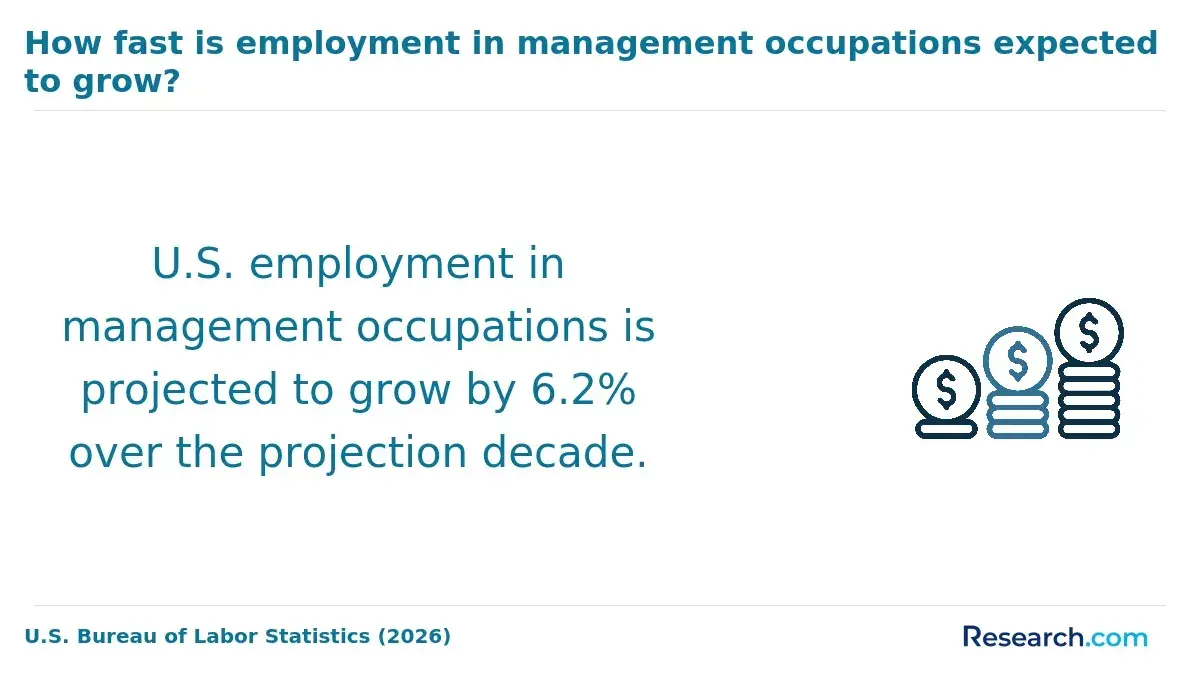
The Bureau of Labor Statistics projects about 1.1 million openings annually across all U.S. management occupations from 2025 to 2035, including openings created when workers leave occupations.
This broad figure signals management demand, not the number of openings in public healthcare or a forecast of jobs available to MBA graduates. Professionals considering a clinical-management route can also examine online MBA career paths discussed for nurses, while recognizing that nursing roles have separate clinical qualifications.
An online program may allow a full-time public employee to remain in their role and apply assignments to current operational problems. A campus-based program may make in-person relationships, employer visits, and certain experiential activities easier to access.
Neither format is inherently more rigorous or more useful for advancement; the relevant differences are the actual course schedule, projects, and support available to enrolled students.
"Online" does not necessarily mean self-paced. Ask whether courses require live evening sessions, fixed group meetings, proctored exams, or campus visits.
Also ask whether online students can use career services and healthcare employer connections on the same terms as campus students. For a professional facing legislative deadlines, emergency response, or budget-cycle peaks, a workable course sequence may matter more than the delivery label.
The general MBA core teaches students to interpret financial information, plan operations, make strategic decisions, and lead people. Healthcare-focused courses may apply those tools to care delivery, payment systems, quality, or healthcare policy. Content varies substantially, so inspect required courses and recent syllabi rather than relying on the concentration name.
For a public-sector professional, the most useful learning connects business methods to accountability constraints. A financial analysis might need to account for appropriations and restricted funding, not just margin.
An operations proposal might need to respect procurement rules, access obligations, and public reporting. Applied projects are especially valuable when the school permits work on a real agency problem without exposing confidential patient or government information.
Check what the curriculum does not cover. A private-hospital strategy elective may be useful, but it is not a substitute for training in public budgeting or health policy if those are the capabilities your next role requires.
Requirements vary by school. Applicants commonly need a bachelor's degree and may be asked for transcripts, a résumé, a statement of purpose, and recommendations.
Schools differ on work-experience expectations, GMAT or GRE policies, interviews, and prerequisite or foundation coursework. A nonbusiness degree does not automatically rule out admission, though an applicant may benefit from refreshing accounting or quantitative skills.
Public-sector applicants can make their experience legible to admissions teams by describing the scope of programs, budgets, contracts, teams, or stakeholder decisions they have handled, not just listing an agency title.
If you are earlier in your career, compare online MBA programs without work experience requirements, then confirm each school's current policy and whether its courses suit your level of responsibility.
Completion time depends on required credits, course sequencing, transfer-credit policies, and whether you study part time or at an accelerated pace. Published tuition may be quoted per credit, per term, or for the whole program; those figures are not interchangeable.
Request a current estimate that includes mandatory fees, materials, any required travel, and the cost of additional terms if your schedule changes.
For a meaningful affordability comparison, calculate your expected out-of-pocket cost after confirmed employer assistance, then consider interest if you will borrow. Government and public-hospital education benefits may come with course-approval rules, grade requirements, service commitments, or reimbursement paid only after a term ends.
Ask your benefits office about those conditions before treating assistance as available cash. Geographic searches can help identify options - for example, you can compare affordable MBA schools in North Carolina - but verify online availability and the total price for your enrollment status directly with each school.
There is no single reliable salary for graduates of this concentration. The Bureau of Labor Statistics reports a U.S. median annual wage of $126,520 for management occupations in May 2025, compared with $50,980 across all occupations.
That comparison describes broad occupational groups, not MBA graduates, healthcare managers specifically, or the pay increase caused by a degree.
For a public-sector decision, the better evidence is the published pay range for positions you could realistically obtain, along with your agency's promotion and classification policies.
Compare that range with your current compensation and account for location, experience, and whether you would need to change employers. A higher-paying private-sector position is a possible path, not an automatic post-MBA outcome.
First, confirm that the institution holds recognized institutional accreditation; this is distinct from accreditation of its business school. Business-school accreditors include AACSB, ACBSP, and IACBE, whose standards and coverage differ.
An online MBA accreditation comparison can help you investigate one business-school accreditation route, but verify a school's current status with the accreditor.
Do not assume that an MBA's business-school accreditation means its healthcare concentration has separate healthcare-administration accreditation. If a future employer specifically requests a particular program credential, check that requirement against the exact online program before applying.
Do healthcare management MBA graduates need licenses or certifications?
Most general healthcare administration roles do not have an MBA-specific license. Requirements attach to particular occupations, however: clinical roles retain their professional licensing rules, and certain regulated administrator positions have separate state requirements. An MBA does not replace any of those qualifications.
Optional certifications in areas such as project management, quality, or healthcare administration may complement experience, but eligibility and employer value differ. Check postings for your target role before paying for a certification or assuming MBA coursework meets its examination or experience requirements.
Other Things You Should Know About MBA
Possibly. Aid depends on the school's participation, the program's eligibility, and your personal circumstances - not simply whether classes are online. Ask the financial aid office and complete the required aid application to learn what you qualify for.
Often, if the instructor approves it and your employer permits the use of the information. Obtain approval before sharing internal data, and follow privacy, records, and security rules.
That depends on the school's leave, withdrawal, and course-sequencing policies. Ask how a break affects tuition, financial aid, and your return date before you enroll.
Not automatically. A school may evaluate eligible prior graduate coursework or other learning under its own policies, but workplace training certificates alone should not be assumed to reduce degree requirements.
- Public Service Loan Forgiveness | studentaid.gov https://studentaid.gov/manage-loans/forgiveness-cancellation/public-service
- 1101 Classification and Compensation | ga.gov https://pamms.dhs.ga.gov/ohr/1101/
- Understanding Your Eligibility | Health.gov https://health.gov/careers/understanding-your-eligibility
- Developing a management and finance training for future public health leaders - PMC https://pmc.ncbi.nlm.nih.gov/articles/PMC10213770/
- General Schedule Qualification Policies | U.S. Office of Personnel Management https://www.opm.gov/policy-data-oversight/classification-qualifications/general-schedule-qualification-policies/
- MHA vs MBA: How to Choose a Healthcare Leadership Degree | Boston College https://onlinemha.bc.edu/mha-vs-mba-healthcare-leadership-degrees/
- Full-Time or Part-Time Study: Which is Right for You? | jhu.edu https://ep.jhu.edu/news/full-time-or-part-time-study-which-is-right-for-you/
- 18 Careers You Can Pursue with an MBA (Aside from Business) | umn.edu https://online.umn.edu/story/18-careers-you-can-pursue-mba-aside-business
- Invest in Your Future Online MBA in Healthcare Management | uttyler https://online.uttyler.edu/degrees/business/mba/healthcare-management/invest-in-your-future-online-mba-in-healthcare-management/
- MBA vs MHA vs MPA: Choosing the right master's degree | USC Price https://priceschool.usc.edu/price-blog/mba-vs-mha-vs-mpa-choosing-the-right-masters-degree/