Careers after an online MBA in Artificial Intelligence for Business for first-time managers

Co-Founder and Chief Data Scientist
Your first management role may require you to evaluate AI projects before you have experience leading a team or owning a budget. An online MBA in artificial intelligence for business can help bridge that gap, but it will not turn every graduate into an AI engineer or secure a promotion. This guide explains the roles a first-time manager can realistically pursue, the skills and experience employers may expect, and the salary and job-market evidence worth considering before you enroll.
Key Things You Should Know
- The strongest near-term paths are usually adjacent to your current function: leading an AI-assisted operations, marketing, product, or analytics team is more plausible than moving directly into senior AI leadership.
- The U.S. Bureau of Labor Statistics (BLS) reports a $126,520 median annual wage for management occupations in May 2025, but that figure covers workers across management roles and experience levels - not AI-focused MBA graduates.
- BLS projects about 1.1 million management-occupation openings annually, on average, from 2025 to 2035; an MBA may help you compete for relevant roles, but employers will still assess your record of delivering results and managing people.
What careers can you pursue after an online MBA in artificial intelligence for business?
For a first-time manager, an AI-focused MBA is most useful as a bridge from using AI tools to deciding where they belong in a business process, who is accountable for the results, and how a team will adopt them. Career paths often begin in the function you already know: an operations specialist might supervise workflow improvements, while a marketing professional might lead responsible use of AI in campaign planning.
From there, experience can support progression into broader product, operations, strategy, or transformation management. That progression is not automatic. Employers hiring a director of AI or an enterprise AI leader generally expect substantial leadership, implementation, and domain experience beyond an MBA.
Industry knowledge matters as much as the technology label. A manager pursuing sustainability work, for example, should compare whether AI coursework or an online MBA in sustainability better supports the business problems they want to own. A concentration should follow the target role, not merely a popular technology.
How does an online MBA in artificial intelligence prepare first-time managers?
An AI-focused MBA combines general management education with the business application of AI. For a new manager, the valuable shift is learning to make decisions through other people: setting priorities, explaining trade-offs, resolving conflict, allocating resources, and evaluating whether a proposed tool improves an outcome.
Consider a customer-service supervisor asked to introduce an AI assistant. Technical staff may build or configure it, but the supervisor must define success, involve frontline employees, plan training, identify errors that require human review, and report results. A relevant MBA project can provide practice with those decisions. It cannot replace the experience of being accountable for a team, so seek opportunities at work to lead a pilot, coach colleagues, or manage a small budget while studying.
What jobs can first-time managers get with an AI-focused MBA?
Job titles vary widely, and many employers do not include "AI" in the title of a role that uses it. The comparison below separates accessible next steps from roles that typically demand deeper experience.
| Potential role | Typical management responsibility | What may matter beyond the MBA |
| Operations supervisor or manager | Improve workflows and oversee employees using AI-enabled systems | Operational results, process knowledge, and people leadership |
| Marketing or customer-experience manager | Guide campaigns or service improvements using AI-supported insights | Functional experience, measurement skills, and customer judgment |
| Product manager for an AI-enabled offering | Prioritize customer needs, features, risks, and cross-functional work | Product experience and close collaboration with technical teams |
| AI transformation or program manager | Coordinate adoption across teams and track business outcomes | A demonstrated record of delivering change across stakeholders |
The first two paths are often the most direct for someone promoted from an individual-contributor role. Product and transformation positions can be attainable, but their scope differs by employer; read the requirements rather than assuming the MBA qualifies you for every posting. In a health system, for instance, operational leadership also calls for knowledge of care delivery and regulation. Compare that need with MBA programs for healthcare administration before choosing an AI emphasis.
There is no universal curriculum for an online MBA in artificial intelligence for business. Most MBAs provide a management core - such as accounting, finance, operations, strategy, and organizational behavior - while AI study may be a formal concentration, a smaller elective group, or a few courses. Check the credential and transcript language if the distinction matters to you.
Relevant AI coursework may examine business use cases, data-informed decisions, implementation, ethics, privacy, and governance. A capstone or applied project can be especially useful when it asks you to build a business case, assess risks, and plan employee adoption. Review actual course descriptions and project requirements: a managerial AI course is not necessarily training in programming or advanced machine learning. If your goal is to build models professionally, a technical degree or focused technical coursework may be more direct.
Admission rules differ by school. Online MBA applications commonly ask for a bachelor's degree, academic records, a résumé, and written statements; recommendations, interviews, work-experience expectations, and GMAT or GRE policies vary. An AI emphasis does not, by itself, establish a requirement for a computer science degree or coding experience.
As a first-time manager, use your application to show how you have influenced decisions, trained colleagues, managed a project, or addressed a business problem - even if you have not held a management title. If your experience or academic record does not match a school's usual profile, compare online MBA programs with accessible admissions, then confirm each program's current requirements directly. Accessible admission should not be mistaken for suitable AI coursework or career support.
Completion time and cost depend on the school's required credits, course sequence, enrollment pace, and tuition model. Part-time study can let a new manager apply lessons at work, while a faster schedule may limit time for team responsibilities. Online delivery does not necessarily eliminate live classes, group meetings, or campus visits; compare those requirements with your work calendar. MBA programs with flexible schedules can be a starting point, but verify the scheduling rules for the specific AI coursework you want.
For a usable cost comparison, request the required credit total and price per credit or published program tuition, then add mandatory fees, materials, any travel, and borrowing costs. Ask whether employer tuition assistance applies and what repayment conditions it carries. Without a specific school and enrollment plan, there is no reliable single price or completion date for this type of MBA.
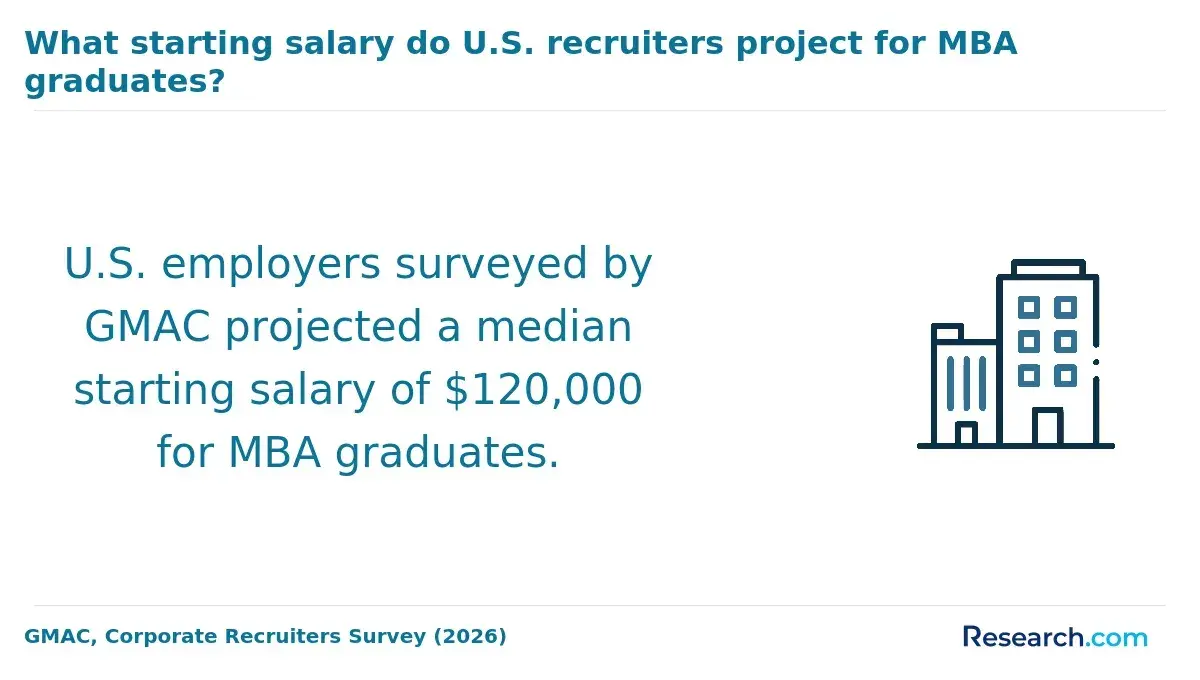
There is no defensible single salary for graduates of an online AI-focused MBA. Pay depends on occupation, location, employer, scope of responsibility, and prior experience. BLS reports that the median annual wage across U.S. management occupations was $126,520 in May 2025. That is a benchmark for a broad workforce, not a starting salary or an estimate of the MBA's effect on earnings.
For a first-time manager, a more useful comparison is local compensation for the specific role you could obtain with your existing experience versus the role you reasonably expect after study. Include your current pay, likely promotion timing, and total education cost. Treat a large salary increase as a possibility to substantiate with relevant job postings and employer conversations - not as a reason to enroll on its own.
BLS projects overall employment in management occupations to grow faster than the average for all occupations from 2025 to 2035, with about 1.1 million openings per year, on average, from growth and workers leaving those occupations permanently. That signals a broad market for managers; it does not measure demand specifically for AI-focused MBAs or show how many openings suit first-time managers.
AI-related responsibilities may also be added to existing management jobs rather than advertised as distinct AI positions. Search both ways: examine postings in your function for requirements involving process improvement, analytics, automation, change management, and team leadership. Compare those requirements with the skills you can demonstrate, not just the terminology in your degree title.
An MBA in artificial intelligence for business does not itself require a professional license, and the degree is not a license to practice a regulated profession. Employers may value optional credentials in project management, analytics, cloud platforms, or particular tools, but a certificate is not interchangeable with experience leading an implementation.
Choose additional training only after identifying a target role's requirements. If postings emphasize technical model development, build technical skills rather than assuming MBA electives will suffice. If they emphasize supervising people and coordinating change, evidence of coaching, budgeting, and project delivery may matter more than another badge.
How can you choose an accredited online MBA in artificial intelligence for business?
First, verify that the university holds recognized institutional accreditation. Then check whether the business school holds specialized accreditation, if that matters to you; the two are different, and neither confirms that an AI concentration is offered online. Ask for the current curriculum and determine whether "AI for business" is a named concentration, an elective option, or marketing language.
Next, assess fit for your first management move: look for coursework in leadership and AI governance, applied projects with business decisions, scheduling you can sustain, and career services accessible to online students. Ask how students work with peers and employers rather than assuming an online MBA has the same recruiting opportunities as a full-time campus program.
Finally, compare the complete cost against the specific advancement opportunity you expect. An online MBA financial planning comparison can help you build a shortlist, but confirm each school's current tuition and fees. The MBA is most compelling when you need both broad management development and AI adoption skills, can apply them at work, and can justify the cost. If you mainly need one technical skill or a first chance to supervise, a targeted course and an employer-backed stretch assignment may be the better first step.
Other Things You Should Know About MBA
Employers may focus on the institution, curriculum, your experience, and what you accomplished while enrolled. Ask prospective employers or alumni in your field how they assess the programs you are considering.
A concise case study of a pilot can show the business problem, your role, stakeholder input, success measures, risks, and results. Be careful not to disclose confidential employer data.
Yes. Leading a cross-functional project, coaching colleagues, or coordinating a rollout can demonstrate influence and judgment. Describe your actual authority clearly rather than presenting project leadership as formal supervision.
Not necessarily. Enrolling earlier can make sense if your employer offers relevant projects and education support. If you have no path to apply management skills, gaining that experience first may make the MBA more valuable.
- Career Paths and Typical Duties for Jobs With an MBA | UNC Kenan-Flagler's Business School's Online MBA https://onlinemba.unc.edu/news/jobs-with-an-mba/
- Which Management Jobs Are at Risk from AI? - Stevens Online https://online.stevens.edu/blog/which-management-jobs-at-risk-ai/
- Skills or degree? The rise of skill-based hiring for AI and green jobs - ScienceDirect https://www.sciencedirect.com/science/article/pii/S0040162525000733
- AI Career Paths: Emerging Jobs in the Artificial Intelligence Space | The Pennsylvania Institute of Technology https://www.pit.edu/news/ai-career-paths-emerging-jobs-in-the-artificial-intelligence-space/
- Practical AI implementation: Success stories from MIT Sloan Management Review | MIT Sloan https://mitsloan.mit.edu/ideas-made-to-matter/practical-ai-implementation-success-stories-mit-sloan-management-review
- Careers in AI: Explore the jobs you can get with an AI MBA | D'Amore-McKim School of Business https://damore-mckim.northeastern.edu/resources/cc-careers-in-ai-explore-the-jobs-you-can-get-with-an-ai-mba/
- MBA in Artificial Intelligence: Is It Worth It? | University of Southern Indiana https://online.usi.edu/degrees/business/mba/artificial-intelligence/is-an-mba-worth-it/
- The Future of Jobs Report 2025 | World Economic Forum https://www.weforum.org/publications/the-future-of-jobs-report-2025
- Navigating the AI Product Manager Job Market | Scrum Alliance https://resources.scrumalliance.org/Article/navigating-the-ai-product-manager-job-market
- AI Product Manager: Role, Skills & Hiring (May 2026) | Paraform https://www.paraform.com/insights/what-is-ai-product-manager