2027 Is an Online Ed.D. in Leadership and Learning in Organizations a Good Fit for Continuing Education Directors?
Audited and Verified:
Our Editorial and Data Verification Process
Research.com uses government datasets, official education statistics and primary institutional information to support its career and degree guides. Our review process checks factual accuracy, occupational definitions, source dates and the requirements associated with the credentials discussed.
How This Article Was Fact-Checked
Our editorial team verifies salary estimates, employment projections, education requirements and program information against original data providers and official organizations. Salary figures are checked against the relevant occupational definitions and reporting periods. Information about licensure, accreditation and required in-person training is reviewed separately.
Fact-checked and verified on:

Co-Founder and Chief Data Scientist
Continuing education directors already lead programs for adult learners. An online Ed.D. in Leadership and Learning in Organizations may help them tackle larger questions about program effectiveness, organizational change, and workforce partnerships - but it is a substantial investment, not a routine promotion requirement.
This guide helps directors assess whether doctoral study matches their responsibilities and goals, what to check before enrolling, and when a shorter or more specialized path would serve them better.
Key Things You Should Know
- An online leadership and learning Ed.D. is most useful when a director wants to lead institution-wide change or rigorously evaluate adult-learning programs - not simply qualify for a director title.
- The median annual salary for postsecondary education administrators was $104,590 in May 2025; that occupational figure is not an Ed.D. graduate salary.
- Compare the program's applied project, live attendance, total cost, and employer support before committing. Online delivery does not necessarily mean self-paced study.
Is an online Ed.D. in Leadership and Learning in Organizations right for continuing education directors?
It can be a good fit for a director whose next challenge is organizational, not just instructional. Continuing education directors may oversee noncredit courses, certificates, professional development, employer partnerships, budgets, and teams. A practice-oriented Ed.D. can help them investigate why programs succeed or stall and lead changes across departments. It will not, by itself, provide budget authority, secure a promotion, or replace experience managing partnerships and staff.
The deciding factor is the work you intend to do. This comparison separates problems that warrant sustained doctoral inquiry from those with more direct solutions.
| Director's goal | Likely fit | Reason |
| Lead a cross-institution effort to improve adult-learner access or program effectiveness | Potentially strong Ed.D. fit | Calls for change leadership, stakeholder coordination, and applied evaluation. |
| Improve enrollment reporting or learn a specific instructional technology | Targeted training may fit better | A defined technical gap rarely requires a doctorate. |
| Move into academic research as a primary career | Compare research-focused PhD programs | Research training, publication expectations, and faculty opportunities differ by program. |
A useful test is to identify a consequential decision you control or influence, the evidence needed to improve it, and colleagues willing to help implement findings. If your goal is broader university leadership, compare practice-focused Ed.D. study for higher education organizational work with programs centered on teaching, curriculum, or K-12 administration.
What careers can an Ed.D. in Leadership and Learning in Organizations prepare you for?
For an established continuing education director, the most plausible benefit is stronger preparation for expanded responsibility: leading a larger continuing or professional education division, coordinating workforce-development partnerships, directing organizational learning, or advising institutions on adult-learning strategy. These roles involve different hiring criteria. A university may prioritize enrollment and budget results; an employer's learning function may prioritize talent-development and performance experience.
Cross-sector moves are possible but not automatic. A director who has negotiated employer partnerships and evaluated training may have evidence relevant to workforce learning. Moving into organizational consulting, however, also requires credible client work and change-implementation skills. If that is the target, compare curricula and cost across affordable doctoral education in organizational leadership rather than assuming a higher-education-focused degree is the best match. Build a portfolio of authorized, clearly attributed work; a degree alone is not evidence that you led its outcomes.
How does an online Ed.D. compare with a campus-based doctoral program?
Online study can let a director remain employed and investigate problems in their own institution. Campus-based study may make regular in-person collaboration easier. Neither format establishes academic quality on its own: faculty guidance, research expectations, peer interaction, and the final project matter more.
Before choosing an online cohort, request its live-class schedule, attendance policy, group-work expectations, required campus visits, and project timeline. Compare those obligations with admissions and project requirements in campus programs, not just the convenience of commuting. A director responsible for evening courses may find mandatory evening doctoral meetings especially difficult. For a wider comparison of academic designs, see understanding different Ed.D. degree formats and focuses.
Relevant study may include adult learning, organizational change, leadership, program evaluation, and qualitative or quantitative inquiry. For a continuing education director, the value lies in connecting those subjects: an enrollment problem, for example, could involve scheduling, advising, employer demand, or course design. Training staff alone would not resolve every possible cause.
Examine required courses and the actual final-project rules rather than relying on a program name. Some doctorates culminate in a dissertation in practice or another applied project; others require a dissertation with different expectations. Education doctorates with applied final projects can be a comparison point, but confirm each school's deliverable, faculty oversight, and whether your proposed workplace setting is permitted. Using learner or employee data may also require institutional permission, privacy safeguards, and a determination about research oversight.
Requirements vary by institution. Programs may ask for a completed graduate degree, transcripts, recommendations, a statement of purpose, and evidence of relevant professional experience; some also specify grades, tests, or interviews. A continuing education director should document decisions made, teams and budgets managed, partnerships developed, and problems addressed - not rely on the job title alone.
Use the statement of purpose to describe a real leadership or learning challenge and why doctoral inquiry would help. Ask admissions staff whether your previous graduate study meets entry requirements and, separately, whether any credits can satisfy degree requirements. Eligibility for admission does not mean credits will transfer or shorten the program.
Both depend on the required credits, enrollment pace, tuition structure, and time needed to complete the final project. Without a specific school's published charges and policies, a reliable total or completion date cannot be given. Request a written estimate covering tuition, mandatory fees, technology, required travel and lodging, and the cost of continuing enrollment if the project takes longer than planned.
Compare that estimate with lower-tuition pathways to an education doctorate, but include time away from work and any employer reimbursement conditions. A lower advertised tuition rate may not be the lower-cost option if required travel or a longer schedule changes the total. Ask your employer whether support is approved, when it is paid, and whether changing jobs triggers repayment.
Verify that the university holds institutional accreditation recognized by the US Department of Education or the Council for Higher Education Accreditation, and confirm that the accreditation covers the institution awarding the doctorate. Then check the exact degree listed in the university catalog and any claims the program makes about specialized recognition. Institutional accreditation does not establish that a particular Ed.D. meets an employer's preference or a state's licensure rules.
There is no universal doctorate or professional license for the continuing education director title. Employers set qualifications for particular jobs, and duties within a role can matter: overseeing professional licensure courses, for instance, does not automatically require the director to hold every license for which learners are preparing.
Before enrolling to qualify for a specific position, read its current posting and ask the employer which credentials are required versus preferred. A leadership and learning Ed.D. should not be mistaken for a state-approved principal or superintendent preparation program. If a promotion primarily depends on financial management, partnership development, or operational results, mentorship and targeted development may offer a more direct route.
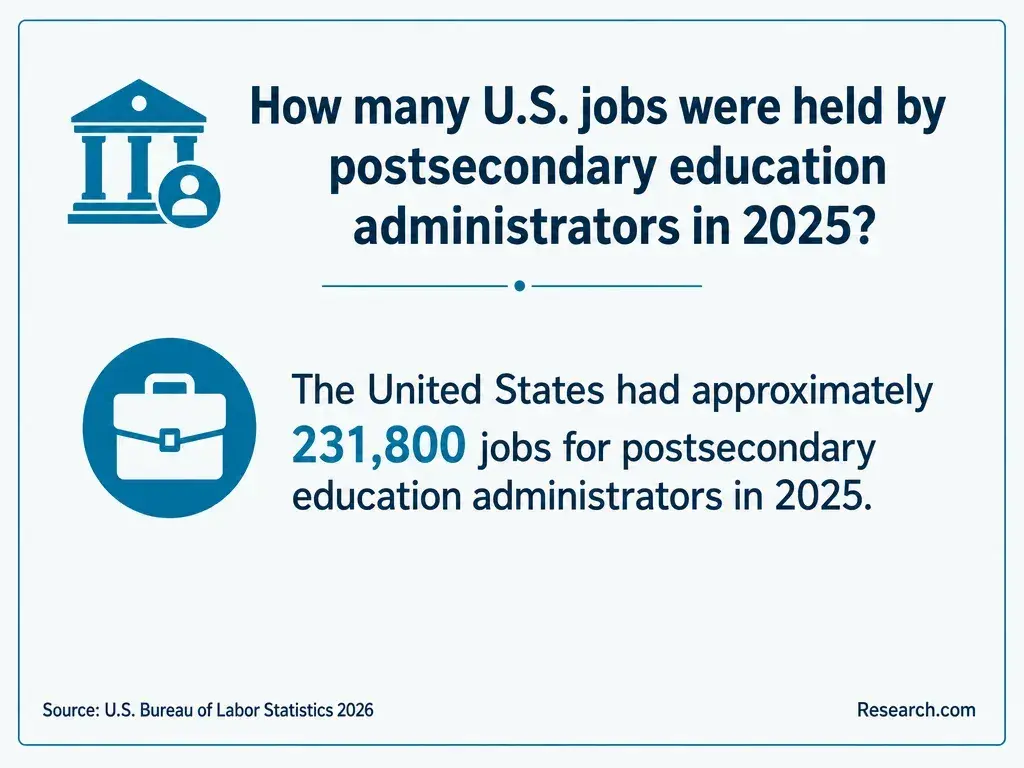
The US Bureau of Labor Statistics reported a $104,590 median annual salary for postsecondary education administrators in May 2025. That broad occupation can provide context for directors working in colleges and universities, but it does not isolate continuing education directors or measure the earnings of Ed.D. graduates. Pay for an individual role depends on the institution, location, scope of responsibility, and experience. Use comparable job postings and your employer's pay structure - not the occupational median alone - to assess a possible career move.
What is the job outlook for continuing education directors and postsecondary administrators?
The Bureau of Labor Statistics projects 1.8% employment growth for postsecondary education administrators from 2025 to 2035. The projection covers a broad occupation, not a separate continuing education director category, so it cannot predict openings in a particular institution or region. For directors considering advancement, the stronger signal is whether prospective employers need demonstrated results in adult-learner programs, partnerships, and organizational leadership - and whether an Ed.D. would strengthen evidence they do not already have.
Other Things You Should Know About EdD Leadership
No. A director's doctorate does not itself authorize an organization to issue continuing education units. Check the applicable provider standards and any rules imposed by the profession accepting the units.
Potentially. The key is whether the program approves the proposed question and whether the director can obtain appropriate access and permissions. Noncredit status alone does not determine project eligibility.
Often, but only within the university's and partner organization's rules. Obtain permission before sharing findings, and remove confidential learner, employee, and business information.
Not automatically. Institutions evaluate the discipline of the doctorate, graduate coursework, relevant expertise, teaching experience, and the particular course assignment.
- DAPIP | Homepage - Office of Postsecondary Education (OPE) https://ope.ed.gov/dapip/
- General Schedule Qualification Policies | U.S. Office of Personnel Management https://www.opm.gov/policy-data-oversight/classification-qualifications/general-schedule-qualification-policies/
- Business-Adult Education Partnerships Toolkit: Resources | U.S. Department of Education https://lincs.ed.gov/federal-initiatives/business-adult-education-toolkit/resources
- Types of Financial Aid: Grants, Work-Study, and Loans | studentaid.gov https://studentaid.gov/understand-aid/types
- Overview of K-12 Career Technical Education | California Legislative Analyst's Office https://lao.ca.gov/Publications/Report/5021
- Educational Leadership (Ed.D.) Admission Requirements | Kean University https://www.kean.edu/academics/college-education/educational-leadership-edd-admission-requirements
- Continuing Education and Workforce Development | Columbia-Greene Community College https://www.columbiagreene.edu/about/continuing-education/
- Online EdD - Higher Education | American International College https://online.aic.edu/programs/online-edd/higher-education
- EdD in Organizational Change and Leadership | USC Online https://online.usc.edu/programs/organizational-change-leadership/
- Effective Practices that Support Adult Learners | acenet.edu https://www.acenet.edu/Research-Insights/Pages/Student-Support/Effective-Practices-Adult-Learners.aspx