2027 Evaluating a Community Aging Initiative's Coordination Process: A DrPH Applied Project Planning Guide

Co-Founder and Chief Data Scientist
A community aging initiative may bring together health departments, Area Agencies on Aging, clinics, transportation providers, and nonprofits, yet still leave older adults navigating disconnected services. For an experienced practitioner considering a DrPH applied project, the challenge is to evaluate those handoffs without mistaking a busy referral network for effective coordination.
This guide shows how to define a manageable question, choose defensible measures, secure partner and data approvals, and produce findings organizations can use. It also helps you judge whether the project - and a DrPH program - fits your authority, schedule, and career goals.
Key Things You Should Know
- Evaluate a defined handoff, such as referrals from an aging-services intake team to transportation providers; do not label the entire initiative "coordinated" based on referral volume alone.
- Pair a process measure with a useful denominator and a partner- or older-adult-reported measure; a completed referral does not by itself establish that a needed service was received.
- Before collecting data, confirm three separate permissions: academic project approval, participating organizations' agreement, and authorization to access or share the proposed information.
What is a DrPH applied project for evaluating a community aging initiative?
A DrPH applied project is practice-focused doctoral work intended to help a decision-maker address a population-health or organizational problem. Here, the problem might be unclear referral ownership across organizations serving older adults. The project's purpose could be to identify where handoffs break down and recommend a workable shared follow-up process - not to prove, in advance, that partners are performing poorly.
Define the initiative, its service area, the organizations involved, and one decision the partners can actually make. A feasible output might be a jointly reviewed referral-process map, an evaluation brief, and a proposed protocol for closing the loop on referrals. Check the DrPH program's required project format and assessment criteria; an applied project is not interchangeable with a PhD dissertation or an MPH practicum.
A DrPH makes the most sense when the practitioner must lead cross-organization change and demonstrate advanced evaluation and leadership skills. Someone who primarily needs introductory program-evaluation training may find a shorter route more proportionate; public health graduate study areas and career outcomes provide context for that comparison.
How does a DrPH project evaluate coordination among community aging organizations?
Start with the path an older adult or caregiver follows, not the organizations' charts. A health department may identify a need, an aging-services agency may conduct intake, and a transportation provider may receive a referral. Coordination depends on whether responsibilities, eligibility information, response times, and follow-up are clear at each transfer.
A practical evaluation separates network activity - meetings, agreements, and referrals - from handoff performance - whether a receiving organization acknowledges a referral, resolves eligibility questions, and reports its disposition when appropriate. Ask each partner to validate the process map and identify decisions it has authority to change. Include older adults and caregivers in the interpretation when feasible, with accessible ways to participate and without assuming organizations speak for them.
Scope the doctoral role accordingly. Staff with undergraduate public health preparation may support intake mapping or routine data collection; the doctoral contribution is to negotiate a shared evaluation question, assess organizational constraints, and turn evidence into a decision partners can govern together. For organizations building that supporting workforce, comparing online undergraduate public health programs is a separate staffing decision, not a substitute for project leadership.
What methods measure whether a community aging initiative improves service coordination?
Use a process evaluation when the immediate question is how referrals work; use a before-and-after improvement evaluation only if comparable baseline and follow-up records exist. Interviews can explain why a measure changes, while routine records show how often a defined step occurs. Neither approach alone proves that coordination caused better health outcomes.
The following measures illustrate different decisions. Partners should select only those their records and permissions can support, then agree on definitions before comparing periods or organizations.
| Measure | Definition to agree on | What it can - and cannot - show |
| Referral acknowledgment | Referrals acknowledged by the receiving partner divided by eligible referrals sent | Shows whether a handoff was received, not whether service began |
| Closed-loop referral | Eligible referrals with a documented disposition divided by eligible referrals sent | Shows follow-up documentation; "closed" must not be equated with a met need |
| Time to disposition | Elapsed time from referral to a defined outcome, reported for records with usable dates | Can reveal delays, but missing dates and differing case complexity affect interpretation |
| Experience of navigating services | Accessible interviews or brief questions about whether people understood next steps | Adds lived experience, but respondents may not represent everyone referred |
Compare like with like: document eligibility changes, seasonal demand, staffing changes, missing records, and whether the same partners reported in each period. Stratification by service area or referral type can expose uneven performance, but small groups require careful privacy protection. Methods training can help with data definitions and uncertainty; biostatistics master's format and scheduling comparisons are relevant if the practitioner needs substantially deeper quantitative preparation than the project itself requires.
The strongest project demonstrates competencies through decisions and artifacts, not a list of course names. Community engagement appears in how older adults and partners shape the question. Evaluation skill appears in the logic connecting referral steps, measures, limitations, and recommendations. Leadership appears in resolving disagreement over definitions and assigning feasible responsibility for change.
Health equity also needs an operational meaning: assess whether the process works differently across geography, language access, disability-related access needs, or other factors the partners can examine responsibly. Communicate uncertainty plainly to decision-makers and budget for any proposed improvement. Review the specific school's DrPH competency rubric rather than assuming an MPH foundation or an elective satisfies doctoral expectations; online MPH programs with CEPH accreditation address a different degree-level decision.
First confirm what the school calls the requirement. A supervised applied practice experience, an integrative assignment, and a culminating DrPH project may have different approvals, hours, deliverables, and supervisors. Employment at the partner organization does not automatically satisfy any of them.
Before committing, agree on the following in writing so academic expectations do not outrun the partner's capacity.
- Specify the partner's decision, the project boundaries, student responsibilities, supervisor, faculty contact, milestones, and deliverables.
- Confirm who may authorize access to each dataset, who retains records, what can be shared across organizations, and what must be removed from a public or portfolio version.
- Ask the university's designated office whether the proposed activities require an ethics or human-subjects determination; obtain community and organizational permissions separately.
- Plan review cycles with the people who will use the findings, including time for disagreement, corrections, and an implementation decision.
Working practitioners should test the schedule against meetings, travel, caregiving, and ordinary job duties; online coursework does not make partner meetings asynchronous. Budget and pacing choices for public health students can help frame the education side, but the partner must also have time to supervise the work.
Prioritize program evaluation, qualitative inquiry, applied statistics, implementation or organizational change, community engagement, and public health ethics. For this project, the crucial sequence is learning to define a referral process, negotiate usable measures, assess data quality, interpret accounts from different stakeholders, and present a feasible change - not mastering every advanced statistical technique.
Compare course descriptions and schedules with the proposed work. Ask whether faculty supervise cross-agency evaluations, whether evaluation methods are taught before project proposal approval, and whether required live sessions conflict with partner operations. If an applicant has a specific methods gap, one course or supervised evaluation assignment may be more efficient than another degree. When additional graduate study is necessary, compare its net cost rather than assuming published tuition is the final price; public health graduate tuition after institutional funding illustrates that separate financial check.
Requirements vary by school. Programs commonly assess graduate preparation, relevant professional experience, recommendations, and a statement of practice-focused goals, but applicants must verify the specific degree, experience definition, tests, deadlines, and any prerequisites. An MPH or a managerial title is not a universal requirement.
For this project, competitiveness also depends on evidence that the applicant has led work across stakeholders and can reach an appropriate site. Document decisions made, budgets or teams managed, evaluation responsibilities, and the limits of any tentative partner support. Admission and project approval are separate: a promising proposal does not grant access to an organization's records. Applicants considering an MPH to build foundational skills can compare MPH programs with broader admissions criteria, but should not treat MPH admission as evidence of DrPH readiness.
There is no dependable universal duration or price. Total time depends on course load, required campus visits, project milestones, partner approvals, and the time needed to collect and revise findings. Total cost includes tuition and fees plus potential travel, software, reduced work hours, and any charges that continue while a project remains unfinished.
Request a term-by-term estimate for your intended pace, including project or continuation enrollment, and ask what happens if a partner withdraws or data approval is delayed. Compare any employer support with its eligibility and repayment conditions. A shorter advertised program is not necessarily cheaper if its pace disrupts employment or makes the field project impractical. Use public health doctoral program cost-benefit considerations as a starting comparison, then calculate your own cost using the school's written charges and policies.
Check both the institution's recognized institutional accreditation and the Council on Education for Public Health (CEPH) listing. For CEPH, verify the exact accredited school, unit, or program and whether the DrPH you would enter is covered; a university's accredited MPH does not, by itself, establish the status of a separate doctoral offering.
Accreditation is not project approval. Ask the school for its current DrPH handbook, competency and culminating-project requirements, site-supervision rules, and policies on remote participation and data review. Confirm that these apply to your entry term. When planning doctoral study in public health, treat those documents and the accreditor's listing as stronger evidence than a general claim that a program is "fully accredited."
What careers and salaries can DrPH graduates pursue in aging services?
Relevant work includes aging-services program director, cross-agency partnership lead, public health evaluation director, and leadership roles in government, health systems, or community nonprofits. Responsibilities may include contracts, budgets, service-network governance, evaluation, and communicating findings to funders. Employers hire for those responsibilities and prior experience - not for the DrPH alone.
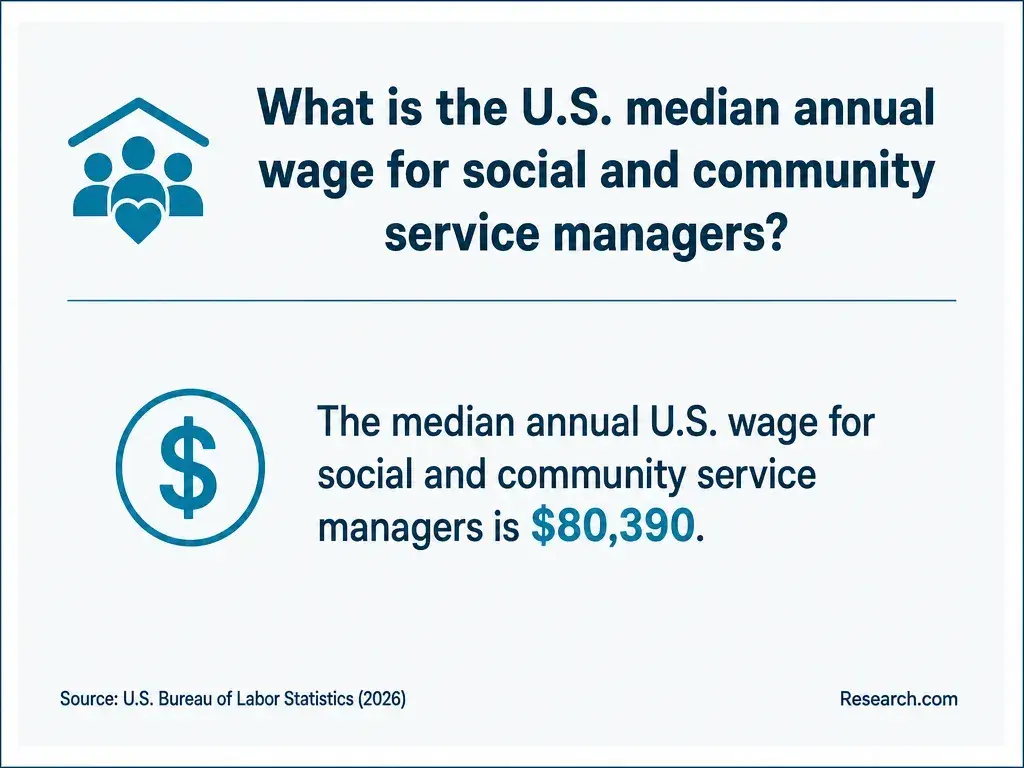
For pay research, the US Bureau of Labor Statistics occupation social and community service managers may be a closer comparison for many nonprofit aging-program leadership roles than a general healthcare-management category. Its occupation-wide median is not a DrPH graduate salary: geography, employer type, job scope, and public-sector pay scales matter. Compare actual postings for your target role and location with your likely education cost. Comparing MPH graduate earning opportunities can supply broader degree context, but cannot predict the return on this particular applied project.
Other Things You Should Know About Public Health
Yes. Agree on a small shared set of definitions and use authorized aggregate counts or a carefully scoped record review. Document which organizations cannot contribute comparable data; do not imply that the combined results cover the whole service area.
Include them when their role affects navigation and participation is appropriate. Keep caregiver and older-adult perspectives distinguishable, and do not assume a caregiver can consent on another person's behalf.
Review the measure, missing data, and process map with that partner before drawing conclusions. Report both the evidence and credible alternative explanations, then identify a change the partners can test.
Only with the necessary school and partner permissions. A public version may need aggregate results, removed identifiers, and a description of methods that does not disclose confidential agreements or records.
- Secondary Analysis Research - PMC - NIH https://pmc.ncbi.nlm.nih.gov/articles/PMC7520737/
- Health Information Exchange - Health IT Playbook https://playbook.healthit.gov/playbook/health-information-exchange/
- Data Collection | The Office of Research Integrity https://ori.hhs.gov/education/products/n_illinois_u/datamanagement/dctopic.html
- Care Coordination | Agency for Healthcare Research and Quality https://www.ahrq.gov/ncepcr/care/coordination.html
- Data Sharing and Collection Principles and Standards | cdc.gov https://www.cdc.gov/program-collaboration-service-integration/php/data-security/principles.html
- Area Agencies on Aging | acl.gov http://acl.gov/programs/aging-and-disability-networks/area-agencies-aging
- Care Transitions - Making Healthcare Safer III - NCBI - NIH https://www.ncbi.nlm.nih.gov/books/NBK555516/
- Continuity and care coordination of primary health care | springer.com https://link.springer.com/article/10.1186/s12913-023-09718-8
- The uses of Patient Reported Experience Measures in health systems: A systematic narrative review - ScienceDirect https://www.sciencedirect.com/science/article/pii/S0168851022001920
- What Is Relational Coordination? - The Heller School https://heller.brandeis.edu/relational-coordination/about-rc/index.html