2027 DNP Psychiatric-Mental Health NP Programs for Nurses in Wyoming: BSN and MSN Entry Routes and Clinical Training
Audited and Verified:
Our Editorial and Data Verification Process
Research.com uses government datasets, official education statistics and primary institutional information to support its career and degree guides. Our review process checks factual accuracy, occupational definitions, source dates and the requirements associated with the credentials discussed.
How This Article Was Fact-Checked
Our editorial team verifies salary estimates, employment projections, education requirements and program information against original data providers and official organizations. Salary figures are checked against the relevant occupational definitions and reporting periods. Information about licensure, accreditation and required in-person training is reviewed separately.
Fact-checked and verified on:

Co-Founder and Chief Data Scientist
For a Wyoming nurse pursuing psychiatric-mental health nurse practitioner practice, the first decision is whether to enter a PMHNP program with a BSN or build on an existing MSN. The second is whether the program can provide approved clinical training where the nurse lives. This guide compares those routes, identifies the Wyoming-based school to investigate, and explains how to check accreditation, placement support, cost, and eligibility for certification and state licensure before committing to a DNP.
Key Things You Should Know
- A BSN-to-DNP PMHNP route provides initial graduate NP preparation; an MSN-to-DNP route qualifies an existing PMHNP differently from an MSN-prepared nurse entering psychiatric practice for the first time.
- Check three separate conditions before enrolling: the nursing program's accreditation, its PMHNP certification preparation, and authorization to complete clinical training in Wyoming.
- A clinical placement must provide supervised psychiatric care with program approval; online coursework, RN employment, and a DNP project do not automatically replace that experience.
What Are DNP Psychiatric-Mental Health NP Programs in Wyoming?
A Doctor of Nursing Practice (DNP) psychiatric-mental health nurse practitioner program prepares an already-licensed RN for advanced psychiatric assessment, diagnosis, treatment, and ongoing care across the lifespan. It also includes doctoral-level work in evidence-based practice, quality improvement, and systems leadership. The PMHNP population focus matters: a DNP in leadership or another NP specialty does not, by itself, prepare a nurse for PMHNP certification.
"In Wyoming" can mean either a Wyoming-based school or an out-of-state school that enrolls Wyoming residents and approves Wyoming clinical sites. Those are different options. A nurse comparing them should confirm where instruction occurs, where supervised care can occur, and whether the route accepts the nurse's current credential. Someone who is not yet an RN needs an initial RN-licensure pathway first; claims about a rapid bridge should be assessed separately from graduate study using this guide to six-month LPN-to-RN claims and alternatives.
What Are the BSN and MSN Entry Routes for Wyoming PMHNP Programs?
The right entry route depends less on the highest degree a nurse holds than on whether that nurse has already completed PMHNP-specific graduate preparation. An MSN in education or leadership is not the same starting point as an MSN that prepared its graduate for PMHNP certification.
The comparison below shows what each route must accomplish. Schools set their own admission and credit-review policies, so the MSN routes in particular require an individual evaluation.
| Starting point | Likely educational route | Critical question |
| RN with a BSN, not yet an NP | BSN-to-DNP with a PMHNP track; alternatively, a qualifying PMHNP MSN followed by a DNP | Does the track provide the psychiatric coursework and supervised care needed for initial PMHNP certification eligibility? |
| RN with a non-PMHNP MSN | PMHNP post-graduate preparation, potentially combined with a DNP | What does the school's formal review require beyond prior graduate coursework and clinical hours? |
| Already-certified PMHNP with an MSN | Post-master's DNP focused on advanced practice and doctoral work | Which prior competencies and documented practice hours will the DNP program accept? |
A BSN-prepared RN whose immediate goal is PMHNP practice may find an MSN route more direct than a BSN-to-DNP, provided it meets certification and Wyoming licensing requirements. Compare the full sequence - not just the first degree - when considering affordable nursing master's study for BSN graduates. An RN with an associate degree should first ask each graduate program whether a BSN or an eligible bridge is required.
Which Wyoming Schools Offer Accredited DNP PMHNP Programs?
The University of Wyoming's Fay W. Whitney School of Nursing is the Wyoming-based school to investigate first for doctoral nursing study and a PMHNP track. Do not assume that a school's DNP listing confirms an open PMHNP cohort, both BSN and MSN entry options, or a particular clinical arrangement. Obtain the catalog and admissions requirements for the intended entry term, including the exact degree, track, and campus-visit schedule.
If the available in-state route does not fit, an out-of-state PMHNP program may be an option for a Wyoming resident. Compare its Wyoming enrollment authorization and clinical-placement policy against the local option; an online label alone establishes neither. An accelerated MSN preparation in psychiatric nursing may also be worth comparing if becoming a PMHNP sooner matters more than earning the doctorate in the same program.
Because program offerings and cohorts can change, this is not a verified, exhaustive list of currently admitting Wyoming DNP PMHNP tracks. Ask any school under consideration for written confirmation of its next PMHNP intake and Wyoming student eligibility before paying an application deposit.
Check institutional accreditation and nursing program accreditation separately. For the latter, confirm that the applicable graduate nursing degree is accredited by a recognized nursing accreditor such as the Commission on Collegiate Nursing Education (CCNE) or the Accreditation Commission for Education in Nursing (ACEN). Verify the accreditor's current listing and scope rather than relying on a schoolwide accreditation statement.
Accreditation alone does not establish PMHNP certification eligibility, Wyoming clinical-placement permission, or state APRN licensure eligibility. Ask the school to identify the exact PMHNP track, its applicable accreditation, and how its curriculum meets the current requirements of the American Nurses Credentialing Center (ANCC) PMHNP certification pathway. This distinction matters for post-graduate study too: accelerated FNP certificate admissions and requirements concern a different NP population focus and cannot substitute for PMHNP preparation.
Applicants generally need an active RN license, an eligible nursing degree, transcripts, and evidence of readiness for graduate clinical study. A school may also request references, a statement of purpose, an interview, or RN experience. Minimum GPA, prerequisite, and license-jurisdiction rules differ by program and entry route; admission to a university is not the same as admission to its PMHNP track.
For an MSN applicant, the most consequential document may be a formal gap analysis: a program review of prior courses, population-focus preparation, and documented supervised clinical hours. Request the review before assuming an earlier MSN or NP credential will shorten the route. Applicants without an RN license should resolve initial nursing admission and licensure first; nursing admission options beyond highly selective programs address that earlier step, not entry to PMHNP practice.
Before applying, request a written answer identifying the qualifying degree and RN license, required prior coursework, whether work experience is expected, and whether an acceptable Wyoming clinical site must be secured before admission or before a later clinical course.
Online delivery can reduce routine travel for a Wyoming nurse, but it does not make clinical practice virtual or self-paced. A distance program may still require scheduled live classes, simulation, campus intensives, and supervised patient care at approved sites. A campus-based or hybrid program may offer more in-person contact while requiring substantial travel from rural communities.
Compare the actual calendar: required visits, their duration, live-session times, clinical days, and whether the school finds sites or only approves sites a student proposes. A working nurse should ask how clinical schedules interact with paid shifts and what happens if a preceptor becomes unavailable. When reviewing accelerated DNP admissions and requirements, check whether a shorter published timeline assumes full-time enrollment or prior PMHNP preparation; it does not remove required specialty training.
Initial PMHNP preparation typically builds on advanced health assessment, pathophysiology, and pharmacology, then develops psychiatric assessment, diagnostic reasoning, psychotherapy and psychopharmacology knowledge, and care across age groups. The DNP portion adds evaluation of evidence, practice improvement, and a doctoral project. The school's curriculum should show which courses and supervised experiences prepare a student for the PMHNP role - not merely list general DNP competencies.
Clinical-site fit is especially important in Wyoming. A placement needs an approved preceptor, faculty oversight, relevant psychiatric patient encounters, and documentation the program accepts. A student's RN job may offer useful experience but does not automatically count as supervised NP clinical education. For the same reason, comparing RN-to-BSN practice expectations is not a sound way to judge an initial PMHNP track: the programs prepare nurses for different responsibilities.
Ask how the program ensures exposure to patients across the lifespan and what its contingency plan is if a Wyoming site cannot provide needed experiences. Simulation and a DNP quality-improvement project can develop valuable skills, but neither should be assumed to replace required supervised PMHNP patient care. Projects involving patient information also require site permission, privacy safeguards, and any applicable institutional review.
A BSN-to-DNP route generally involves more coursework and new specialty clinical preparation than a post-master's DNP for an already-prepared PMHNP. A nurse with a non-PMHNP MSN may need substantial additional psychiatric coursework and clinical experience despite holding a graduate degree. Published completion times are therefore useful only when matched to the applicant's entry route, enrollment pace, accepted credits, and clinical-site availability.
Without a verified tuition schedule and individual degree plan, a reliable Wyoming-specific total cannot be stated. Request a term-by-term estimate that separates tuition from mandatory fees and includes books, technology, background checks, clinical travel, campus visits, certification and licensing expenses, and reduced earnings during clinical terms. Check how tuition changes if placement delays extend enrollment. Comparing psychiatric NP program costs can help frame the alternatives, but a lower advertised tuition rate is not necessarily a lower total cost for a Wyoming student.
Completing a PMHNP program is one step, not permission to practice independently. A graduate pursuing the role should confirm eligibility for the ANCC psychiatric-mental health nurse practitioner certification examination under the organization's current rules, then meet the Wyoming State Board of Nursing's applicable APRN licensing requirements. The board - not the school or certifying organization - determines authorization to practice in Wyoming.
Keep entrance testing distinct from professional credentialing. Entrance exam policies for nursing applicants, such as TEAS or HESI policies, do not determine PMHNP board-certification eligibility. Likewise, holding an RN multistate privilege does not itself confer APRN authority. Before graduation, verify current ANCC eligibility documentation, Wyoming application requirements, and any conditions affecting the intended work setting or telehealth practice.
What Careers, Salaries, and Job Outlook Can Wyoming PMHNPs Expect?
A Wyoming PMHNP may work in outpatient behavioral health, integrated primary care, hospitals, community services, or telehealth, subject to licensing and employer requirements. Roles differ in patient mix, appointment length, consultation access, crisis coverage, and onboarding. A new PMHNP should evaluate clinical support and expected caseload as carefully as compensation.
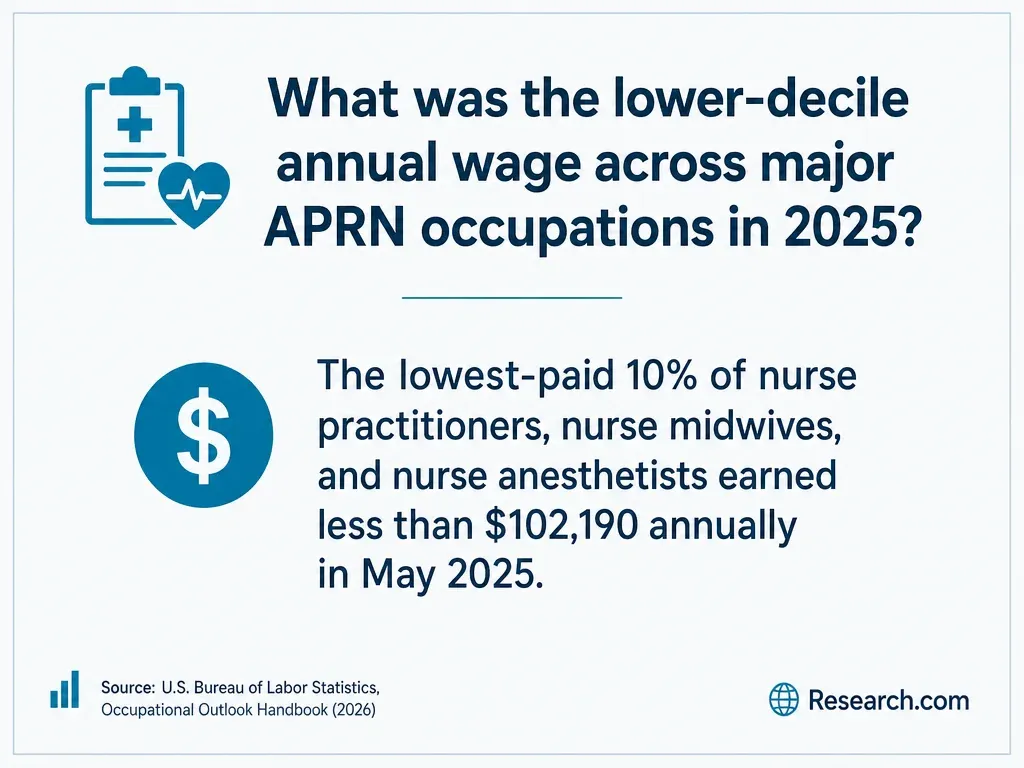
The U.S. Bureau of Labor Statistics reports nurse practitioner wages and employment projections for the occupation overall, not a separate Wyoming PMHNP or DNP-graduate salary. Its national figures can provide context, but they cannot predict a local offer, specialty premium, or return on a doctorate. Compare actual Wyoming job postings and employment terms with the full cost of each pathway, including the online NP tuition and fee considerations that may be missing from an advertised per-credit price. If an eligible PMHNP MSN meets the intended employer's requirements, earning a DNP first is a professional choice rather than an automatic condition of entering the role.
Other Things You Should Know About Nursing
Not solely on the strength of a Wyoming license. The nurse must check the rules of the state where the patient is located, as well as applicable employer and payer requirements, before providing care.
Military experience may strengthen an application, but it does not replace RN licensure or automatically satisfy graduate PMHNP clinical requirements. Ask the school for an individual review of documented education and experience.
Policies vary. Some schools coordinate placements; others expect students to propose sites. Ask who secures a replacement if a preceptor withdraws and whether the school has approved Wyoming sites.
No. An appropriately prepared and certified MSN-level PMHNP may qualify for positions that do not require a doctorate. Check the specific employer's qualifications and the current licensing requirements for the role.
- WSBN - Licensing - Wyoming State Board of Nursing https://wsbn.wyo.gov/licensing
- BSN to DNP Psychiatric Mental Health Nurse Practitioner | ouhsc.edu https://nursing.ouhsc.edu/Programs-Academics/Doctor-of-Nursing-Practice/BSN-to-DNP-Psychiatric-Mental-Health-Nurse-Practitioner
- Post-MSN to DNP Pathway | School of Nursing | The University of Alabama at Birmingham https://www.uab.edu/nursing/home/academics/doctoral/dnp/msn-to-dnp
- Psychiatric Mental Health Nurse Practitioner | UW School of Nursing https://nursing.uw.edu/academics/dnp/pmhnp/
- PMHNP MSN | Psychiatric Nurse Practitioner | Wayne State https://nursing.wayne.edu/msn-mental-health-nurse
- DNP FAQ's | uwyo.edu https://www.uwyo.edu/nursing/programs/dnp/faqs.html
- Tuition & Fees | National University https://www.nu.edu/admissions/tuition/
- Admissions Criteria: Master of Science in Nursing | Frontier Nursing University https://frontier.edu/admissions/admissions-criteria-msn/