2027 DNP Adult-Gerontology Acute Care NP Programs for Nurses in Tennessee: BSN and MSN Entry Routes and Clinical Training
Audited and Verified:
Our Editorial and Data Verification Process
Research.com uses government datasets, official education statistics and primary institutional information to support its career and degree guides. Our review process checks factual accuracy, occupational definitions, source dates and the requirements associated with the credentials discussed.
How This Article Was Fact-Checked
Our editorial team verifies salary estimates, employment projections, education requirements and program information against original data providers and official organizations. Salary figures are checked against the relevant occupational definitions and reporting periods. Information about licensure, accreditation and required in-person training is reviewed separately.
Fact-checked and verified on:

Co-Founder and Chief Data Scientist
A Tennessee nurse considering a Doctor of Nursing Practice (DNP) in adult-gerontology acute care needs to know more than whether a school offers online classes. The entry route determines how much advanced practice coursework and supervised care remains; the clinical plan determines whether the degree is feasible.
\This guide helps BSN-prepared RNs and MSN-prepared nurses compare those routes, examine Tennessee program options, and check the education, certification, and licensing steps required for acute care NP practice.
Key Things You Should Know
- A BSN-to-DNP route includes initial adult-gerontology acute care NP preparation; an MSN-to-DNP route may either add that specialty or build on an existing NP qualification. Check which one the school actually offers.
- Clinical preparation must match the adult-gerontology acute care population focus. Prior RN employment and clinical hours from another specialty do not automatically replace program-approved NP experiences.
- Graduation, national certification, and Tennessee APRN licensure are separate steps. Two national AGACNP certification credentials to investigate are ANCC's AGACNP-BC and AACN Certification Corporation's ACNPC-AG.
What are DNP adult-gerontology acute care NP programs in Tennessee?
A DNP adult-gerontology acute care nurse practitioner (AGACNP) program combines practice-focused doctoral study with graduate preparation for the NP role and adult-gerontology acute care population.
AGACNPs assess and manage adults with acute, complex, or critical conditions within their education, certification, state authority, and employer privileges. The population focus is not interchangeable with family practice or adult-gerontology primary care.
The University of Tennessee Health Science Center and the University of Tennessee, Knoxville are Tennessee institutions worth checking for AGACNP doctoral pathways. Treat a school's current catalog, not an older program directory, as the authority on whether its track is admitting students, which degree it awards, and whether it accepts BSN-prepared RNs, MSN-prepared nurses, or both.
An AGACNP master's program alongside a general DNP completion program is not necessarily an integrated AGACNP DNP route.
These are postlicensure pathways for RNs. Applicants who do not yet hold an RN license need prelicensure nursing study options online or another qualifying RN route before considering AGACNP graduate admission; online prelicensure coursework still entails approved hands-on learning.
What are the BSN and MSN entry routes for Tennessee DNP AGACNP programs?
The deciding question is whether the nurse already has AGACNP preparation, not simply whether the nurse has an MSN. Schools may call substantially different pathways "post-master's DNP."
This comparison shows what each entry point generally needs to accomplish. A receiving school determines the actual course and clinical plan after reviewing transcripts and documented competencies:
| Starting point | Likely educational need | Key question for the school |
| RN with a BSN | Initial AGACNP graduate preparation plus DNP-level coursework and project work | Is this an integrated BSN-to-DNP AGACNP track that leads to certification eligibility? |
| RN with a non-APRN MSN | AGACNP role and population-focus preparation; some prior graduate courses may be reviewed | Does this route admit non-APRN MSN graduates, and what supervised care remains? |
| NP certified in another population focus | Formal AGACNP specialty preparation and a school-approved gap analysis | Does the program add AGACNP eligibility, or is it DNP completion only? |
| Already-qualified AGACNP with an MSN | Primarily doctoral requirements, subject to the program's review | How are prior graduate courses and practice hours evaluated? |
A nurse with an associate degree should first establish how to reach an eligible graduate entry point. ADN-to-MSN bridge programs may offer an academic route, but an MSN award alone does not establish AGACNP preparation or admission to a particular DNP track.
For an already-certified AGACNP, DNP completion may be appropriate; earning a second initial NP qualification would usually duplicate the wrong part of the pathway.
What are the admission requirements for Tennessee DNP AGACNP programs?
Applicants should expect a school to review their nursing degree, RN license, academic record, recommendations, professional goals, and readiness for graduate clinical work.
Acute care or critical care RN experience may be required or strongly preferred by a particular track, but bedside experience does not itself confer NP eligibility. An MSN applicant may also need transcripts, syllabi, certification records, and supervised-hour documentation for a formal review.
Before applying, ask admissions whether the requirement applies to university admission or specifically to the AGACNP track. Confirm any GPA threshold, statistics prerequisite, experience requirement, interview, license restrictions, and application deadline in the catalog for the intended entry term.
Clinical sites can impose additional screening, immunization, or background-check conditions after academic admission.
Guides to understanding accessible nursing admissions can help applicants think about selectivity, but they should not be used to infer that a specific AGACNP DNP track has open seats or relaxed clinical standards.
"Online" usually describes where much of the academic instruction occurs, not where NP clinical care takes place. A hybrid program may require campus intensives, simulation, scheduled live classes, examinations, and approved in-person clinical placements.
A campus-based program may make faculty contact and skills sessions easier to access but require more routine travel.
For working nurses, the most useful comparison is the actual weekly schedule: live-class times, expected clinical days, travel to intensives, and whether suitable preceptors are available near home.
Ask who identifies sites, who secures agreements, whether placements outside Tennessee are permitted, and what happens if a proposed site falls through. Do not assume an existing RN job can serve as an NP clinical placement.
These clinical obligations differ from some RN-to-BSN study without added bedside rotations. Convenience claims that are reasonable for an RN-to-BSN completion program cannot be carried over to initial AGACNP preparation.
Initial AGACNP preparation typically develops advanced health assessment, pathophysiology, and pharmacology alongside diagnostic reasoning and management of acutely ill adults. DNP study adds evidence appraisal, systems leadership, quality and safety methods, and an applied practice project. A project is not a substitute for observed NP patient care.
Supervised experiences should let students demonstrate AGACNP competencies with an appropriate adult-gerontology patient population, qualified preceptors, faculty oversight, and documented evaluation.
The school must specify which hours are direct patient care, which count toward doctoral requirements, and whether any simulation is accepted. An ICU RN's employment hours, however valuable, are not automatically graduate NP clinical hours.
Population focus matters even when two programs use similar clinical terminology. Reading about post-master's family NP clinical training requirements may help an APRN recognize the need for new supervised experiences, but FNP preparation does not replace AGACNP-specific education. Ask a prospective program for its clinical competency map and placement expectations before choosing a route.
A BSN-entry student generally has more specialty coursework and clinical preparation ahead than an already-qualified AGACNP entering DNP completion. An MSN in another specialty can shorten some academic work only if the receiving program accepts it; it does not eliminate a new population-focus requirement.
Part-time enrollment, course sequencing, placement availability, and project approval can also change the completion date.
Published tuition alone cannot establish the cheaper route. Ask each school for a term-by-term estimate based on your evaluated credits and enrollment plan, including graduate tuition, mandatory fees, clinical compliance costs, books, certification and licensing expenses, campus travel, and possible reduced earnings during rotations.
Compare total cost through completion rather than multiplying a headline per-credit rate by an unevaluated credit estimate.
If an MSN or certificate would meet the intended licensing and career goal without a DNP, comparing lower-cost NP programs is sensible. Conversely, a lower tuition quote offers little value if the school cannot arrange an acceptable AGACNP clinical pathway for the student's location.
Check three distinct issues: the institution's recognized accreditation, the nursing program's accreditation and covered degree level - commonly through CCNE or ACEN, and the program's ability to enroll the student and support the intended certification and licensing pathway. Accreditation of a university does not prove that every advertised NP concentration is offered in every entry route.
Request the accreditor's listing for the specific nursing degree and ask the school to document how its AGACNP graduates meet the intended certifier's education requirements.
Also confirm Tennessee authorization and any clinical-placement restrictions if living or rotating elsewhere. Standards must match the qualification sought: short-format LPN coursework and clinical requirements, for example, concern practical nursing preparation, not accreditation or eligibility for an APRN specialty.
Completion of a qualifying AGACNP educational track is one step, not a license. Graduates should verify examination eligibility directly with the certifier, apply for and pass an accepted AGACNP national certification exam, and meet the Tennessee Board of Nursing's requirements for APRN authorization. They must maintain the underlying RN license and satisfy applicable state application requirements before practicing as an APRN.
Two credentials to compare are the American Nurses Credentialing Center's AGACNP-BC and AACN Certification Corporation's ACNPC-AG. Check each organization's current eligibility guide and the board's accepted certifications before selecting an exam.
A school's statement that graduates are "exam eligible" is not the certifier's individual eligibility decision or the board's licensing decision.
Certification follows the completed population focus. PMHNP certificate programs by duration, for instance, concern a different NP specialty; AGACNP education or certification does not authorize psychiatric-mental health NP practice.
AGACNPs may work with acutely or critically ill adults in hospitals, specialty services, and other settings whose patient needs fit their preparation and privileges. Duties can include assessment, diagnostic decision-making, treatment planning, and coordination with physicians and other clinicians.
Employers may still require specialty orientation and demonstrated competence after licensure; an RN's ICU experience is useful context, not proof of readiness for an independent NP assignment.
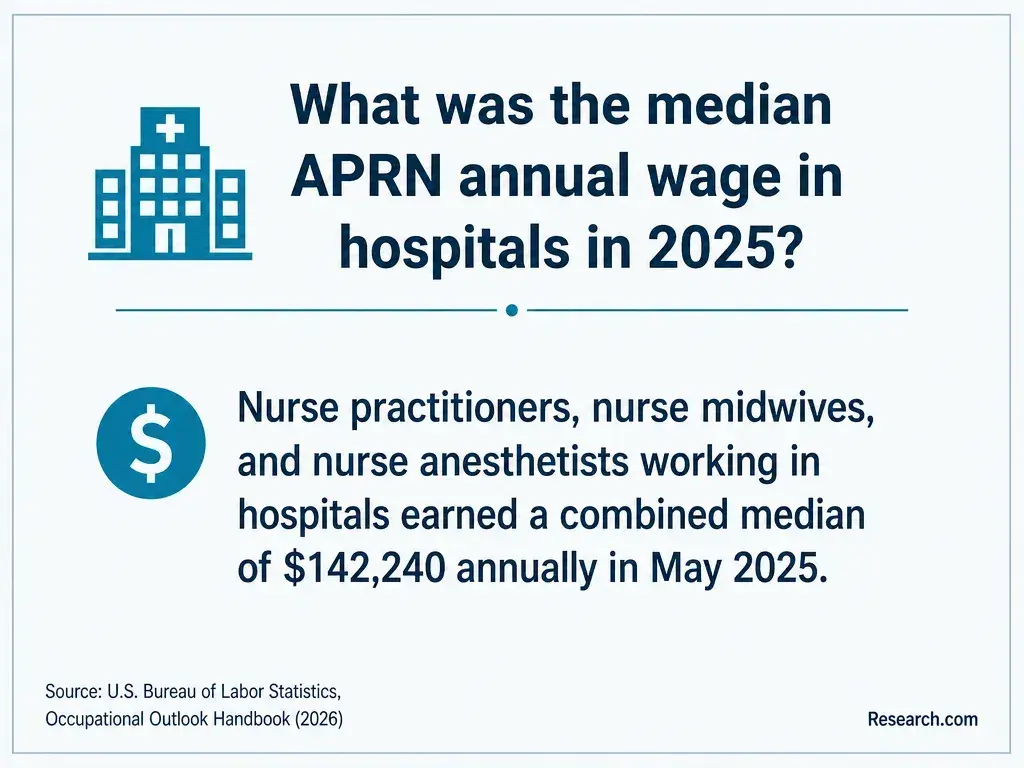
The U.S. Bureau of Labor Statistics reports wages and employment projections for the broader nurse practitioner occupation, not a separate Tennessee DNP AGACNP salary or a guaranteed return on doctoral tuition.
Use the latest BLS nurse practitioner figures for market context, then compare local offers by clinical service, shift and call expectations, benefits, and experience requirements. A degree-level salary claim is particularly weak when it does not separate new NPs from experienced practitioners.
Someone seeking longitudinal outpatient care rather than acute management should compare the role, not merely program length, with family NP preparation. Family NP programs organized by duration address a different population-focus choice and should not be treated as a faster version of AGACNP training.
How can nurses choose a reputable Tennessee DNP AGACNP program?
Begin with the intended role and your current credential. A BSN-prepared RN needs an initial AGACNP pathway; an MSN-prepared non-APRN needs a program that explicitly adds AGACNP preparation; an already-qualified AGACNP may need only doctoral completion. Then obtain answers that can be compared across schools rather than relying on marketing labels.
Ask each program to provide these decisions in writing before you commit a deposit:
- Identify the exact entry route, degree award, AGACNP curriculum, and anticipated national certification eligibility.
- Request an individualized review of prior courses, documented clinical hours, remaining supervised care, and total required credits.
- Confirm who arranges clinical sites, which locations are allowed, and the schedule for campus visits and live sessions.
- Get a term-by-term cost and completion plan, including what happens if placement or a DNP project delays progression.
- Verify nursing accreditation, applicable state authorization, and any published certification-exam outcomes with their reporting period and cohort size.
A short advertised completion time is useful only if it fits that individualized plan. Comparisons of accelerated Doctor of Nursing Practice programs should therefore come after, not before, confirmation that the track supplies any missing AGACNP education and clinical preparation.
Other Things You Should Know About Nursing
AGACNP preparation centers on the adult-gerontology population. Do not assume it authorizes pediatric practice; check the certifier's population definition, Tennessee scope requirements, and employer privileges for a proposed role.
Not necessarily. Project design and data access depend on the school and practice partner. Any use of patient information needs institutional permission, privacy safeguards, and the applicable quality-improvement or research review.
Not universally. A qualifying graduate NP pathway may be offered at the MSN or DNP level. Choose the degree after confirming certification eligibility and the preparation your intended employer and role require.
Possibly, but Tennessee authorization alone does not settle another state's APRN requirements. Check the destination board's licensing rules and the employer's credentialing requirements before accepting a position or providing care there.
- APRN Practice FAQ - Texas Board of Nursing https://www.bon.texas.gov/faq_practice_aprn.asp.html
- Adult Gerontology Acute Care Nurse Practitioner | Cedar Crest College https://www.cedarcrest.edu/program/nursing-adult-gerontology-acute-care-nurse-practitioner/graduate-certificate/
- Adult Gerontology Acute Care Nurse Practitioner | DNP | UTHSC https://www.uthsc.edu/nursing/dnp/agacnp.php
- MS Adult-Gerontology Acute Care Nurse Practitioner | CU Anschutz Nursing https://nursing.cuanschutz.edu/degrees-programs/graduate-programs/ms/ag-acnp
- Adult-Gerontology Acute Care Nurse Practitioner | Tennessee Tech University https://www.tntech.edu/majors/nursing-practice_adult-gerontology-acute-care-nurse-practitioner.php
- Adult-Gerontology Acute Care NP (DNP) - Rutgers Nursing https://nursing.rutgers.edu/adult-gerontology/adult-gerontology-acute-care-np-dnp/
- Clinical Placement | Vanderbilt University School of Nursing https://nursing.vanderbilt.edu/current-students/clinical-placement/