2027 DHA Alumni Outcomes: Questions to Ask Before Treating Testimonials as Evidence

Co-Founder and Chief Data Scientist
A compelling graduate story can make a Doctor of Healthcare Administration (DHA) look like a clear path to promotion. But the story may leave out the graduate's years of experience, employer support, and career progress before enrollment. If you are weighing a DHA against an MHA, MBA, or continued work experience, you need evidence that applies to your situation. This guide shows you what testimonials can establish, which outcome data to request, and how to judge whether a program's training, cost, and format support your next career step.
Key Things You Should Know
- A DHA testimonial shows what happened to one graduate, not how often similar students completed the program or advanced afterward.
- Ask for outcomes by cohort, including the number who entered, graduated, and responded to career surveys; a success rate without those denominators can mislead.
- The U.S. median annual wage for management occupations was $126,520 in May 2025, but that broad occupational figure is not a DHA graduate salary or evidence that a doctorate caused a raise.
What Are DHA Alumni Outcomes, and What Do Testimonials Actually Prove?
DHA alumni outcomes are measurable results after enrollment or graduation, such as completion, job changes, promotions, research work, and compensation. A testimonial is a selected person's account of their experience. It can reveal what a graduate valued about the curriculum or faculty, but it cannot establish a typical result.
Use a story to generate questions, not to estimate your own chances. The distinctions below show what additional evidence each common claim needs.
| Testimonial claim | What it establishes | What it does not establish |
| "I became a hospital executive." | That the featured graduate reports reaching that position. | How many classmates did so, or whether the degree caused the appointment. |
| "The program fit my schedule." | That its format worked for this graduate. | Whether required meetings, research deadlines, or travel will fit your schedule. |
| "My doctoral project changed practice." | That the graduate reports applying their work. | Whether every student receives comparable project support or access to organizational data. |
A useful follow-up is to ask what the person's role was before enrollment and when the reported change occurred. Also establish which credential the story concerns: a practice-oriented DHA is not automatically equivalent to a research PhD. If research training is central to your goal, compare healthcare management research and professional doctorates before treating graduates' stories as interchangeable.
How Can You Verify a DHA Program's Accreditation and Institutional Status?
First, verify that the university - not just its marketing page - is institutionally accredited by an accreditor recognized by the U.S. Department of Education or the Council for Higher Education Accreditation.
Check the accreditor's own directory, confirm that the specific institution and campus or online unit are covered, and look for current status or sanctions. Ask the school whether the DHA is authorized for enrollment in your state; institutional accreditation and state authorization address different questions.
Next, distinguish institutional accreditation from accreditation of a particular healthcare management program. Do not assume that a university's accreditation, or the accreditation of its MHA, extends to its DHA.
The Commission on Accreditation of Healthcare Management Education (CAHME) accredits eligible healthcare management programs; verify the exact degree and program in its directory rather than inferring coverage from a school-level claim. Readers weighing a master's instead can learn more about evaluating online MHA programs through CAHME accreditation.
Finally, ask how employers or institutions relevant to your goal assess the credential. Accreditation is an important threshold, not proof of strong career outcomes.
What Career Paths Can a Doctor of Healthcare Administration Degree Support?
A DHA may support experienced professionals pursuing healthcare operations leadership, quality improvement, strategy, policy implementation, consulting, or certain teaching and applied-research roles.
Employers generally assess the doctorate alongside a candidate's record of managing teams, budgets, clinical partnerships, or organizational change. A nurse leader moving into system-wide operations faces a different transition from someone with no healthcare experience seeking a first administrative job.
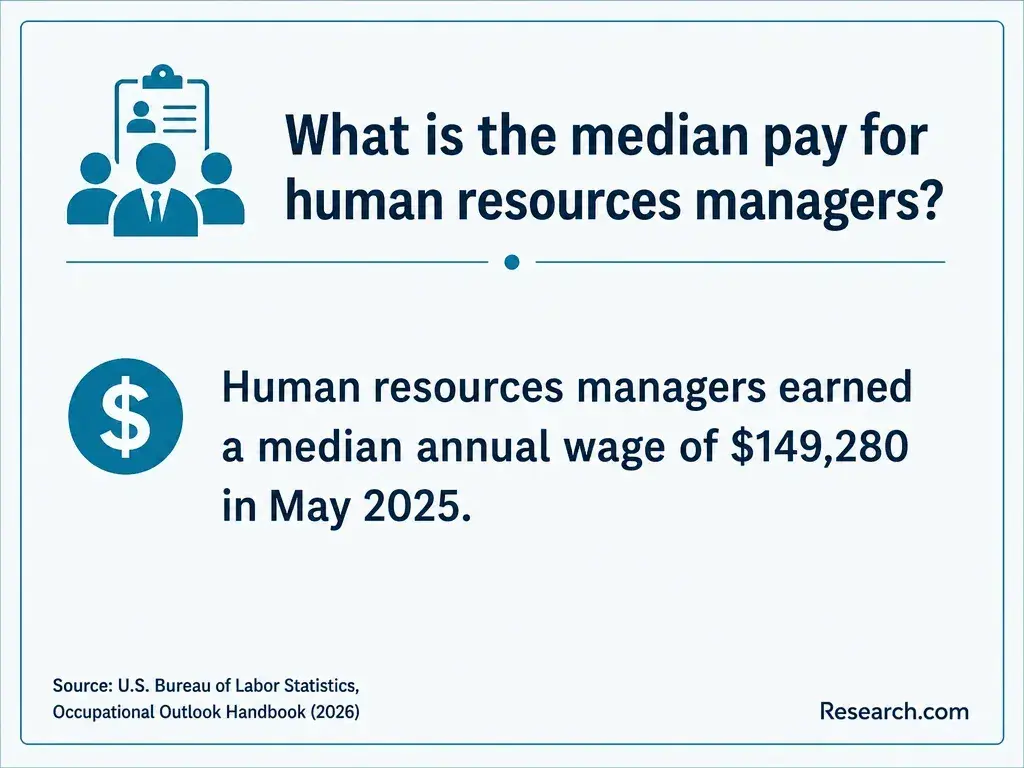
The U.S. Bureau of Labor Statistics reports a $126,520 median annual wage for management occupations in May 2025. That figure covers many industries and education levels; it should not be presented as a DHA salary or used to forecast an individual graduate's earnings.
Define the function you want before comparing alumni titles. Health information management, for example, has a different technical and records-focused emphasis from broad organizational leadership. The distinction between healthcare leadership education compared with health information management matters if the roles in testimonials are not the roles you intend to pursue.
Start with your current position, target role, and the qualification gap between them. Then compare alumni whose starting points resemble yours - not just those with impressive final titles. A director seeking broader executive responsibility should look for graduates who were directors before enrollment. A professional changing industries should look for evidence of transitions by people without established healthcare networks.
Ask whether the target job actually favors doctoral training. A DHA can make sense when you need to lead and evaluate complex organizational initiatives and can apply doctoral work in your workplace.
If your immediate gap is general management, finance, or healthcare administration fundamentals, a master's or targeted development may be more direct. Compare cost-conscious MBA pathways for healthcare professionals against the DHA on curriculum, total cost, and employer expectations - not degree prestige alone.
For each promising alumni example, record the person's prior experience, role before and after graduation, time between graduation and advancement, and whether their employer sponsored the degree or project. Those details make the story more relevant without turning it into proof of causation.
Request a recent, consistently defined set of cohort results in writing. The school may not collect every measure, but it should be able to explain what it tracks and how it selected the alumni featured in its materials.
Use these questions to test whether reported outcomes represent the students who enrolled, rather than only those willing to share good news.
- For each entering cohort, how many students started, graduated, remain enrolled, or left, and over what observation period?
- Among graduates contacted about employment, how many responded, and were results reported separately for those already employed in healthcare?
- How are promotions, new jobs, salary changes, and time to completion defined and verified?
- What share of graduates completed an applied project with an external organization, and what support was available to students without workplace access to data?
- Can the school arrange conversations with graduates whose starting roles and career goals resemble mine, including graduates who did not change jobs?
Interpret comparisons carefully. Graduates of accredited U.S. universities offering healthcare administration bachelor's degrees may be building entry-level experience, while DHA students may already hold leadership positions.
Comparing their post-degree titles without accounting for starting experience would say little about either program's effectiveness. If a school reports only selected stories, treat its typical outcome as unknown - not necessarily poor, but unverified.
Delivery mode alone does not establish which DHA produces better outcomes. Working professionals may find online study easier to combine with a current leadership role and an employer-based doctoral project. Campus study may offer more routine in-person contact. Either format can include live classes, group work, residencies, and demanding research deadlines; verify the actual design rather than relying on the "online" label.
Compare like with like: entrants' experience, full-time or part-time enrollment, completion periods, project support, and access to faculty and career services. Ask each school whether outcome reports separate online and campus students. A combined graduation or placement figure may obscure differences, while a small subgroup may be too limited for a reliable conclusion.
If scheduling flexibility is your overriding constraint, online healthcare management master's programs with faster schedules offer another option to examine. Faster completion does not make a master's equivalent to a doctorate; it may simply fit a nearer-term skill or promotion goal better.
Look for coursework that connects healthcare strategy, finance, operations, quality and patient safety, organizational leadership, ethics, and policy to decisions administrators actually make.
Then examine the research sequence: methods, evidence appraisal, data analysis, proposal development, ethical review where applicable, and the final dissertation or applied project. Titles vary, so read course descriptions and project requirements rather than assuming every DHA teaches the same skills.
Ask to see permitted final-project topics and the support offered for choosing a question, obtaining data, and completing revisions. A program built around your workplace can be valuable if your employer permits the work; it can become a barrier if access depends on approvals you cannot secure.
If you need a narrower leadership qualification rather than extended doctoral research, examine 12-month health administration graduate degree options and compare their depth and pace with your goal.
Requirements vary by institution. DHA applicants commonly need a prior degree and may be asked for a résumé, statement of purpose, recommendations, and evidence of relevant professional experience.
Some programs may require a master's degree or set specific academic, research, or leadership expectations; do not treat any one school's policy as universal. Confirm current testing, interview, prerequisite, and application-deadline rules directly with each program.
Your preparation should match the outcome you seek. If you have limited healthcare experience, ask whether the cohort, coursework, and career services are designed for entrants like you.
An MHA may provide a more direct foundation; resources for nonclinical career changers applying to an MHA can help you assess that alternative. If you are already a healthcare leader, explain in your application which organizational problem you hope to investigate and whether you can realistically access the people or information your project would require.
There is no responsible single price or completion time for all DHA programs. Total cost depends on required credits, per-credit or term tuition, mandatory fees, enrollment pace, and possible residency travel. Research or project continuation charges can matter if completion takes longer than planned. Request a written estimate based on your intended pace, including what you would owe if you needed additional terms.
Compare that estimate with employer assistance, available aid, and the time you would give up for coursework and research. Borrowing adds financing costs; leaving or reducing work can create a larger opportunity cost than tuition alone. Ask recent graduates how long their final projects took and whether the published completion timeline assumes uninterrupted enrollment.
If doctoral-level training is not necessary for your target role, review affordable graduate healthcare administration degrees as a cost and time comparison. The less expensive option is not automatically the better one, but it gives you a benchmark for the additional value a DHA would need to provide.
Do DHA Graduates Need Licensure or Professional Certification for Healthcare Administration Roles?
A DHA itself does not grant a clinical license, and many general healthcare administration jobs do not require a license simply because they involve management. Requirements depend on the position and jurisdiction.
For example, a role that includes regulated clinical practice requires the relevant clinical license; certain facility administrator positions may have separate state-specific licensing rules. Check the job description and applicable state board before assuming the doctorate qualifies you.
Professional certifications may demonstrate specialized experience or knowledge, but they are distinct from a DHA and may have their own eligibility rules. If your target is an early-career, nonlicensed administrative role, a doctorate may be unnecessary: compare employer requirements with affordable online healthcare administration degrees and the experience you could gain while working. For a regulated role, identify the required license first and evaluate degrees second.
Other Things You Should Know About Healthcare Administration
Possibly. Hiring requirements vary by institution, subject, and position. Ask prospective employers whether they accept a professional doctorate for the courses you hope to teach and whether they expect teaching experience or scholarly publications.
The graduate has earned a doctoral title, but its use in patient-facing settings may be governed by state law and workplace policy. The person must not imply they hold a clinical license they do not have.
Only if the university permits enrollment from their location. Check eligibility, live-session times, payment arrangements, and whether the degree will be recognized where they intend to work. Online enrollment alone does not provide U.S. work authorization.
Transfer decisions belong to the receiving institution and may be limited for doctoral research or project work. Obtain its written evaluation before withdrawing from a current program.
- Institutional Review Boards: Actions Needed to Improve Federal Oversight and Examine Effectiveness | U.S. GAO https://www.gao.gov/products/gao-23-104721
- Ipeds Survey Methodology | ed.gov https://nces.ed.gov/ipeds/survey-components/ipeds-survey-methodology
- Definitions: Graduate Outcomes | hesa.ac.uk https://www.hesa.ac.uk/support/definitions/graduates
- Doctor of Health Administration | MUSC College of Health Professions https://chp.musc.edu/programs/doctor-health-administration
- AACSB Global Standards for Business Education https://www.aacsb.edu/educators/global-standards
- Doctor of Health Administration (DHA) | UNF Catalog https://www.unf.edu/brooks/health-administration/doctor-of-health-administration.html
- Doctor of Health Administration (DHA) | Morehouse School of Medicine https://www.msm.edu/online/dha/index.php
- Doctor of Health Administration (DHA) | rutgers.edu https://bloustein.rutgers.edu/graduate/dha/
- Best Online Doctorate in Health Administration | DHA & PhD 2026 - PublicAdministrationPolicy.org https://publicadministrationpolicy.org/degree/doctorate-in-health-administration/
- Doctor of Healthcare Administration (DHA) Degree Programs | Health Administration Degrees https://www.healthadministrationdegrees.com/programs/doctor-of-healthcare-administration/