2027 Customer Experience vs. Business Development for a Business Administration BS: Which Fits?
Audited and Verified:
Our Editorial and Data Verification Process
Research.com uses government datasets, official education statistics and primary institutional information to support its career and degree guides. Our review process checks factual accuracy, occupational definitions, source dates and the requirements associated with the credentials discussed.
How This Article Was Fact-Checked
Our editorial team verifies salary estimates, employment projections, education requirements and program information against original data providers and official organizations. Salary figures are checked against the relevant occupational definitions and reporting periods. Information about licensure, accreditation and required in-person training is reviewed separately.
Fact-checked and verified on:

Co-Founder and Chief Data Scientist
Customer experience and business development can both build on a BS in Business Administration, but they solve different problems. One improves what happens when people interact with a company; the other creates opportunities for the company to grow. If you are choosing electives, an internship, or a first professional role, that distinction matters more than the job titles alone.
This guide compares the work, academic preparation, and career evidence behind each path so you can choose where to invest your time - and recognize when experience or targeted training matters more than another credential.
Key Things You Should Know
- Choose customer experience if you want to improve existing customer journeys, service processes, and retention; choose business development if you want to identify prospects, build partnerships, and evaluate growth opportunities.
- A business administration BS can support either path, but employers also need evidence of relevant work. A service-process analysis or customer research project fits the first path; a documented market or partnership analysis fits the second.
- Neither title has a single BLS wage category. For context, market research analysts earned a May 2025 median annual wage of $78,760 across the occupation - not an expected starting salary for either path.
What Is the Difference Between Customer Experience and Business Development?
Customer experience (CX) concerns the full set of interactions a customer has with an organization, from finding information to buying, getting help, and continuing to use a product or service. CX work may involve researching friction points, improving service handoffs, and measuring whether changes help customers. Business development (BD) seeks new sources of business, such as prospective clients, distribution relationships, or strategic partnerships. It may involve market assessment, outreach, relationship building, and evaluating whether an opportunity is commercially viable.
The distinction is the principal question each function asks. CX asks, "How can we improve the experience of people we serve?" BD asks, "Where can we create a worthwhile new relationship or source of revenue?" Both require listening and analysis, and responsibilities overlap in smaller organizations. Neither should be confused with employee experience or human resources; if improving staff hiring and support is your real goal, human resources degree planning basics provide a more relevant comparison.
Which Career Path Fits Your Skills and Professional Goals?
Start with work you have already done. Customer service, complaints resolution, process documentation, and user research can translate into CX. Sales support, fundraising, account coordination, market research, and partner outreach can translate into BD. A transition between adjacent duties is usually easier to demonstrate to employers than a move into an unfamiliar function with no work samples.
These questions help turn a preference into a practical choice:
- What outcome motivates you? Choose CX if reducing friction and improving ongoing relationships appeals to you; consider BD if finding and assessing new opportunities does.
- What evidence can you produce? For CX, document a permitted service-process review or anonymized journey map. For BD, build a sourced market assessment or a hypothetical partner-screening framework.
- What kind of pressure suits you? CX can involve difficult service problems and coordination across teams. BD may involve outreach, rejection, revenue targets, and uncertain deal timelines.
If your aim is primarily to supervise staff rather than work in either function, compare the duties of the roles you want before choosing electives. Shorter study timelines for leadership bachelor's students may be relevant, but a faster degree does not replace the experience employers expect for management responsibility.
What Does a Business Administration BS Teach for Each Career Path?
A BS in Business Administration typically provides a shared foundation in accounting, marketing, management, operations, and quantitative reasoning. For CX, that foundation helps you connect service problems to costs, processes, and organizational decisions. For BD, it helps you assess markets, communicate a value proposition, and judge whether growth plans make financial sense. The exact core and available concentrations vary by school; "BS" alone does not establish greater depth in either function.
The degree's value is strongest when you apply its concepts to a relevant problem. A CX student might map a customer handoff and propose a way to evaluate an improvement. A BD student might compare potential customer segments using stated assumptions and public information. Neither exercise proves a real-world result. If your interest is specifically in leading implementation projects rather than owning customer or growth strategy, online degree options in project management at lower cost offer a different educational comparison.
Look beyond an elective's title to its assignments and prerequisites. The most useful course mix depends on whether you need to understand existing customers or assess new opportunities.
This comparison shows where coursework can add distinct value; it is not a promise that every BS program offers these classes.
| Course area | Customer experience application | Business development application |
| Marketing research and statistics | Interpret feedback and identify patterns without treating a small sample as representative. | Estimate market demand and test assumptions about prospective customers. |
| Operations and information systems | Map handoffs, service workflows, and responsible use of customer data. | Understand delivery capacity and systems needed to support a proposed relationship. |
| Accounting and finance | Assess the cost of a proposed service change. | Distinguish projected revenue from margin, cash needs, and risk. |
| Communication and negotiation | Present findings to service and product teams. | Conduct outreach and discuss potential partnership terms. |
Ask an adviser whether relevant courses count toward the major, a formal concentration, or only free electives, and whether prerequisites or limited course availability affect graduation. If your interest is specifically in supplier networks and distribution rather than BD broadly, shorter online supply chain degree pathways may align more closely with that goal.
Early-career CX candidates may pursue customer experience coordinator, customer insights assistant, service operations coordinator, or customer success associate roles. BD candidates may look at business development representative, sales development representative, partnerships coordinator, or sales operations coordinator roles. Titles are inconsistent: read the duties and performance measures before assuming two postings describe the same work.
An entry-level CX role might ask you to organize feedback and track service issues; a BD representative role might emphasize prospect research, outreach, and accurate records in a customer relationship management system. A customer success role may also carry renewal or sales targets. Manager and director positions generally require demonstrated functional results and broader responsibility, not just a bachelor's degree.
For a first role, match one job posting's requirements to coursework and a work sample, then seek an internship, supervised project, or relevant paid work to address the largest gap. If finishing a bachelor's degree is a hiring requirement, a guide to accelerated bachelor's study can help you examine timing; confirm remaining credits and workload before assuming a shorter calendar path is feasible.
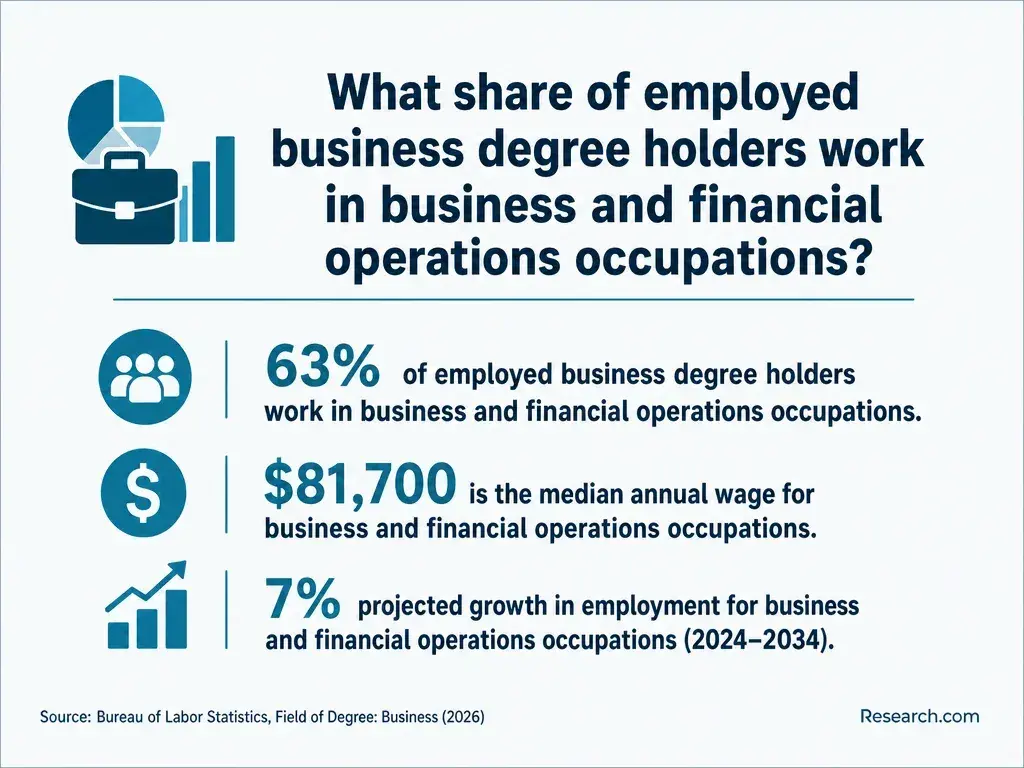
There is no single dependable national salary for "customer experience professional" or "business development professional." Those labels span service, research, sales, partnerships, and management jobs, often with different pay structures. As a relevant research-oriented benchmark, the US Bureau of Labor Statistics reports a May 2025 median annual wage of $78,760 for market research analysts. That occupation can overlap with customer insights or market assessment, but its occupation-wide median is not an entry-level CX or BD salary.
Compare actual postings by location, responsibilities, required experience, base pay, and any commission or bonus terms. For BD roles, ask how variable pay is calculated and whether the advertised amount depends on meeting targets. To judge whether completing a degree is financially sensible, compare cost-to-finish for shorter business administration programs against your realistic remaining coursework and current earnings - not an occupation-wide median.
BLS does not publish a single growth projection covering all CX or BD titles. For one related analytical occupation, it projects 7% US employment growth for market research analysts from 2025 to 2035. That suggests continued demand for some research skills used in both paths; it does not mean every CX or BD role will grow at that rate.
Employer demand also depends on industry, location, and what a particular team needs done. Review local postings for recurring requirements - such as survey interpretation, service operations, prospecting, or partnership coordination - before committing to a concentration. If a degree is necessary but the outlook for your target role is uncertain, compare inexpensive business administration degree options alongside internship access and career support rather than paying more on the assumption that one job title guarantees a return.
General CX and BD roles do not have a universal professional license or graduate-degree requirement. Employers may prefer familiarity with a particular customer relationship management platform, analytics tool, sales method, or industry. A certificate can document training, but it is not interchangeable with a degree or proof that you have improved customer outcomes or closed agreements.
Check the specific job and industry before ruling out additional requirements. Work involving regulated financial products or real estate, for example, may require separate authorization for certain activities. An MBA or specialized graduate degree can become useful for a defined advancement goal, but it is usually not the first step for someone seeking an entry-level role. If the bachelor's degree is your immediate requirement, free application options at accredited online schools can reduce one upfront cost; verify program fit and total charges separately.
Choose the format that lets you complete relevant work, not simply the one that sounds more convenient. Online study may suit someone already working in service or sales who can use approved, nonconfidential workplace questions for coursework. Campus study may make it easier to attend in-person recruiting events, collaborate on projects, or pursue local internships. Neither format guarantees access to a CX or BD placement.
Before enrolling, check live-class times, group assignments, presentation requirements, internship rules, and whether courses needed for your preferred electives are offered when you need them. An asynchronous course can still have fixed weekly deadlines. Compare fees and the cost of any required travel as well as tuition; online business education on a smaller budget is useful only if the program also supports your intended coursework and completion schedule.
How Do You Choose an Accredited Business Administration BS Program?
First verify the institution's recognized accreditation and the exact degree it awards. If a school cites AACSB, ACBSP, or IACBE, check whether that business accreditation covers the program you would enter; it is distinct from institutional accreditation. Then compare the published curriculum with the CX or BD tasks you want to perform. An elective is not an official concentration unless the school designates it as one.
Use these checks to make the final comparison rather than relying on a program's advertised career outcomes:
- Request a degree audit showing which prior credits apply to the business core, desired electives or concentration, and remaining graduation requirements.
- Ask for recent syllabi or assignment descriptions for research, sales, operations, and applied-project courses.
- Confirm internship access, career support, course scheduling, total remaining cost, and whether any reported outcomes identify the relevant graduates and jobs.
If affordability is decisive, business administration college affordability and FAFSA participation can help frame your search. Confirm aid eligibility and your personal award with each school; an affordable advertised price is not a final cost-to-finish estimate.
Other Things You Should Know About Business Administration
Yes, particularly when you can show customer knowledge, clear communication, and experience identifying needs. You may still need to demonstrate prospecting, market assessment, or sales skills for the target role.
Yes. A research assignment can compare an existing customer's experience with an unmet market need. Use the results to identify which work you want to pursue further, while keeping any employer or customer information confidential.
Not necessarily. Customer success commonly focuses on helping assigned customers achieve value after a sale and may include renewals. CX can span the entire customer journey across multiple teams.
No. Some BD jobs are primarily sales outreach, while others focus on partnerships, new markets, or strategic opportunities. The job description - not the title - reveals whether the work fits your goals.
- Planning and conducting market and customer research | Business Queensland https://www.business.qld.gov.au/running-business/marketing-sales/market-customer-research/plan-conduct
- Applying Experiential Learning to Career Development... - PMC https://pmc.ncbi.nlm.nih.gov/articles/PMC8711830/
- Soft Skills: The Competitive Edge | dol.gov https://www.dol.gov/agencies/odep/publications/fact-sheets/soft-skills-the-competitive-edge
- Students & Recent Graduates | U.S. Office of Personnel Management https://www.opm.gov/policy-data-oversight/hiring-information/students-recent-graduates/
- Top Skills Employers Look for in Business Professionals | Lasell University https://www.lasell.edu/academics/lasell-insights/top-skills-employers-look-for-in-business-professionals.html
- Understanding the B2B customer experience and journey | sciencedirect.com https://www.sciencedirect.com/science/article/pii/S0148296325003042
- Customer Experience (CX Concentration) - Career 360 https://career360.snhu.edu/channels/customer-experience-cx-concentration/
- Two Approaches to Experiential Learning | AACSB https://www.aacsb.edu/insights/articles/2023/04/two-approaches-to-experiential-learning
- What is Customer Experience? | SNHU https://www.snhu.edu/about-us/newsroom/business/what-is-customer-experience
- What Can You Do With a Business Administration Degree? | American Military University https://www.amu.apus.edu/area-of-study/business-administration-and-management/resources/what-can-you-do-with-a-business-administration-degree-exploring-options/