2027 Comparing a Workforce Policy Memo With a Hiring Plan

Co-Founder and Chief Data Scientist
A healthcare organization can agree that staffing needs to improve and still hire the wrong people - or hire no one at all. A workforce policy memo explains the problem and recommends a direction; a hiring plan turns that direction into positions, budgets, and deadlines.
For healthcare administrators, students, and professionals considering a move into workforce planning, the distinction matters because patient coverage, labor costs, and clinical requirements must all align. This comparison shows what belongs in each document, how to connect them, and which education paths can help you do the work.
Key Things You Should Know
- A workforce policy memo recommends staffing priorities and decision rules; a hiring plan specifies the roles, funding, recruitment steps, and measures needed to carry them out.
- For a continuously staffed position, the starting coverage requirement is 168 hours per week - not one employee. Leave, training, breaks, and shift design increase the staffing needed to provide that coverage.
- Healthcare workforce planning combines service-demand data, actual staff availability, clinical requirements, and budget limits. An MBA can help with management decisions, but it does not replace clinical licensure or healthcare experience.
What is the difference between a workforce policy memo and a healthcare hiring plan?
A workforce policy memo is a concise analysis for decision-makers. It identifies a staffing problem, weighs evidence and options, and recommends a policy or operating approach. A healthcare hiring plan is an implementation document: it identifies which positions to fill, when, with what funding, and how the organization will know whether recruitment worked.
The distinction is easiest to see by comparing what a manager should be able to decide after reading each document.
| Comparison point | Workforce policy memo | Healthcare hiring plan |
| Primary decision | Which staffing approach should the organization adopt, and why? | Which approved positions should be recruited, and how? |
| Typical content | Problem, evidence, alternatives, recommendation, risks, and decision requested | Role requirements, headcount, funding, recruitment schedule, ownership, and success measures |
| Time horizon | May address a sustained workforce issue across departments or service lines | Usually follows defined vacancies, expansion plans, or replacement needs |
| Key limitation | A recommendation alone does not authorize or fill a position | A list of openings does not establish that hiring is the right policy response |
For example, a memo might recommend strengthening evening access through revised scheduling and selective recruitment. The hiring plan would specify whether that means additional nurses, medical assistants, or scheduling staff, subject to clinical scope and approved funding. Distinguishing operational staffing from information-focused roles also matters; understanding healthcare administration and HIM degree distinctions can help when defining who owns workforce decisions versus the data systems supporting them.
How does a workforce policy memo guide healthcare staffing decisions?
A useful memo connects an observable problem to a defensible choice. It might show that appointment delays persist despite adequate authorized positions, then compare recruitment with schedule redesign, retention measures, cross-training, or changes in patient flow. Its recommendation should name the affected services, explain trade-offs, identify the decision-maker, and state what evidence would prompt reassessment.
Healthcare constraints make that analysis more than a headcount exercise. A lower-cost staffing mix is not viable if workers lack the licenses, competencies, supervision, or scope of practice needed for the care provided. State rules, applicable federal requirements, contracts, and organizational policies may also constrain the options. A memo should identify those checks rather than assume one staffing formula works everywhere.
Most administrators can develop an operational memo without a doctorate. Professionals seeking to lead sustained research or system-wide policy evaluation may also review online healthcare management doctorate programs; that is a different educational goal from learning to write a practical staffing recommendation.
What should a healthcare hiring plan include?
The hiring plan should make an approved staffing decision executable. Before recruitment begins, the manager, finance team, human resources, and clinical leaders need a shared account of what is being hired and why.
- Positions and justification: Job titles, reporting lines, work locations, shifts, required credentials, and the service or coverage gap each role addresses.
- Capacity and funding: Approved positions, expected work hours, compensation and onboarding costs, budget owner, and any limits on temporary labor.
- Recruitment and selection: Sourcing methods, screening criteria, interview responsibilities, credential checks, and realistic approval and start-date milestones.
- Implementation measures: Vacancy duration, offer acceptance, time to independent practice where applicable, retention, and whether patient coverage improves.
A plan should also state what happens if recruitment is unsuccessful. Adjusting shifts or investing in training may be more feasible than repeatedly advertising a hard-to-fill role. For organizations developing an internal pipeline of future administrative staff, flexible start dates for healthcare administration bachelor's study may be worth considering as a development option, not as an immediate fix for a clinical vacancy.
Begin with the service being delivered, then test whether the existing workforce can cover it. Useful inputs include patient volume and acuity, demand by day and shift, appointment delays, authorized versus filled positions, actual productive hours, overtime, turnover, leave, and the time needed to orient new hires. Separate a vacancy on the organization chart from an unmet care need: either can exist without the other.
Compare those inputs at the department and shift level. An organization-wide average can hide a weekend coverage gap, while a temporary surge should not automatically become a permanent position. Finance and clinical leaders should check the assumptions together, particularly when reimbursement, supervision, or required competencies affect the proposed staffing mix.
Professionals who need stronger budgeting and data interpretation skills can compare targeted courses with economical online healthcare administration study options. The right investment depends on whether the gap is a specific analytical skill or broader preparation for management.
Translate the goal into a defined service and coverage standard before naming a job title. A memo calling for continuous coverage, for example, implies 168 hours of coverage each week. That is a scheduling requirement, not a claim that one employee can work those hours or that the organization needs a particular fixed number of employees.
A disciplined translation follows these steps:
- Define the service, locations, shifts, patient needs, and clinical competencies the policy is meant to support.
- Estimate required coverage and compare it with employees' available productive hours, accounting for leave, training, and other noncoverage time.
- Test alternatives - including schedule changes, retention efforts, cross-training, and hiring - against clinical requirements and the budget.
- Seek the appropriate clinical, finance, human resources, and executive approvals before converting the preferred option into funded requisitions.
- Track whether the change improves the original service measure, and revise the plan if it does not.
This is where general management training can be useful: the administrator must connect operations, workforce costs, and implementation. Someone seeking that broader preparation could compare fast-track online healthcare management graduate degrees, while checking whether an accelerated schedule leaves enough time for applied workforce-planning work.
Look for coursework that lets students move from evidence to an operational decision. Healthcare operations can address capacity and patient flow; managerial finance can test whether proposed positions are affordable; human resources and organizational behavior can examine recruitment and retention; and healthcare law or policy can frame regulatory and governance constraints. Analytics coursework is most useful here when students interpret workforce and service data rather than merely learn software.
An applied assignment is a stronger signal than a course title alone. Ask whether students estimate staffing needs, compare hiring with nonhiring options, write a recommendation for decision-makers, and defend its cost and clinical assumptions. Students considering year-long master's programs in healthcare administration should check whether the condensed sequence includes that kind of project; a shorter timeline does not by itself establish practical depth.
Many programs cover relevant pieces, but applicants should not assume every degree teaches both documents explicitly. An MBA with healthcare electives may provide broad preparation in budgeting, operations, and people management. A Master of Health Administration (MHA) may place those decisions more directly in healthcare organizations. A program with a single healthcare course is not necessarily equivalent to a formal healthcare concentration or a specialized administration degree.
Compare syllabi and applied projects, not just program names. Ask whether students practice writing policy recommendations, building staffing budgets, interpreting workforce measures, and working with clinical stakeholders. When reviewing MHA degree choices through online universities, also verify the current curriculum, any required field experience, and whether online students can access relevant projects and career support.
Requirements depend on the job. An analyst or coordinator may enter with a relevant bachelor's degree and strong data, scheduling, finance, or human resources experience. Management roles commonly call for substantial related experience; some employers prefer a graduate degree. Clinical staffing leadership may additionally require a professional license and clinical practice background. Neither an MBA nor an MHA confers clinical licensure.
For a professional already working in healthcare, the decision is often whether a graduate degree adds needed management breadth or sector-specific depth. For a career changer, transferable skills matter, but so does access to healthcare projects and employers. Choosing an MHA when your background is outside healthcare can help frame that transition; admission to a program should not be mistaken for immediate qualification to manage clinical staffing.
A certification is most useful when it addresses a defined gap in the work. Human resources credentials may support recruiting and workforce practices; project-management credentials may help with implementation; and healthcare management credentials may signal relevant professional knowledge. Eligibility, examinations, continuing education, and employer recognition vary by credential, so check the issuing organization's current rules before paying for one.
Do not treat a certification as interchangeable with a degree - or either one as a substitute for experience. If your immediate task is to improve staffing forecasts, a focused analytics or workforce-planning course may offer a more direct return than a full MBA. If you need broader leadership preparation, weigh the total cost and time commitment of a degree; comparing affordable health administration graduate schools is a starting point, but verify current tuition, fees, and program requirements with each school.
What healthcare administration jobs involve workforce policy and hiring plans?
Workforce analysts examine demand, vacancies, schedules, and labor costs. Human resources or talent acquisition managers turn approved needs into recruitment activity. Clinic managers and department administrators balance service coverage with budgets and staff performance. Senior operations leaders may set broader workforce priorities, but they typically reach that responsibility through substantial operational experience.
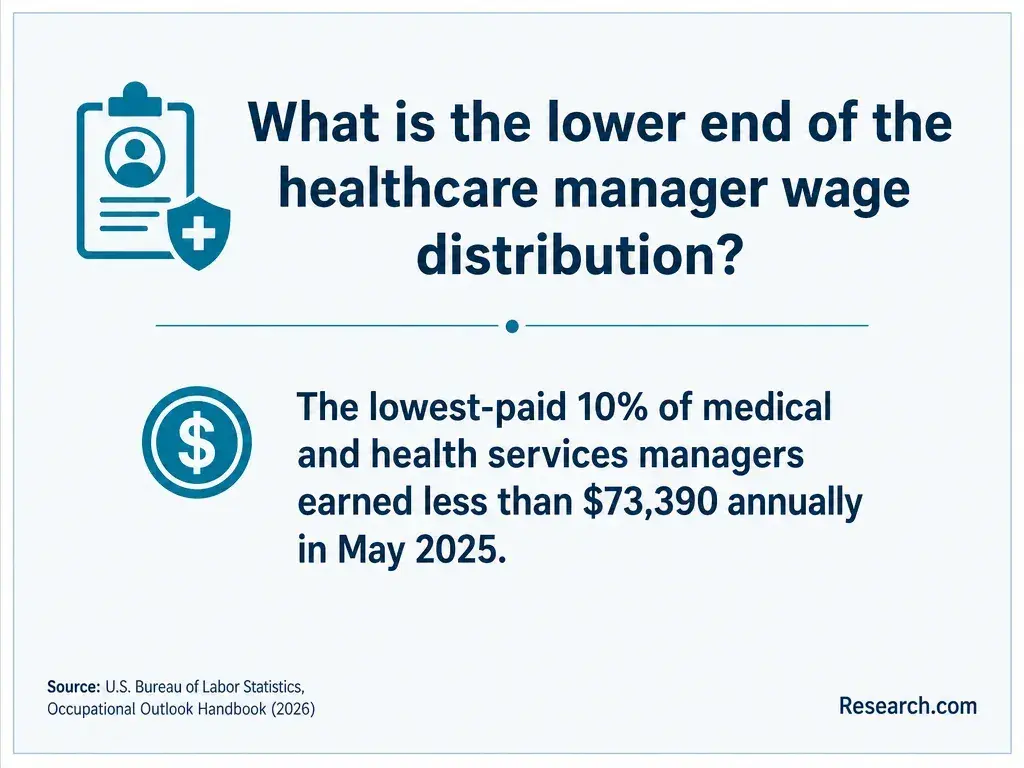
Pay figures require care. The U.S. Bureau of Labor Statistics reports a $126,520 median annual wage for management occupations in May 2025. That figure covers management jobs across industries; it is not a salary estimate for healthcare workforce planners or MBA graduates. Compare compensation for the specific occupation, location, and experience level you are targeting rather than using the broad median to justify a degree purchase.
For an early-career applicant, relevant experience with scheduling, finance, human resources, or healthcare operations may be the most direct next step. A bachelor's degree can support entry into administrative work; someone evaluating a quicker route to that credential can investigate shorter healthcare administration bachelor's pathways, while confirming transfer-credit rules and whether the pace is manageable. Experienced professionals should instead identify the responsibilities they cannot yet demonstrate and choose a degree, targeted course, or workplace project accordingly.
Other Things You Should Know About Healthcare Administration
Not usually. A memo generally recommends a decision; its effect depends on who approves it and whether it is adopted into organizational policy. Legal and contractual staffing obligations apply regardless of what a memo recommends.
Approval depends on organizational authority and the role. Common participants include the hiring manager, finance, human resources, and the relevant clinical leader, with executive approval where required.
Revisit it when service demand, patient needs, turnover, funding, or recruitment results change materially. A filled requisition is not proof that the original coverage problem has been solved.
They should use only information they are authorized to access and follow applicable privacy, employment, and organizational rules. Aggregated measures may answer a staffing question without exposing an individual employee's sensitive information.
- HHS Office of Human Resources Guidance, Hiring Assessment Strategies | HHS.gov https://www.hhs.gov/about/agencies/asa/ohr/hr-library/hiring-assessment-strategies.html
- CHCO Council Latest Memos | U.S. Office of Personnel Management https://www.opm.gov/chcoc/latest-memos/
- Innovations and Hiring Improvements to Address Public... - PMC https://pmc.ncbi.nlm.nih.gov/articles/PMC12527800/
- How To Develop a Project Scope Statement in 8 Steps | Northeastern University Graduate Programs https://graduate.northeastern.edu/knowledge-hub/develop-project-scope-statement/
- Breaking down the new memos on federal hiring | Niskanen Center https://www.niskanencenter.org/breaking-down-the-new-memos-on-federal-hiring/
- 32 HR Policies and Procedures You Should Have | Paycor https://www.paycor.com/resource-center/articles/articles-hr-policies/
- Guidance Memo on Time-to-Hire Under the Merit Hiring Plan | publicnow.com https://docs.publicnow.com/viewDoc.aspx